
Cabinet Cooling Fans · Comparison
AC vs DC Axial Cooling Fans: Supply and Control Questions
The choice between an AC and a DC axial cooling fan begins with the available supply and control architecture, but it does not end there. Frame size, airflow under resistance, power, speed control, monitoring, bearing, noise, environment and mounting evidence must describe the exact candidate.
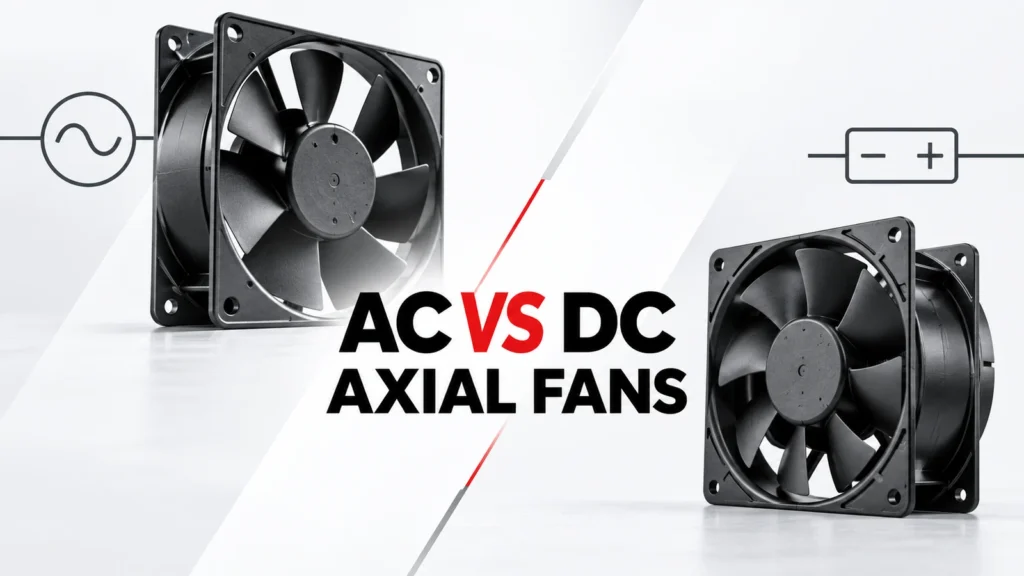
This comparison organizes buyer questions for AC and DC fan inquiries. It does not claim that one supply type is universally more efficient, quiet or reliable, and it does not transfer a voltage, airflow or control feature between RITOKS fan models.
Buying Decision at a Glance
| Decision input | Buyer must confirm | Evidence required |
|---|---|---|
| Supply | Available AC or DC voltage, frequency and tolerance | Exact fan nameplate and datasheet |
| Air duty | Required flow and pressure through the real system | Fan curve and enclosure resistance context |
| Control | On/off, speed command, tachometer or alarm needs | Exact interface and wiring documentation |
| Mechanical fit | Frame, depth, cutout, guard and connector | Drawing for the selected model |
| Environment | Temperature, dust, humidity, orientation and service life | Declared operating limits and maintenance plan |
Start With the Available Power Architecture
An AC fan can connect to a suitable AC supply when the exact model supports it. A DC fan requires a suitable DC source and may fit systems that already distribute low-voltage DC. Neither choice is automatically simpler because conversion, protection, connectors and control ownership differ by machine.
State nominal voltage, frequency for AC, expected tolerance, source capacity and any isolation or power-supply boundary. Do not select a fan by a voltage family and assume every size or bearing option shares that supply.
Define Airflow as a System Requirement
Free-air airflow is measured with minimal restriction. A cabinet adds filters, guards, grilles, cable ducts, heat exchangers and component obstructions. The operating point depends on the fan curve and the resistance of the complete airflow path.
Provide the thermal objective, required flow or permissible temperature rise, inlet and outlet arrangement and contamination constraints. A larger frame does not guarantee better delivered airflow if the system boundary and pressure loss are ignored.
Ask Which Control Signals Actually Exist
Some fan systems need only on/off operation. Others require speed command, tachometer feedback, alarm output or temperature-based control. These features are exact-model questions, not automatic differences between every AC and DC fan.
Request signal type, voltage levels, connector or lead details, failure behavior and controller compatibility from the manufacturer. Do not connect a PLC or controller based on wire color, a similar fan diagram or an assumed “PWM” label.
Compare Mechanical and Environmental Evidence
Check frame dimensions, depth, mounting holes, airflow direction, guard, filter, cable exit, connector and maintenance access. For replacements, preserve the old fan’s full label and drawing but treat fit and performance as separate checks.
Record ambient temperature, orientation, dust, humidity, vibration and expected service conditions. Bearing descriptions and lifetime claims are meaningful only with stated conditions and exact manufacturer data.
Keep Fan Type Separate From Enclosure Method
A standalone axial fan can move air locally across a component or through a designed duct. A filter-fan assembly provides an enclosure inlet or outlet function with filtration and a mounting system. AC versus DC supply does not decide that system boundary.
Rittal enclosure-cooling guidance supports evaluating airflow, filters and restrictions at the cabinet level. Use the concept when defining the duty, while keeping Rittal figures separate from RITOKS product evidence.
Build an Evidence File Before Approval
Create one review sheet for the proposed Cabinet Fan order code or system. Put project inputs in one column and supplier evidence in the other. Preserve the exact pages, drawings, curves and tables used in the decision, including their revision or retrieval date. A category page can establish product-family context, but an exact rating, connection or performance claim must trace to the quoted configuration.
Check that every accepted value describes the same orderable item. Similar housings can contain different circuits, supplies, terminals, airflow arrangements or accessories. Do not combine a family maximum from one variant, a drawing from another and an optional feature from a third. Mark unresolved fields explicitly instead of allowing them to disappear in the commercial quotation.
Control Changes During Sourcing
Keep the application record frozen while suppliers respond. If the load, voltage, environment, duty, enclosure, control method or required output changes, issue a revised record and ask each supplier to reconfirm the candidate. Otherwise two quotations may look comparable while answering different technical requirements.
A proposed substitute returns to the same evidence gate. Matching dimensions, a similar product photograph or one equal headline rating is not enough. The substitute must satisfy the required functions and conditions with its own exact documentation.
Common Procurement Errors
- Selecting Cabinet Fan from one headline rating while leaving the application context undefined.
- Using a curve, diagram or performance claim from a neighboring model.
- Comparing data measured under different voltage, temperature, airflow or duty conditions.
- Treating included accessories and system functions as obvious from a product name.
- Approving a substitution without reopening the technical evidence review.
A free-air airflow value is not the delivered flow through a filtered cabinet. A DC supply label also does not prove speed control or alarm output. Compare each fan at the actual electrical input, air-path resistance and required control interface.
How to Compare Supplier Offers
| Comparison point | Required evidence | Do not accept |
|---|---|---|
| Supply | Exact voltage, AC frequency and tolerance | “AC” or “DC” family label only |
| Air performance | Curve at expected system resistance | Free-air headline without cabinet path |
| Control | Exact signals, connector and failure behavior | Speed control inferred from supply type |
| Mechanical fit | Drawing, depth and mounting reviewed | Shared frame dimension only |
| Environment | Operating limits and bearing conditions | Generic lifetime or noise claim |
Normalize every Cabinet Fan offer to the same application record. Keep document revisions, test conditions and open questions beside each value. A proposal can remain commercially interesting while technically incomplete, but missing evidence must stay visible until it is resolved.
Decision Workflow
- Define heat-removal and airflow-path requirements.
- Record the available supply and control architecture.
- Shortlist exact models with suitable frame and mounting.
- Compare fan curves at the expected resistance, not free air alone.
- Verify control signals, connector, environment and documentation.
- Test the assembled airflow and temperature performance in the real system.
List supply type, voltage, AC frequency where relevant and the required control or feedback signals. Draw the cabinet air path, then compare exact fan performance, mechanical fit and environmental limits before assessing price.
RFQ Preparation Checklist
A useful RFQ for ac vs dc cooling fan is concise enough to answer and complete enough to prevent silent assumptions. Identify unknown values as questions and require an exact orderable code rather than a generic family recommendation.
- Application and thermal objective
- Required airflow or permissible temperature rise
- Inlet, outlet, filters and system-resistance information
- Available AC/DC supply, frequency and tolerance
- On/off, speed-control, tachometer or alarm needs
- Frame, depth, mounting, guard and connector requirements
- Ambient, dust, humidity, orientation and bearing preference
- Quantity, destination and exact model documents
Request the current datasheet revision and the scope of any certification, compatibility or performance claim. Record quantity and destination after the technical inputs so commercial terms do not obscure unresolved engineering questions.
Stop Conditions Before Order Release
Do not release the order while a critical application input is unknown, the quoted model is ambiguous, a required rating is supported only by another manufacturer’s document, or installation conditions fall outside the available evidence. These are engineering gaps, not editorial details.
The approval record should state what the selected item does, what remains outside its scope and which exact documents support the decision. If the application or candidate changes, reopen the affected checks rather than carrying the previous conclusion forward.
Frequently Asked Questions
Are DC fans always easier to control?
Not automatically. Verify the exact fan signals, controller and power architecture.
Is an AC fan always more suitable for a mains-powered cabinet?
Not necessarily. The complete supply, airflow, control, mechanical and environmental requirements decide the candidate.
Can fans with the same frame size be substituted?
No. Depth, mounting, airflow curve, voltage, connector, control and environmental data must be checked independently.
Related RITOKS Products and Guidance
Use these links as separate category, product and Resource records. A contextual link does not claim interchangeability, compatibility or an approved system combination.
Industrial AC axial cooling fans
Cabinet cooling fan selection guide
Technical References
These primary manufacturer sources support only the general concepts identified below. Their product values, diagrams and approvals do not transfer to RITOKS products.
Rittal, Blue e+ Filter Fan Product Information
Supports treating filtered enclosure ventilation as a system with airflow, filter and environmental considerations. Rittal performance values do not describe RITOKS fans.
Rittal, Technical System Catalogue: Cooling with Ambient Air
Supports separating internal heat loss, surface heat exchange, permissible temperature rise, airflow and environmental conditions. Rittal formulas and equipment data must be used only within their stated conditions.
Request an Exact-Model Review
Send the application requirements, exact documentation questions, quantity and destination through the RITOKS contact form. An RFQ requests an exact-model review; this guide does not approve a wiring design, installation or automatic substitute.