
DC Molded Case Circuit Breakers (MCCB) · Technical Explainer
DC MCCB Trip Units: Fixed, Adjustable and Documentation Questions
A DC MCCB trip unit cannot be identified reliably from the molded case alone. Products that look similar may use fixed protection, adjustable settings or different trip technologies. The useful buyer question is not which option sounds more advanced, but which functions are documented for the exact orderable breaker and application.
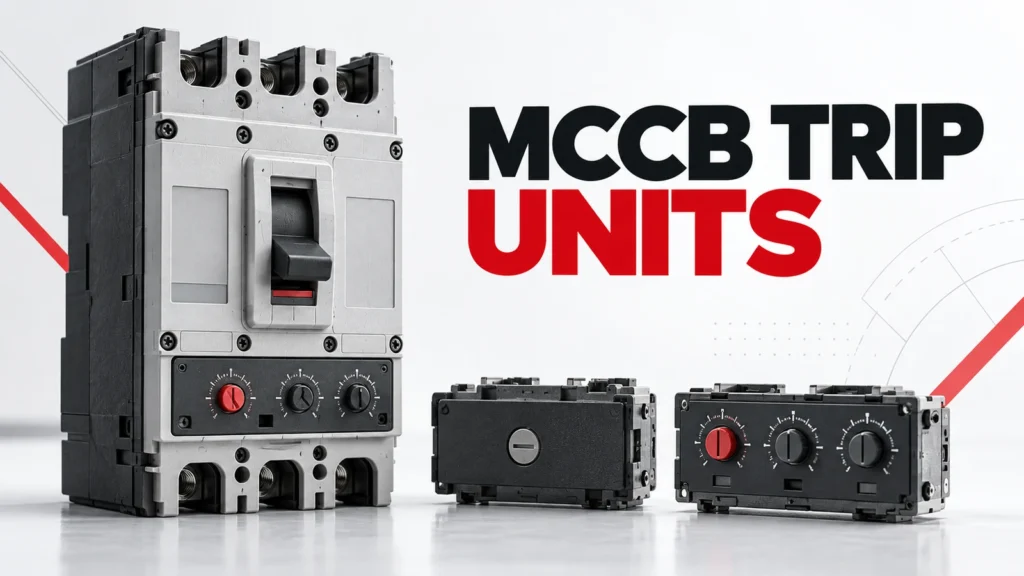
This article explains a documentation method for DC MCCB trip units. It does not set protection values, coordinate breakers, approve a pole connection or claim that a generic trip-unit label applies to the published RITOKS DC MCCB family.
Buying Decision at a Glance
| Decision input | Buyer must confirm | Evidence required |
|---|---|---|
| Circuit data | Maximum DC voltage, load current and prospective fault current | Project calculation and exact circuit record |
| Trip technology | Thermal-magnetic, electronic or other documented design | Exact datasheet and trip-unit designation |
| Settings | Fixed values or available adjustment ranges | Model-specific table, curve and instructions |
| DC configuration | Pole arrangement, polarity and connection | Exact manufacturer diagram |
| Coordination | Upstream/downstream protective devices and conductors | Project study or manufacturer coordination evidence |
Start With the Protection Requirement
Define the conductors, load, source, continuous current and prospective short-circuit current at the breaker location. A trip unit is part of a protection system; choosing from adjustment knobs before the circuit data is known reverses the engineering sequence.
Record the maximum operating and possible open-circuit voltage for the DC source. Keep the project fault calculation separate from the breaker rating. The first describes what can occur at the installation point; the second describes what the exact breaker is documented to interrupt under stated conditions.
Distinguish Fixed From Adjustable Evidence
A fixed trip unit has protection characteristics established for its exact design. An adjustable unit permits specific settings within documented ranges. Neither word proves the number of functions, the adjustment method or the suitability for a particular circuit.
Ask for the exact trip-unit designation, available settings, tolerances, curves and sealing or access provisions. A family brochure may show several options; the quotation must identify which one belongs to the offered order code.
Name Each Protection Function
Do not treat “adjustable” as a complete function list. Long-time, short-time, instantaneous and ground-fault terminology can appear in breaker documentation, but the presence and meaning of each function are model dependent. Request only what the project needs and require the supplier to mark supported, optional or unavailable.
If the documentation uses different terminology, retain the manufacturer wording and define it in the review sheet. Do not translate a setting from another brand or assume that two dials with similar labels operate identically.
Keep DC Pole Configuration With the Rating
DC interruption can depend on how poles are connected and on the exact voltage condition. Schneider documentation demonstrates model-specific pole wiring and DC interrupting tables. Those records show why configuration matters, but they are not wiring instructions for a RITOKS breaker.
Request the exact manufacturer diagram for the quoted model and application. Do not infer series connections, polarity or permissible voltage from the number of visible poles. A correct trip-unit discussion cannot rescue an unsupported DC connection.
Review Curves, Tolerances and Environmental Conditions
Time-current curves provide more decision value than an unlabeled adjustment range. Confirm which curve belongs to the exact trip unit and note reference temperature, current basis, tolerance bands and any documented environmental derating.
The project reviewer must evaluate conductor protection, load behavior and discrimination requirements using approved methods. This article can organize the evidence, but it cannot produce a coordination decision without exact curves and complete system data.
Build an Evidence File Before Approval
Create one review sheet for the proposed DC MCCB order code or system. Put project inputs in one column and supplier evidence in the other. Preserve the exact pages, drawings, curves and tables used in the decision, including their revision or retrieval date. A category page can establish product-family context, but an exact rating, connection or performance claim must trace to the quoted configuration.
Check that every accepted value describes the same orderable item. Similar housings can contain different circuits, supplies, terminals, airflow arrangements or accessories. Do not combine a family maximum from one variant, a drawing from another and an optional feature from a third. Mark unresolved fields explicitly instead of allowing them to disappear in the commercial quotation.
Control Changes During Sourcing
Keep the application record frozen while suppliers respond. If the load, voltage, environment, duty, enclosure, control method or required output changes, issue a revised record and ask each supplier to reconfirm the candidate. Otherwise two quotations may look comparable while answering different technical requirements.
A proposed substitute returns to the same evidence gate. Matching dimensions, a similar product photograph or one equal headline rating is not enough. The substitute must satisfy the required functions and conditions with its own exact documentation.
Common Procurement Errors
- Selecting DC MCCB from one headline rating while leaving the application context undefined.
- Using a curve, diagram or performance claim from a neighboring model.
- Comparing data measured under different voltage, temperature, airflow or duty conditions.
- Treating included accessories and system functions as obvious from a product name.
- Approving a substitution without reopening the technical evidence review.
An adjustment dial does not show which trip functions are fitted. Compare the offered trip-unit designation, setting ranges, tolerances and curves against the DC source and pole connection. The word adjustable is not a complete protection specification.
How to Compare Supplier Offers
| Comparison point | Required evidence | Do not accept |
|---|---|---|
| Trip unit | Exact technology and designation supplied | Generic “MCCB trip” description |
| Adjustability | Each setting and range tied to order code | Photograph of knobs or family maximum |
| Curves | Exact curve, tolerance and conditions | Curve from another frame or trip option |
| DC rating | Voltage, poles and diagram reviewed together | Single current or kA figure |
| Coordination | Project-specific evidence where required | Shared brand or matching ampere ranges |
Normalize every DC MCCB offer to the same application record. Keep document revisions, test conditions and open questions beside each value. A proposal can remain commercially interesting while technically incomplete, but missing evidence must stay visible until it is resolved.
Decision Workflow
- Freeze the circuit voltage, load current and fault-current record.
- Define the protection functions the project requires.
- Obtain the exact MCCB and trip-unit order code.
- Check fixed or adjustable settings against the exact curves and instructions.
- Verify the DC pole arrangement and breaking capacity for the same configuration.
- Complete the project coordination and conductor review before order release.
Start with prospective fault current, maximum DC voltage and permitted pole arrangement. Ask each supplier to identify the exact breaker and trip unit, then document which functions are fixed or adjustable and what setting evidence is available before comparing price.
RFQ Preparation Checklist
A useful RFQ for dc mccb trip unit is concise enough to answer and complete enough to prevent silent assumptions. Identify unknown values as questions and require an exact orderable code rather than a generic family recommendation.
- DC source, maximum voltage and circuit function
- Continuous current, load behavior and conductor information
- Prospective fault current at the MCCB location
- Required trip functions and adjustment needs
- Pole arrangement and exact manufacturer diagram request
- Required curves, tolerances and coordination documents
- Enclosure, ambient, quantity and destination
Request the current datasheet revision and the scope of any certification, compatibility or performance claim. Record quantity and destination after the technical inputs so commercial terms do not obscure unresolved engineering questions.
Stop Conditions Before Order Release
Do not release the order while a critical application input is unknown, the quoted model is ambiguous, a required rating is supported only by another manufacturer’s document, or installation conditions fall outside the available evidence. These are engineering gaps, not editorial details.
The approval record should state what the selected item does, what remains outside its scope and which exact documents support the decision. If the application or candidate changes, reopen the affected checks rather than carrying the previous conclusion forward.
Frequently Asked Questions
Is every molded-case breaker trip unit adjustable?
No. Confirm the exact trip technology and settings for the quoted order code.
Does an adjustable trip unit always provide more protection functions?
No. Adjustability and function count are separate model-specific questions.
Can a trip curve from a similar frame be used?
Not as approval evidence. Use the curve and tolerances identified for the exact trip unit and breaker configuration.
Related RITOKS Products and Guidance
Use these links as separate category, product and Resource records. A contextual link does not claim interchangeability, compatibility or an approved system combination.
2P DC molded case circuit breaker family
Technical References
These primary manufacturer sources support only the general concepts identified below. Their product values, diagrams and approvals do not transfer to RITOKS products.
Schneider Electric, DC Wiring Diagram for LA/LH Molded Case Circuit Breakers
Shows that DC pole connection can be exact-model dependent. Its diagrams apply only to the identified Schneider products and are not RITOKS wiring instructions.
Schneider Electric, FA/FH DC Rating FAQ
Supports checking DC voltage and interrupting performance for the exact breaker and pole configuration. Schneider values do not describe RITOKS MCCBs.
Request an Exact-Model Review
Send the application requirements, exact documentation questions, quantity and destination through the RITOKS contact form. An RFQ requests an exact-model review; this guide does not approve a wiring design, installation or automatic substitute.