
Technical Resources · Selection Guide
DC MCCB Selection Guide: Voltage, Current, Poles and Trip Evidence
A buyer can identify a molded-case breaker by its housing but cannot approve a DC MCCB from the case size or ampere figure. The exact DC voltage, available short-circuit current, pole connection and trip behavior have to be known together. The purpose of this guide is to make competing MCCB offers comparable for a specified DC circuit, not to select between miniature and molded-case architectures.

Treat each proposed orderable code as a separate candidate. An AC marking, a series maximum or a diagram for a neighboring variant does not establish the rating of the product in the quotation. If the project does not yet have a fault-current assessment or a defined source topology, an RFQ can request information, but it cannot close the engineering approval.
Selection at a Glance
| Input | Buyer record | Evidence from exact candidate |
|---|---|---|
| DC voltage | Normal and maximum possible voltage at the device | Rated DC voltage under the specified pole connection |
| Load and duty | Continuous current and expected operating conditions | Rated current, trip-unit range and environmental conditions |
| Fault level | Prospective short-circuit current at the installation location | DC interrupting rating at the same voltage and configuration |
| Poles and topology | Circuit arrangement and required conductors | Manufacturer connection diagram and polarity requirements |
| Control and accessories | Required trip functions, indication or other options | Documented compatibility with the complete orderable code |
Build the Circuit Record First
Record the source type, maximum DC voltage, operating current and likely conditions during normal service. Include the proposed breaker position and the prospective short-circuit current there. A value measured or estimated elsewhere in the system should not be silently used for this position. Identify who supplied the fault estimate; the quotation process should not manufacture one.
Ask whether the application needs a particular operating function, trip response, indication or enclosure arrangement. Separate mandatory functions from preferences. A setting range cannot be judged until the actual trip unit is known; not every molded-case product has the same adjustable elements. This early separation avoids comparing a complete offer with another that lists only a frame or a nominal current.
Match Voltage, Poles and Fault Rating Together
Read the exact manufacturer DC table. The relevant row may specify a voltage, number of poles, connection method and interrupting rating together. Schneider Electric publishes a DC wiring document for its LA/LH MCCBs and a separate FA/FH FAQ whose rating table changes with voltage and pole configuration. These examples establish the importance of model-specific evidence; they do not authorize copying either connection into a RITOKS product.
If the proposed candidate is described as 2P, ask for the diagram for that exact variant. Do not treat “2P” as a wiring instruction. Compare the documented DC breaking rating to the project fault level at the applicable voltage. If a vendor quotes a higher headline interruption figure at a different voltage, that number cannot settle the present circuit.
Separate the Frame From the Trip Unit
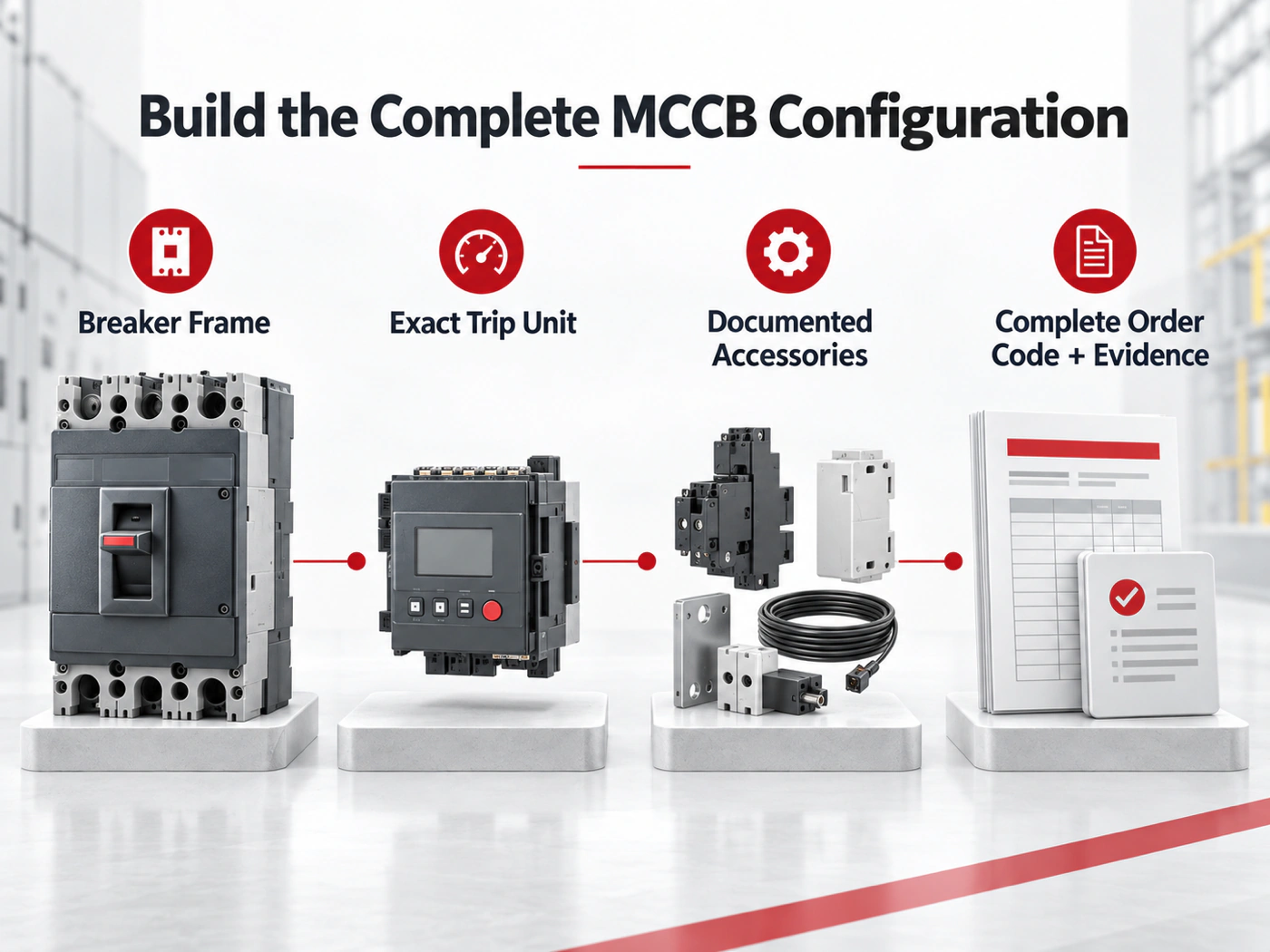
A molded-case enclosure may be offered with different trip mechanisms or settings. Record whether the quoted trip unit is fixed or adjustable and which functions are present. Request the actual settings or permissible range where applicable, plus the associated manufacturer document. Do not infer electronic protection, communications, earth-fault functions or an accessory interface merely from the shape or family name.
Also ask what the order code includes. A handle, terminal option, auxiliary contact or release may be sold as a separate accessory or may not be supported. Compare quotes on a like-for-like functional basis, not only on a list price or a frame designation. Any claim that another protective device is coordinated with this MCCB requires an exact documented combination.
Compare Two Offers by Documentation
| Question | Complete answer | Incomplete answer |
|---|---|---|
| Voltage and poles | Exact DC table row and wiring document supplied | Only family maximum or AC rating supplied |
| Fault interruption | DC rating at project voltage and pole scheme supplied | Headline kA number without conditions |
| Trip behavior | Exact trip-unit code and settings/functions supplied | Generic claim of adjustability |
| Accessories | Exact supported part codes listed | Option shown in a different product image |
An incomplete offer is not necessarily an unsuitable device; it is not yet comparable. Request the missing page or order code. If either supplier proposes a different pole configuration to achieve the voltage rating, return that proposal to the designer instead of treating it as an editorial substitution.
Record document revisions as well as values. A later quotation can otherwise appear to match while referring to a superseded trip unit, accessory or connection page. Where the project requires remote indication, shunt release or another accessory, ask whether it changes the complete order code or operating limits. This makes the RFQ comparable without assuming that every accessory shown for the frame is available on the selected DC variant.
Decision Workflow
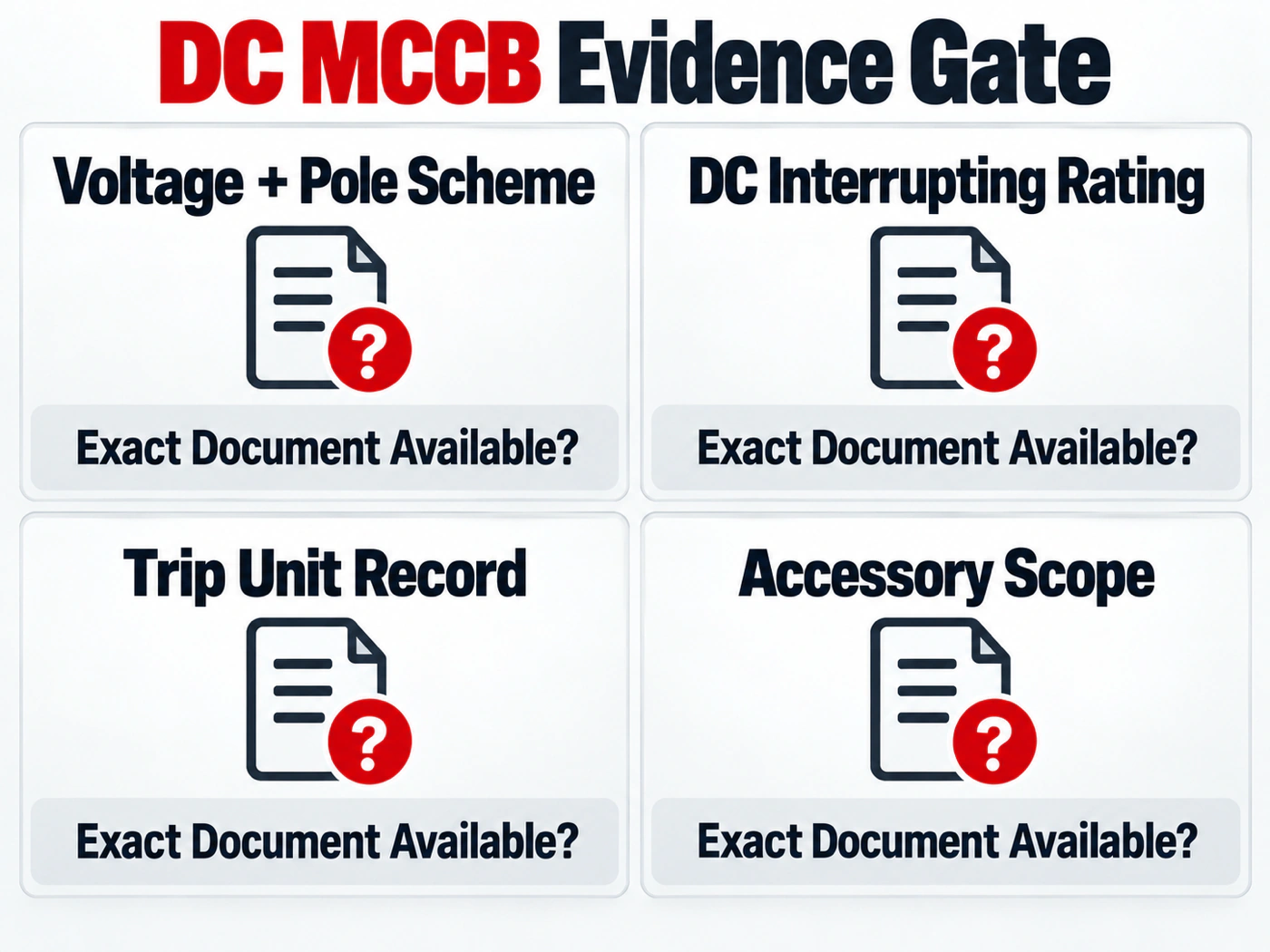
- Freeze the circuit voltage envelope, continuous load record and local prospective fault estimate.
- State the protection and switching functions the project expects from the MCCB.
- Request an exact order code, DC ratings table, connection diagram and trip-unit description for each offer.
- Compare voltage, poles and interruption at the same conditions, then trip and accessory requirements.
- Escalate missing fault, wiring or coordination evidence to the project engineer and manufacturer before approval.
Published RITOKS Example and RFQ
The published RITOKS 2P DC MCCB page lists variants associated with 500V and 1000V. The family page is a starting point, not a blanket claim that all rows share one breaking capacity, pole connection or trip unit. In a request for quotation, identify the intended variant and ask which exact datasheet row supports its rating. A substitute must be checked from its own document.
- Source type, maximum DC voltage, normal current and prospective fault current at the breaker.
- Required pole/connection arrangement, protection function and trip information.
- Panel environment, enclosure, mounting and any accessory requirements.
- Candidate order code, exact DC table, wiring document and evidence for any requested coordination.
- Quantity, destination and date needed for a technical response.
Build a Complete Orderable Configuration
An MCCB quotation may describe a frame while leaving the trip unit, terminals, operator and auxiliary functions unspecified. Convert that description into a bill of material that identifies the base breaker, trip unit and every required accessory. For each item, ask whether it is factory fitted, field fitted or merely optional. This is especially important when two offers use the same frame current but deliver different protection functions or omit the parts needed by the panel design.
Treat adjustable settings as engineering inputs, not sales features. The quotation should state the available adjustment functions and ranges for the exact trip unit, while the project review determines the settings. Do not publish or order a setting copied from another installation. If a release, contact or operator changes the complete product code, keep that code intact in the comparison so the final order cannot silently revert to the bare frame.
Stop Conditions Before Purchase
Pause the selection when the maximum circuit voltage, local prospective fault current or required connection scheme is missing. Also pause when the seller provides a family brochure but cannot identify the applicable table row, or when the proposed trip unit is absent from the order code. These are publication- and purchasing-critical gaps because they prevent a like-for-like comparison. A lower price or faster lead time does not close them.
For the final RFQ record, separate verified facts from requested confirmations. List project conditions first, then the candidate configuration, then the exact documents still required. State whether accessories and enclosure work are included and whether any coordination claim is being made. If coordination is requested, require the manufacturer-supported combination record; do not infer it from matching brand names or current ranges.
Preserve the final comparison with the selected order code and document revisions. A later quote that changes a trip unit, accessory or pole configuration should be treated as a revised configuration, even when the frame designation remains familiar. This gives procurement a repeatable acceptance record without claiming that the article has selected or set the protection device. Record the reviewer and review date for durable traceability.
Frequently Asked Questions
Can I compare MCCBs by frame current alone?
No. A frame or ampere figure does not establish the DC voltage, interrupting rating, pole wiring or trip functions. Compare the full orderable configuration against the same circuit record.
Can a diagram for another manufacturer be reused?
No. The Schneider documents here illustrate why an exact diagram is necessary; they are not wiring instructions for the RITOKS candidate or any other brand.
What if the trip unit is not specified in the offer?
Request its exact code and supported functions before comparing settings or accessories. “Adjustable” is too imprecise to approve a protection requirement.
Related RITOKS Products and Guidance
Use these pages as separate product and family records. A link is not a claim that two devices are interchangeable or coordinated.
DC Molded Case Circuit Breakers category
MCB versus MCCB architecture comparison
Technical References
The following manufacturer sources support the general concepts identified below. Their model ratings, diagrams and approvals do not transfer to RITOKS products.
Schneider Electric, DC Wiring Diagram, MCCB LA-LH
Supports the need for an exact-model DC connection document; this LA/LH diagram does not describe the RITOKS product.
Schneider Electric, FA/FH DC rating FAQ
Its tabulated examples show that rated DC voltage and interruption depend on the exact breaker and pole configuration; the listed values are Schneider-only.
Request an Exact-Model Review
Send the recorded application requirements, exact documentation questions, quantity and destination through the RITOKS contact form. An RFQ requests an exact-model review; this guide does not approve a wiring design or recommend an automatic substitute.