
DC Molded Case Circuit Breakers (MCCB) · RFQ Checklist
DC MCCB RFQ Checklist: Ratings, Trip Data and Accessories
A useful DC MCCB RFQ describes the circuit and the protection decision that the breaker must support. Asking only for a frame size or headline current leaves the supplier to guess the DC voltage, fault duty, pole arrangement, trip behavior and accessories. Those guesses can produce quotations that look comparable but answer different engineering requirements.
This checklist helps panel builders and procurement teams request consistent evidence for a DC molded-case circuit breaker. It does not choose protection settings, approve a pole connection or claim that a published product family supports every listed option. Exact ratings and functions must come from the proposed order code and its current manufacturer documents.
The RFQ in One View
State the DC source and operating range, system topology, prospective fault current at the breaker, normal load duty, required protection behavior and installation environment. Attach the approved single-line diagram. Ask the supplier to identify one exact breaker, its pole connection instructions, DC interrupting data, trip-unit information and accessory order codes. Record all exceptions against those same fields.
| RFQ field | Project input | Supplier evidence |
|---|---|---|
| DC voltage | Operating range and maximum circuit condition | Exact DC voltage rating and conditions |
| Fault duty | Prospective fault current at installation point | Exact breaking-capacity declaration |
| Pole arrangement | Source and conductor topology | Manufacturer DC connection diagram |
| Trip function | Protection and coordination requirement | Trip-unit type, curve and adjustment document |
| Accessories | Control, indication and installation needs | Compatible order codes and wiring documents |
| Mechanical | Space, orientation and access constraints | Dimensions and installation instructions |
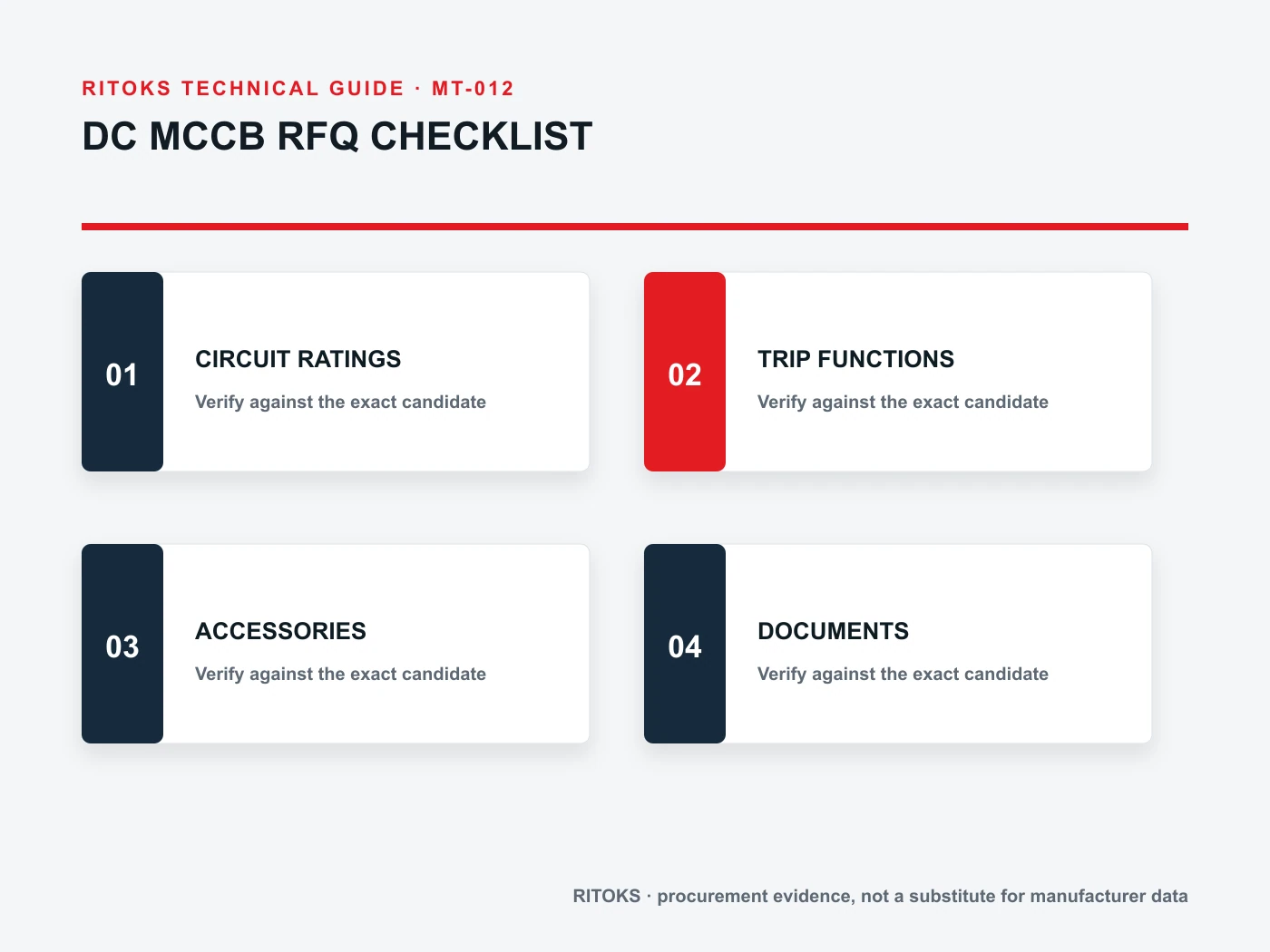
Describe the DC Source and Topology
Identify whether the circuit is supplied by PV, battery, conversion equipment or another DC source. Provide the normal and maximum voltage cases, source configuration and grounding relationship as approved by the system designer. Include a diagram showing the breaker's location and the conductors it is expected to interrupt. A generic label such as “battery system” does not tell the supplier enough to confirm a DC breaker connection.
DC ratings can depend on pole use and connection arrangement. The relevant manufacturer diagram may differ between devices that share a frame shape. Do not specify pole series or polarity from appearance. Ask the supplier to map the exact order code and wiring instruction to the project diagram, and return any mismatch for engineering resolution.
Define Normal Load and Switching Duty
Provide the load current profile, expected continuous duty, operating cycle and any planned manual or remote switching. A breaker selected only from a nominal current number may miss the real thermal or operational requirement. State whether the MCCB is primarily a protective device, an isolation point, or part of a specific switching sequence; do not assume those roles are interchangeable.
Where the load includes inrush, charging or other non-steady behavior, describe it in the application record. The supplier can then identify which exact trip characteristics and operating conditions require evaluation. A product page can introduce a family, but only the exact datasheet and the design calculation can resolve the duty.
Provide Fault Current at the Installation Point
The prospective fault current should be determined for the location where the MCCB will be installed, using the approved source and circuit model. Share the design basis and any range of credible conditions. The supplier needs this to compare the circuit duty with the exact DC breaking-capacity declaration, including the voltage and pole configuration under which it applies.
Do not substitute an AC interrupting rating or a value from another DC voltage row. Also avoid treating a lower fault current as proof that all coordination questions are settled. Upstream and downstream protection, energy let-through and equipment withstand are project-level matters that require the responsible engineer and applicable manufacturer evidence.
Specify the Required Trip Behavior
State what the protection design requires the breaker to detect and how it must coordinate with other devices. Ask whether the proposed trip unit is fixed or adjustable, which functions are provided, which ranges are available and which curve or setting document belongs to the exact model. A label such as “electronic” does not by itself prove a specific function or setting range.
If settings are intended, include who will calculate, approve, apply and record them. The RFQ can request the setting information, but should not invent a value before the system study is complete. For a fuller explanation of this evidence boundary, see the DC MCCB selection guide alongside the exact manufacturer documentation.
List Accessories as Separate Orderable Requirements
Write out every requested shunt trip, undervoltage release, auxiliary contact, alarm contact, motor operator, terminal accessory or other option. For each item, state its purpose, control supply, contact requirement and panel interface. Ask the supplier to confirm that it is available for the quoted breaker variant and to provide the matching order code and wiring instruction.
An accessory pictured in a family brochure may be optional or unavailable for a particular frame and trip unit. Do not assume inclusion from a product title. Compare offers by delivered scope: breaker, trip unit, requested accessories and documentation. An apparently lower price can simply omit a required function.
Include Panel and Environmental Constraints
Provide the mounting space, orientation, clearances, conductor approach, termination method and access needed for operation and maintenance. Include the expected ambient and enclosure conditions. These data allow the supplier and panel builder to check the exact installation manual rather than assuming that a frame with similar dimensions will fit safely.
Ask for dimensions, terminal details, torque instructions and any condition that affects rating or installation. A cabinet photograph is useful context but cannot replace measured space and a drawing. If installation conditions vary across sites, identify each variant rather than hiding it in a single generic RFQ.
Ask for an Exact-Model Document Set
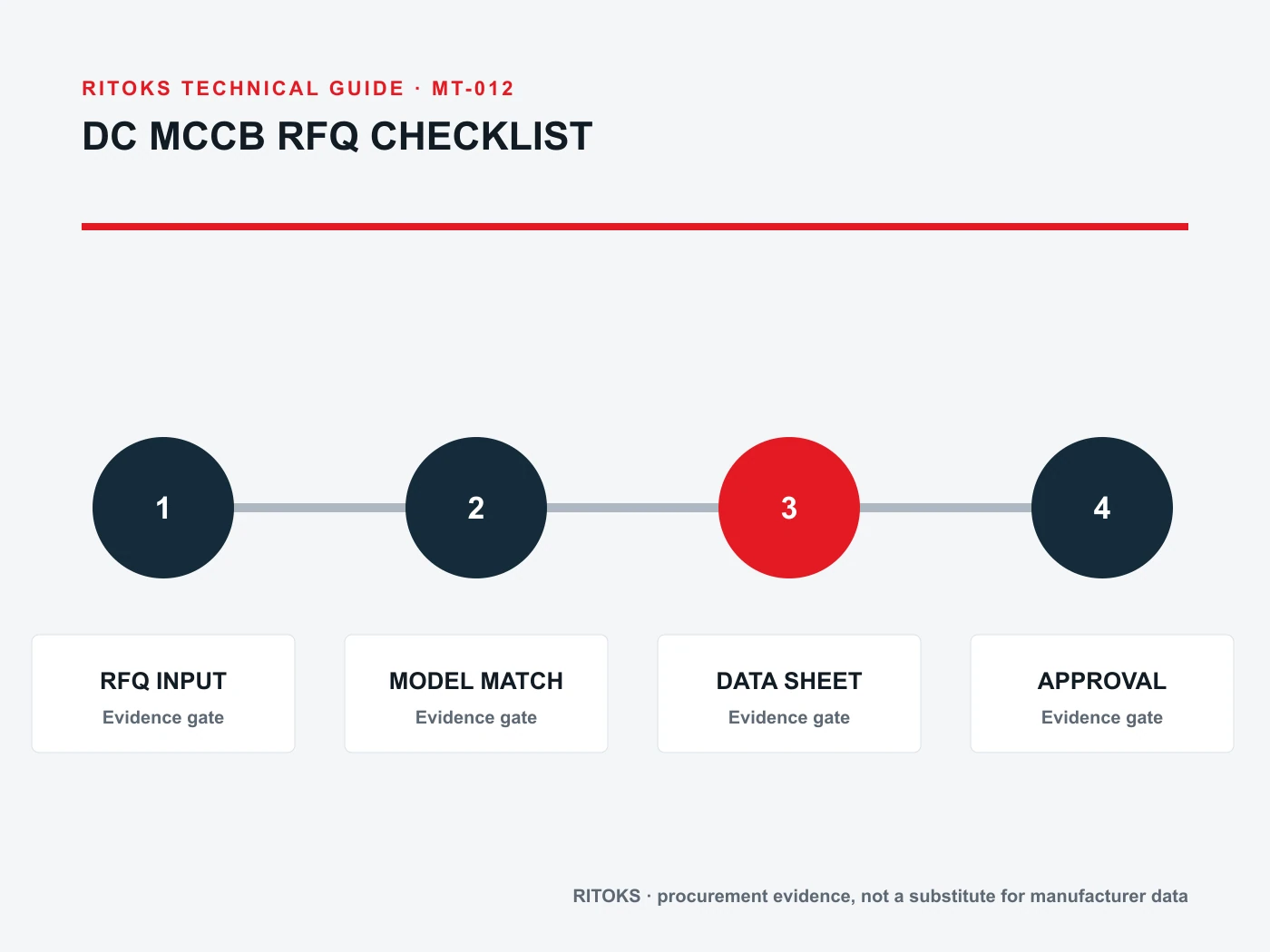
Request the current datasheet, DC rating table, connection diagram, trip-unit or time-current document, accessory list, dimensions and installation manual for the quoted order code. If a document covers a whole family, ask the supplier to identify the rows and figures that apply. Keep document revisions and quotation revision together in the approval record.
The DC MCCB category and the published 2-pole DC molded-case breaker family can help buyers identify a candidate family. Neither page should be used to transfer a particular voltage, breaking capacity or accessory feature to an unverified quote.
Normalize Supplier Responses
Use one response sheet for all suppliers. Put project requirements in the first column, each exact proposed order code in a separate column, and a reference to supporting evidence beside each answer. Mark “not supplied,” “requires design confirmation” or “alternative proposed” where appropriate. This makes technical gaps visible before the purchase decision.
Do not convert a supplier exception into compliance by paraphrasing it away. If one offer assumes a different topology, trip function or accessory scope, ask for a revised quote against the same application record. Commercial comparison becomes meaningful only after the offers are technically comparable.
Common RFQ Omissions
Frequent omissions include the maximum DC voltage rather than only nominal voltage, the fault-current basis at the installation point, a pole connection diagram, the required trip behavior and the complete accessory scope. Another omission is assuming an AC curve or breaking figure describes the DC use case. The RFQ should name the exact document required for every critical answer.
Many buyers also forget the handover information needed by the panel builder: dimensions, terminals, control wiring, setting responsibility and maintenance access. An apparently suitable breaker can still create redesign if these interfaces arrive only after procurement. Treat the mechanical and control sections as part of the technical requirement.
Manage Revisions and Substitutions
Give the application record and approved quotation a revision. If the source voltage, fault study, control scheme or enclosure changes, tell every supplier which fields changed and request reconfirmation. If the supplier changes the exact order code, repeat the affected ratings, connection, trip and accessory checks rather than accepting it as a paperwork substitution.
Keep the final approved documents with the purchased breaker identity. This helps receiving, installation and later maintenance distinguish an approved variant from a look-alike. The same record also explains why an alternative was rejected, which is valuable when equipment is replaced years later.
Questions to Send with the RFQ
Before releasing the request, have the design and purchasing teams read the same revision. The designer should confirm that source, fault and coordination inputs are current; purchasing should confirm that the response format asks for included scope and exceptions. This simple review prevents a supplier from answering a superseded single-line drawing while the commercial team compares its price with a newer design.
- Which exact order code is proposed for the supplied DC source and fault duty?
- Which DC rating table and pole connection diagram apply to that code?
- What trip unit, functions, curves and adjustment ranges are actually included?
- Which accessories are included, optional or unavailable?
- Which installation conditions affect rating or fit?
- What assumptions or exceptions remain open for engineering approval?
Send a complete project record through the RITOKS inquiry page when asking for a candidate. The output should be an exact, reviewable proposal with stated assumptions. Final protection coordination and settings remain with the responsible system designer.