
DC Miniature Circuit Breakers (MCB) · Comparison
2-Pole vs 4-Pole DC Circuit Breakers: Architecture and Selection Questions
Two-pole and four-pole DC circuit breakers are not simply small and large versions of the same answer. Pole count affects the permitted connection path, how conductors are disconnected and sometimes the voltage at which the complete device has documented interruption capability. The correct arrangement depends on system earthing, voltage, fault-current direction and the manufacturer's exact wiring diagram.
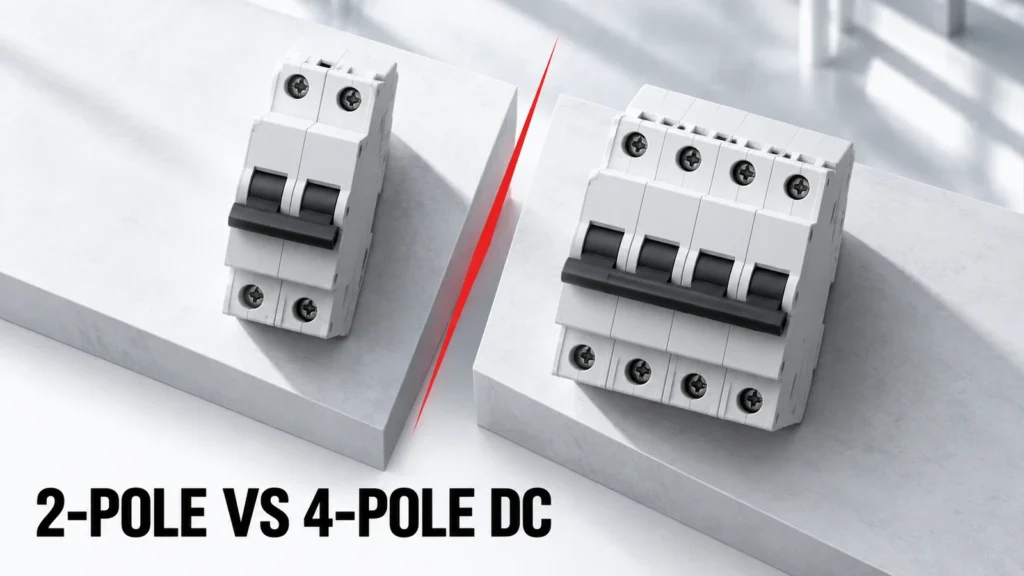
This comparison is a question framework for DC MCB buyers. It does not say that four poles are automatically safer or that two poles are always enough. The rating and connection evidence must belong to the proposed order code, not a neighbouring product in the catalogue.
First distinguish conductors from breaker poles
A two-conductor DC system has positive and negative conductors, but that fact alone does not define the number of breaker poles needed. A manufacturer may specify that more than one pole be wired in series along one conductor to achieve a particular DC voltage rating. Another arrangement may use poles in both conductors. The drawing, not the word “four-pole,” establishes what is actually disconnected.
On the project single-line, mark every conductor, source and load connection. Then draw the proposed current path through each pole. If a bridging link is required, identify whether it is a manufacturer-approved accessory, supplied connection or prohibited field alteration. Do not count external terminals and assume each terminal corresponds to an independently protected conductor.
Ask whether the breaker is intended to open one polarity, both polarities or a specified series route. System earthing and fault scenarios affect that decision. A grounded conductor arrangement may be reviewed differently from an isolated system; the engineer must apply the relevant installation rules and fault study.
Compare the exact DC voltage rating
DC arcs do not have the natural current zero crossings of AC. Product-specific pole arrangements may therefore be used to manage interruption at higher DC voltages. Schneider Electric's DC breaker guides show that voltage limits can depend on series-pole connections and system topology. Those examples are for Schneider products, not a universal conversion formula.
Obtain the maximum operating voltage at the installation point, including charging or other high-voltage states. Compare it with the candidate's rated DC operational voltage for the exact number of poles and connection drawing. Do not use a headline voltage from a four-pole variant to approve a two-pole variant, or vice versa.
If a supplier proposes extra poles in series, request the diagram showing terminal order, polarity and links. The higher voltage claim must be explicitly documented for that exact arrangement. A user-created series bridge based on a competitor's drawing is not evidence that the new breaker will interrupt correctly.
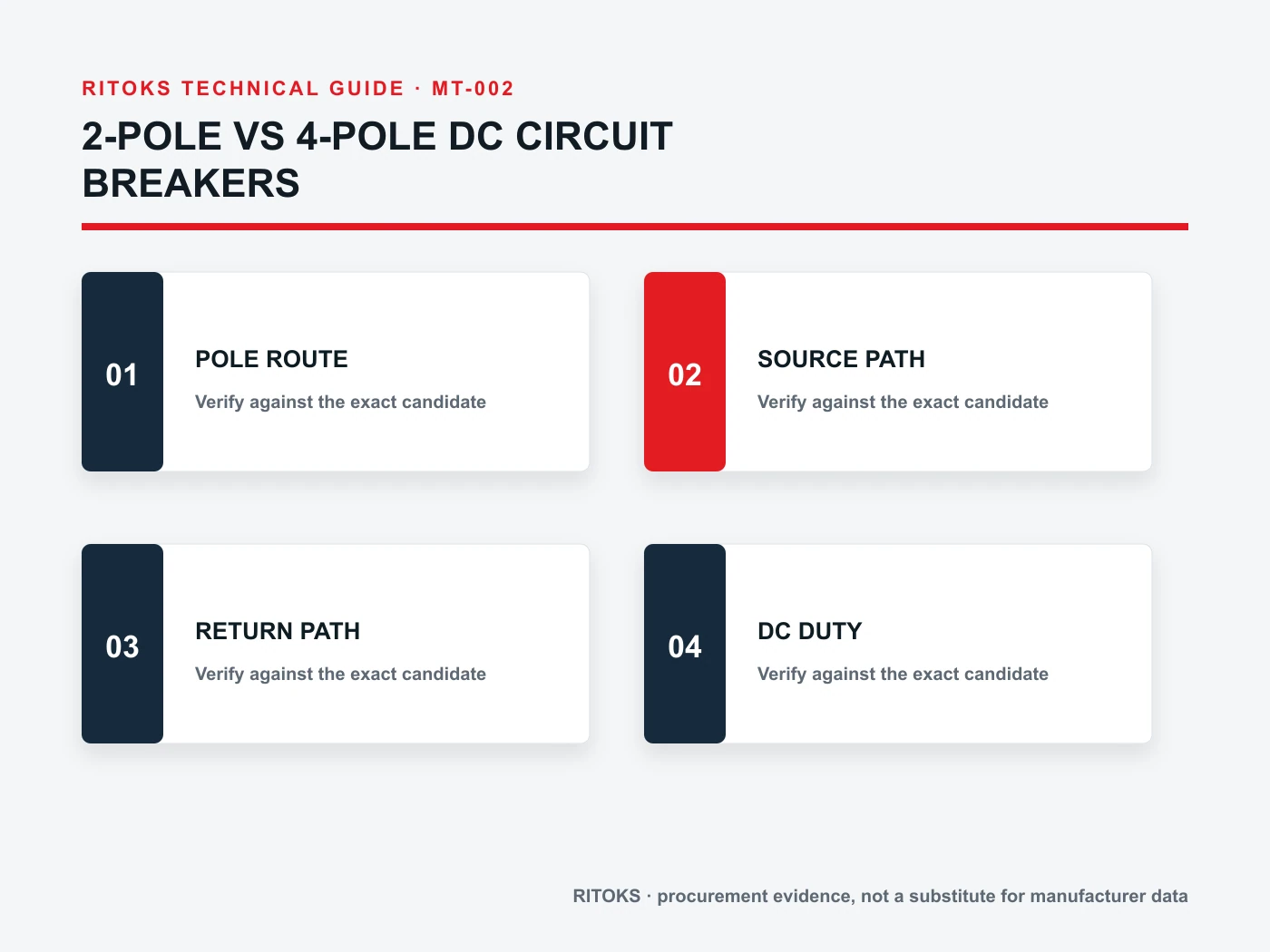
Check prospective fault current at the same voltage basis
A breaker must interrupt the fault available at its terminals. Provide the location-specific prospective DC fault current, not only the source's nominal current. Batteries, converters, parallel strings and other feeds may change the duty. Compare the result with the exact candidate's published DC breaking capacity at the relevant voltage and pole connection.
The current rating and breaking capacity are different specifications. More poles do not automatically create a higher fault-current rating, and a product's AC interrupting data cannot stand in for DC data. Ask the supplier to identify the rating table and test conditions that support the proposed connection.
Keep any assumptions about source contribution and grounding visible. If a fault study is not complete, identify the breaker comparison as provisional. Procurement can seek candidate documents while engineering closes the available-fault-current calculation.
Review current direction and polarity rules
Some DC protective devices have source/load or plus/minus orientation requirements. A system with battery charging and discharging may have normal current in more than one direction, and fault current can have still another path. A four-pole body does not remove the need to read polarity markings and installation instructions.
For each operating and fault state, show which terminal is energized and how current reaches the device. Compare that with the exact manufacturer drawing. If the proposed breaker is described as non-polarized, confirm the scope of that statement at the required voltage and interruption duty; do not interpret it as unlimited bidirectional capability.
Where the drawing leaves a doubt, ask the supplier for written clarification tied to the order code. Do not resolve ambiguous markings by trial wiring. A wrong orientation may not be obvious during normal operation yet matter during fault interruption.
Consider isolation and maintenance needs
State which conductors must be disconnected for the intended maintenance or isolation function. A protection breaker and a switch-disconnector may have different approved functions. Confirm whether the exact candidate is rated for the intended isolation role and what remains live after opening in the proposed pole arrangement.
Panel builders should label both sides of the device and show links clearly in as-built drawings. A four-pole device with two poles in series per polarity is not the same maintenance picture as four independent conductors. The enclosure and lockout procedure must reflect the real topology.
Compare two-pole and four-pole candidates fairly
| Decision | Two-pole review | Four-pole review |
|---|---|---|
| Connection | Which conductor/path uses each pole? | Are poles series-linked or on separate paths? |
| DC voltage | Rating at exact wiring arrangement | Rating at exact wiring arrangement |
| Fault duty | DC breaking data at that voltage | DC breaking data at that voltage |
| Direction | Terminal and polarity instructions | Terminal and polarity instructions |
| Isolation | Which conductors open? | Which conductors open? |
Do not fill the table with generic “2P” and “4P” assumptions. Enter order codes and document revisions. If the candidates serve different connection topologies, explain that clearly instead of presenting one as a drop-in upgrade.
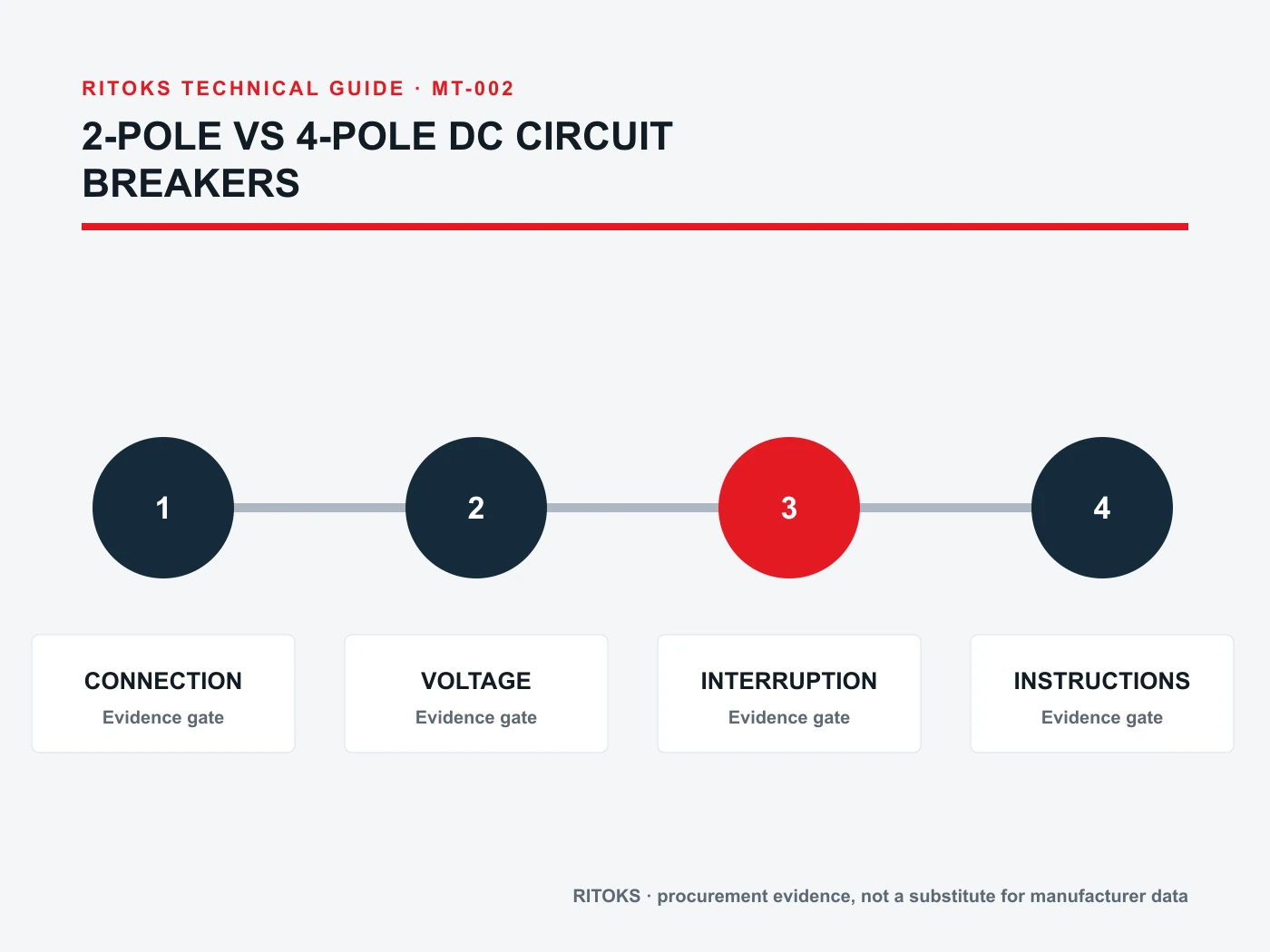
Space, thermal and wiring consequences
Four poles generally require more physical width and may need more links or conductor routing, but actual dimensions belong to the product drawing. More current path elements can also change heat dissipation; the manufacturer may provide specific derating or installation requirements. Check enclosure temperature, adjacent devices, busbar or cable termination space and mounting orientation.
A compact two-pole proposal should not be selected merely to save rail space if its documented DC voltage or connection duty is inadequate. Likewise, a larger four-pole unit should not be adopted without checking its wiring and thermal implications. The best fit is the approved electrical path that can be installed and maintained correctly.
Document every source of the rating claim
A credible comparison should name the exact data sheet, its revision, the page containing the DC rating table and the installation drawing that shows the matching terminal path. Keep those documents together. A rating table without the connection diagram, or a connection diagram without the breaking-capacity conditions, leaves an important gap. Buyers should ask suppliers to identify which proposed order code each page covers.
If a quoted device has several listed voltages, determine whether they correspond to different pole counts, series routes, grounding systems or test conditions. Do not merge the most favorable values into a composite specification. The comparison should also state any accessories or factory links needed to realize the tested arrangement. A low unit price can be misleading if special links, a larger enclosure or additional wiring are required.
At the design review, let someone other than the drafter trace the current route on both drawings. This independent check can catch a missing bridge or a conductor placed on the wrong terminal before the assembly is built. The result should be recorded as a topology check, separate from the voltage and fault-current calculations.
What to send in a comparison RFQ
Send the system single-line, voltage envelope, earthing arrangement, fault-current result, expected current directions, conductors to be disconnected and panel-space limits. Ask the supplier for exact two-pole and four-pole order codes, DC rating tables, wiring diagrams, polarity instructions, breaking data and installation requirements.
The DC MCB category provides commercial context. The two-pole DC MCB family and higher-current DC MCB family are starting points, not evidence that a specific four-pole alternative exists or that either fits the application.
Use RITOKS contact to request model-specific documents. If the proposed pole count changes the panel drawing, return the choice to engineering before ordering. Keep the final connection diagram with the bill of materials for inspection and future replacements.
Common questions
Is a four-pole DC breaker always better?
No. It may support a different manufacturer-approved connection or disconnection objective, but suitability depends on the exact voltage, fault duty, wiring and system design.
Does two-pole mean both polarities are protected?
Not necessarily. The poles may be wired in series on one path in a documented configuration. Read the specific diagram and identify which conductors actually open.
Can poles be bridged in the field for a higher rating?
Only where the exact manufacturer documentation permits the connection, identifies the required links and states the resulting rating. Never infer it from another product.
Bottom line
Choose a DC breaker pole arrangement by mapping the system conductors and fault paths to the manufacturer's exact connection diagram. Then verify voltage, DC breaking capacity, polarity and isolation requirements for that arrangement. Pole count is a starting question, not a rating.