
PV DC Isolator Switches · Comparison
2-Pole vs 4-Pole DC Isolator: Configuration Questions
A buyer comparing a 2 pole vs 4 pole DC isolator must first define what is being isolated and how the circuit is wired. More poles can offer a different connection arrangement, but a 4-pole body is not an automatic higher-voltage version of a 2-pole device. DC switching performance depends on the tested path and the complete order code.
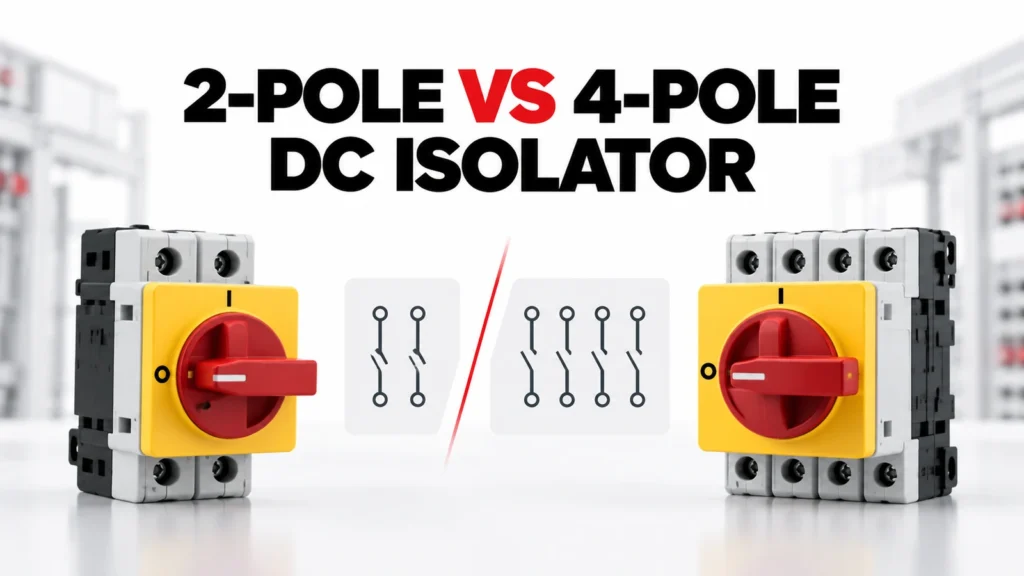
The useful comparison is therefore a circuit and evidence comparison. This article organizes the drawings, ratings and installation questions needed before a panel builder or PV designer commits to either configuration.
Decision Inputs at a Glance
| Review area | What the buyer records | Evidence to request |
|---|---|---|
| Circuit | Positive and negative conductors and isolation boundary | Project single-line diagram |
| Poles | Which contacts carry each conductor | Exact switch connection diagram |
| Duty | Load-break or isolation requirement | Manufacturer utilization and DC rating evidence |
| Installation | Mounting, access, enclosure and interlock | Exact drawing and instructions |
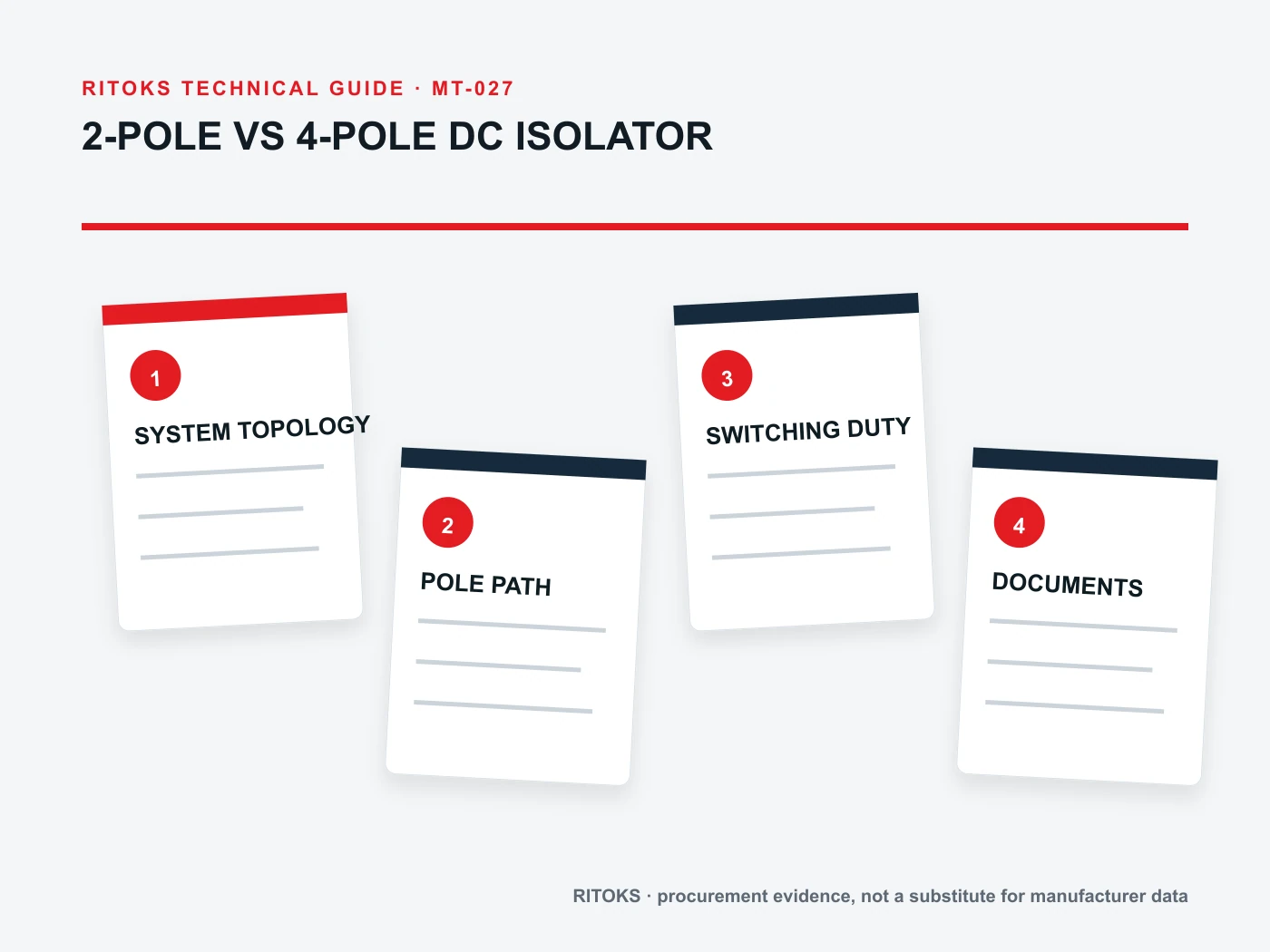
Define what the switch must isolate
Identify the source, load and service boundary. In a PV string or another DC circuit, the number of conductors entering the device and the intended isolation state are design inputs. Do not start from a product photo or a pole-count headline.
The single-line diagram should show all live paths, the location of the switch relative to equipment and the action expected when it opens. This helps distinguish a maintenance isolation task from another switching function.
Understand a 2-pole candidate
A 2-pole device provides two separate contact paths, but their permissible use is determined by its exact design and tested DC rating. Ask for the terminal diagram and how each conductor is to pass through the switch in the proposed circuit.
Do not assume the same wiring for all voltages or for every 2-pole model. A catalog family may contain options with different connection instructions, enclosures or external operating handles.
Understand a 4-pole candidate
Four available contacts create more possible path arrangements. Some designs use poles in series to obtain a specified DC rating, but the permissible series arrangement must be explicitly shown by the manufacturer for the particular switch. A field-created jumper pattern is not approval evidence.
Check which terminals are intended for the positive and negative paths, the allowed orientation and any restrictions on the supply side. Record the manufacturer drawing in the project file and compare it with the as-built panel.
Match the DC rating to the real duty
DC arc interruption differs from an AC nameplate condition. Specify the maximum operating voltage, expected current, source behavior and whether the switch must make or break load current. The relevant application rating must describe the same connection configuration being installed.
Do not assemble one approval from a voltage value on one page, a current value from another variant and a wiring image from a third. Request an exact-model datasheet and any utilization or application evidence needed for the circuit.
Review enclosure and operating access
The same electrical pole arrangement can be delivered as an open component or in an enclosure. Outdoor exposure, ingress expectations, operating handle, lockout needs, mounting orientation and service access change the orderable item.
Provide the panel or site conditions before comparison. A mechanical enclosure label does not resolve electrical switching suitability, and an electrically suitable switch still needs correct mounting and access.
Treat 2-pole and 4-pole quotations fairly
Request the complete codes and connection diagrams for both options. Compare delivered scope, terminal arrangement, included links or accessories, handle details and the application rating. A lower price for one body is not equivalent if the required enclosure or operator is missing.
Ask the supplier to mark each requirement as confirmed, conditional or unsupported. Put alternatives on the same single-line diagram to see whether they serve the same isolation boundary.
Verify installation against the chosen diagram
Before energizing, inspect conductor routing, terminal identification, mechanical action and the actual isolation point against the approved documents. Ensure that any series connection is exactly the one shown for the chosen device.
Retain the approved drawing and order code with the panel documentation. A later replacement should repeat the duty and wiring review, even if the substitute has the same number of poles.
Build an Exact-Model Evidence File
A category or product-family page helps locate relevant options; it does not by itself approve one variant. For DC isolators, keep the full proposed order code, current datasheet, terminal or mounting drawing, operating instructions and any project calculation together. Read the conditions attached to each rating or function. If the evidence belongs to a neighboring model, request the correct document instead of carrying the claim across.
The project team owns the system inputs and acceptance criteria. The supplier owns the evidence for the offered item. In the technical review, place each mandatory requirement beside the exact document and revision that answers it. Mark a missing field as open, conditional or unsupported. This creates a traceable decision and prevents a favorable headline value from hiding an incompatible connection or installation condition.
Compare Complete Offers
| Item | Record in the comparison | Reason |
|---|---|---|
| Orderable item | Full code, variant and included accessories | Prevents family-level assumptions |
| Application match | Written response to each project input | Keeps exceptions visible |
| Documentation | Datasheet, drawing, instructions and revisions | Links claims to the offered item |
| Open points | Owner and due date for clarification | Avoids silent acceptance |
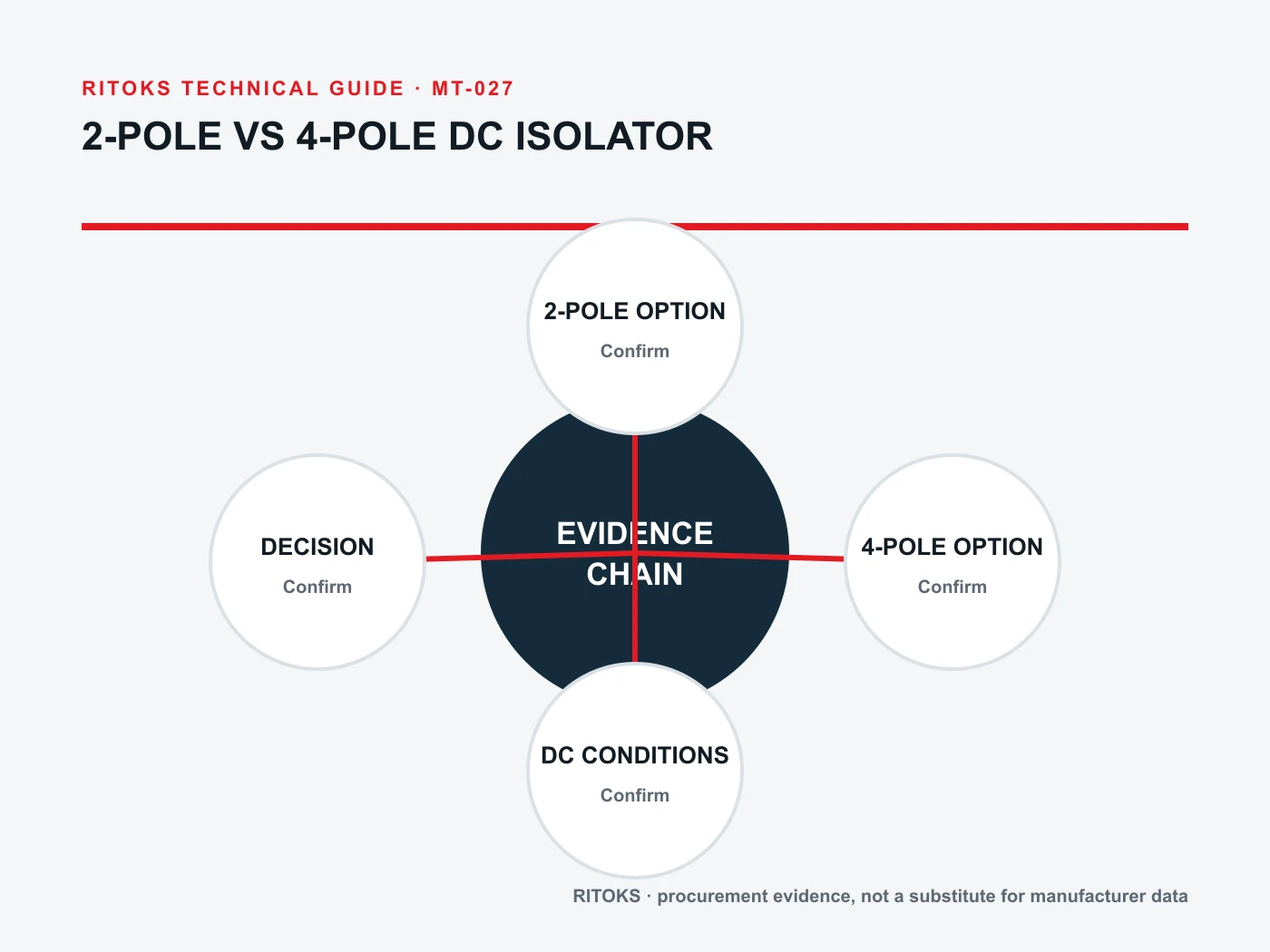
Use the same project brief for every quotation. Commercial terms such as price and lead time can be compared once the technical scope is normalized. Do not treat omitted accessories, unsupported ratings or an unresolved wiring assumption as equivalent to a documented offer. If an alternative is proposed, ask which inputs change and repeat the affected review.
Review Installation and Acceptance
Before installation, confirm that the delivered label, complete code and accessories match the approved record. Compare terminals, mounting, conductor access and any stated orientation with the exact instructions. A product that appears physically similar to the approved version may still have a different electrical configuration, control option or test basis.
Plan an as-built check that addresses the project's real risks. This may involve wiring against the approved diagram, functional response, measurements under representative operating states and confirmation of any communication or alarm feature. Record the conditions and results. The acceptance plan should come from the application and supplier evidence, not from a generic article checklist.
Request for Quotation Checklist
- Identify the circuit, equipment and location that DC isolators must serve.
- Attach the system drawing and operating states that define the application.
- Record circuit boundary and its source document.
- Record conductors and its source document.
- Record pole path and its source document.
- Record diagram and its source document.
- Confirm the exact-model evidence for operating voltage.
- Confirm the exact-model evidence for switching duty.
- Confirm the exact-model evidence for enclosure.
- Confirm the exact-model evidence for order code.
- Request the full order code, accessories, drawings and data-sheet revision.
- Ask for exclusions, assumptions, substitutes and unresolved engineering points.
The RFQ should be specific enough for a supplier to answer without inventing missing project values. If an essential input is not yet known, label it as a question and identify who will determine it. Do not turn an assumption into a rating, a compliance claim or an approved installation method.
What Changes the Decision
A decision can change when the source arrangement, load behavior, environment, installation geometry or required function changes. Revisit the selected DC isolators whenever one of those inputs moves outside the approved brief. Recheck the order code and the exact evidence affected by the change; do not rely on a previous approval for a circuit that now asks the component to do different work.
Keep a short revision history of the project brief, supplier response and accepted exception list. This record helps engineering, purchasing and commissioning work from the same version. It is especially useful when a quotation is revised, a substitute is offered or the panel design changes after the first comparison.
Questions to Resolve Before Approval
Ask who owns each remaining technical question for the proposed DC isolators. The buyer should confirm the system inputs and installation constraints; the supplier should confirm the exact item, included options and applicable documentation. Put the answer and document revision beside the question. An unanswered point should remain visible in the comparison rather than being converted into an assumed feature.
When a quotation offers an alternative, ask for a written explanation of the changed circuit, mounting or performance basis. Review any new drawing with the project engineer and record whether the proposed change is acceptable. A substitution is a new technical decision even if it appears commercially equivalent. This is especially important when multiple suppliers use similar family labels for different configurations.
Frequently Asked Questions
Does four poles always mean a higher DC voltage?
No. Only the exact switch rating and manufacturer connection diagram establish its permissible DC duty.
Can I bridge poles myself?
Use only a connection scheme specifically documented for the exact device and application.
Is an enclosed switch electrically equivalent to an open version?
The enclosure may change installation suitability, but exact electrical ratings and included components still need review.
Relevant RITOKS Pages
For product-family context, see Circuit Protection. The related published product pages include 2p 4p Dc Pv Isolator Switch 32 63a 600 1000v, Ip66 4p Dc Pv Isolator Switch 1 63a 1000 1200v. Use their current exact-model documents when comparing a proposed item.
For an application-specific quotation, send the project brief to RITOKS with the diagrams and open questions above.