
PV DC Isolator Switches · Technical Explainer
PV Rooftop DC Isolation: Environmental and Enclosure Considerations
A rooftop PV isolator is exposed to more than the electrical circuit. Solar heating, precipitation, dust, condensation, cable strain, mounting orientation and maintenance access all affect whether the installed assembly remains suitable. Procurement should therefore combine the DC switching review with an explicit environmental and enclosure review.
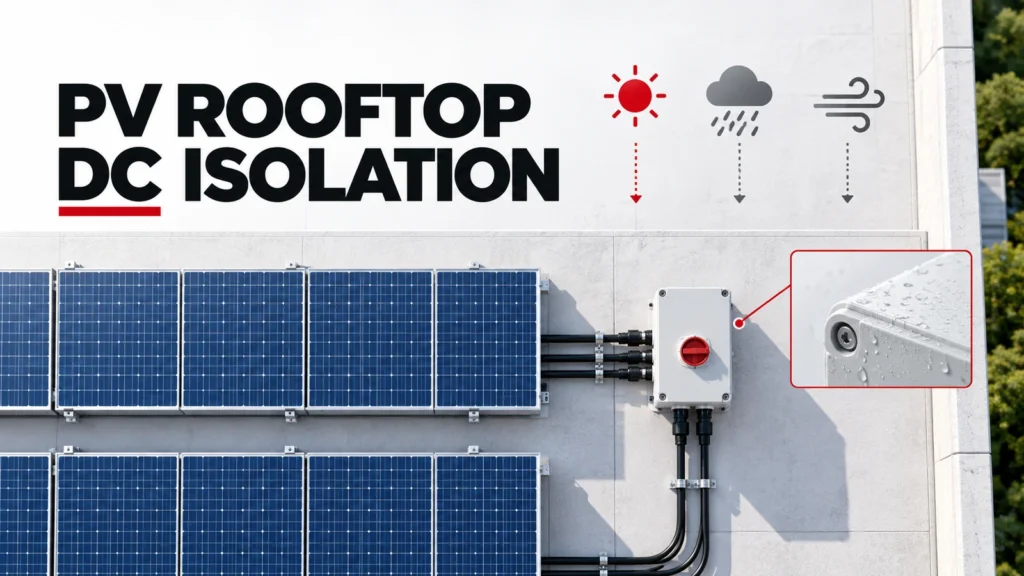
This guide explains environmental and enclosure inputs for a DC isolator installed in a rooftop photovoltaic system. It does not give installation instructions, claim a finished-system ingress rating, select a current or voltage, or approve an exact isolator without project and manufacturer evidence.
Decision Inputs at a Glance
| Decision input | Buyer must confirm | Evidence required |
|---|---|---|
| Electrical duty | DC source envelope, load-breaking need and pole arrangement | Approved single-line and exact isolator data |
| Exposure | Sun, precipitation, dust, pollutants and temperature cycle | Site environmental record |
| Enclosure assembly | Housing, lid, seals, entries and mounting interface | Exact drawing and installation instructions |
| Cable system | Conductor size, glands, bend radius and strain relief | Cable schedule and entry design |
| Operation | Access, labeling, lockout and inspection | Site safety and maintenance procedure |
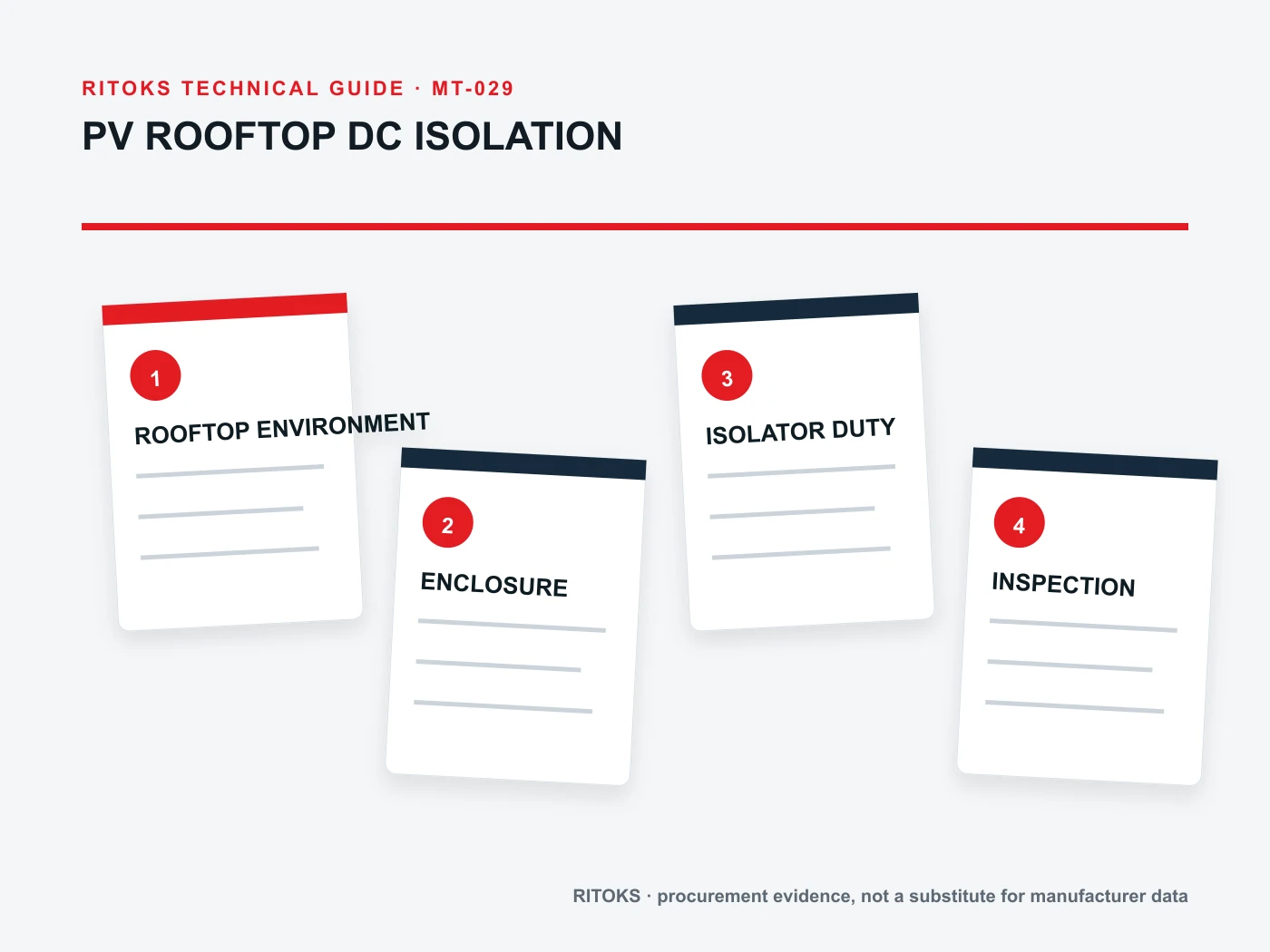
Separate the Switching Question From the Enclosure Question
First confirm that the isolator’s documented DC utilization and pole arrangement match the circuit. Then review whether the complete enclosed assembly is suitable for the rooftop environment. Passing one review does not automatically pass the other.
Keep the exact order code visible throughout. An open switch mechanism, a panel-mounted handle and a factory-enclosed rooftop unit may share a family name but present different installation evidence.
Describe the Real Rooftop Exposure
Record direct solar exposure, likely precipitation path, wind-driven dust, airborne pollution, altitude where relevant and the expected temperature cycle around the device. Avoid reducing this to the single word “outdoor.”
Consider local heat sources and mounting surfaces. The air and enclosure temperature beside a sunlit roof can differ from a general weather record, so the project should define its design basis explicitly.
Review Enclosure Interfaces as a System
The housing, lid, gasket, fasteners, cable entries, mounting holes and operating shaft form one environmental boundary. Require drawings and instructions that show the approved arrangement.
A component-level rating cannot be assumed for a field-modified enclosure. Drilling, gland selection, orientation and sealing practice may change the result, so the finished installation needs documented responsibility.
Plan Cable Entry and Mechanical Support
Confirm conductor size, number of entries, gland range, bend space and strain relief before choosing the enclosure. Cable weight and thermal movement should not be carried by terminals or compromise seals.
Arrange entries so water paths and service loops follow the approved installation method. Exact routing and torque must come from the project and product instructions, not from a generic article.
Make Safe Operation and Identification Practical
Locate the handle where technicians can identify, reach and operate it under the site procedure. Define labels, circuit identity, operating state and any lockout requirement.
An isolator is not automatically a complete safe-isolation system. The engineering and safety teams must define verification of absence of voltage, multiple sources and stored energy under applicable procedures.
Create an Inspection and Replacement Record
Inspection should cover enclosure condition, seals, entries, handle operation, labels and signs of overheating or contamination, subject to the manufacturer and site instructions.
Record the installed model and revision of its documents. When replacing a unit, repeat the electrical, mechanical and environmental comparison rather than accepting a visually similar substitute.
Build an Exact-Model Evidence File
Create one approval record for the proposed DC Isolator order code. Put each project requirement beside the supplier document that answers it. Preserve the exact datasheet, dimensioned drawing, circuit diagram, performance curve or application note used, including its revision or retrieval date. A category page establishes family context but cannot prove an exact rating, terminal arrangement, optional feature or system combination.
Check that every accepted statement describes the same orderable item. Similar housings can contain different circuits, terminals, materials, firmware or accessories. Do not combine a maximum from one variant, a drawing from another and a feature from a third. Mark unresolved fields explicitly so they remain visible during engineering and commercial review.
Keep Project Inputs Separate From Product Evidence
The project team defines the application: source, load, duty, environment, controls, mechanical limits and required functions. The supplier identifies an exact DC Isolator and supports it with exact documents. Neither side should fill a gap by inference from appearance, a shared family name or one matching headline value.
Freeze the application record while quotations are compared. If the circuit, load, duty, environment, enclosure, thermal method or required output changes, issue a revised record and ask each supplier to reconfirm the candidate. Otherwise apparently comparable quotations may be answering different technical requirements.
Common Procurement Errors
- Selecting DC Isolator from one headline rating while the application context remains incomplete.
- Using a circuit, curve, terminal drawing or performance claim from a neighboring model.
- Treating a family page or product photograph as exact technical evidence.
- Assuming an accessory, system function or coordination result is included without documentation.
- Approving a substitute without repeating the electrical, thermal, mechanical and evidence review.
Resolve these gaps before comparing price and lead time. The reviewer should be able to trace every accepted statement either to the project requirement or to the exact candidate document. A proposal may remain commercially interesting while technically incomplete, but missing evidence must not disappear inside the quotation.
How to Compare Supplier Offers
| Comparison point | Required evidence | Do not accept |
|---|---|---|
| Exact identity | Full orderable code and variant description | Family name alone |
| Application match | Response against the frozen project inputs | Generic suitability statement |
| Technical evidence | Current exact-model documents with revision | Screenshot or neighboring-model page |
| Delivered scope | Included accessories, interfaces and documents | Undefined “standard package” |
| Open questions | Visible deviation and clarification list | Silence treated as compliance |
| Substitution | Fresh review against every requirement | “Equivalent” based on appearance |
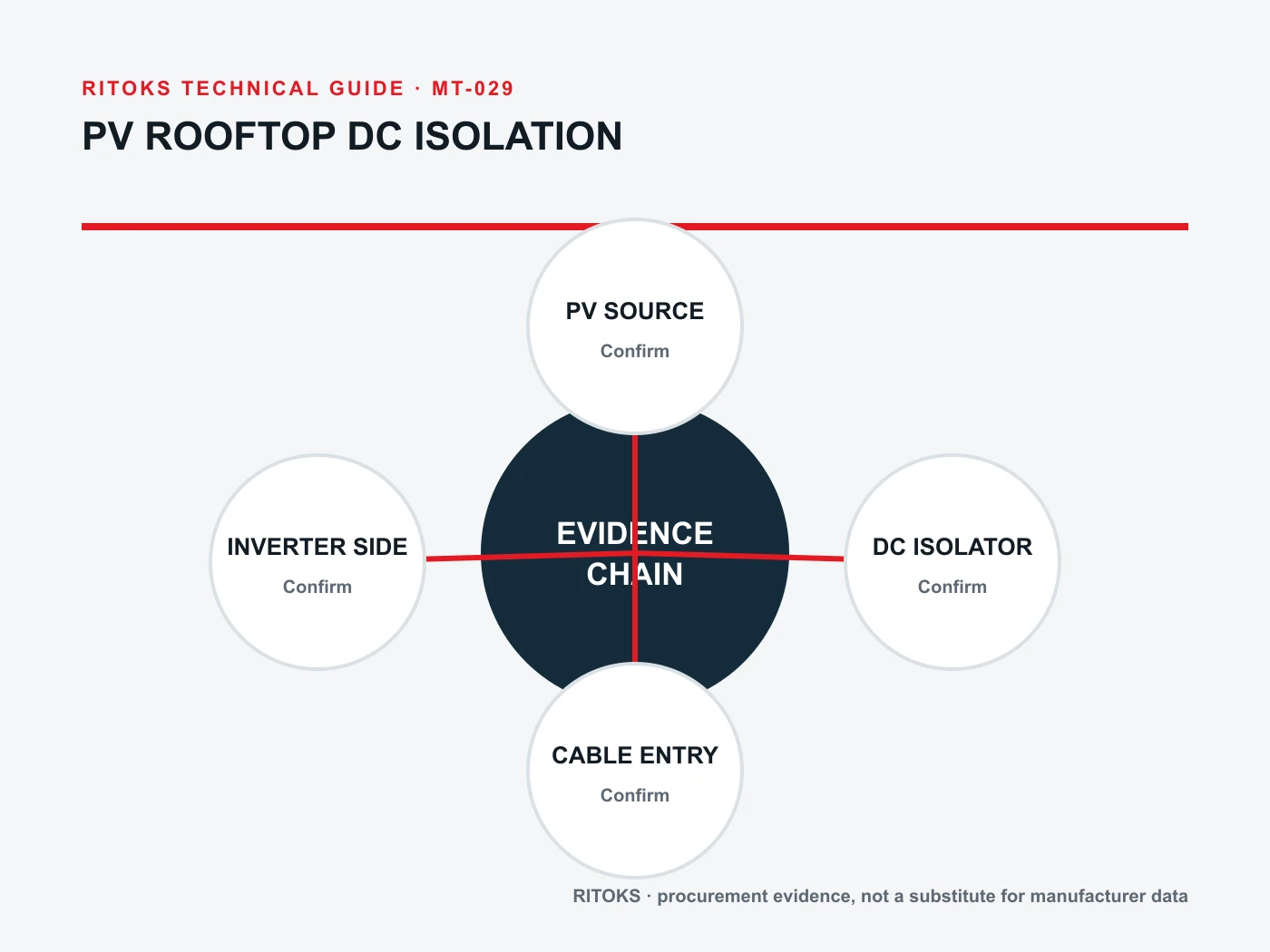
Normalize every DC Isolator offer to the same application record. Keep document revisions, test conditions, included accessories and open questions beside each value. This makes differences in delivered scope visible and prevents a lower-cost but narrower offer from appearing equivalent to a complete solution.
Decision Workflow
- Freeze the application architecture and operating case.
- Record environmental, thermal and mechanical constraints.
- Identify the required DC Isolator function without assuming a model.
- Request a complete order code and exact supporting documents.
- Compare every claim with its conditions and definitions.
- Resolve deviations and coordination questions before commercial approval.
- Archive the accepted evidence with the final bill of materials.
Stop the review when a critical application input is unknown, the quoted model is ambiguous, a required claim is supported only by another manufacturer or another order code, or the installation falls outside the available evidence. These are engineering gaps, not editorial details.
RFQ Preparation Checklist
A useful RFQ for pv rooftop dc isolator is concise enough to answer and complete enough to prevent silent assumptions. Identify unknown values as questions and require a full orderable code rather than a generic family recommendation.
- DC circuit
- Switching duty
- Solar exposure
- Cable entry
- Service position
- Enclosure
- Glands
- Mounting
- Operation
- Inspection
- Quantity, destination and required document language
Request the current datasheet revision and the exact scope of any certification, compatibility, coordination or performance claim. Record quantity and destination after the technical inputs so commercial terms do not obscure unresolved engineering questions.
Handoff From Engineering to Purchasing
Engineering approval should identify the exact DC Isolator code, accepted document revisions, unresolved deviations and the application record used for the decision. Purchasing can then compare commercial offers without silently changing the technical basis. If a supplier proposes another code, different accessory or revised configuration, route it back through the same review instead of treating it as an administrative substitution.
Keep the approved evidence with the purchase order and final bill of materials. Receiving and production teams need enough information to recognize the accepted item and to stop when labeling, terminal arrangement, accessories or documentation differ. This handoff also gives maintenance teams a traceable starting point for replacement decisions rather than relying on a photograph, an old invoice description or one headline rating.
Frequently Asked Questions
Is an outdoor label enough for rooftop selection?
No. Confirm the exact exposure, enclosure assembly, installation method and model documentation.
Does a DC isolator provide overcurrent protection?
No. Isolation and overcurrent protection are separate functions.
Can cable glands be chosen after the isolator arrives?
That creates avoidable risk. Conductor and entry requirements should be part of enclosure selection.
Related RITOKS Products and Guidance
These links provide published product-family context only. A contextual link does not claim interchangeability, compatibility or an approved system combination.
Published RITOKS DC Isolator product page
Published RITOKS DC Isolator product page
Related published RITOKS technical guide
Related published RITOKS technical guide
Technical Reference
The following source supports only the general engineering concept stated in this guide. Its product ratings, circuit diagrams, approvals and coordination results do not transfer to RITOKS products.
ABB, Switch-disconnectors and enclosed switch-disconnectors overview
Supports keeping switching and enclosure configurations distinct; ABB ratings do not transfer to RITOKS products.
Request an Exact-Model Review
Send the application requirements, exact-document questions, quantity and destination through the RITOKS contact form. An RFQ requests an exact-model review; this guide does not approve a circuit, installation or automatic substitute.