
Motor Protection Circuit Breakers for Three-Phase Motors · Technical Explainer
MPCB Breaking Capacity and Motor-Circuit Fault Evidence
An MPCB's adjustable motor-current range does not tell you whether it can interrupt the short circuit available at the panel. Breaking capacity is a separate rating tied to the device, system voltage and applicable test conditions. Buyers need the prospective fault current at the MPCB location and exact-model interruption evidence before approving a motor-control bill of materials.
This guide focuses on fault evidence, not overload setting or a complete starter design. It explains the questions to ask about Icu, Ics, voltage and combination coordination without assigning a value to an unreviewed RITOKS breaker.
Find the fault current where the MPCB is installed
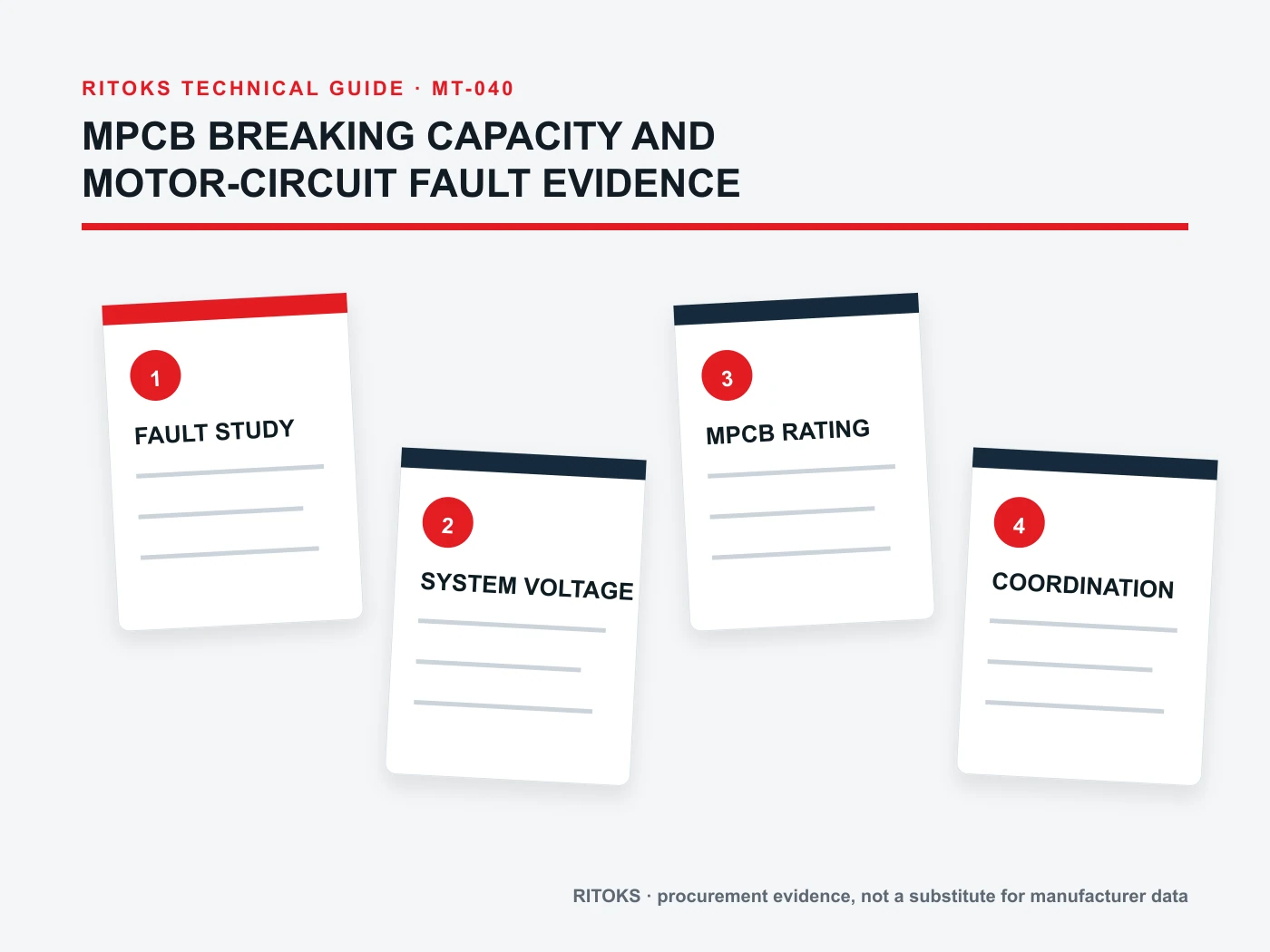
Start with the project short-circuit study. The prospective current at a motor branch depends on transformer and source impedance, cables, upstream equipment and the precise installation point. It is not necessarily the same as the available fault at the switchboard incomer or another motor feeder.
Record the study's assumptions and the operating configurations it covers. Alternate supplies, generator operation or future transformer changes can alter fault duty. If the study is incomplete, identify the breaker selection as provisional. A supplier may suggest candidates but cannot validate the installation from motor power alone.
Keep the fault level separate from the motor's normal and starting current. The MPCB has to carry and protect the motor under ordinary duty and also interrupt or participate in clearing a much higher fault. One ampere label cannot stand for both jobs.
Match the exact voltage to the interruption table
Breaking capacity may vary substantially across voltage values for one model. Schneider Electric's published motor-circuit-breaker datasheets show different Icu and Ics entries at different AC voltages. The numbers are Schneider product values, not a RITOKS specification; they demonstrate why the exact system voltage belongs beside the rating.
Ask for the exact device order code, pole configuration, rated operational voltage and short-circuit table. Do not compare a candidate's best-looking rating at a lower voltage with the project's higher-voltage duty. Note frequency and any conditional or upstream-protection requirement in the data.
A breaker that meets motor current but lacks documented fault duty at the installation voltage should remain open for engineering review. A larger frame is not automatically a cure; it may bring different overload range, coordination and panel constraints.
Understand Icu and Ics without merging them
IEC-style product data may distinguish ultimate short-circuit breaking capacity, Icu, from service short-circuit breaking capacity, Ics. The two refer to different test and post-fault performance criteria. Schneider Electric's user guide describes Ics as a service rating expressed relative to Icu for its devices. Do not treat the values as synonyms or assume their relationship is the same for every model.
The project specification should state which ratings need to be checked under the applicable standard and local requirements. Ask what the breaker can be expected to do after a fault and what inspection or replacement procedure the site will follow. A fault-clearing event is not a routine switching operation, even when the device has a service breaking-capacity rating.
Do not infer the exact device's Ics from a family brochure or a competitor product. Obtain the model-specific table at the project voltage and record it with the design. If the supplier gives Ics as a percentage of Icu, calculate or quote the corresponding value using that model's data, not a generic rule.
Review starter combination and coordination
An MPCB often sits with a contactor and other starter components. The performance of the combination during a short circuit may have its own tested coordination basis. Manufacturer coordination tables should identify the exact devices and conditions. A similarly sized contactor or changed overload component may not inherit the former result.
Ask whether the cited fault rating is for the MPCB alone or conditional on a specified upstream device or combination. Record any required fuse, contactor, busbar or terminal accessory. The result should be checked against the panel's prospective fault current and applicable assembly design requirements.
Schneider Electric's motor-starter catalogue provides examples of coordinated combinations, but those tables are not transferable to unrelated RITOKS devices. Request RITOKS-specific evidence where a combination claim is necessary. Without it, keep the assembly rating question unresolved.
Keep overload behavior separate
The adjustable overload range addresses sustained motor current. Breaking capacity addresses a high-current fault. A device can be correctly adjustable for the motor yet have inadequate short-circuit duty for the site, or meet the fault duty but have an unsuitable overload range. Both checks belong in the approval record.
Starting current and acceleration time should be reviewed against the trip characteristic so normal starts do not cause unnecessary operations. Do not enlarge the overload setting to compensate for a breaking-capacity concern; those are different design problems. The motor nameplate and fault study must both be present in the RFQ.
Make the evidence chain visible
| Item | Project evidence | Device evidence |
|---|---|---|
| System voltage | Motor-feeder supply conditions | Exact rated operational voltage |
| Fault duty | Prospective current at MPCB | Icu/Ics at relevant voltage |
| Combination | Contactor and upstream devices | Coordination or conditional tables |
| Motor protection | Nameplate and start profile | Adjustment and trip characteristics |
| Installation | Panel wiring and environment | Terminal and mounting instructions |
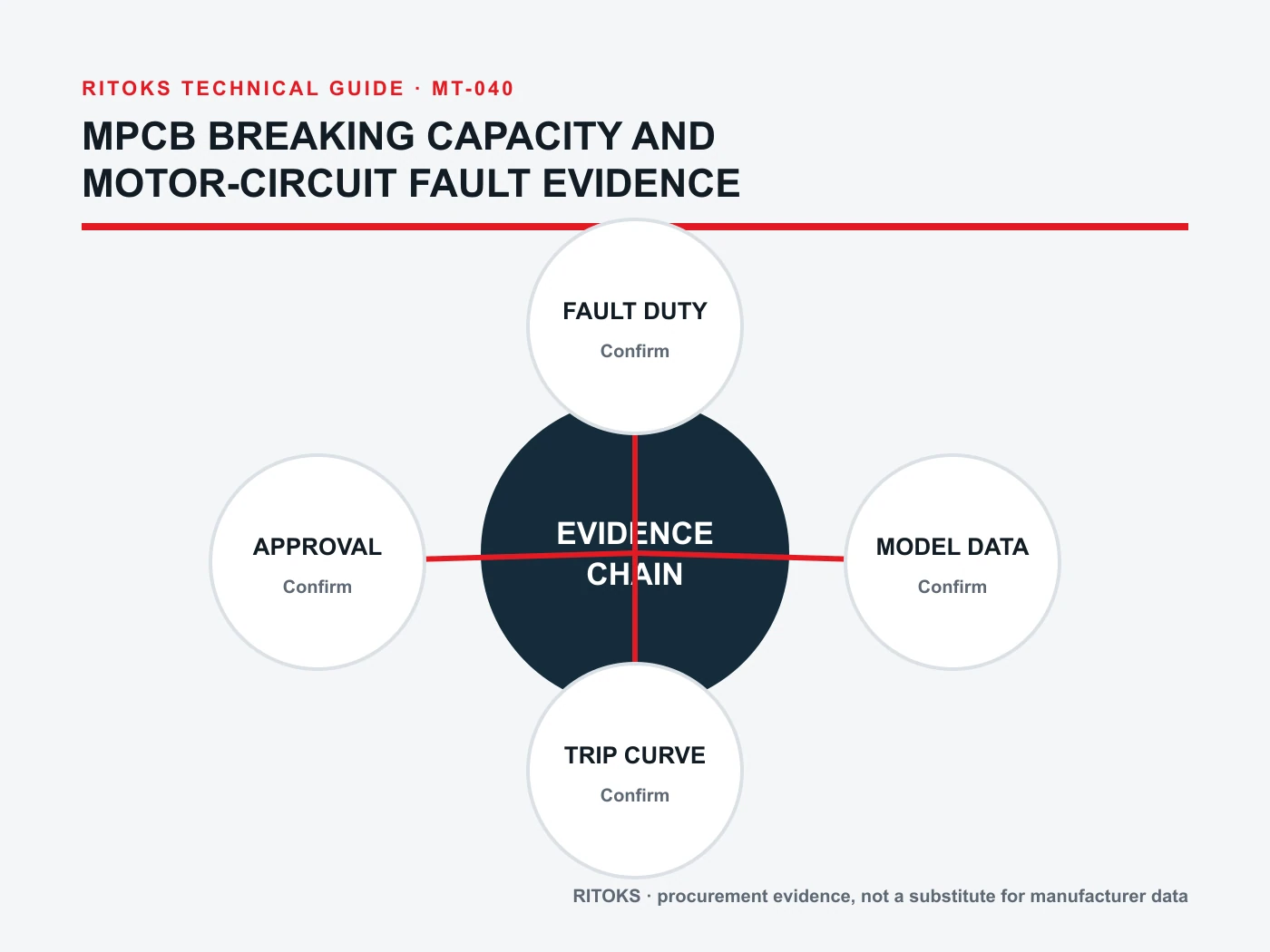
A PASS should cite an exact document and order code. If a field is not yet known, mark it pending and say who will provide it. Do not fill missing evidence with an attractive family-level statement.
What changes after a product substitution
A substitute MPCB should be reviewed at the same site voltage and prospective fault current. Compare its Icu, Ics, overload range, trip curve, physical terminals and compatibility with the existing contactor. A matching frame size or motor-power label does not prove equivalent fault performance.
Document the original and proposed order codes and the reason for the change. If the supplier claims a higher fault rating with a specific upstream fuse or accessory, add that condition to the panel drawing and bill of materials. A condition that is absent from the installed assembly cannot be counted in the rating review.
Keep commissioning and maintenance records. After an actual short-circuit event, follow manufacturer and site procedures for inspection, testing or replacement. Do not assume a handle that can be reset proves the device remains fit for service.
Question conditional ratings carefully
A supplier may present a high short-circuit capability achieved only with a specified upstream fuse or another protective component. Such a figure is not the standalone rating of every installation using that MPCB. Ask for the exact combination, voltage, upstream device rating and installation conditions. Then confirm that the proposed panel actually includes those elements and that the associated equipment is permitted.
Check the downstream contactor and busbar as well. A panel can contain an MPCB with adequate interruption data while another component in the motor starter lacks the necessary coordination evidence. The assembly designer must evaluate the complete fault path. This is one reason a kA number copied from a product card is insufficient for a panel approval.
If the site may be supplied from alternate sources, identify the most demanding credible configuration. Generator contribution, transformer replacement or parallel feeds can change the available fault at the branch. Use the project's short-circuit study instead of assuming the worst case is always the normal utility connection.
Record whether the quoted data are Icu, Ics or a conditional combination rating. These terms should remain explicit in procurement documents and as-built records so later maintenance does not compare unlike claims. Include the rated voltage next to every figure, since a bare kA value loses the condition that makes it meaningful.
RITOKS category and inquiry path
Review the MPCB category and GYMP7 motor protection breaker family for commercial context. Those pages do not themselves resolve the project's available fault current or the exact variant's breaking data.
Send the single-line, study result, motor nameplate, contactor order code and required voltage through RITOKS contact. Request the exact datasheet, breaking-capacity table and coordination evidence. If any document is missing, keep final approval pending rather than rounding a fault estimate or borrowing a rating.
Frequently asked questions
Is an MPCB's motor-current range its breaking capacity?
No. Adjustment range concerns motor overload selection. Breaking capacity concerns interruption of the prospective short-circuit current at a stated voltage.
Can I use the highest Icu listed for the product family?
Only if it belongs to the exact candidate at the applicable system voltage and conditions. Ratings may differ by voltage and variant.
Does a successful fault interruption mean immediate reuse?
Not automatically. Follow the device manufacturer's post-fault instructions and site inspection policy, considering the documented service breaking rating and fault severity.
Bottom line
MPCB breaking-capacity review begins with a location-specific fault study and ends with exact-model voltage and interruption evidence. Keep the motor overload and starter-combination checks alongside it, but do not let them replace it. A clear evidence chain is more valuable than a large unqualified kA headline.
References
- IEC, IEC 60947-2:2024 circuit-breakers.
- Schneider Electric, Ics service breaking capacity in motor protection breakers.
- Schneider Electric, GV2P20 exact-model data sheet (illustrates voltage-dependent ratings; not RITOKS data).