
AC Power Protection · Comparison
6kA vs 10kA MCB: Understanding Breaking-Capacity Ratings
When comparing miniature circuit breakers, 6kA and 10kA refer to short-circuit breaking-capacity ratings.
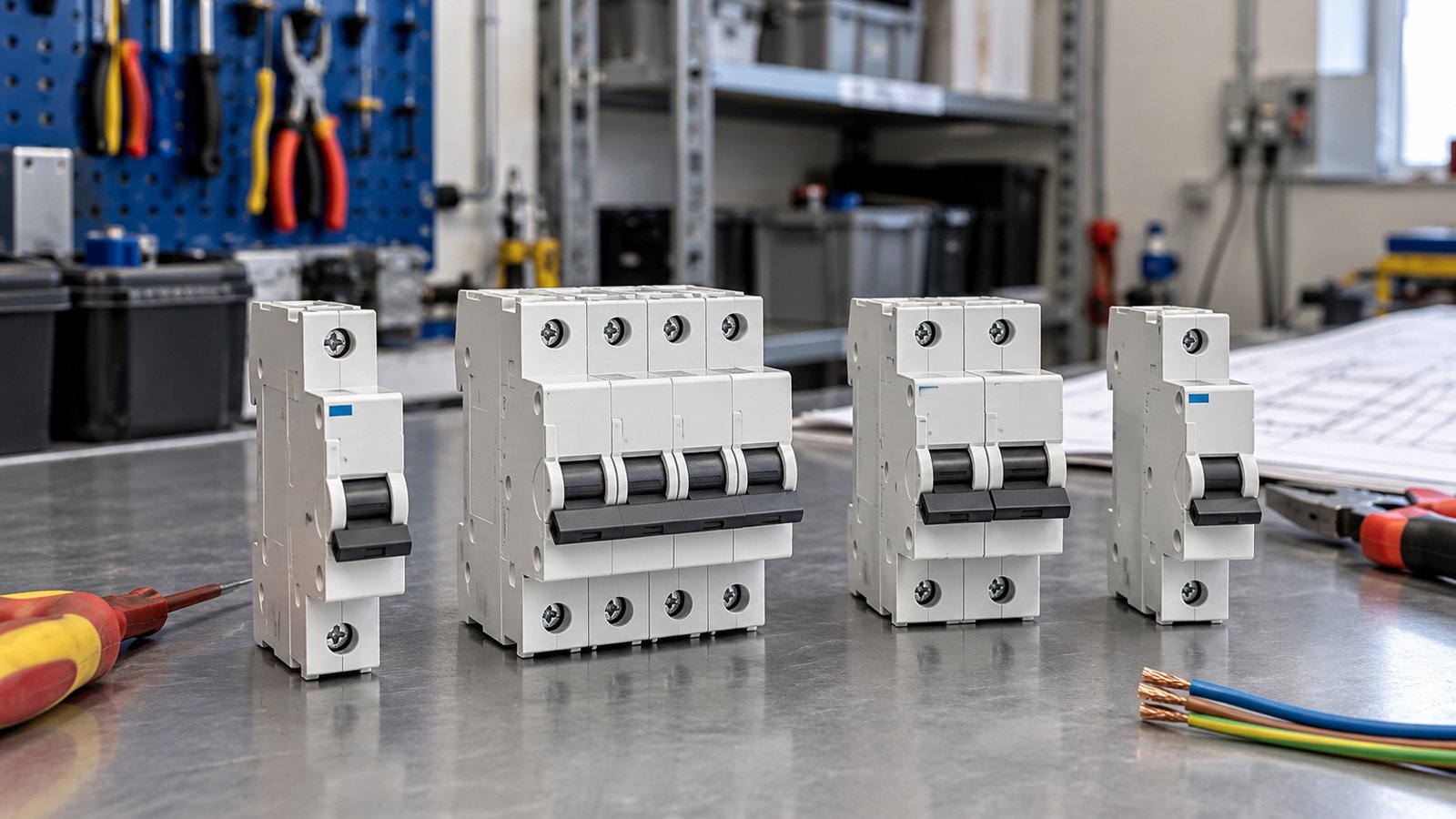
They do not describe the breaker’s normal current rating, pole configuration or trip curve.
A 6kA breaker and a 10kA breaker may both be rated 32A, use the same pole arrangement and offer the same B or C trip characteristic. The difference is the level of prospective short-circuit current the breaker is rated to interrupt under the relevant standard and specified conditions.
The most important point is simple:
10kA is a higher breaking-capacity rating than 6kA under equivalent rating conditions, but that does not mean 10kA is automatically the correct choice for every installation.
The required breaking capacity must be considered against the prospective short-circuit current at the point where the breaker will be installed. Hager’s technical guidance for IEC/EN 60898-1 MCBs states that the rated short-circuit capacity, Icn, should be equal to or greater than the prospective short-circuit current at the point of application.
In This Guide
- Quick Answer: 6kA vs 10kA MCB
- What MCB Breaking Capacity Means
- Prospective Short-Circuit Current
- Icn, Ics and Standards Context
- What Changes Between 6kA and 10kA
- Current RITOKS Options
- Verification Process
- Common Mistakes
- Frequently Asked Questions
Quick Answer: 6kA vs 10kA MCB
| Rating | What It Indicates | What It Does Not Tell You |
|---|---|---|
| 6kA | A published short-circuit breaking-capacity rating of 6kA under the stated conditions | Normal current rating, trip curve, pole count or automatic application suitability |
| 10kA | A higher published short-circuit breaking-capacity rating of 10kA under equivalent conditions | That the breaker is universally safer, better or required for every project |
The comparison is only meaningful when the relevant standard, voltage, exact breaker model and rating designation are also known.
A single kA number should not be treated as the entire breaker specification.
What Does MCB Breaking Capacity Mean?
A short circuit can produce current far above the normal operating current of a circuit.
An MCB therefore needs to do more than protect against ordinary overload conditions. It must also be capable of interrupting a short-circuit current within the limits for which it has been designed and tested.
For IEC/EN 60898-1 miniature circuit breakers, ABB’s technical details for miniature circuit breakers describes Icn as the rated short-circuit capacity assigned to the breaker by the manufacturer according to a specified test sequence. The value relates to prospective short-circuit current.
This is why breaking capacity is different from rated current.
For example:
- 32A describes a current rating.
- C curve describes a tripping characteristic.
- 10kA Icn describes a short-circuit breaking-capacity rating.
They answer different questions.
For the broader selection process involving current, poles, trip curve and breaking capacity together, see the AC MCB Selection Guide.
What Is Prospective Short-Circuit Current?
Prospective short-circuit current is the current that could flow at a particular point in an electrical system if a short circuit occurred under the defined conditions.
It is not simply the normal load current multiplied by a convenient factor.
The available fault current depends on the electrical system supplying the installation, including factors such as source characteristics and circuit impedance.
For breaker selection, the important general principle is that the interrupting capability of the protective device must be adequate for the prospective short-circuit current at its installation point. ABB similarly explains that short-circuit protection devices must be selected with the maximum prospective short-circuit current at the connection point in mind.
This article does not provide a fault-current calculation method.
That calculation belongs to the electrical design of the actual system.
Why 6kA and 10kA Cannot Be Selected From the Load Name Alone
It can be tempting to use shortcuts such as:
- 6kA for residential
- 10kA for commercial
- 10kA for industrial
Those statements are too broad to be reliable selection rules.
The required breaking capacity comes from the prospective fault conditions at the installation point and the applicable project requirements—not simply whether the building is called residential, commercial or industrial.
Two installations with similar loads can have different prospective short-circuit currents because their supply systems are different.
Likewise, different points inside the same distribution system may not have identical fault-current conditions.
Application category alone does not determine the required kA rating.
What Does Icn Mean?
For MCBs under IEC/EN 60898-1, Icn refers to rated short-circuit capacity.
ABB describes Icn as the short-circuit breaking capacity assigned to the breaker according to the standard’s defined test sequence. Hager states that the breaker’s Icn should be equal to or greater than the prospective short-circuit current at the point of application.
So if a product is explicitly published as:
10kA Icn
that statement is more precise than simply saying:
10kA breaker
because it identifies the type of short-circuit rating being referenced.
However, the standard and voltage still matter.
What Does Ics Mean?
Ics refers to service short-circuit breaking capacity.
Under IEC/EN 60898-1, Icn and Ics are related but are not identical terms. ABB explains that the standard uses different prescribed test sequences for rated short-circuit capacity and service short-circuit capacity.
This distinction matters when reading product data.
For example, the current RITOKS data for RTSXD01 and RTSXD04 publishes:
- Icn: 10kA
- Ics: 7.5kA
Those numbers should be preserved exactly as published.
They should not be simplified into a claim that both values mean the same thing.
Likewise, where another RITOKS product simply publishes 6kA without identifying Icn or Ics, this article should not invent the missing designation.
Icn, Ics and Icu Are Not Interchangeable
Another common source of confusion is comparing short-circuit figures taken from different standards as though they were the same rating.
IEC/EN 60898-1 commonly uses the Icn terminology for miniature circuit breakers.
IEC/EN 60947-2 uses terms including Icu, the rated ultimate short-circuit breaking capacity, as well as Ics, the rated service short-circuit breaking capacity.
ABB notes that the two standards have different scopes and definitions, so engineers need to identify which short-circuit-capacity definition applies to the particular design.
A Schneider Electric MCB product page provides a useful real-world example: the same device can publish 6000A Icn under IEC/EN 60898-1 while also publishing a different breaking-capacity value under IEC/EN 60947-2, depending on voltage and standard.
That does not mean one number is wrong.
It means the rating context is different.
6kA vs 10kA: What Actually Changes?
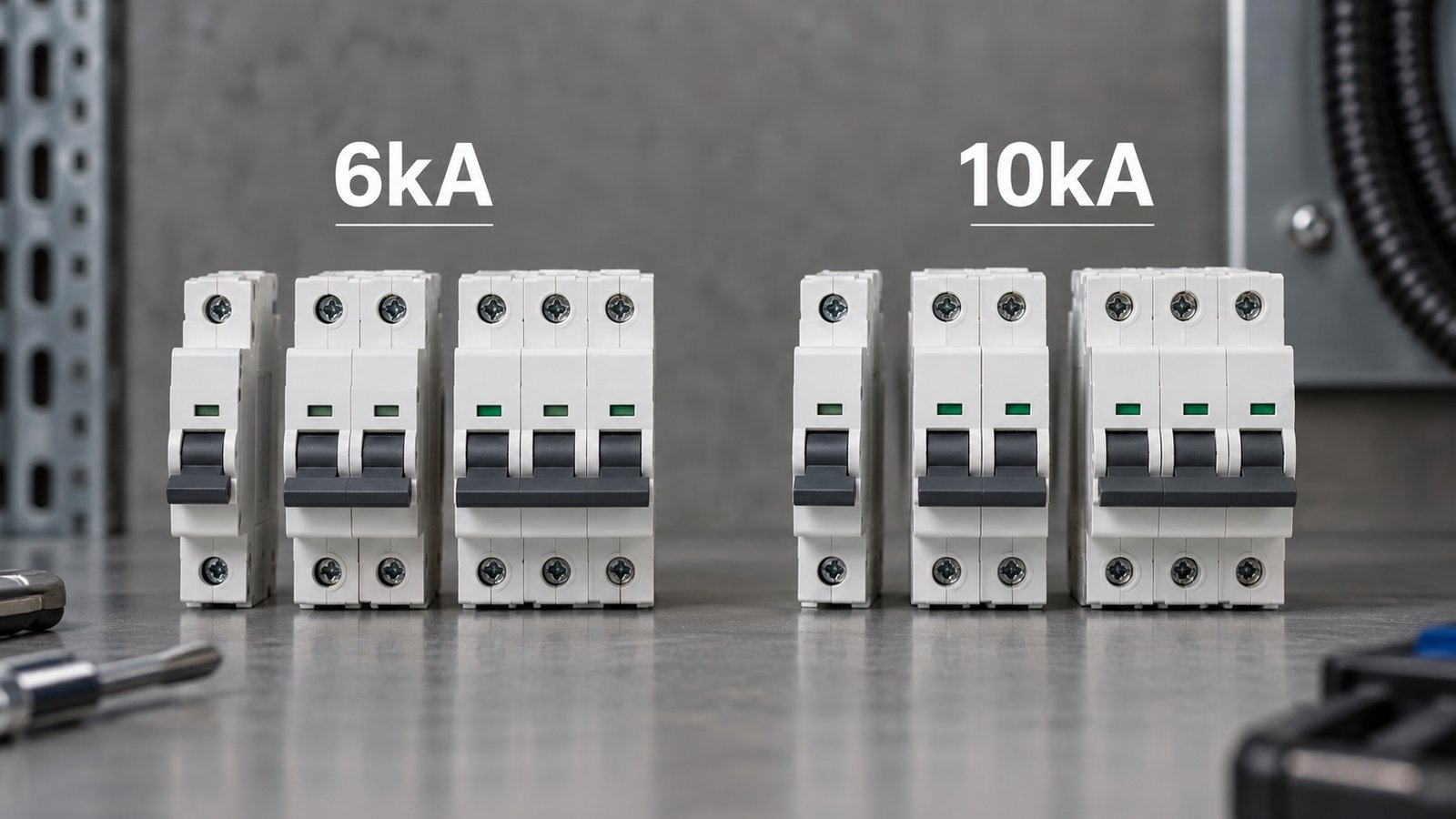
When two breaker ratings are otherwise compared under equivalent conditions, 10kA represents a higher short-circuit breaking-capacity rating than 6kA.
In practical terms, the published rating indicates that the breaker has been assigned a higher level of short-circuit interruption capability under its specified rating conditions.
What does not automatically change?
- a higher normal current rating
- more poles
- a different B/C/D trip characteristic
- better overload protection
- greater product quality
- longer service life
- better selectivity
- suitability for a particular industry
Those parameters must be checked independently.
6kA Is Not a “Lower Quality” Breaker
A 6kA breaker is not automatically inferior to a 10kA breaker.
If the installation requirements call for a breaking capacity that a correctly specified 6kA device satisfies, then a 10kA value should not be interpreted as a quality upgrade in isolation.
The kA rating describes a particular electrical capability.
It is not a product grade such as:
- standard
- premium
- professional
Similarly, marketing names such as “Economic” or “Pro” should not be used as substitutes for verified engineering specifications.
10kA Is Not Automatically the Better Choice
A higher published breaking-capacity rating can be necessary when the prospective fault current requires it.
But selection should not follow the logic:
Higher number = always better.
The engineering question is instead:
What prospective short-circuit current and applicable requirements must this breaker safely address?
After that requirement is known, compatible breaker models can be shortlisted.
Other parameters still matter, including:
- rated voltage
- current
- poles
- trip curve
- breaking-capacity designation
- applicable standard
- mounting
- exact product variant
Current RITOKS Breaking-Capacity Options
Current published RITOKS AC MCB data in the AC Power Protection and Miniature Circuit Breakers (MCB) ranges includes several different breaking-capacity values.
| RITOKS Model | Published Breaking Capacity | Notes |
|---|---|---|
| RTSXD01 | 10kA Icn / 7.5kA Ics | Explicit Icn and Ics values published |
| RTSXD03 | 6kA | Icn/Ics designation not published |
| RTSXD02 | 6kA | Icn/Ics designation not published |
| RTSXD04 | 10kA Icn / 7.5kA Ics | Explicit Icn and Ics values published |
| RTS-ACM60 | 6kA typical | Must be confirmed by exact variant |
| RTS-AC47 | 1kA | Icn/Ics designation not published |
This table reflects published model-family information only.
It does not prove:
- the prospective fault current of a buyer’s installation
- a model-specific short-circuit test report
- coordination with another protective device
- SCCR of a complete panel
- universal suitability for any application type
Which Current RITOKS Models List 10kA?
Two currently published RITOKS AC MCB families explicitly list 10kA Icn / 7.5kA Ics:
RTSXD01
The RTSXD01 family publishes:
- AC 230/400V
- 1–63A
- multiple pole configurations
- B/C/D curve availability
- 10kA Icn
- 7.5kA Ics
RTSXD04
The RTSXD04 family also publishes:
- AC 230/400V
- 1–63A
- multiple pole configurations
- B/C/D curve availability
- 10kA Icn
- 7.5kA Ics
The presence of those ratings allows these models to be compared on published short-circuit capacity.
It does not establish the required rating for a buyer’s installation.
Which Current RITOKS Models List 6kA?
The current site publishes 6kA for:
RTSXD03
- AC 240V
- 1–32A
- 1P+N
- 6kA
RTSXD02
The RTSXD02 family publishes:
- AC 240V
- 1–32A
- 1P+N
- 6kA
RTS-ACM60
The RTS-ACM60 family publishes:
- 230/240V AC
- 6–63A
- 1P / 2P
- 6kA typical
For RTS-ACM60, the value is explicitly subject to exact variant confirmation.
That caveat should remain part of any sourcing decision.
Where Does Trip Curve Fit Into the Comparison?
Trip curve and breaking capacity are separate specifications.
For example, a buyer might need:
- C curve
- 32A
- 2P
- 10kA
Each item describes something different.
The B/C/D designation relates to the breaker’s trip characteristic, while the kA short-circuit rating describes breaking capacity under its specified rating conditions.
For a detailed explanation of trip characteristics, see B Curve vs C Curve vs D Curve MCBs: What’s the Difference?
Do not use trip curve to infer breaking capacity, or breaking capacity to infer trip curve.
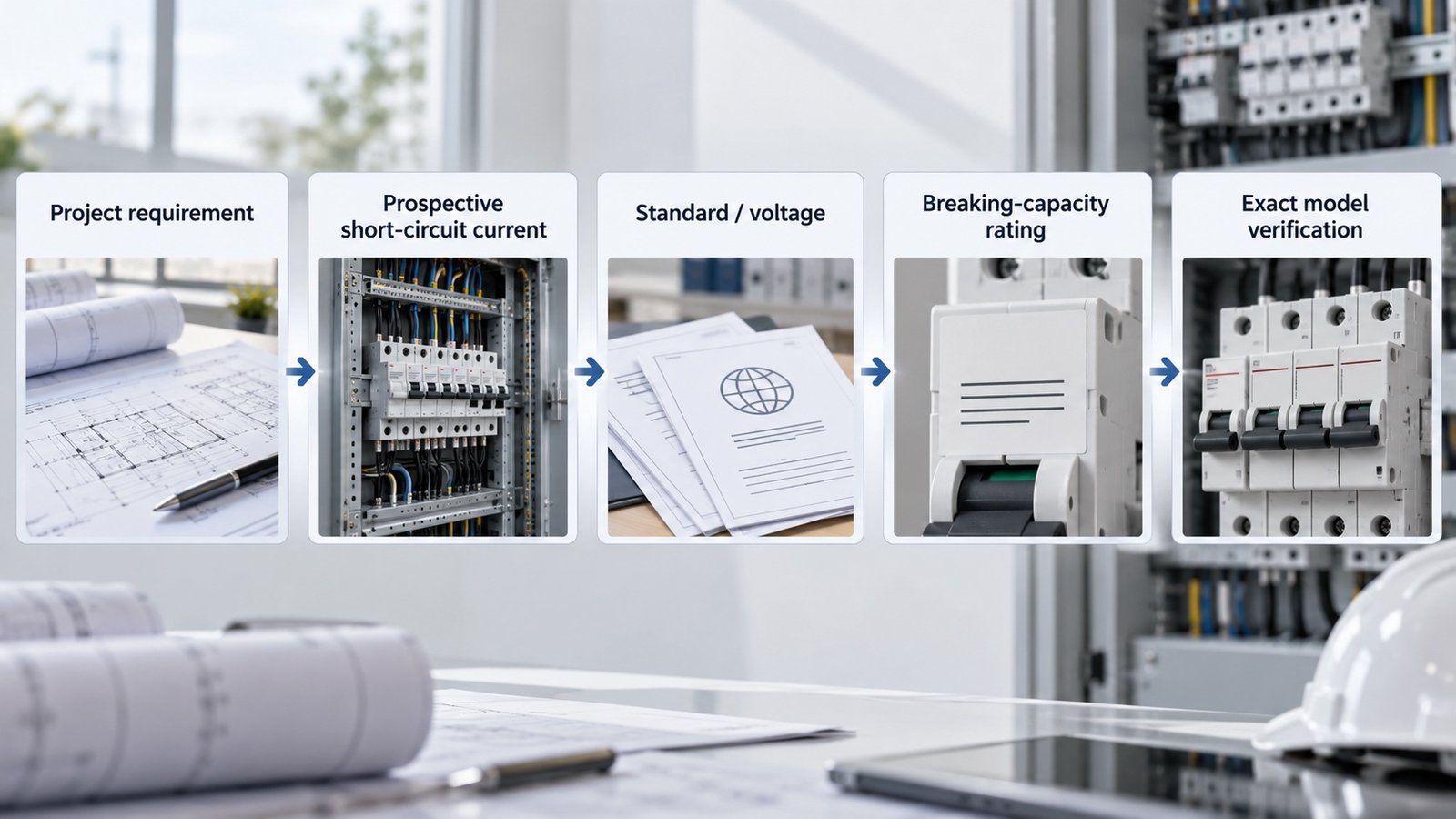
A Safer Breaking-Capacity Selection Process
A technical procurement process can be kept simple without turning it into a fault-current design calculation.
1. Determine the Required Short-Circuit Rating
Use the project’s electrical design, specification or verified prospective short-circuit-current data.
Do not estimate the required value from building type alone.
2. Confirm the Standard and Rating Designation
Check whether the required value is stated as:
- Icn
- Ics
- Icu
- or another relevant short-circuit parameter
Do not assume those terms are interchangeable.
3. Confirm the Voltage
Short-circuit performance can be associated with rated operational voltage.
The voltage condition should therefore be checked together with the kA value.
4. Match the Exact Product
Verify:
- exact model
- voltage
- current
- poles
- trip curve
- breaking capacity
- applicable standard
- variant
5. Request Technical Documentation Where Needed
If the project requires formal engineering verification, request the exact product documentation rather than relying only on a marketing-page summary.
Common 6kA vs 10kA MCB Mistakes
“6kA Is for Residential and 10kA Is for Industrial”
This is too broad.
The correct breaking capacity depends on prospective fault conditions and applicable project requirements.
“10kA Is Safer Than 6kA”
A higher breaking-capacity number is not a universal safety ranking.
The relevant question is whether the breaker rating satisfies the installation’s actual requirement.
Comparing Only the kA Number
A breaking-capacity figure should be read together with:
- standard
- voltage
- rating designation
- exact product
Treating Icn and Ics as Identical
They are different standardized short-circuit performance concepts.
Assuming Panel SCCR Equals MCB Breaking Capacity
Do not automatically equate an individual breaker’s short-circuit rating with the short-circuit current rating of an entire assembly.
System and assembly ratings involve their own requirements.
Using the Product Page as a Fault-Current Calculation
A product page can tell you what the breaker is published to offer.
It cannot determine the prospective short-circuit current at your installation.
What Should Buyers Include in an MCB RFQ?
For a clearer MCB sourcing request, provide:
- system voltage
- required current rating
- pole configuration
- required trip curve
- required breaking capacity
- applicable standard if specified
- required Icn / Ics / other rating designation if specified
- quantity
- application
- required technical documentation
If the exact required short-circuit rating has not yet been determined, that requirement should be resolved in the electrical design before using product availability alone to make the final selection.
Frequently Asked Questions
What Is the Difference Between a 6kA and 10kA MCB?
The difference is their published short-circuit breaking-capacity rating under the applicable rating conditions. A 10kA rating represents a higher breaking capacity than 6kA when the comparison is otherwise equivalent.
Is 10kA Better Than 6kA?
Not automatically. 10kA provides a higher breaking-capacity rating, but the correct requirement depends on prospective short-circuit current and the applicable project specification.
What Does Icn Mean on an MCB?
Under IEC/EN 60898-1, Icn refers to rated short-circuit capacity. The value should be considered against the prospective short-circuit current at the point of application.
What Is Ics?
Ics is the service short-circuit breaking-capacity concept defined under the relevant standard. It is not simply another name for Icn.
Does a 10kA MCB Trip Faster Than a 6kA MCB?
The kA breaking-capacity rating alone does not answer that question. Trip behavior must be evaluated using the breaker’s trip characteristic and time-current data, not inferred from its breaking-capacity value.
Does RITOKS Offer Both 6kA and 10kA MCBs?
Yes. Current published families include 6kA options such as RTSXD02 and RTSXD03, and 10kA Icn / 7.5kA Ics options such as RTSXD01 and RTSXD04. RTS-ACM60 lists 6kA as typical and subject to variant confirmation.
Need Help Comparing AC MCB Options?
RITOKS publishes AC miniature circuit breaker families with different:
- current ratings
- pole configurations
- B/C/D curve availability
- breaking-capacity ratings
- mounting formats
Use an AC MCB RFQ checklist to provide the required electrical parameters and any project-specific short-circuit requirement.
The goal is not simply to select the breaker with the largest kA number, but to match the required specification with a confirmed product configuration.
Related Resources
Continue exploring AC Power Protection
AC MCB RFQ Checklist: What Buyers Should Specify
AC MCB RFQ Checklist: What Buyers Should Specify A clear AC miniature circuit breaker RFQ can save multiple…
Read guide
1P+N vs 2P Circuit Breakers: Configuration Questions for Buyers
1P+N vs 2P Circuit Breakers: Configuration Questions for Buyers When buyers compare 1P+N and 2P circuit breakers, the…
Read guide