
AC Power Protection · RFQ Checklist
AC MCB RFQ Checklist: What Buyers Should Specify
A clear AC miniature circuit breaker RFQ can save multiple rounds of clarification between a buyer and supplier.

Instead of sending only:
“Please quote 32A MCB.”
a useful inquiry should identify the electrical and commercial requirements that are already defined for the project.
Depending on the application, that may include:
- system voltage
- rated current
- pole configuration
- trip curve
- breaking capacity
- quantity
- mounting format
- required documentation
- destination market
- delivery requirements
The goal of an RFQ is not to replace electrical engineering.
It is to communicate the project requirements clearly enough for the supplier to compare them against available product families and exact variants.
If a parameter such as trip curve, breaking capacity or neutral arrangement has not yet been determined by the project design, it should not be guessed simply to complete the inquiry.
Contents
AC MCB RFQ Quick Checklist
| Parameter | What the Buyer Should Provide | Why It Matters |
|---|---|---|
| System voltage | Required AC voltage | Narrows compatible breaker families |
| Rated current | Required current rating | Identifies suitable published current options |
| Pole configuration | 1P, 1P+N, 2P, 3P, 3P+N, 4P, as specified | Configuration availability differs by product family |
| Trip curve | B, C, D or other specified characteristic | Curve availability differs by model |
| Breaking capacity | Required kA rating where specified | Must match the project’s short-circuit requirement |
| Icn / Ics requirement | Include the required designation where relevant | Not every product page publishes both values |
| Quantity | Required order quantity | Needed for quotation and availability discussion |
| Mounting | DIN rail or other project requirement | Helps confirm physical compatibility |
| Application / panel context | Short project description | Helps identify what additional information may be needed |
| Required documents | Datasheet, drawings, certification evidence, etc. | Documentation availability must be confirmed by exact model |
| Destination | Country or market | Useful where standards, labeling or documentation requirements differ |
| Delivery requirement | Target date or schedule | Helps clarify commercial feasibility |
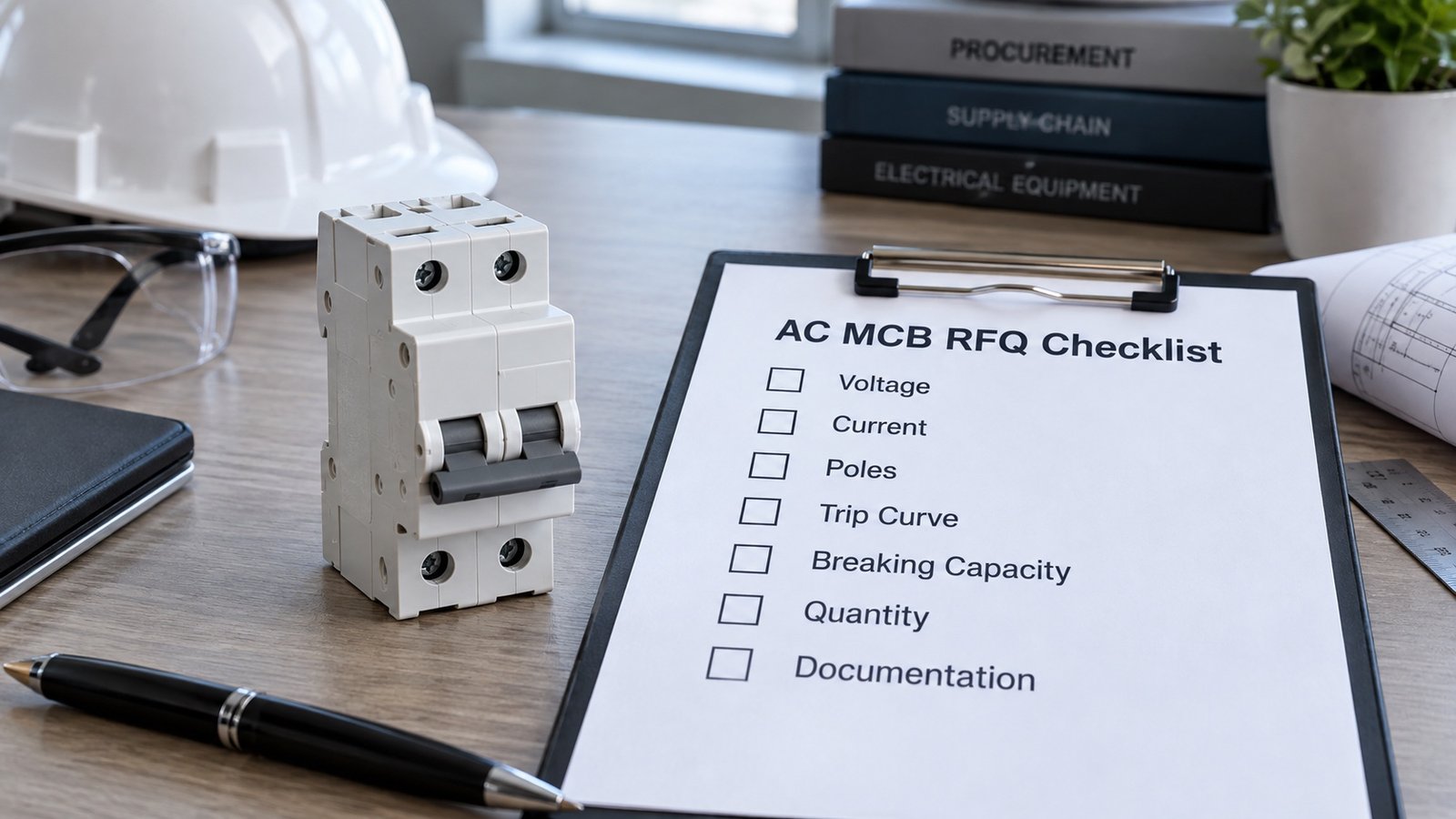
Not every inquiry needs every field.
But the more requirements that are already known, the easier it is to avoid comparing products that do not match the project.
1. Specify the System Voltage
Start with the voltage defined by the project.
Examples of current published RITOKS AC MCB families include products with ratings such as:
- AC 230/400V
- AC 240V
- AC 230/240V
These are product-family examples, not instructions for choosing a voltage.
The buyer should provide the voltage required by the actual electrical system.
A good RFQ field is simply:
System voltage: [required voltage]
If the project uses a particular supply arrangement or has additional voltage-related requirements, include those separately.
2. Provide the Required Current Rating
The supplier should not have to infer the required breaker current from the application name alone.
If the project specification already defines the current rating, include it directly.
For example:
Rated current: [required current]
Current RITOKS AC MCB families cover different published ranges, including:
- 1–32A
- 1–63A
- 6–63A
- 10–63A
The published range only tells the buyer what a particular family currently offers.
It does not determine what current rating the circuit itself requires.
For broader current, pole and curve selection considerations, see the AC MCB Selection Guide.
3. Specify the Pole Configuration
Pole configuration should be written explicitly.
Possible requirements may include:
- 1P
- 1P+N
- 2P
- 3P
- 3P+N
- 4P
Different RITOKS product families publish different combinations.
For example, RTSXD01 and RTSXD04 currently list:
- 1P+N
- 2P
- 3P
- 3P+N
- 4P
RTS-ACM60 currently lists:
- 1P
- 2P
The RFQ should therefore state the configuration already required by the project rather than asking for “a breaker” without pole information.
If the project specifically depends on neutral switching, neutral protection or another internal pole behavior, include that as a separate documentation requirement.
Do not assume the configuration label alone confirms those details.
For more information, see 1P+N vs 2P Circuit Breakers: Configuration Questions for Buyers.
4. Include the Required Trip Curve
If the project already specifies a trip characteristic, include it.
For example:
Trip curve: B
or:
Trip curve: C
or:
Trip curve: D
Current published RITOKS data confirms:
- RTSXD01 — B/C/D
- RTSXD03 — B/C
- RTSXD02 — B/C
- RTSXD04 — B/C/D
- RTS-ACM60 — B/C
RTS-AC47 does not currently have a confirmed curve designation on its published page.
The RFQ should not ask the supplier to infer the correct curve solely from a simple label such as “motor,” “lighting” or “industrial panel.”
If the curve has not yet been defined, that engineering requirement should be resolved separately.
See B Curve vs C Curve vs D Curve MCBs: What’s the Difference? for a focused explanation of trip-curve terminology.
5. State the Required Breaking Capacity
Breaking capacity is another specification that should be provided when it has already been established for the project.
A buyer might write:
Breaking capacity: [required kA]
Current RITOKS published data includes examples such as:
- RTSXD01 — 10kA Icn / 7.5kA Ics
- RTSXD02 — 6kA
- RTSXD03 — 6kA
- RTSXD04 — 10kA Icn / 7.5kA Ics
- RTS-ACM60 — 6kA typical, subject to variant confirmation
- RTS-AC47 — 1kA
Where a product page publishes only a kA value without identifying Icn or Ics, the missing designation should not be invented.
Likewise, the supplier should not be assumed to determine prospective short-circuit current simply from the RFQ’s voltage and application description.
If the project engineering documentation already includes prospective short-circuit current or a required breaking capacity, include it in the inquiry.
For the technical distinction, see 6kA vs 10kA MCB: Understanding Breaking-Capacity Ratings.
6. Include Icn or Ics Requirements When They Matter
Not every sourcing inquiry needs a separate Icn or Ics field.
But when the specification explicitly requires one, write it clearly.
For example:
Required short-circuit rating designation: [Icn / Ics / project specification]
This matters because some current RITOKS product pages publish both values while others do not.
RTSXD01 and RTSXD04, for example, currently publish:
- 10kA Icn
- 7.5kA Ics
RTSXD02 and RTSXD03 publish 6kA without a separate Icn/Ics designation on the current site.
The RFQ should preserve the terminology used by the project rather than treating different short-circuit rating terms as interchangeable.
7. Describe Mounting and Space Constraints
For OEM panel projects, electrical ratings are only part of the sourcing question.
Physical installation can matter as well.
Useful RFQ information may include:
- required DIN rail format
- available panel space
- maximum device dimensions
- preferred terminal arrangement
- accessory space
- dimensional drawing requirement
Several current RITOKS AC MCB families publish 35mm or 35.5mm DIN rail mounting information.
However, this should not be treated as a substitute for full dimensional confirmation.
If panel space is tight, ask for the exact dimensional drawing for the selected model and configuration.
A useful RFQ entry is:
Maximum available space / dimensional constraint: [project requirement]
8. Mention Required Accessories
Some MCB projects involve more than the base breaker.
Current published product information includes examples such as:
- RTSXD04 — optional F3 auxiliary contact and S3 shunt release
- RTS-AC47 — optional shunt-trip release
- RTS-ACM60 — optional residual-current module
If the project needs an accessory, include it explicitly.
For example:
Required accessory: [auxiliary contact / shunt release / other specified accessory]
Do not assume that an accessory is compatible with every breaker variant.
The breaker and accessory combination should be confirmed together.
For accessories with electrical parameters, such as a shunt-release control voltage, provide the required specification where available.
9. Specify the Required Documentation
For B2B and OEM panel procurement, technical documentation can be as important as the product itself.
Depending on the project, buyers may request:
- datasheet
- dimensional drawing
- connection diagram
- time-current information
- breaking-capacity documentation
- applicable standard information
- certification evidence
- accessory documentation
- product labeling information
A request for documentation does not mean every document is automatically available for every model.
The better wording is:
Required documentation: [list documents required for approval]
The supplier can then confirm what is available for the exact model and variant.
10. Separate Standard Requirements From Certification Requirements
A product page may mention a standard reference.
That is not automatically the same as providing a certificate, laboratory report or approval accepted in a particular market.
If a project requires a specific standard, state:
Required standard: [standard]
If it also requires documentary evidence, state that separately:
Required certification / evidence: [document or approval requirement]
This distinction helps prevent ambiguity during quotation.
Do not assume that a standard mentioned on a product page guarantees every required certificate or destination-market approval.
11. Include the Destination Country or Market
For international procurement, destination information can be useful.
It may affect discussions around:
- documentation
- labeling
- packaging
- standard requirements
- commercial terms
- delivery arrangements
A simple RFQ field is:
Destination market: [country / region]
This does not mean the supplier automatically guarantees regulatory compliance in that market.
Any market-specific approval requirement should be stated explicitly and verified separately.
12. Provide Quantity and Delivery Requirements
Technical specifications are only one side of an RFQ.
Commercial information is also needed.
Include:
Quantity: [required quantity]
and, where relevant:
Required delivery date: [target date]
or:
Project schedule: [required schedule]
If the project will be purchased in several batches, mention that as well.
This helps separate:
- prototype requirement
- pilot order
- production order
- recurring demand
without requiring the supplier to guess the commercial scale.
13. Packaging, Labeling and OEM Requirements
Buyers may also have project-specific commercial requirements such as:
- packaging format
- carton labeling
- product identification
- documentation format
- OEM branding or private labeling
These are reasonable items to include in an RFQ when they matter.
However, availability should be confirmed for the exact product, quantity and project.
The RFQ should therefore use wording such as:
Packaging / labeling requirement: [requirement]
OEM branding requirement, if applicable: [requirement]
rather than assuming that every model automatically supports every customization option.
Example AC MCB RFQ Template
The following template is intentionally non-engineering-specific.
Replace the placeholders with requirements already defined for your project.
Project Information
- Company: [company name]
- Project / panel type: [project description]
- Destination market: [country / region]
- Quantity: [quantity]
- Required delivery: [target date]
MCB Requirement
- System voltage: [required voltage]
- Rated current: [required current]
- Pole configuration: [1P / 1P+N / 2P / 3P / 3P+N / 4P]
- Trip curve: [required curve]
- Breaking capacity: [required kA]
- Icn / Ics requirement: [if specified]
- Mounting: [required mounting]
- Preferred model / family: [if known]
Additional Requirements
- Accessories: [if required]
- Dimensions / space limit: [if applicable]
- Neutral behavior requirement: [if specifically defined]
- Required standard: [if specified]
- Required technical documents: [documents]
- Certification requirement: [if applicable]
- Packaging / labeling: [requirement]
- OEM branding: [if required]
Notes
Other project requirements: [additional information]
This template helps communicate existing requirements.
It should not be used to invent electrical parameters that the project has not yet determined.
What If Some Parameters Are Not Yet Known?
It is acceptable for an RFQ to contain unknown items.
For example:
Trip curve: To be confirmed by project engineer
is better than guessing a curve simply to fill the field.
Likewise:
Breaking capacity: Project requirement pending
is clearer than assuming 6kA or 10kA from the building type.
The supplier can identify which information is missing for product matching, while the project team remains responsible for requirements that belong to electrical design.
Common AC MCB RFQ Mistakes
Sending Only the Current Rating
“32A MCB” leaves major questions unanswered.
Voltage, poles, trip curve and breaking capacity may still be needed.
Leaving Out Pole Configuration
A 32A 1P+N breaker and a 32A 2P breaker are not the same configuration.
Asking for “Standard Curve”
There may be several curve options.
Specify the required curve if the project has already defined it.
Saying “6kA or 10kA — Whichever Is Better”
Breaking capacity is not a quality ranking.
Provide the required short-circuit rating from the project specification.
Asking for “IEC Certified” Without Naming the Requirement
A standard reference, test report and market approval are not necessarily the same thing.
Specify the actual documentation needed.
Forgetting Variant-Dependent Data
Some values may vary by exact model or option.
For example, RTS-ACM60 currently describes 6kA as typical and subject to variant confirmation.
Assuming a Configuration Label Defines Neutral Behavior
If neutral switching or protection is important, request that information explicitly.
Assuming OEM Branding Is Automatically Available
Include the requirement in the RFQ and ask for confirmation for the exact product and quantity.
A Practical RFQ Workflow
A simple sourcing process is:
Project requirements → RFQ checklist → Candidate product family → Exact variant verification → Documentation confirmation → Quotation
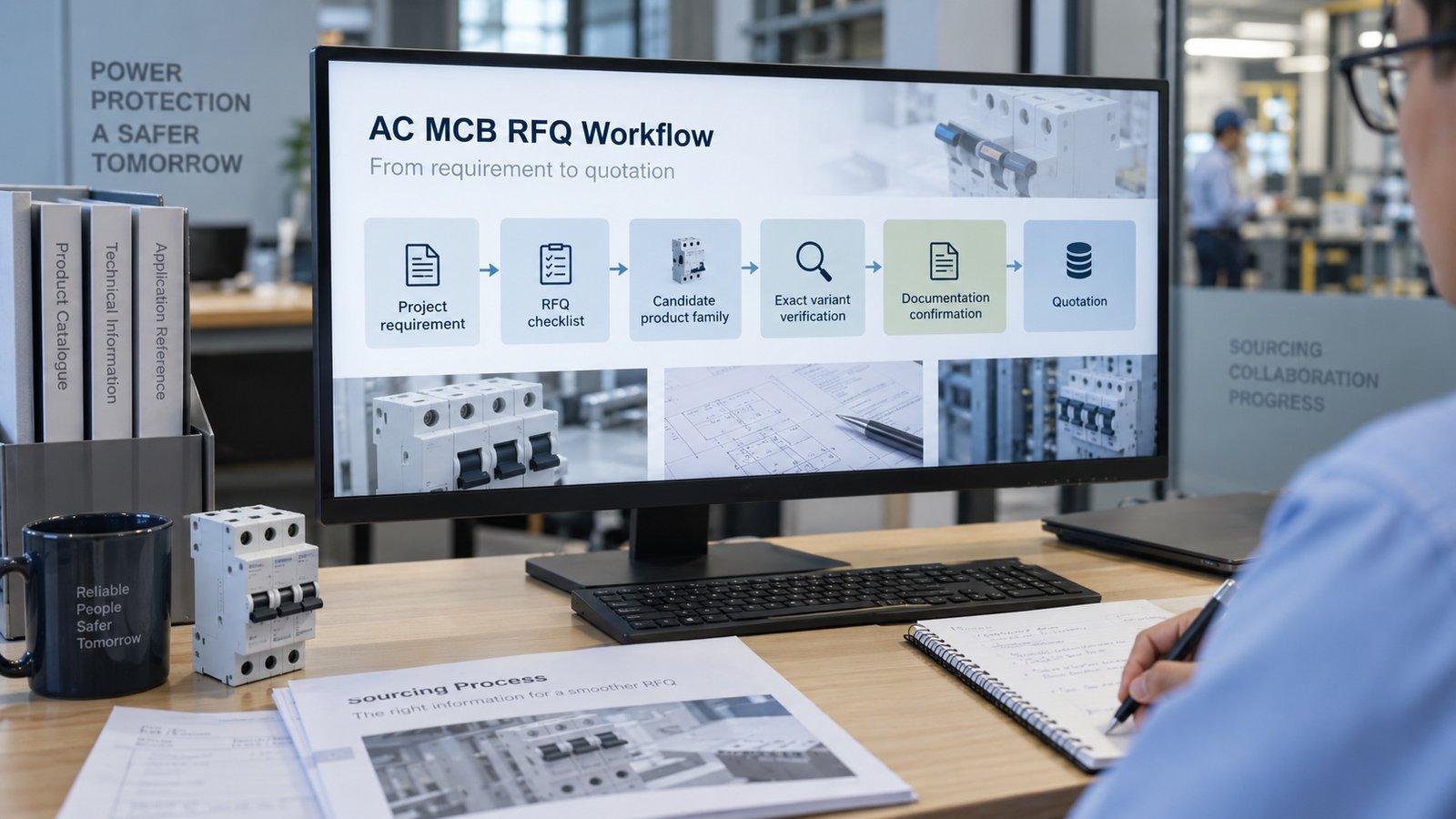
This keeps electrical design and supplier quotation as separate steps.
The supplier compares the supplied requirements with available product configurations.
The buyer or project engineer remains responsible for requirements that must be determined by the electrical design.
Which RITOKS AC MCB Families Can Buyers Review?
Current published AC MCB families include several different specification combinations.
RTSXD01
Published examples include:
- AC 230/400V
- 1–63A
- 1P+N through 4P configurations
- B/C/D
- 10kA Icn / 7.5kA Ics
RTSXD02
Published examples include:
- AC 240V
- 1–32A
- 1P+N
- B/C
- 6kA
RTSXD04
Published examples include:
- AC 230/400V
- 1–63A
- 1P+N through 4P configurations
- B/C/D
- 10kA Icn / 7.5kA Ics
- selected accessory options
These examples can help buyers identify a possible starting family.
The final quotation should still be based on the exact required configuration and confirmed variant.
Frequently Asked Questions
What Information Should Be Included in an MCB RFQ?
At minimum, include the parameters already defined by your project, such as voltage, current, poles, quantity and application context.
Where applicable, also provide trip curve, breaking capacity, mounting, documentation and delivery requirements.
Should I Include B, C or D Curve in the RFQ?
Yes, if the project specification has already defined the required curve.
If it has not been determined, do not guess.
Should I Specify 6kA or 10kA?
Provide the required breaking capacity when it has been established by the project’s electrical design.
Do not select the value only from whether the project is residential, commercial or industrial.
Do I Need to Specify Icn and Ics?
Only where the project or procurement specification requires that distinction.
Some product families publish both values, while others currently publish only a general kA value.
Can RITOKS Determine the Breaker Size From My Voltage?
The current site does not support a claim that voltage alone is sufficient for complete breaker selection.
Provide the electrical requirements already defined by the project.
Can I Request Technical Documents With the Quote?
Yes.
List the required documents in the RFQ so availability can be confirmed for the exact model.
Can I Request Custom Packaging or OEM Branding?
You can include packaging, labeling or OEM requirements in the inquiry.
Availability should be confirmed according to the selected model, quantity and project rather than assumed for every product.
Do I Need to Change the Website Inquiry Form to Send These Details?
No.
The existing inquiry flow includes a requirements/specifications field where these details can be entered. A buyer can also use the checklist in this article when preparing the inquiry.
Ready to Send an AC MCB RFQ?
A useful RFQ does not need to be complicated.
The most important step is to separate:
requirements already defined by the project
from:
items that still require engineering or model-specific confirmation.
Before sending your inquiry, review:
- voltage
- current
- poles
- trip curve
- breaking capacity
- quantity
- mounting
- required documents
- destination
- delivery requirements
Then send the specification together with any model preference or project notes.
Related Resources
Continue exploring AC Power Protection
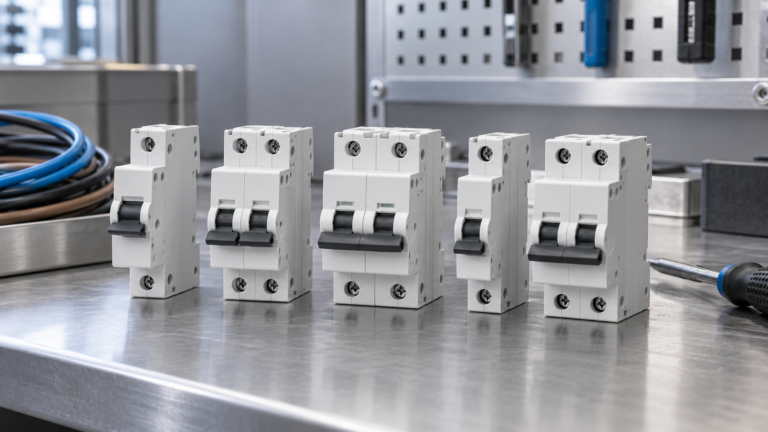
1P+N vs 2P Circuit Breakers: Configuration Questions for Buyers
1P+N vs 2P Circuit Breakers: Configuration Questions for Buyers When buyers compare 1P+N and 2P circuit breakers, the…
Read guide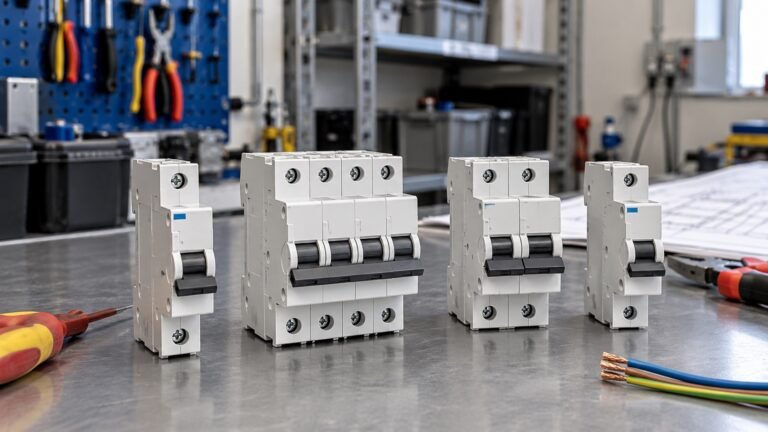
6kA vs 10kA MCB: Understanding Breaking-Capacity Ratings
6kA vs 10kA MCB: Understanding Breaking-Capacity Ratings Representative AC MCB formats shown in an industrial electrical workbench environment.…
Read guide