
Solid State Relays for Electronic Switching · Technical Explainer
Solid State Relays for Industrial Heater Control: Application Inputs
Solid State Relays for Industrial Heater Control: Application Inputs begins with a controlled application record, not a catalog headline. Buyers should define the real system, installation and service conditions before comparing candidate products. Every decisive claim then needs support from the exact proposed order code.
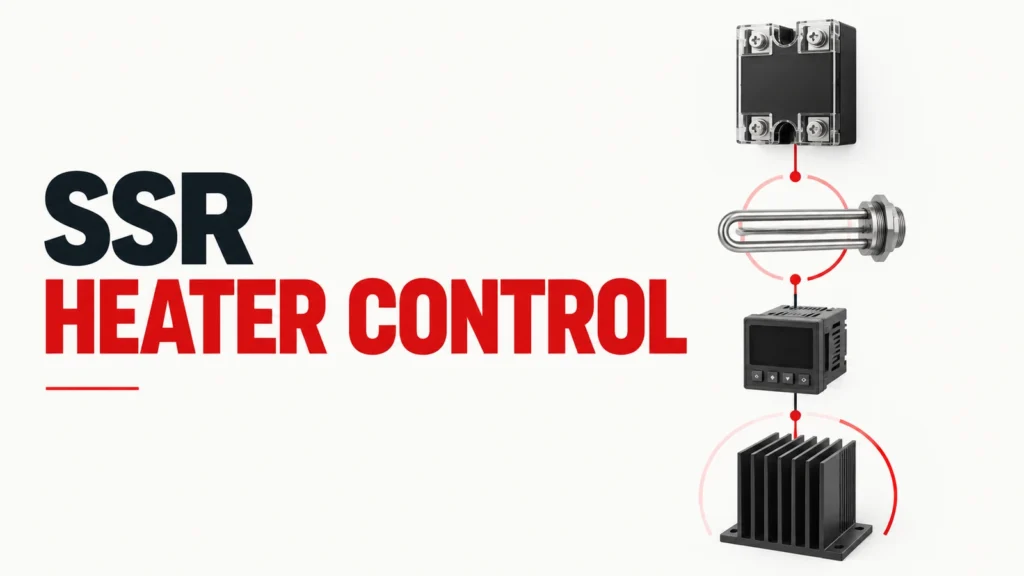
This application guide organizes the information needed to review a solid state relay for an industrial heater circuit. It does not size an SSR, design heater wiring, choose protective devices, calculate a heatsink or approve an installation without the exact relay datasheet and a project-specific electrical and thermal review.
Entscheidungsgrundlagen auf einen Blick
| Bewertungsbereich | Der Käufer muss festlegen | Erforderliche Nachweise |
|---|---|---|
| Load circuit | Heater type, source, switching arrangement and steady/transient current | System drawing and measured or calculated load data |
| Steuerung | Controller output, logic behavior and switching request | Controller documentation and interface diagram |
| Umschaltmodus | Cycle strategy, response needs and acceptable electrical effects | Control sequence and exact-model switching description |
| Wärmepfad | Loss method, interface, heatsink, ambient and airflow | Exact-model thermal data and assembled verification |
| Schutz | Fault behavior, branch protection and coordination objective | Approved protection study and device evidence |
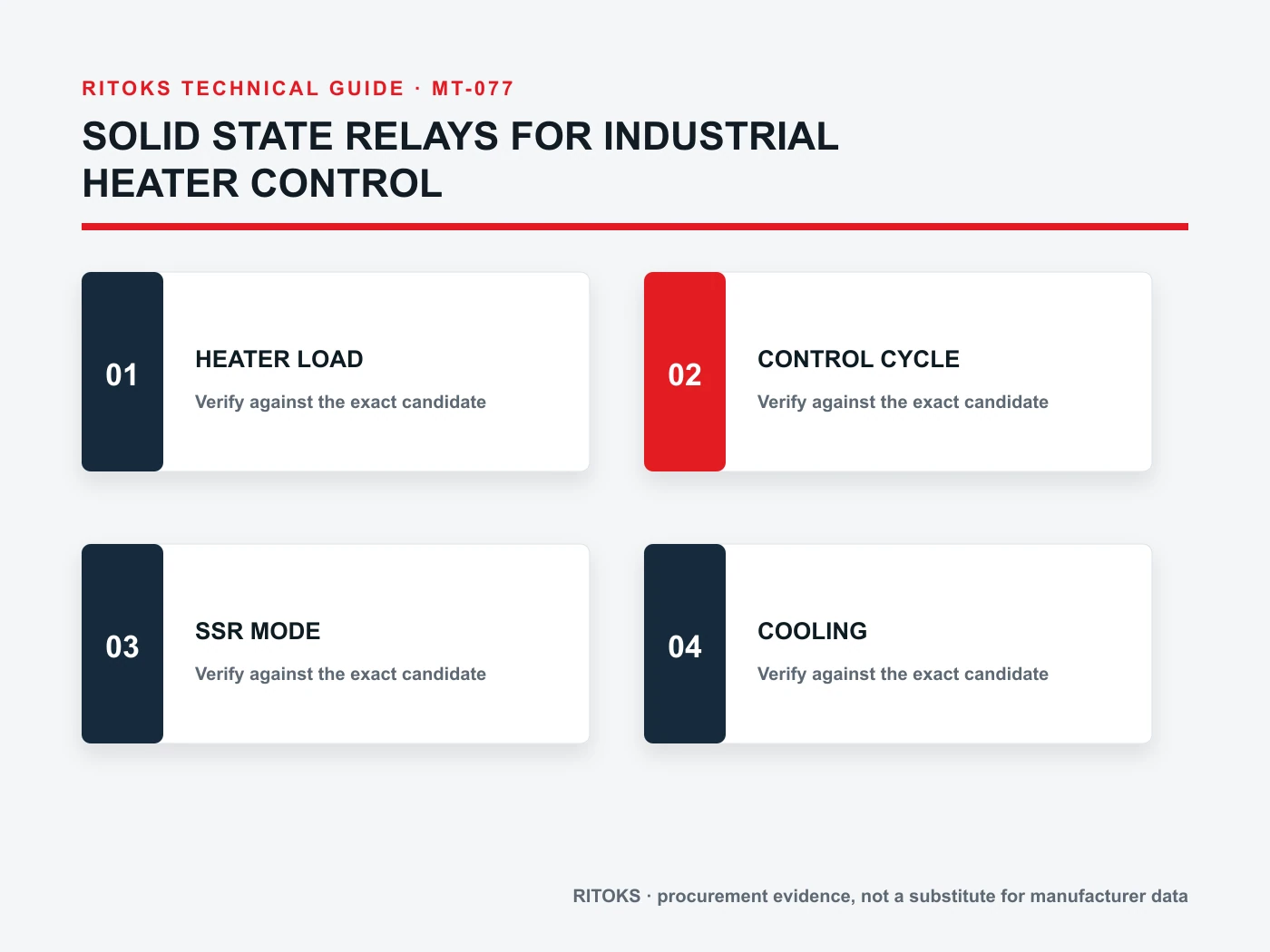
Start With the Heater Circuit, Not the Relay Label
Describe whether the load is a simple resistance heater, a multi-zone bank, a transformer-fed heater or another arrangement. Record the source, phase arrangement, branch structure, normal operating current, startup behavior and any operating state that changes the effective load. “Heater control” is an application name, not an electrical specification.
Show each SSR in the functional circuit and identify which conductors it switches. The review must distinguish a single switched path from a multi-phase system and must not infer pole count or topology from a product photograph. The project drawing and the exact relay circuit diagram must agree.
Define the Control Signal and Switching Request
Document the controller output type, available signal range, off-state behavior, update rate, isolation boundary and failure response. Confirm that the exact SSR input is compatible with the controller under all specified states. A broad statement such as “PLC controlled” leaves critical interface questions unanswered.
Explain what the controller is asking the output to do. Slow temperature regulation, burst control and fast modulation create different switching patterns and thermal duty. The candidate must be reviewed against the real sequence rather than a nominal heater current alone.
Match Switching Behavior to the Application
Switching mode affects when the output begins conduction relative to the AC waveform. The appropriate behavior depends on the load, the control method and the acceptable system response. Do not transfer a switching description from another SSR family or assume that all AC-output products use the same trigger behavior.
Ask for the exact-model description of turn-on and turn-off behavior, leakage state and any restrictions on the connected load. If the process needs phase-related control or unusually short cycles, identify that requirement explicitly so a supplier does not quote a device intended for a different control method.
Treat Thermal Design as Part of Selection
An SSR dissipates heat while conducting. The loss must be derived using the exact output characteristics and the real current waveform, then carried through the package, interface, heatsink, airflow and ambient environment. A relay current label is not a cabinet-temperature guarantee.
Record mounting orientation, interface material, heatsink condition, air path, nearby heat sources and enclosure temperature. Verify the finished assembly at representative load and duty. If the project changes the cycle pattern, enclosure or cooling arrangement, repeat the thermal review.
Review Protection and Failure Behavior Separately
The SSR controls the load but does not replace the system protection design. Define fault current paths, branch protection, short-circuit coordination objectives, overtemperature response and the process state required if the output fails open or closed.
Request evidence for the exact proposed combination. A general statement about fast protection or an adjacent fuse family is not coordination evidence. The control design should also detect or safely handle a commanded-off output that continues conducting.
Plan for Leakage, Isolation and Service
Electronic outputs can behave differently from mechanical contacts in the off state. Review exact leakage, isolation and output-circuit information when it affects heater voltage, maintenance expectations or diagnostic measurements. Do not describe the output as a visible isolation point unless the complete approved system provides that function.
For service work, document the separate isolating and lockout method required by the installation. Also define terminal access, conductor routing, replacement constraints and how technicians will verify the correct order code before substitution.
Erstellen Sie eine Beweisdatei nach dem Exaktmodell
Create one approval record for the proposed Solid State Relay order code. Put each project requirement beside the supplier document that answers it. Preserve the exact datasheet, drawing, curve, table, instruction or selection output used, including its revision or retrieval date. A category page can establish family context, but it cannot prove an exact rating, construction, terminal arrangement or system combination.
Stellen Sie sicher, dass jede akzeptierte Angabe denselben bestellbaren Artikel beschreibt. Kombinieren Sie nicht das maximale Familienvolumen einer Variante, ein Diagramm einer anderen und ein optionales Merkmal einer dritten. Kennzeichnen Sie ungeklärte Felder ausdrücklich, damit sie bei der technischen und kaufmännischen Prüfung sichtbar bleiben.
Projektdaten von Produktnachweisen trennen
The project team defines the application: source, load, duty, environment, controls, mounting, service and required functions. The supplier identifies an exact Solid State Relay and supports it with exact documents. Neither side should fill a gap by inference from appearance, a shared family name or one matching headline value.
Sperren Sie die Angebotsunterlagen, während die Angebote verglichen werden. Sollten sich die elektrischen Betriebsbedingungen, die Umgebungsbedingungen, die Kühlmethode, das Gehäuse, die Installation oder die erforderlichen Funktionen ändern, erstellen Sie eine überarbeitete Version der Unterlagen und bitten Sie jeden Lieferanten, das Angebot erneut zu bestätigen.
Legen Sie vor der Bestellung die Abnahmespezifikation fest
Write the acceptance record before a preferred Solid State Relay is chosen. Include the project inputs, proposed order code, included accessories, document revisions, exceptions, assumptions and the person responsible for resolving each open point. This prevents the technical basis from being reconstructed after price negotiations have already narrowed the choice.
Unterscheiden Sie zwingende Anforderungen von Präferenzen und zukünftigen Optionen. Eine zwingende Anforderung erfordert direkte Nachweise oder eine dokumentierte technische Entscheidung. Eine Präferenz kann den Vergleich beeinflussen, sollte jedoch nicht als Sicherheits- oder Konformitätsanforderung dargestellt werden. Zukünftige Optionen sollten nur dann geprüft werden, wenn das Projekt tatsächlich mit ihnen rechnet, da optionale Merkmale den Bestellcode, die Anschlüsse, die Abmessungen oder die Begleitunterlagen verändern können.
Überprüfen Sie den gelieferten Artikel und die fertige Baugruppe
Incoming inspection should compare the delivered Solid State Relay, labels, accessories and documents with the approved record. Do not accept a same-family replacement solely because its appearance or one rating matches. Record any substitution and repeat the affected review before installation.
Überprüfen Sie nach der Montage die Funktionen und Zustände, die sich nicht allein anhand der Komponentenunterlagen nachweisen lassen. Die Überprüfung kann je nach Fall den mechanischen Sitz, die Verkabelung gemäß dem genehmigten Schaltplan, das Steuerungsverhalten, Temperaturen, den Luftstrom, Alarme oder den Wartungszugang umfassen. Legen Sie repräsentative Betriebszustände und Abnahmekriterien im Projekt-Prüfplan fest, anstatt in der Bestellung allgemeine Grenzwerte festzulegen.
Häufige Fehler bei der Beschaffung
- Selecting a Solid State Relay from one headline value while the application context remains incomplete.
- Verwendung einer Kurve, eines Schaltkreises, einer Zeichnung oder eines Anspruchs aus einem benachbarten Bestellcode.
- Eine Kategorieseite, ein Produktfoto oder eine Nenngröße als eindeutigen Nachweis für die Kompatibilität betrachten.
- Es wird davon ausgegangen, dass ein Zubehörteil, eine Systemfunktion oder ein Koordinationsergebnis ohne Dokumentation enthalten ist.
- Genehmigung eines Ersatzteils ohne erneute Überprüfung der elektrischen und mechanischen Eigenschaften sowie der Nachweise.
Beheben Sie diese Lücken, bevor Sie Preis und Lieferzeit vergleichen. Ein Angebot kann auch dann wirtschaftlich interessant bleiben, wenn es technisch unvollständig ist, doch dürfen fehlende Nachweise nicht im Angebot untergehen.
So vergleichen Sie Angebote von Lieferanten
| Bewertungsbereich | Der Käufer muss festlegen | Erforderliche Nachweise |
|---|---|---|
| Bestellnummer | Vorgeschlagenes Produkt mit allem Zubehör | Genaue technischen Daten und Anwendungsbereich |
| Anwendungsübereinstimmung | Angegebene Betriebs- und Umgebungsbedingungen | Schriftliche Antwort auf jede Anforderung |
| Mechanische Integration | Montage, Anschlüsse, Abstände und Wartung | Genaue Zeichnungen und Anleitungen |
| Elektrische Beweise | Geltende Nennwerte, Kennlinien und Topologie | Technische Unterlagen zu Exact-Modellen |
| Offene Punkte | Unbekannte Größen, Ausnahmen und Annahmen | Liste der Klarstellungen mit Datum |
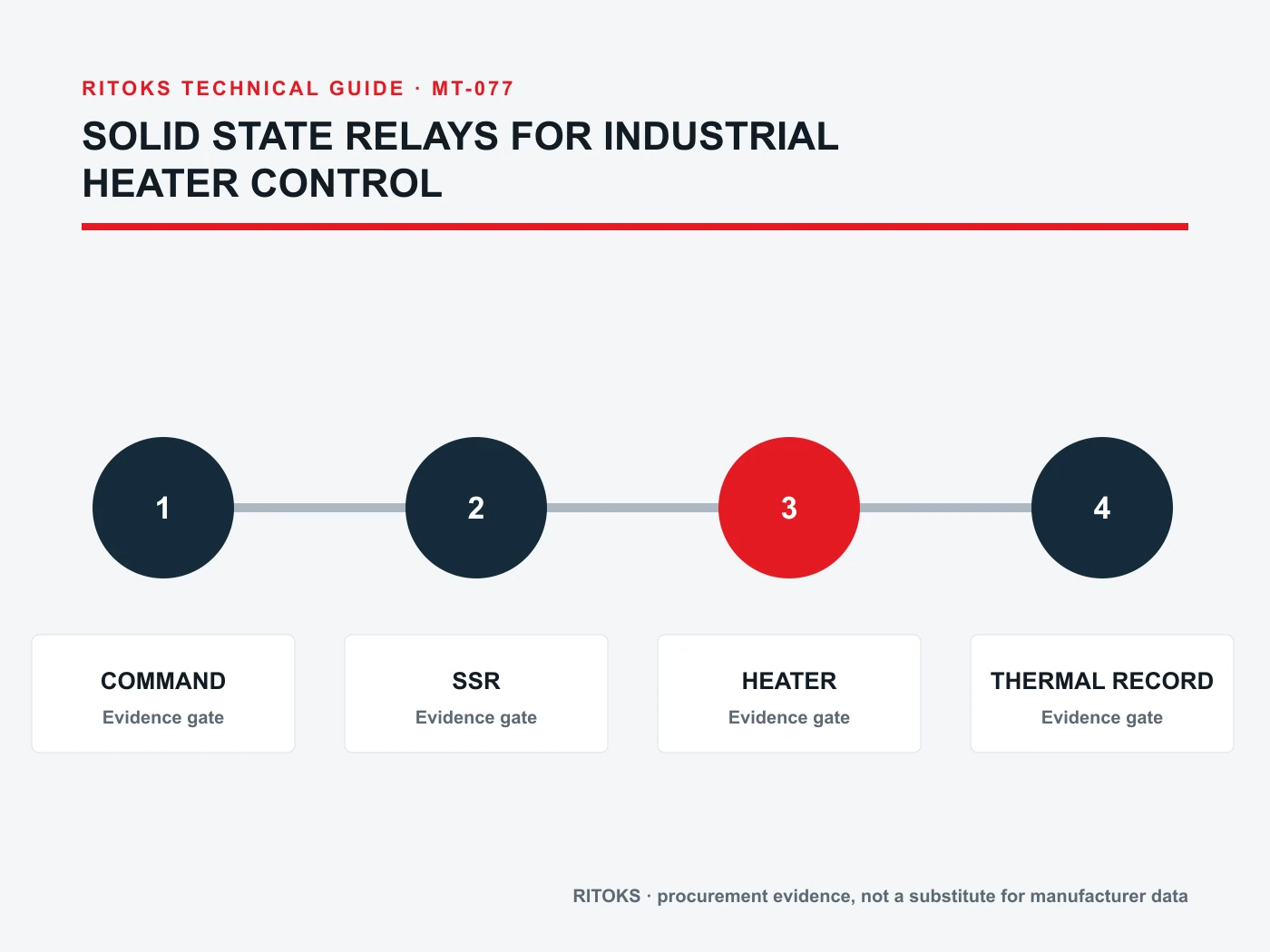
Normalize every Solid State Relay offer to the same application record. Keep document revisions, test conditions, included accessories and open questions beside each value. This makes differences in delivered scope visible and prevents a lower-cost but narrower offer from appearing equivalent to a complete proposal.
Entscheidungsablauf
- Die Systemgrenzen und Betriebszustände festlegen.
- Erfassen Sie die elektrischen, mechanischen, umgebungsbezogenen und servicebezogenen Eingaben.
- Wählen Sie einen vollständigen Bestellcode eines Bewerbers zur Überprüfung aus.
- Überprüfe jede kritische Aussage anhand der Beweise des exakten Modells.
- Klären Sie Ausnahmen und Annahmen, bevor Sie einen kommerziellen Vergleich anstellen.
- Überprüfen Sie die fertige Baugruppe, sofern dies aufgrund des Anwendungsrisikos erforderlich ist.
Halten Sie inne, wenn eine entscheidende Eingangsgröße unbekannt ist, das angeführte Modell mehrdeutig ist, eine erforderliche Angabe nur durch einen anderen Hersteller oder eine andere Bestellnummer gestützt wird oder die Installation außerhalb des verfügbaren Evidenzrahmens liegt. Hierbei handelt es sich um technische Lücken, nicht um redaktionelle Details.
Checkliste zur Vorbereitung einer Angebotsanfrage
A useful RFQ for ssr for heater control is concise enough to answer and complete enough to prevent silent assumptions. Identify unknown values as questions and require a full orderable code rather than a generic family recommendation.
- HEATER CIRCUIT
- CONTROL SIGNAL
- SWITCHING MODE
- THERMAL PATH
- FAULT PATH
- PROTECTION
- FAILURE STATE
- SERVICE ISOLATION
- Erforderliche Unterlagen und Änderungen
- Menge, Bestimmungsort und gewünschter Lieferumfang
Bitten Sie den Lieferanten, Ausschlüsse, Annahmen und Optionen gesondert aufzuführen. Halten Sie Menge und Bestimmungsort im Anschluss an die technischen Angaben fest, damit die kaufmännischen Bedingungen noch offene technische Fragen nicht verschleiern.
Häufig gestellte Fragen
Can I select a Solid State Relay from one rating or size?
Nein. Für die Auswahl sind die vollständigen Anwendungsdaten, die genauen Konstruktionsangaben sowie alle relevanten elektrischen, mechanischen, thermischen, umwelttechnischen und dokumentationsbezogenen Bedingungen erforderlich.
Kann ich eine Familienseite als Nachweis für die Genehmigung verwenden?
Eine Familienseite dient der Orientierung. Bei der Freigabe sollten das Datenblatt mit der genauen Bestellnummer, die Zeichnung, die Anleitung und die projektspezifischen technischen Nachweise herangezogen werden.
Sind Modelle, die sich äußerlich ähneln, untereinander austauschbar?
Nicht automatisch. Ähnliche Gehäuse können unterschiedliche Schaltungen, Materialien, Anschlüsse, Nennwerte oder Zubehörteile enthalten. Wiederholen Sie die Überprüfung für jeden Ersatz.
Was sollte in dem Angebot offen bleiben?
Jede fehlende Projektangabe, jede nicht überprüfte Angabe zum exakten Modell, jedes unklares mitgeliefertes Zubehör oder jede ungeklärte Einbaubedingung sollte als offener Punkt aufgeführt und nicht als gegeben vorausgesetzt werden.
Zugehörige RITOKS-Ressourcen und Angebotsanfragen
Durchsuchen Sie die Produktkategorie „Halbleiterrelais“, die entsprechende Produktseite aufrufen. Diese Seiten bieten einen geschäftlichen Überblick; die genaue Eignung hängt weiterhin von der Projektgeschichte und der angegebenen Bestellnummer ab.
Sobald der technische Bericht fertig ist, Senden Sie die Bewerbungsunterlagen und die erforderlichen Nachweise an RITOKS. für ein schriftliches Angebot. Die endgültige Auswahl muss der Genehmigung durch den Projektingenieur unterliegen und den aktuellen Herstellerangaben entsprechen.