
Solid State Relays for Electronic Switching · Technical Explainer
Solid State Relays for Industrial Heater Control: Application Inputs
Solid State Relays for Industrial Heater Control: Application Inputs begins with a controlled application record, not a catalog headline. Buyers should define the real system, installation and service conditions before comparing candidate products. Every decisive claim then needs support from the exact proposed order code.
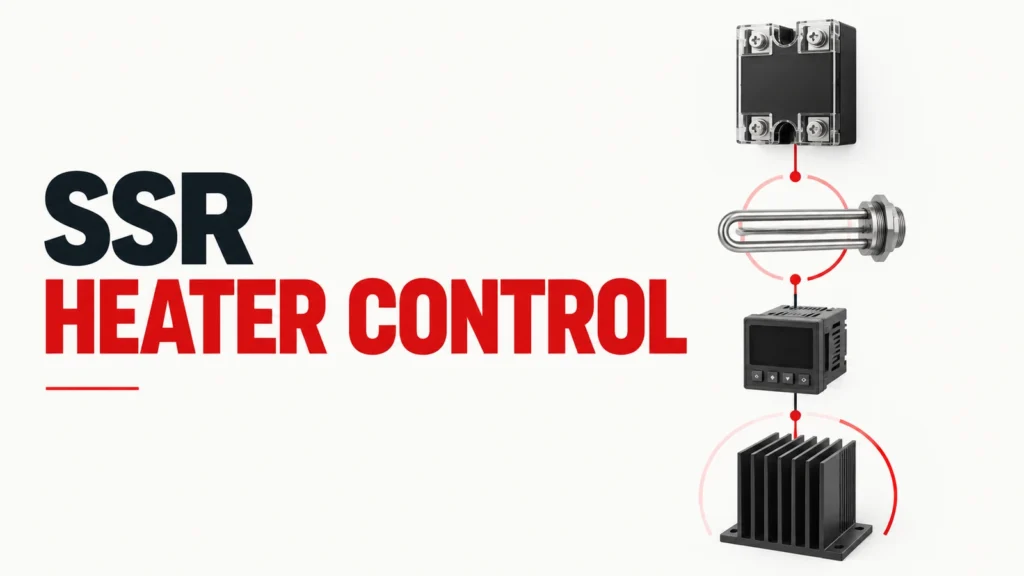
This application guide organizes the information needed to review a solid state relay for an industrial heater circuit. It does not size an SSR, design heater wiring, choose protective devices, calculate a heatsink or approve an installation without the exact relay datasheet and a project-specific electrical and thermal review.
Resumen de los datos para la toma de decisiones
| Área de revisión | El comprador debe definir | Documentación necesaria |
|---|---|---|
| Load circuit | Heater type, source, switching arrangement and steady/transient current | System drawing and measured or calculated load data |
| Control | Controller output, logic behavior and switching request | Controller documentation and interface diagram |
| Modo de conmutación | Cycle strategy, response needs and acceptable electrical effects | Control sequence and exact-model switching description |
| Trayectoria térmica | Loss method, interface, heatsink, ambient and airflow | Exact-model thermal data and assembled verification |
| Protección | Fault behavior, branch protection and coordination objective | Approved protection study and device evidence |
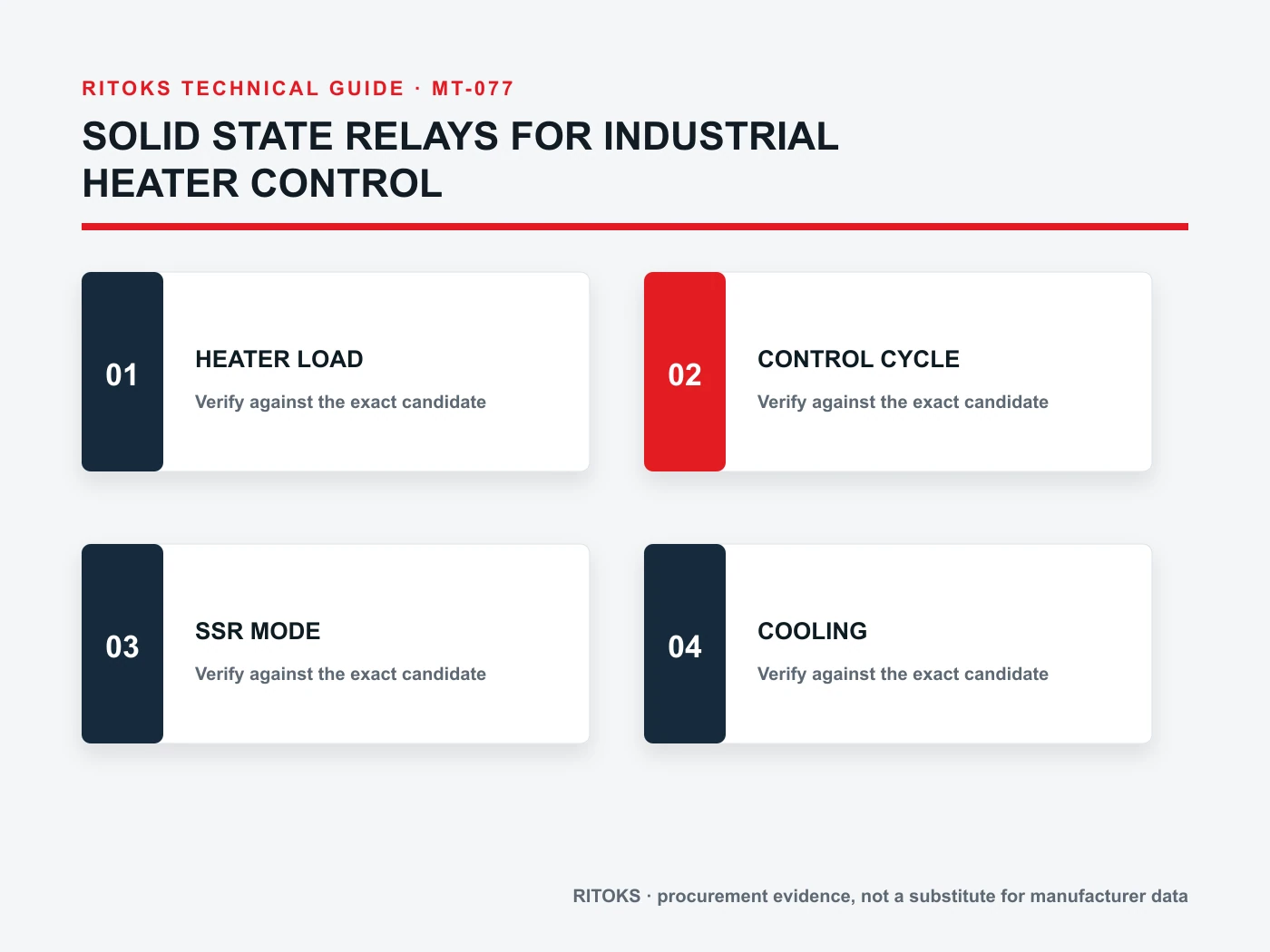
Start With the Heater Circuit, Not the Relay Label
Describe whether the load is a simple resistance heater, a multi-zone bank, a transformer-fed heater or another arrangement. Record the source, phase arrangement, branch structure, normal operating current, startup behavior and any operating state that changes the effective load. “Heater control” is an application name, not an electrical specification.
Show each SSR in the functional circuit and identify which conductors it switches. The review must distinguish a single switched path from a multi-phase system and must not infer pole count or topology from a product photograph. The project drawing and the exact relay circuit diagram must agree.
Define the Control Signal and Switching Request
Document the controller output type, available signal range, off-state behavior, update rate, isolation boundary and failure response. Confirm that the exact SSR input is compatible with the controller under all specified states. A broad statement such as “PLC controlled” leaves critical interface questions unanswered.
Explain what the controller is asking the output to do. Slow temperature regulation, burst control and fast modulation create different switching patterns and thermal duty. The candidate must be reviewed against the real sequence rather than a nominal heater current alone.
Match Switching Behavior to the Application
Switching mode affects when the output begins conduction relative to the AC waveform. The appropriate behavior depends on the load, the control method and the acceptable system response. Do not transfer a switching description from another SSR family or assume that all AC-output products use the same trigger behavior.
Ask for the exact-model description of turn-on and turn-off behavior, leakage state and any restrictions on the connected load. If the process needs phase-related control or unusually short cycles, identify that requirement explicitly so a supplier does not quote a device intended for a different control method.
Treat Thermal Design as Part of Selection
An SSR dissipates heat while conducting. The loss must be derived using the exact output characteristics and the real current waveform, then carried through the package, interface, heatsink, airflow and ambient environment. A relay current label is not a cabinet-temperature guarantee.
Record mounting orientation, interface material, heatsink condition, air path, nearby heat sources and enclosure temperature. Verify the finished assembly at representative load and duty. If the project changes the cycle pattern, enclosure or cooling arrangement, repeat the thermal review.
Review Protection and Failure Behavior Separately
The SSR controls the load but does not replace the system protection design. Define fault current paths, branch protection, short-circuit coordination objectives, overtemperature response and the process state required if the output fails open or closed.
Request evidence for the exact proposed combination. A general statement about fast protection or an adjacent fuse family is not coordination evidence. The control design should also detect or safely handle a commanded-off output that continues conducting.
Plan for Leakage, Isolation and Service
Electronic outputs can behave differently from mechanical contacts in the off state. Review exact leakage, isolation and output-circuit information when it affects heater voltage, maintenance expectations or diagnostic measurements. Do not describe the output as a visible isolation point unless the complete approved system provides that function.
For service work, document the separate isolating and lockout method required by the installation. Also define terminal access, conductor routing, replacement constraints and how technicians will verify the correct order code before substitution.
Crear un archivo de pruebas con un modelo exacto
Create one approval record for the proposed Solid State Relay order code. Put each project requirement beside the supplier document that answers it. Preserve the exact datasheet, drawing, curve, table, instruction or selection output used, including its revision or retrieval date. A category page can establish family context, but it cannot prove an exact rating, construction, terminal arrangement or system combination.
Comprueba que cada descripción aceptada se refiera al mismo artículo que se puede pedir. No combines el límite máximo por familia de una variante, un diagrama de otra y una característica opcional de una tercera. Marca explícitamente los campos sin resolver para que sigan siendo visibles en la revisión técnica y comercial.
Mantén separadas las aportaciones al proyecto de las pruebas del producto
The project team defines the application: source, load, duty, environment, controls, mounting, service and required functions. The supplier identifies an exact Solid State Relay and supports it with exact documents. Neither side should fill a gap by inference from appearance, a shared family name or one matching headline value.
Congela el expediente de la solicitud mientras se comparan los presupuestos. Si cambian las condiciones de funcionamiento eléctrico, el entorno, el método de refrigeración, la carcasa, la instalación o la función requerida, emite un expediente revisado y pide a todos los proveedores que vuelvan a confirmar la propuesta.
Define el registro de aceptación antes de realizar el pedido
Write the acceptance record before a preferred Solid State Relay is chosen. Include the project inputs, proposed order code, included accessories, document revisions, exceptions, assumptions and the person responsible for resolving each open point. This prevents the technical basis from being reconstructed after price negotiations have already narrowed the choice.
Distinga los requisitos obligatorios de las preferencias y las opciones futuras. Una condición obligatoria requiere pruebas directas o una decisión de ingeniería documentada. Una preferencia puede influir en la comparación, pero no debe presentarse como un requisito de seguridad o de cumplimiento. Las opciones futuras solo deben tenerse en cuenta cuando el proyecto las prevea realmente, ya que las características opcionales pueden modificar el código de pedido, los terminales, las dimensiones o la documentación de apoyo.
Comprueba el artículo entregado y el conjunto montado
Incoming inspection should compare the delivered Solid State Relay, labels, accessories and documents with the approved record. Do not accept a same-family replacement solely because its appearance or one rating matches. Record any substitution and repeat the affected review before installation.
Tras el montaje, comprueba las funciones y condiciones que no puedan verificarse únicamente a partir de la documentación de los componentes. La comprobación puede incluir el ajuste mecánico, el cableado según el esquema homologado, el comportamiento de los controles, las temperaturas, el flujo de aire, las alarmas o el acceso para el mantenimiento, según corresponda. Define estados de funcionamiento representativos y criterios de aceptación en el plan de pruebas del proyecto, en lugar de establecer límites universales en la orden de compra.
Errores habituales en las compras
- Selecting a Solid State Relay from one headline value while the application context remains incomplete.
- Utilizar una curva, un circuito, un dibujo o una reivindicación de un código de pedido adyacente.
- Considerar una página de categoría, una fotografía de un producto o una talla nominal como prueba de compatibilidad exacta.
- Suponiendo que se haya incluido un accesorio, una función del sistema o un resultado de coordinación sin la documentación correspondiente.
- Aprobar un sustituto sin repetir la revisión eléctrica, mecánica y de las pruebas.
Resuelve estas lagunas antes de comparar el precio y el plazo de entrega. Una propuesta puede seguir siendo interesante desde el punto de vista comercial aunque esté incompleta desde el punto de vista técnico, pero la información que falte no debe desaparecer en el presupuesto.
Cómo comparar las ofertas de los proveedores
| Área de revisión | El comprador debe definir | Documentación necesaria |
|---|---|---|
| Código de pedido | Artículo completo tal y como se propone, con los accesorios incluidos | Ficha técnica y alcance exactos |
| Coincidencia de aplicaciones | Condiciones operativas y medioambientales presentadas | Respuesta por escrito a cada requisito |
| Integración mecánica | Montaje, bornes, distancias de seguridad y mantenimiento | Planos e instrucciones precisos |
| Pruebas eléctricas | Parámetros nominales, curvas y topología aplicables | Documentación técnica del modelo exacto |
| Puntos pendientes | Incógnitas, excepciones y suposiciones | Lista de aclaraciones con fecha |
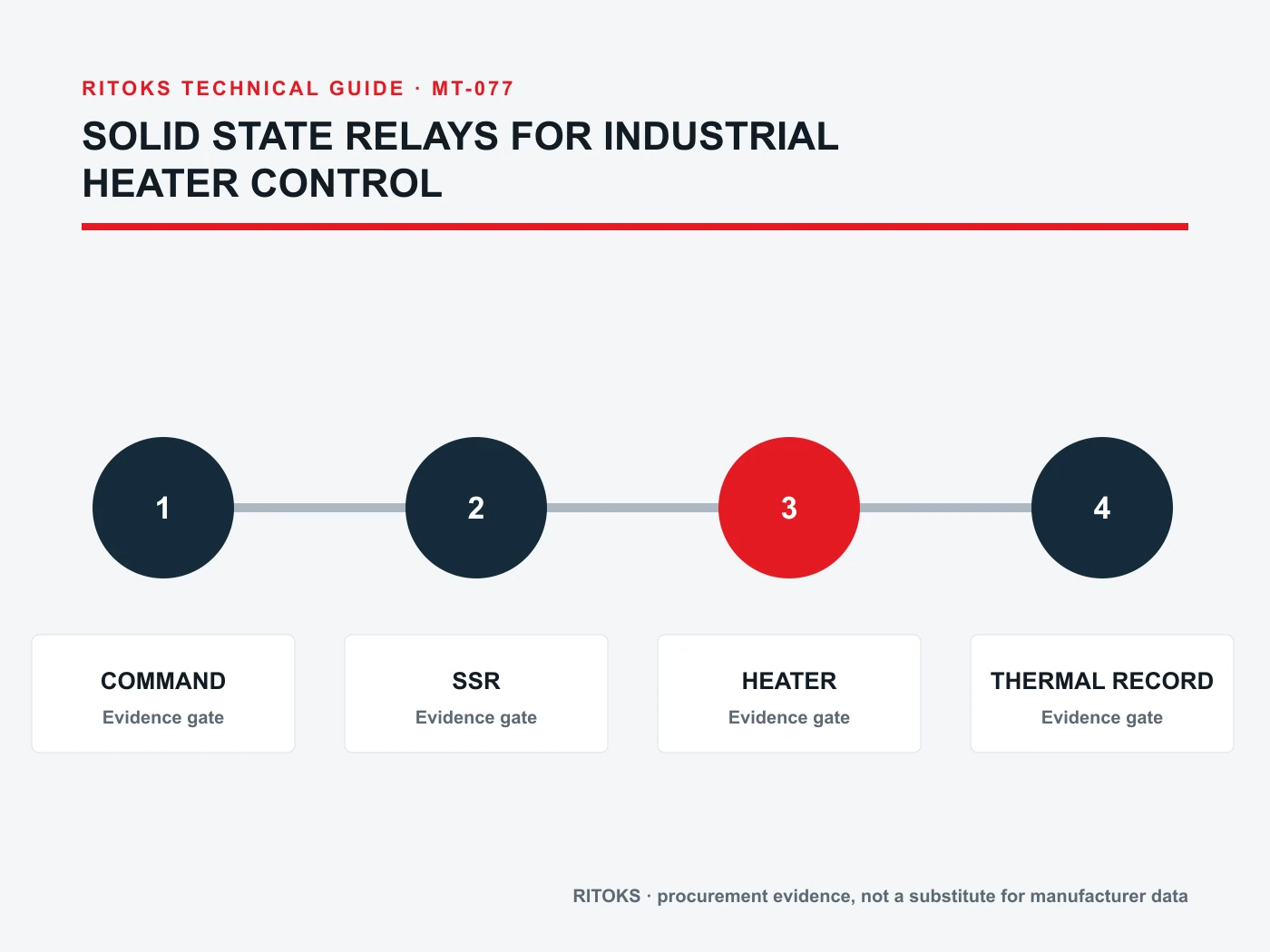
Normalize every Solid State Relay offer to the same application record. Keep document revisions, test conditions, included accessories and open questions beside each value. This makes differences in delivered scope visible and prevents a lower-cost but narrower offer from appearing equivalent to a complete proposal.
Flujo de trabajo de toma de decisiones
- Fija los límites del sistema y los estados de funcionamiento.
- Registra los datos eléctricos, mecánicos, ambientales y de mantenimiento.
- Elige un código de pedido completo de un candidato para revisarlo.
- Comprueba cada afirmación fundamental contrastándola con las pruebas del modelo exacto.
- Resuelve las excepciones y las hipótesis antes de realizar la comparación comercial.
- Comprueba el conjunto terminado cuando el riesgo de la aplicación así lo requiera.
Deténgase cuando se desconozca un dato de entrada fundamental, el modelo citado sea ambiguo, una especificación obligatoria solo esté respaldada por otro fabricante o código de pedido, o la instalación quede fuera del alcance de la información disponible. Se trata de lagunas técnicas, no de detalles editoriales.
Lista de comprobación para la preparación de una solicitud de presupuesto
A useful RFQ for ssr for heater control is concise enough to answer and complete enough to prevent silent assumptions. Identify unknown values as questions and require a full orderable code rather than a generic family recommendation.
- HEATER CIRCUIT
- CONTROL SIGNAL
- SWITCHING MODE
- THERMAL PATH
- FAULT PATH
- PROTECTION
- FAILURE STATE
- SERVICE ISOLATION
- Documentos necesarios y revisiones
- Cantidad, destino y alcance de la entrega solicitado
Pide al proveedor que especifique por separado las exclusiones, las hipótesis y las opciones. Anota la cantidad y el destino tras los datos técnicos, para que las condiciones comerciales no oculten cuestiones de ingeniería sin resolver.
Preguntas frecuentes
Can I select a Solid State Relay from one rating or size?
No. Para la selección es necesario disponer de la solicitud completa, los planos de construcción exactos y todas las condiciones aplicables en materia eléctrica, mecánica, térmica, medioambiental y de documentación.
¿Puedo utilizar una página familiar como prueba de autorización?
Una página de información general resulta útil para orientarse. Para la aprobación, se debe utilizar la ficha técnica con el código de pedido exacto, el plano, las instrucciones y la documentación técnica específica del proyecto.
¿Son intercambiables los modelos de aspecto similar?
No de forma automática. Las carcasas similares pueden contener circuitos, materiales, bornes, valores nominales o accesorios diferentes. Repite la revisión para cada sustituto.
¿Qué datos deben dejarse en blanco en el presupuesto?
Cualquier dato que falte en el proyecto, cualquier afirmación sin verificar sobre el modelo exacto, cualquier accesorio incluido que no esté claro o cualquier condición de instalación sin resolver debe figurar como un punto pendiente, en lugar de darse por sentado.
Recursos relacionados de RITOKS y solicitud de presupuesto
Explora el Categoría de productos: relés de estado sólido, Consulta la página principal del producto en cuestión.. Estas páginas ofrecen información sobre el contexto comercial; la idoneidad concreta sigue dependiendo de los antecedentes del proyecto y del código de pedido indicado en el presupuesto.
Cuando el informe técnico esté listo, Envía la solicitud y la documentación requerida a RITOKS para obtener un presupuesto por escrito. La selección definitiva deberá estar sujeta a la aprobación del ingeniero de proyecto y a la documentación vigente del fabricante.