
Solid State Relays for Electronic Switching · Technical Explainer
Solid State Relays for Industrial Heater Control: Application Inputs
Solid State Relays for Industrial Heater Control: Application Inputs begins with a controlled application record, not a catalog headline. Buyers should define the real system, installation and service conditions before comparing candidate products. Every decisive claim then needs support from the exact proposed order code.
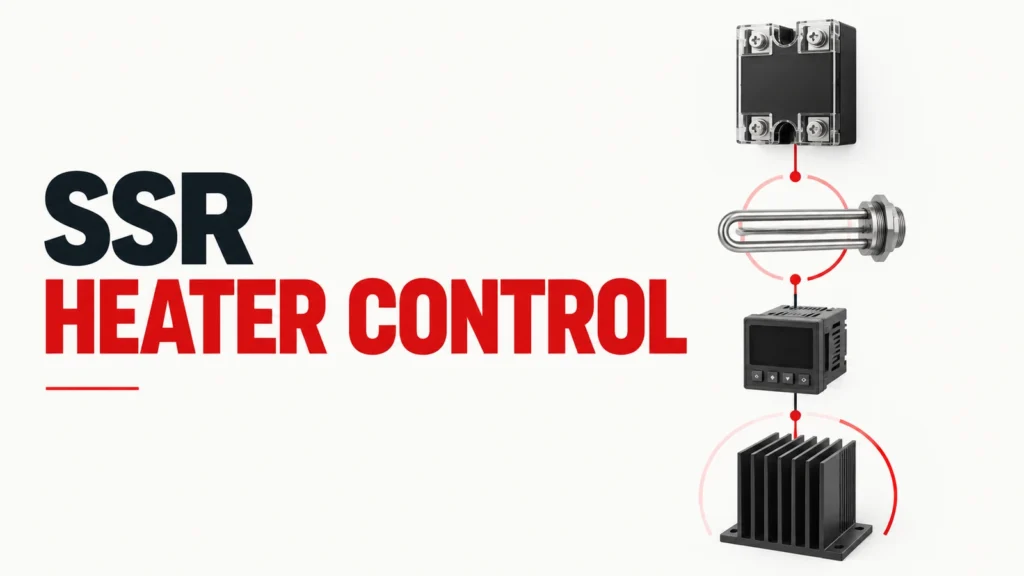
This application guide organizes the information needed to review a solid state relay for an industrial heater circuit. It does not size an SSR, design heater wiring, choose protective devices, calculate a heatsink or approve an installation without the exact relay datasheet and a project-specific electrical and thermal review.
Decision Inputs at a Glance
| Review area | Buyer must define | Evidence required |
|---|---|---|
| Load circuit | Heater type, source, switching arrangement and steady/transient current | System drawing and measured or calculated load data |
| Control | Controller output, logic behavior and switching request | Controller documentation and interface diagram |
| Switching mode | Cycle strategy, response needs and acceptable electrical effects | Control sequence and exact-model switching description |
| Thermal path | Loss method, interface, heatsink, ambient and airflow | Exact-model thermal data and assembled verification |
| Protection | Fault behavior, branch protection and coordination objective | Approved protection study and device evidence |
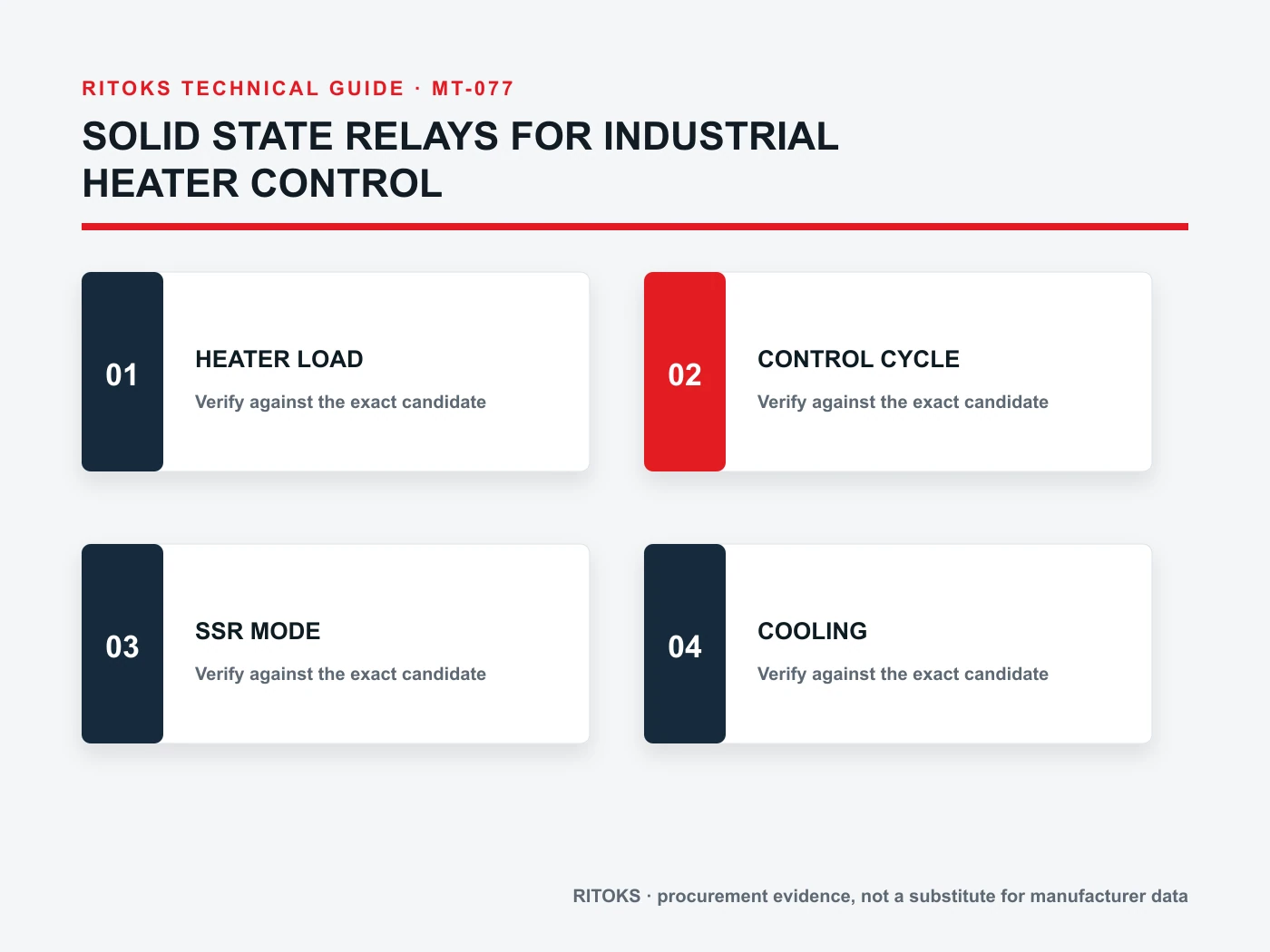
Start With the Heater Circuit, Not the Relay Label
Describe whether the load is a simple resistance heater, a multi-zone bank, a transformer-fed heater or another arrangement. Record the source, phase arrangement, branch structure, normal operating current, startup behavior and any operating state that changes the effective load. “Heater control” is an application name, not an electrical specification.
Show each SSR in the functional circuit and identify which conductors it switches. The review must distinguish a single switched path from a multi-phase system and must not infer pole count or topology from a product photograph. The project drawing and the exact relay circuit diagram must agree.
Define the Control Signal and Switching Request
Document the controller output type, available signal range, off-state behavior, update rate, isolation boundary and failure response. Confirm that the exact SSR input is compatible with the controller under all specified states. A broad statement such as “PLC controlled” leaves critical interface questions unanswered.
Explain what the controller is asking the output to do. Slow temperature regulation, burst control and fast modulation create different switching patterns and thermal duty. The candidate must be reviewed against the real sequence rather than a nominal heater current alone.
Match Switching Behavior to the Application
Switching mode affects when the output begins conduction relative to the AC waveform. The appropriate behavior depends on the load, the control method and the acceptable system response. Do not transfer a switching description from another SSR family or assume that all AC-output products use the same trigger behavior.
Ask for the exact-model description of turn-on and turn-off behavior, leakage state and any restrictions on the connected load. If the process needs phase-related control or unusually short cycles, identify that requirement explicitly so a supplier does not quote a device intended for a different control method.
Treat Thermal Design as Part of Selection
An SSR dissipates heat while conducting. The loss must be derived using the exact output characteristics and the real current waveform, then carried through the package, interface, heatsink, airflow and ambient environment. A relay current label is not a cabinet-temperature guarantee.
Record mounting orientation, interface material, heatsink condition, air path, nearby heat sources and enclosure temperature. Verify the finished assembly at representative load and duty. If the project changes the cycle pattern, enclosure or cooling arrangement, repeat the thermal review.
Review Protection and Failure Behavior Separately
The SSR controls the load but does not replace the system protection design. Define fault current paths, branch protection, short-circuit coordination objectives, overtemperature response and the process state required if the output fails open or closed.
Request evidence for the exact proposed combination. A general statement about fast protection or an adjacent fuse family is not coordination evidence. The control design should also detect or safely handle a commanded-off output that continues conducting.
Plan for Leakage, Isolation and Service
Electronic outputs can behave differently from mechanical contacts in the off state. Review exact leakage, isolation and output-circuit information when it affects heater voltage, maintenance expectations or diagnostic measurements. Do not describe the output as a visible isolation point unless the complete approved system provides that function.
For service work, document the separate isolating and lockout method required by the installation. Also define terminal access, conductor routing, replacement constraints and how technicians will verify the correct order code before substitution.
Build an Exact-Model Evidence File
Create one approval record for the proposed Solid State Relay order code. Put each project requirement beside the supplier document that answers it. Preserve the exact datasheet, drawing, curve, table, instruction or selection output used, including its revision or retrieval date. A category page can establish family context, but it cannot prove an exact rating, construction, terminal arrangement or system combination.
Check that every accepted statement describes the same orderable item. Do not combine a family maximum from one variant, a diagram from another and an optional feature from a third. Mark unresolved fields explicitly so they remain visible in technical and commercial review.
Keep Project Inputs Separate From Product Evidence
The project team defines the application: source, load, duty, environment, controls, mounting, service and required functions. The supplier identifies an exact Solid State Relay and supports it with exact documents. Neither side should fill a gap by inference from appearance, a shared family name or one matching headline value.
Freeze the application record while quotations are being compared. If the electrical duty, environment, cooling method, enclosure, installation or required function changes, issue a revised record and ask every supplier to reconfirm the candidate.
Define the Acceptance Record Before Ordering
Write the acceptance record before a preferred Solid State Relay is chosen. Include the project inputs, proposed order code, included accessories, document revisions, exceptions, assumptions and the person responsible for resolving each open point. This prevents the technical basis from being reconstructed after price negotiations have already narrowed the choice.
Separate mandatory requirements from preferences and future options. A mandatory condition needs direct evidence or a documented engineering decision. A preference can influence comparison but should not be presented as a safety or compliance requirement. Future options should be checked only when the project genuinely expects them, because optional features can change the order code, terminals, dimensions or supporting documents.
Verify the Delivered Item and the Finished Assembly
Incoming inspection should compare the delivered Solid State Relay, labels, accessories and documents with the approved record. Do not accept a same-family replacement solely because its appearance or one rating matches. Record any substitution and repeat the affected review before installation.
After assembly, verify the functions and conditions that cannot be proven from component literature alone. The check may include mechanical fit, wiring against the approved diagram, control behavior, temperatures, airflow, alarms or service access as applicable. Define representative operating states and acceptance criteria in the project test plan rather than inventing universal limits in the purchase order.
Common Procurement Errors
- Selecting a Solid State Relay from one headline value while the application context remains incomplete.
- Using a curve, circuit, drawing or claim from a neighboring order code.
- Treating a category page, product photograph or nominal size as exact compatibility evidence.
- Assuming an accessory, system function or coordination result is included without documentation.
- Approving a substitute without repeating the electrical, mechanical and evidence review.
Resolve these gaps before comparing price and lead time. A proposal may remain commercially interesting while technically incomplete, but missing evidence must not disappear inside the quotation.
How to Compare Supplier Offers
| Review area | Buyer must define | Evidence required |
|---|---|---|
| Order code | Complete proposed item and included accessories | Exact datasheet and scope |
| Application match | Submitted operating and environmental conditions | Written response to each requirement |
| Mechanical integration | Mounting, terminals, clearances and service | Exact drawings and instructions |
| Electrical evidence | Applicable ratings, curves and topology | Exact-model technical documents |
| Open points | Unknowns, exceptions and assumptions | Dated clarification list |
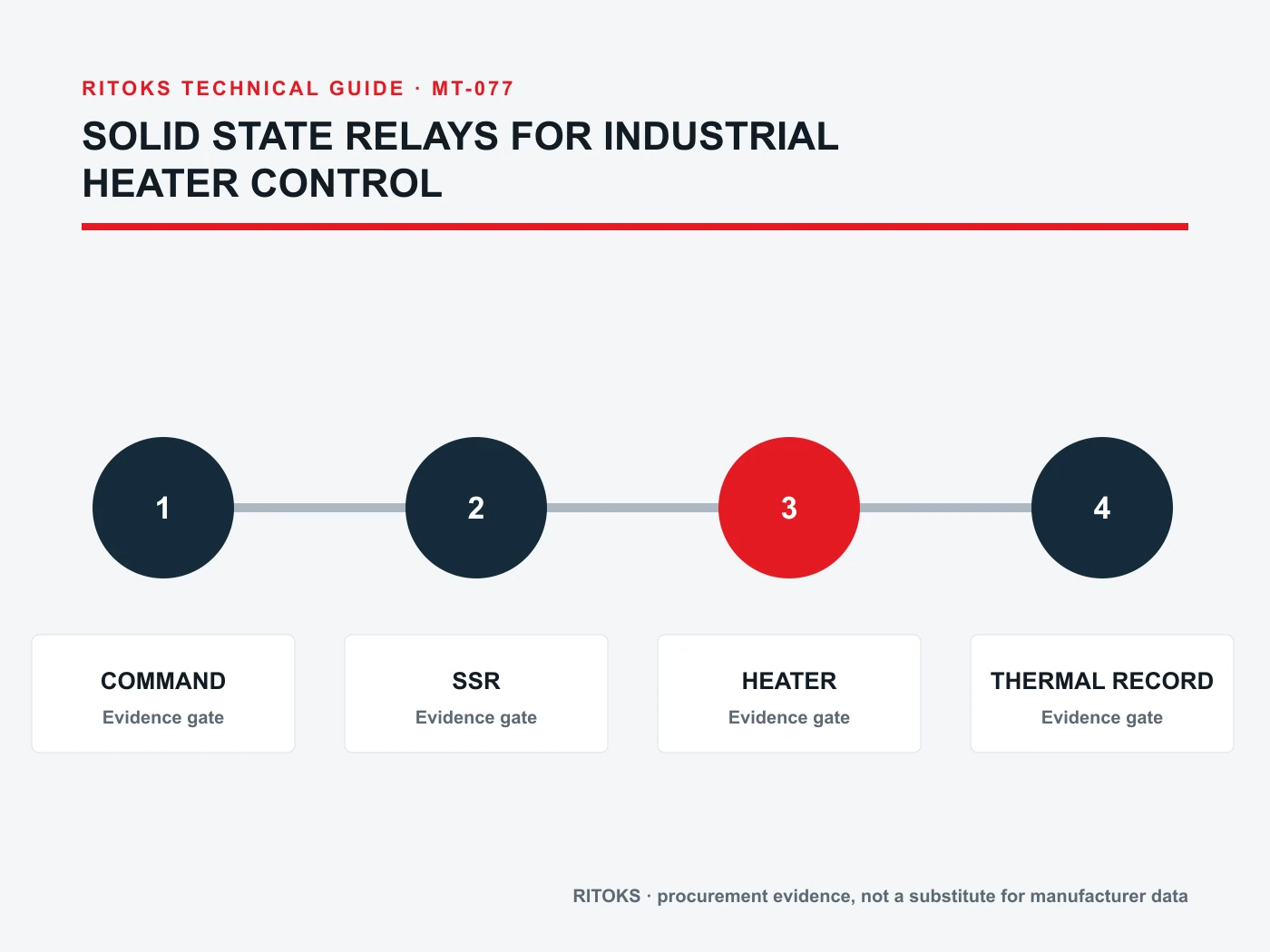
Normalize every Solid State Relay offer to the same application record. Keep document revisions, test conditions, included accessories and open questions beside each value. This makes differences in delivered scope visible and prevents a lower-cost but narrower offer from appearing equivalent to a complete proposal.
Decision Workflow
- Freeze the system boundary and operating states.
- Record electrical, mechanical, environmental and service inputs.
- Choose a complete candidate order code for review.
- Verify every critical statement against exact-model evidence.
- Resolve exceptions and assumptions before commercial comparison.
- Validate the finished assembly where application risk requires it.
Stop when a critical input is unknown, the quoted model is ambiguous, a required claim is supported only by another manufacturer or order code, or the installation falls outside available evidence. These are engineering gaps, not editorial details.
RFQ Preparation Checklist
A useful RFQ for ssr for heater control is concise enough to answer and complete enough to prevent silent assumptions. Identify unknown values as questions and require a full orderable code rather than a generic family recommendation.
- HEATER CIRCUIT
- CONTROL SIGNAL
- SWITCHING MODE
- THERMAL PATH
- FAULT PATH
- PROTECTION
- FAILURE STATE
- SERVICE ISOLATION
- Required documents and revisions
- Quantity, destination and requested delivery scope
Ask the supplier to state exclusions, assumptions and options separately. Record quantity and destination after the technical inputs so commercial terms do not obscure unresolved engineering questions.
Frequently Asked Questions
Can I select a Solid State Relay from one rating or size?
No. Selection requires the complete application, exact construction and all applicable electrical, mechanical, thermal, environmental and documentation conditions.
Can I use a family page as approval evidence?
A family page is useful for orientation. Approval should use the exact order-code datasheet, drawing, instructions and project-specific engineering evidence.
Are similar-looking models interchangeable?
Not automatically. Similar housings can contain different circuits, materials, terminals, ratings or accessories. Repeat the review for every substitute.
What should remain open in the quotation?
Any missing project input, unverified exact-model claim, unclear included accessory or unresolved installation condition should be listed as an open point rather than assumed.
Related RITOKS Resources and RFQ
Browse the Solid State Relay product category, review the primary related product page. These pages provide commercial context; exact suitability still depends on the project record and the quoted order code.
When the technical record is ready, send the application and evidence requirements to RITOKS for a documented quotation. Keep the final selection subject to the project engineer’s approval and the current manufacturer documentation.