
Solid State Relays for Electronic Switching · Technical Explainer
Solid State Relays for Industrial Heater Control: Application Inputs
Solid State Relays for Industrial Heater Control: Application Inputs begins with a controlled application record, not a catalog headline. Buyers should define the real system, installation and service conditions before comparing candidate products. Every decisive claim then needs support from the exact proposed order code.
This application guide organizes the information needed to review a solid state relay for an industrial heater circuit. It does not size an SSR, design heater wiring, choose protective devices, calculate a heatsink or approve an installation without the exact relay datasheet and a project-specific electrical and thermal review.
Panoramica dei dati di input per la decisione
| Area recensioni | L'acquirente deve definire | Documenti richiesti |
|---|---|---|
| Load circuit | Heater type, source, switching arrangement and steady/transient current | System drawing and measured or calculated load data |
| Controllo | Controller output, logic behavior and switching request | Controller documentation and interface diagram |
| Modalità di commutazione | Cycle strategy, response needs and acceptable electrical effects | Control sequence and exact-model switching description |
| Percorso termico | Loss method, interface, heatsink, ambient and airflow | Exact-model thermal data and assembled verification |
| Protezione | Fault behavior, branch protection and coordination objective | Approved protection study and device evidence |
Start With the Heater Circuit, Not the Relay Label
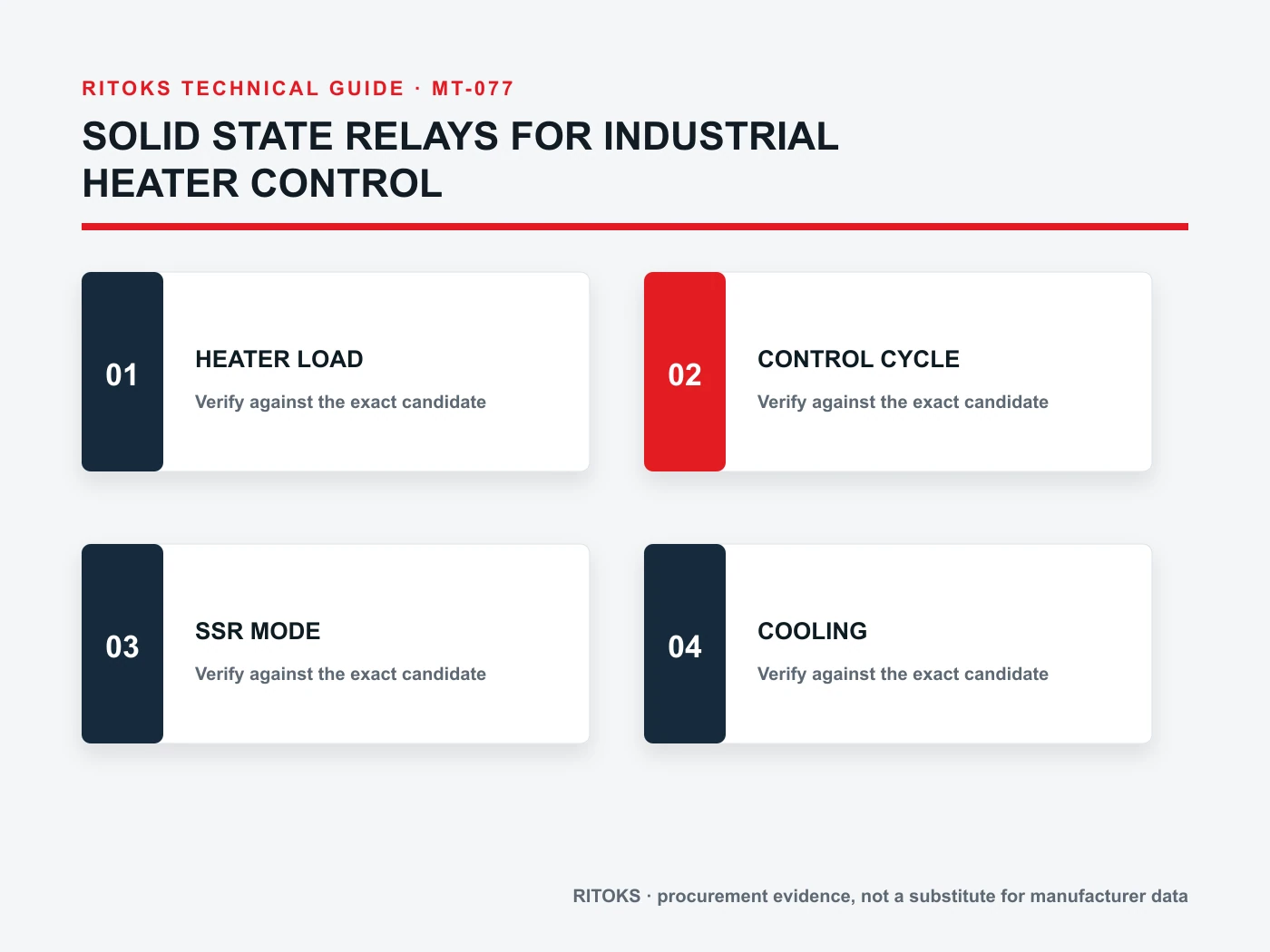
Describe whether the load is a simple resistance heater, a multi-zone bank, a transformer-fed heater or another arrangement. Record the source, phase arrangement, branch structure, normal operating current, startup behavior and any operating state that changes the effective load. “Heater control” is an application name, not an electrical specification.
Show each SSR in the functional circuit and identify which conductors it switches. The review must distinguish a single switched path from a multi-phase system and must not infer pole count or topology from a product photograph. The project drawing and the exact relay circuit diagram must agree.
Define the Control Signal and Switching Request
Document the controller output type, available signal range, off-state behavior, update rate, isolation boundary and failure response. Confirm that the exact SSR input is compatible with the controller under all specified states. A broad statement such as “PLC controlled” leaves critical interface questions unanswered.
Explain what the controller is asking the output to do. Slow temperature regulation, burst control and fast modulation create different switching patterns and thermal duty. The candidate must be reviewed against the real sequence rather than a nominal heater current alone.
Match Switching Behavior to the Application
Switching mode affects when the output begins conduction relative to the AC waveform. The appropriate behavior depends on the load, the control method and the acceptable system response. Do not transfer a switching description from another SSR family or assume that all AC-output products use the same trigger behavior.
Ask for the exact-model description of turn-on and turn-off behavior, leakage state and any restrictions on the connected load. If the process needs phase-related control or unusually short cycles, identify that requirement explicitly so a supplier does not quote a device intended for a different control method.
Treat Thermal Design as Part of Selection
An SSR dissipates heat while conducting. The loss must be derived using the exact output characteristics and the real current waveform, then carried through the package, interface, heatsink, airflow and ambient environment. A relay current label is not a cabinet-temperature guarantee.
Record mounting orientation, interface material, heatsink condition, air path, nearby heat sources and enclosure temperature. Verify the finished assembly at representative load and duty. If the project changes the cycle pattern, enclosure or cooling arrangement, repeat the thermal review.
Review Protection and Failure Behavior Separately
The SSR controls the load but does not replace the system protection design. Define fault current paths, branch protection, short-circuit coordination objectives, overtemperature response and the process state required if the output fails open or closed.
Request evidence for the exact proposed combination. A general statement about fast protection or an adjacent fuse family is not coordination evidence. The control design should also detect or safely handle a commanded-off output that continues conducting.
Plan for Leakage, Isolation and Service
Electronic outputs can behave differently from mechanical contacts in the off state. Review exact leakage, isolation and output-circuit information when it affects heater voltage, maintenance expectations or diagnostic measurements. Do not describe the output as a visible isolation point unless the complete approved system provides that function.
For service work, document the separate isolating and lockout method required by the installation. Also define terminal access, conductor routing, replacement constraints and how technicians will verify the correct order code before substitution.
Creare un file di prove basato su un modello esatto
Create one approval record for the proposed Solid State Relay order code. Put each project requirement beside the supplier document that answers it. Preserve the exact datasheet, drawing, curve, table, instruction or selection output used, including its revision or retrieval date. A category page can establish family context, but it cannot prove an exact rating, construction, terminal arrangement or system combination.
Verificare che ogni dichiarazione accettata descriva lo stesso articolo ordinabile. Non combinare il limite massimo per famiglia di una variante, uno schema di un’altra e una caratteristica opzionale di una terza. Contrassegnare esplicitamente i campi non risolti in modo che rimangano visibili durante la revisione tecnica e commerciale.
Tenere separati i dati di input del progetto dalle prove relative al prodotto
The project team defines the application: source, load, duty, environment, controls, mounting, service and required functions. The supplier identifies an exact Solid State Relay and supports it with exact documents. Neither side should fill a gap by inference from appearance, a shared family name or one matching headline value.
Bloccare la documentazione relativa alla richiesta mentre si procede al confronto dei preventivi. Qualora dovessero verificarsi modifiche relative al carico elettrico, all’ambiente, al metodo di raffreddamento, all’involucro, all’installazione o alle funzioni richieste, emettere una documentazione aggiornata e chiedere a ciascun fornitore di riconfermare la propria proposta.
Definire il verbale di accettazione prima di effettuare l'ordine
Write the acceptance record before a preferred Solid State Relay is chosen. Include the project inputs, proposed order code, included accessories, document revisions, exceptions, assumptions and the person responsible for resolving each open point. This prevents the technical basis from being reconstructed after price negotiations have already narrowed the choice.
Distinguere i requisiti obbligatori dalle preferenze e dalle opzioni future. Una condizione obbligatoria richiede prove dirette o una decisione tecnica documentata. Una preferenza può influenzare il confronto, ma non deve essere presentata come un requisito di sicurezza o di conformità. Le opzioni future devono essere verificate solo quando il progetto le prevede effettivamente, poiché le caratteristiche opzionali possono modificare il codice d'ordine, i terminali, le dimensioni o la documentazione di supporto.
Verificare l'articolo consegnato e il gruppo assemblato
Incoming inspection should compare the delivered Solid State Relay, labels, accessories and documents with the approved record. Do not accept a same-family replacement solely because its appearance or one rating matches. Record any substitution and repeat the affected review before installation.
Dopo il montaggio, verificare le funzioni e le condizioni che non possono essere accertate solo sulla base della documentazione dei componenti. La verifica può includere l'adattamento meccanico, il cablaggio rispetto allo schema approvato, il comportamento dei comandi, le temperature, il flusso d'aria, gli allarmi o l'accessibilità per la manutenzione, a seconda dei casi. Definire stati operativi rappresentativi e criteri di accettazione nel piano di collaudo del progetto, anziché stabilire limiti universali nell'ordine di acquisto.
Errori comuni negli appalti
- Selecting a Solid State Relay from one headline value while the application context remains incomplete.
- Utilizzo di una curva, un circuito, un disegno o una rivendicazione provenienti da un codice d’ordine affine.
- Considerare una pagina di categoria, una fotografia del prodotto o una misura nominale come prova certa di compatibilità.
- Nel caso in cui un accessorio, una funzione di sistema o un risultato di coordinamento siano inclusi senza documentazione.
- Approvare un sostituto senza ripetere la verifica degli impianti elettrici, meccanici e delle prove.
Colmate queste lacune prima di confrontare il prezzo e i tempi di consegna. Un’offerta può rimanere interessante dal punto di vista commerciale anche se tecnicamente incompleta, ma le informazioni mancanti non devono essere omesse nel preventivo.
Come confrontare le offerte dei fornitori
| Area recensioni | L'acquirente deve definire | Documenti richiesti |
|---|---|---|
| Codice ordine | Articolo proposto completo e accessori inclusi | Scheda tecnica e ambito di applicazione precisi |
| Corrispondenza dell'applicazione | Condizioni operative e ambientali specificate | Risposta scritta a ciascun requisito |
| Integrazione meccanica | Montaggio, terminali, distanze di sicurezza e manutenzione | Disegni e istruzioni precisi |
| Prove relative all'impianto elettrico | Valori nominali, curve e topologia applicabili | Documentazione tecnica relativa ai modelli Exact |
| Punti in sospeso | Incertezze, eccezioni e ipotesi | Elenco dei chiarimenti con data |
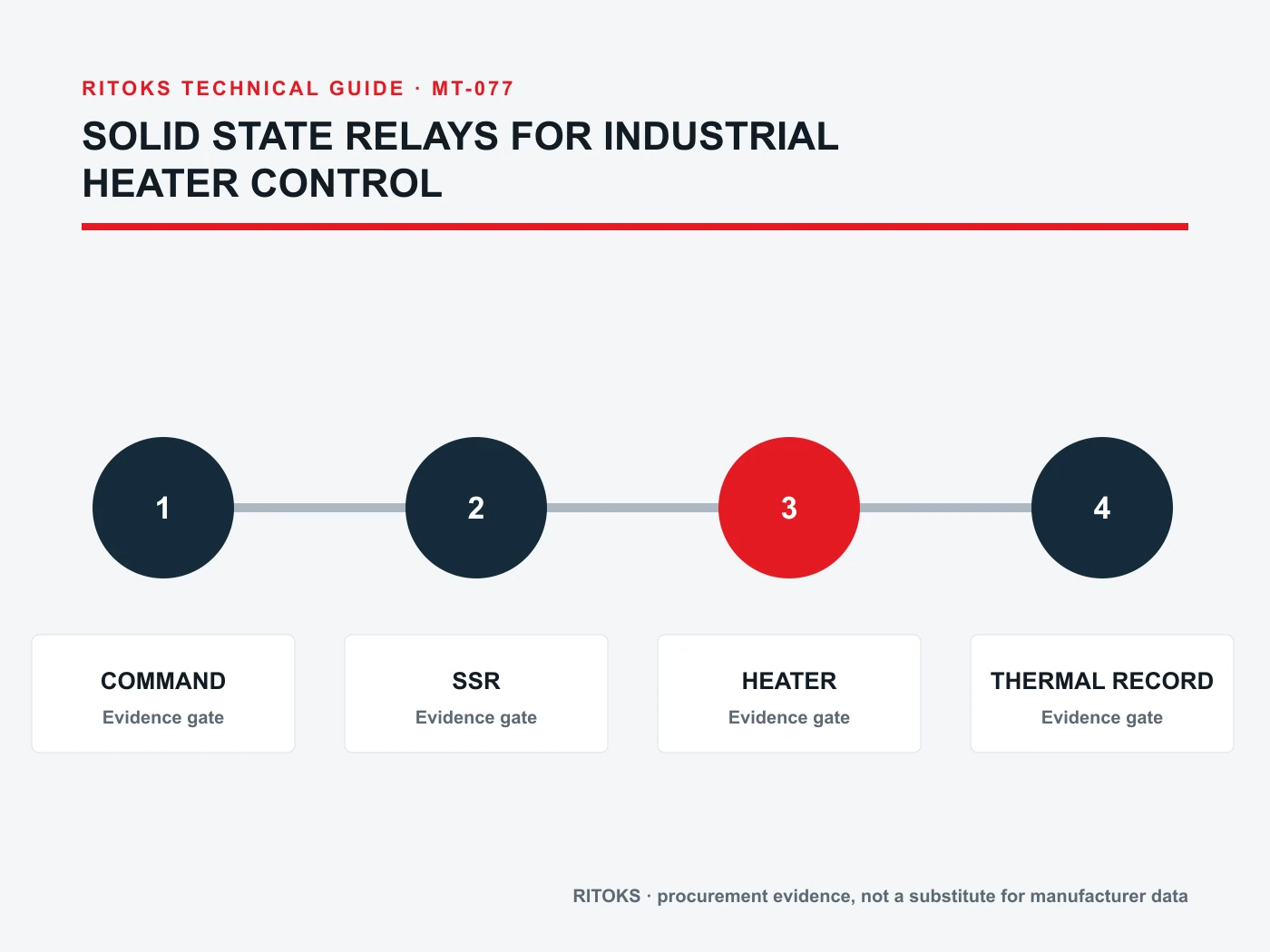
Normalize every Solid State Relay offer to the same application record. Keep document revisions, test conditions, included accessories and open questions beside each value. This makes differences in delivered scope visible and prevents a lower-cost but narrower offer from appearing equivalent to a complete proposal.
Flusso di lavoro decisionale
- Fissare i confini del sistema e gli stati operativi.
- Registrare i dati relativi agli impianti elettrici, meccanici, ambientali e di manutenzione.
- Scegli un codice d'ordine completo da esaminare.
- Verificare ogni affermazione fondamentale alla luce delle prove fornite dal modello esatto.
- Risolvere le eccezioni e le ipotesi prima di procedere al confronto commerciale.
- Verificare l'assemblaggio completato laddove i rischi legati all'applicazione lo richiedano.
Interrompere la procedura qualora un dato di input fondamentale sia sconosciuto, il modello citato risulti ambiguo, un requisito sia supportato solo da un altro produttore o codice d’ordine, oppure l’installazione non rientri nelle prove disponibili. Si tratta di lacune tecniche, non di dettagli redazionali.
Lista di controllo per la preparazione delle richieste di preventivo
A useful RFQ for ssr for heater control is concise enough to answer and complete enough to prevent silent assumptions. Identify unknown values as questions and require a full orderable code rather than a generic family recommendation.
- HEATER CIRCUIT
- CONTROL SIGNAL
- SWITCHING MODE
- THERMAL PATH
- FAULT PATH
- PROTECTION
- FAILURE STATE
- SERVICE ISOLATION
- Documenti richiesti e revisioni
- Quantità, destinazione e ambito di consegna richiesto
Chiedere al fornitore di indicare separatamente le esclusioni, le ipotesi e le opzioni. Annotare la quantità e la destinazione dopo i dati tecnici, in modo che le condizioni commerciali non oscurino le questioni ingegneristiche ancora irrisolte.
Domande frequenti
Can I select a Solid State Relay from one rating or size?
No. La selezione richiede la presentazione della domanda completa, la progettazione esatta e il rispetto di tutte le condizioni applicabili in materia di impianti elettrici, meccanici, termici, ambientali e di documentazione.
Posso utilizzare una pagina dedicata alla famiglia come prova di approvazione?
Una pagina dedicata alla famiglia di prodotti è utile per orientarsi. Per l'approvazione è necessario utilizzare la scheda tecnica con il codice d'ordine esatto, il disegno, le istruzioni e la documentazione tecnica specifica del progetto.
I modelli dall'aspetto simile sono intercambiabili?
Non automaticamente. Alloggiamenti simili possono presentare circuiti, materiali, terminali, valori nominali o accessori diversi. Ripetere la verifica per ogni prodotto sostitutivo.
Cosa dovrebbe rimanere aperto nel preventivo?
Qualsiasi dato mancante relativo al progetto, affermazione non verificata riguardo al modello esatto, accessorio incluso non chiaramente specificato o condizione di installazione non chiarita dovrebbe essere indicato come punto in sospeso, anziché essere dato per scontato.
Risorse RITOKS correlate e richieste di preventivo
Sfoglia la Categoria di prodotti: relè a stato solido, consulta la pagina principale del prodotto in questione. Queste pagine forniscono informazioni sul contesto commerciale; l’effettiva idoneità dipende comunque dai dati del progetto e dal codice d’ordine indicato nel preventivo.
Quando il documento tecnico sarà pronto, inviare la domanda e la documentazione richiesta a RITOKS per ricevere un preventivo dettagliato. La scelta finale dovrà essere soggetta all’approvazione del responsabile tecnico del progetto e alla documentazione aggiornata del produttore.