
Motor Protection Circuit Breakers for Three-Phase Motors · RFQ Checklist
MPCB RFQ Checklist for Motor-Control Panels
An MPCB RFQ for a motor-control panel should identify the motor, supply and fault conditions before it names a breaker frame. A motor protection circuit breaker may combine functions that are separated in other starter architectures, but its adjustable range, short-circuit capability and coordination still have to match the actual circuit. “Breaker for a three-phase motor” is not a sufficient specification.
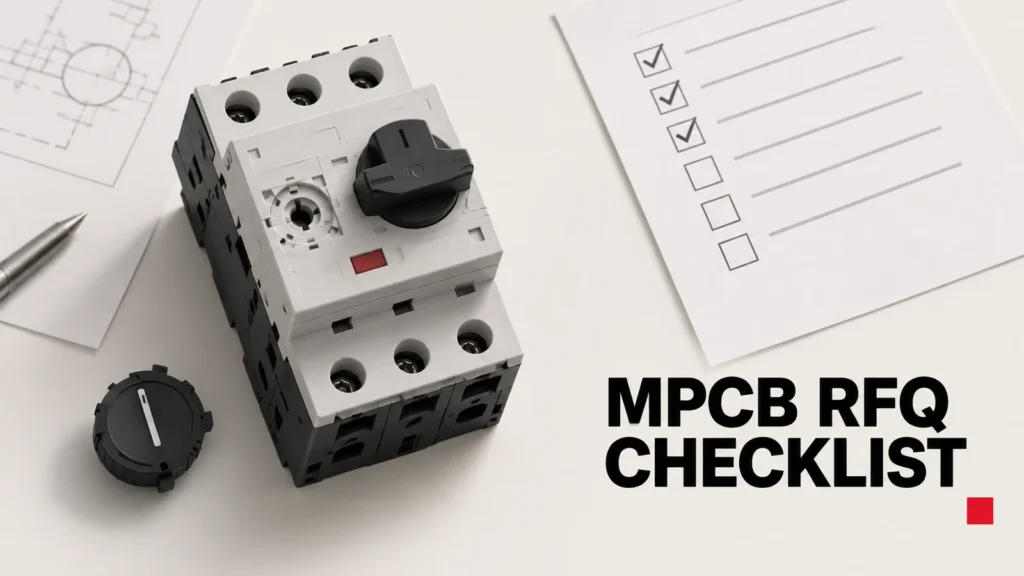
This checklist helps panel builders and buyers request comparable candidates. It separates motor data, circuit study, control arrangement and accessories from the exact-model evidence a supplier should return. It does not prescribe trip settings for an unknown motor.
Start with the motor nameplate and duty
Provide the motor's rated voltage, frequency, phases, full-load current and any service information relevant to the protection design. Add the starting method and expected starts or load cycling. If the motor has multiple speeds or unusual operation, describe those states rather than sending only a maximum current.
The full-load current is a key input for an adjustable overload range, but the range alone does not prove the correct setting. The engineer must review the motor nameplate, starting behavior, applicable code and manufacturer instructions. A product page showing several adjustment variants does not identify the variant needed for a specific motor.
State whether the application is direct-on-line, reversing, star-delta, drive-fed or another arrangement. Protection placement and coordination can differ. If a drive or soft starter is in the circuit, make its relationship to the MPCB explicit rather than assuming a conventional across-the-line arrangement.
Describe supply and prospective fault conditions
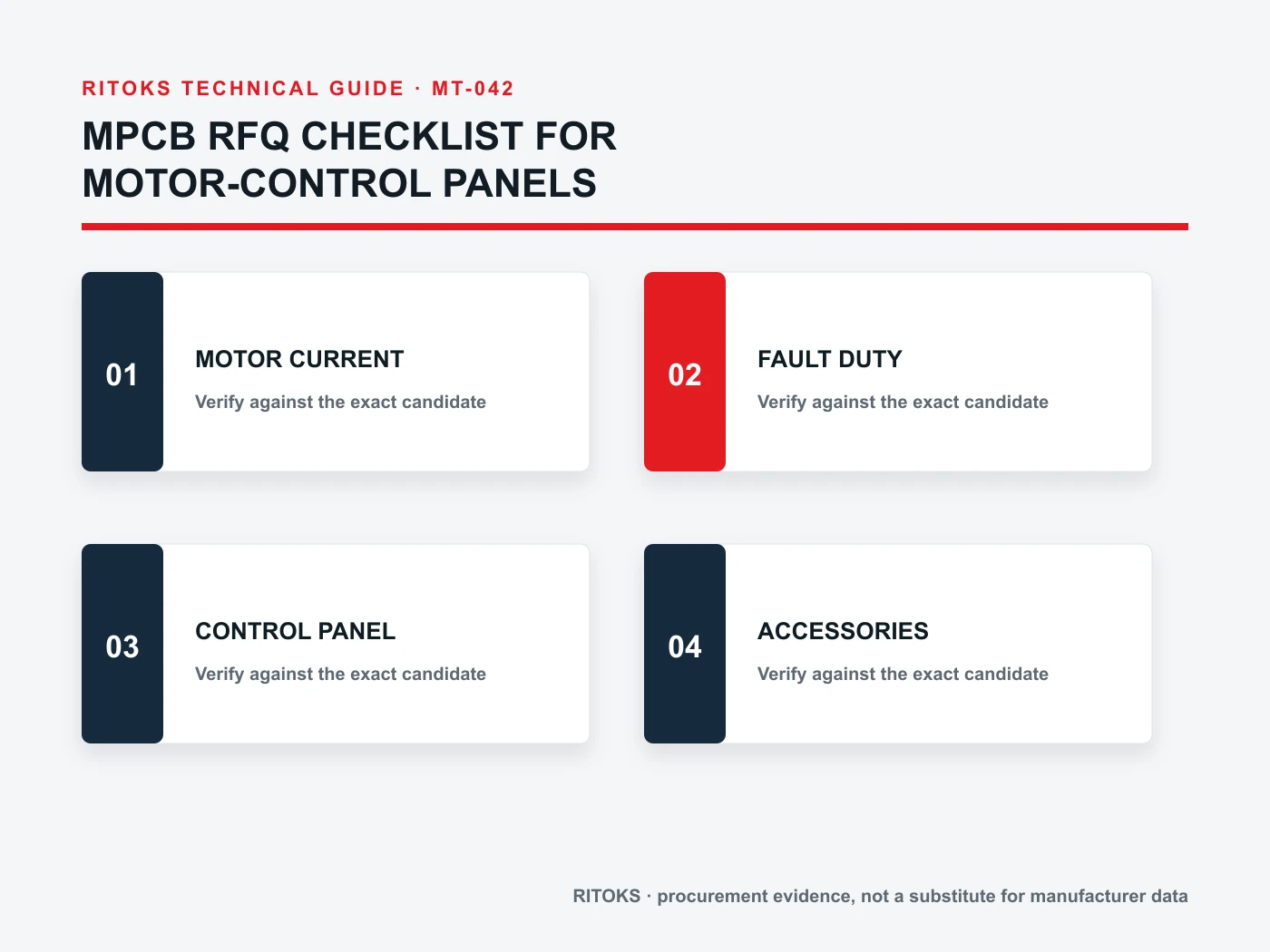
Give the supply voltage and frequency at the breaker, the earthing system where relevant and the prospective short-circuit current at the installation point. Ask for the exact MPCB's breaking-capacity evidence at the applicable voltage. A motor-current match is not enough if the available fault level exceeds the documented device capability.
Identify upstream fuses or breakers and any downstream contactor or overload device. The panel designer should determine whether coordination or selectivity requirements apply and obtain tested combinations where needed. Schneider Electric's motor-starter coordination tables show that protection and control devices are reviewed as combinations; a similar-looking part is not automatically part of the tested arrangement.
Clarify which protective function the MPCB performs. Depending on model and architecture, an MPCB may include overload and instantaneous short-circuit functions, but the exact characteristics and settings are model-specific. Do not infer the trip curve from the case shape, handle color or a generic family name.
Define the motor starting profile
A motor can draw a transient current while accelerating. Supply the expected starting current or manufacturer motor data, acceleration time, starts per operating period and load conditions. The protection engineer must compare this legitimate start with the proposed trip characteristics so the device protects the motor without unnecessary operation.
Do not solve nuisance tripping by simply selecting a much higher setting or larger device. That may erode overload protection. If starting behavior is uncertain, request measured data or a motor study. The inquiry should flag the uncertainty, not hide it under a guessed service factor.
Where starting method changes during operation, explain what the MPCB sees in each state. A star-delta transition, reversing duty or frequent jogging can affect the current profile and contactor coordination. The exact project schematic is necessary to place the device correctly.
List panel and installation constraints
Record enclosure ambient temperature, mounting position, available DIN-rail or panel space, conductor sizes, terminal type and access for adjustment. The manufacturer may specify derating, spacing or wire preparation requirements. A quoted adjustment range should be checked under the installed conditions, not assumed to apply identically in every cabinet.
State how the MPCB will be operated and isolated. If door coupling, rotary handle, locking, auxiliary contacts, trip indication, undervoltage release or shunt release is required, name each accessory. Ask the supplier to show exact compatibility and order codes. An accessory listed somewhere in the family catalogue may not fit every frame or variant.
Identify the wiring and maintenance access requirements, especially when the breaker is upstream of a contactor in a crowded starter panel. Ask for a dimensioned drawing and installation manual. Physical fit is more than the product's face width; terminals, bend radius and handle linkage also need space.
Make the RFQ evidence matrix explicit
| RFQ field | Project supplies | Supplier confirms |
|---|---|---|
| Motor | Nameplate current and start profile | Adjustment range and trip data |
| Supply | Voltage and frequency | Exact electrical ratings |
| Fault | Prospective short-circuit current | Breaking capacity at this voltage |
| Starter | Contactor and upstream device | Combination/coordination evidence |
| Panel | Space, wiring and environment | Dimensions and installation rules |
| Options | Handle, signals and releases | Compatible accessory order codes |
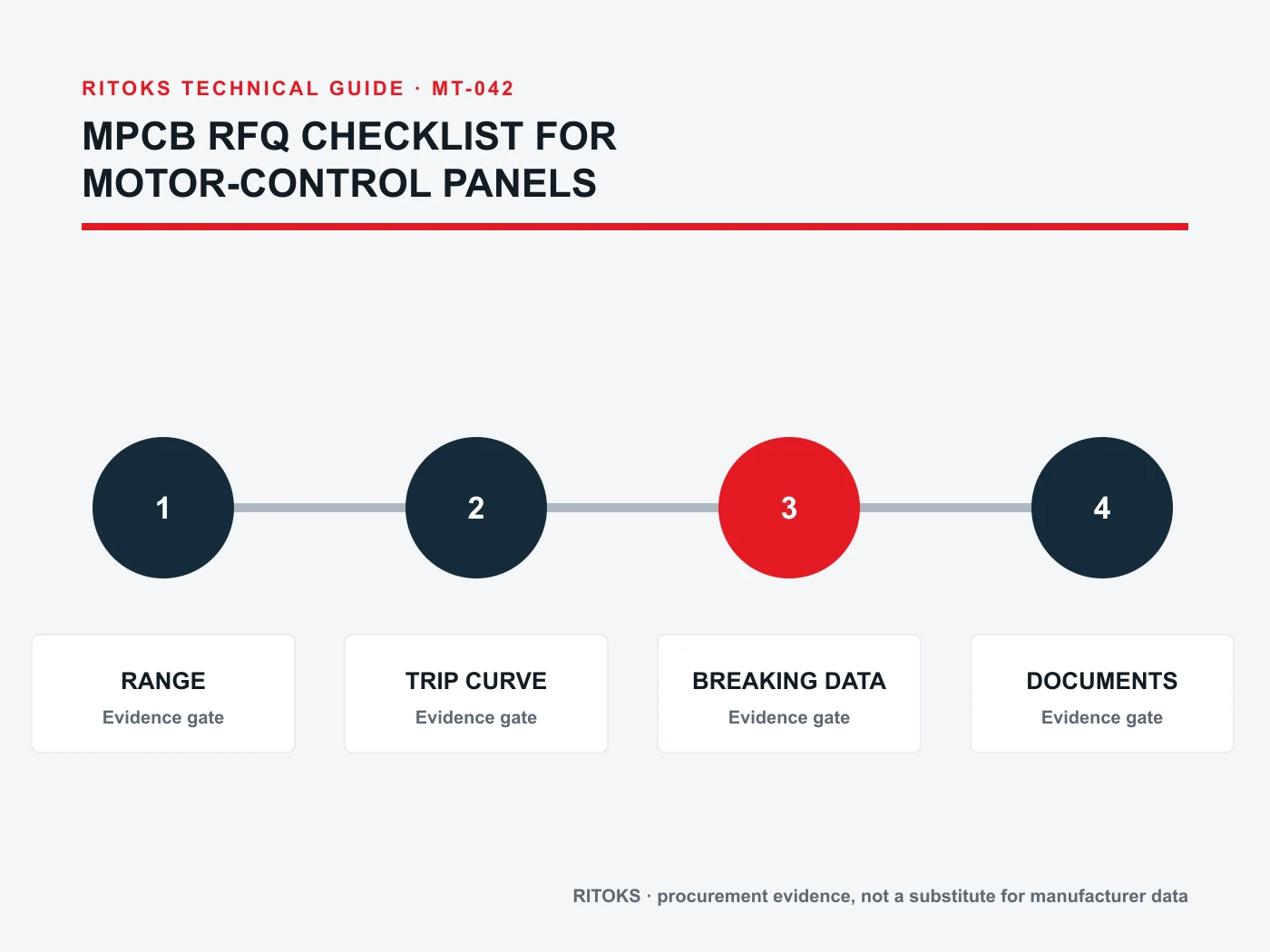
Ask for the exact model datasheet, time-current or trip characteristics, breaking data, installation instructions and accessory catalogue. If a supplier can answer only with a broad family brochure, record which items remain unresolved. A conditional quote is useful when the conditions are visible; it is not final approval.
Keep MPCB, MCB and overload relay roles distinct
A general-purpose miniature circuit breaker, a motor protection circuit breaker and a thermal overload relay serve different selection contexts. Their presence in the same panel does not make them interchangeable. The motor circuit needs a coordinated protection and switching scheme, and the engineer must identify which device handles overload, short circuit and isolation.
Likewise, a contactor is a control switching device, not automatically a protective breaker. If the proposed starter uses an MPCB plus contactor, the pair needs appropriate combination evidence. If the starter instead uses separate overload relay and short-circuit device, the RFQ must describe that architecture rather than calling every component an MPCB.
How to evaluate an alternative offer
Record each bidder's exact order code and the evidence supporting its ratings. Compare the adjustment range at the motor's nameplate current, interruption duty at the system voltage, trip characteristics, coordination with the specified contactor and accessory compatibility. A higher headline current or more accessories does not automatically mean a better fit.
Mark any design changes an alternative requires: a different panel cutout, conductor size, handle linkage or contactor combination. Procurement can then compare total technical impact rather than unit price alone. A replacement that invalidates a tested starter combination should return to engineering review.
Keep the approved drawing revision, setting record and supplier documentation together. During commissioning, check the actual device variant and setting against the design file. If the motor is changed later, re-evaluate the protective range and coordination rather than treating the former MPCB as universally suitable.
Plan commissioning and setting control
An RFQ should say whether the supplier provides a factory setting, a recommended range or only an adjustable device. The site engineer must determine and document the approved setting for the actual motor. A photograph of the setting dial can help the as-built record, but it should be accompanied by the device order code and drawing revision so another breaker is not mistaken for the approved one.
Before energizing, verify line and load terminal connections, conductor preparation, auxiliary-contact wiring and any handle linkage against the installation manual. Test trip indication and control response where the project procedure requires it. The commissioning record should distinguish a functional check from proof of short-circuit performance; the latter relies on documented type tests and applicable coordination evidence, not a field fault test.
For fleet or OEM use, keep a controlled setting schedule by motor designation. That allows later maintenance to see why two visually identical MPCBs have different adjustments. If a motor or gearbox is changed, the schedule prompts an engineering review before someone copies the old setting.
Where RITOKS fits
The MPCB category and GYMP7 motor protection breaker family provide a commercial starting point. Their published family information does not establish the exact model's compatibility with an unreviewed motor or starter assembly.
Send the motor nameplate, single-line, fault study, starter component list and accessory schedule via RITOKS contact. Ask for a proposed variant with the relevant datasheet and installation evidence. Keep unresolved circuit and setting questions for the responsible engineer.
Common RFQ questions
Is motor power sufficient to choose an MPCB?
No. Provide nameplate current, supply voltage, starting behavior and fault conditions. Power alone does not define trip setting or breaking duty.
Can a breaker setting be selected from the catalogue range midpoint?
No. The setting follows the motor and protection design, using the exact device instructions and applicable requirements. The adjustment range merely shows possible settings.
Will any contactor work with the quoted MPCB?
Do not assume it. The combination and coordination requirements must be checked for the actual devices and system fault level.
Bottom line
An MPCB inquiry should connect motor nameplate and start profile to voltage, fault duty, starter coordination, panel constraints and accessories. The supplier response should name an exact model and provide evidence for each key condition. That is the basis for a defensible panel bill of materials, not a guessed ampere rating.