
Motor Protection Circuit Breakers for Three-Phase Motors · Technical Explainer
MPCB Trip Characteristics: What Exact Datasheets Must Confirm
Searches for MPCB trip class often combine several different questions: how quickly sustained overload is cleared, how instantaneous magnetic response is defined, how ambient conditions affect behavior and whether the device is coordinated with a specific motor starter. Buyers should separate these questions before comparing products. One label never replaces the exact time-current data and conditions.
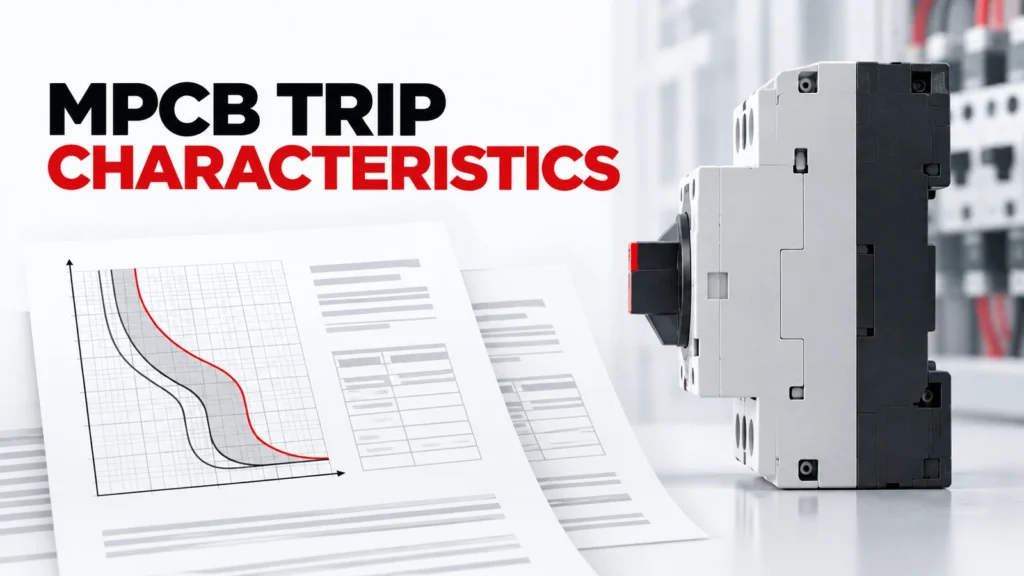
This explainer defines the evidence boundary around MPCB trip characteristics. It does not assign a trip class to GYMP7, provide settings for a specific motor, or approve coordination with any contactor, overload relay or upstream protective device.
Decision Inputs at a Glance
| Decision input | Buyer must confirm | Evidence required |
|---|---|---|
| Motor duty | Rated current, starting current profile and acceleration time | Motor and driven-load record |
| Thermal response | Overload behavior and applicable reference conditions | Exact time-current data |
| Magnetic response | Instantaneous trip threshold or range | Exact device documentation |
| Environment | Ambient, mounting and grouping conditions | Derating or compensation instructions |
| Coordination | Starter components and prospective fault duty | Exact tested or declared coordination record |

Separate the Meaning of Trip Class
Trip class is generally used to describe a defined overload-tripping time relationship under specified conditions. It should not be treated as a universal speed label that predicts every point on a device curve. The applicable definition, reference current and test basis must come from the exact documentation.
An MPCB may also include magnetic short-circuit response. That function answers a different condition from the thermal overload response. A comparison that mixes the two can lead buyers to believe that one number describes both motor starting tolerance and fault interruption.
Match Thermal Response to the Starting Duty
A motor can draw elevated current while accelerating without being in a damaging stalled condition. The protection choice must distinguish legitimate starting from sustained overload according to the motor thermal capability and project design. Record acceleration time, starting method, starts per hour and load inertia.
A device that trips too quickly can create nuisance stops. A response that is too slow can fail to provide the intended overload protection. The correct judgment requires exact curves or tables and the complete motor-control design, not a guessed class from the product family name.
Review the Magnetic Trip Information Separately
Magnetic response is intended for high-current conditions and is normally documented as a threshold, band or multiple under defined conditions. Confirm whether it is fixed or adjustable for the exact order code and how tolerances are presented.
Do not compare the magnetic setting with normal full-load current without examining motor inrush and the system fault study. An apparently low threshold may conflict with starting; an apparently high threshold may affect coordination. These are system decisions that require engineering review.
Check Ambient, Mounting and Phase Effects
Thermal devices can respond differently with ambient temperature, mounting arrangement, adjacent heat sources and phase imbalance. Determine which compensation or sensitivity functions are present and which installation conditions the published curve assumes.
If multiple devices are installed closely, verify spacing and derating guidance. Do not transfer a curve from another frame, current range or accessory configuration simply because the front appearance is similar.
Keep Breaking Capacity Outside the Trip-Class Shortcut
Breaking capacity concerns the device ability to interrupt specified fault conditions under a defined standard and voltage. It is not established by the overload trip class. The prospective fault current and exact interrupting evidence must be reviewed independently.
Likewise, a magnetic pickup setting does not by itself prove a complete short-circuit rating or starter coordination. Keep interrupting, trip and coordination documents as separate evidence items in the approval file.
Use Coordination Records for the Actual Starter
When the MPCB is part of a starter, identify the exact contactor, accessories, supply condition and required coordination objective. A shared manufacturer or matching current range does not prove the combination.
Ask for the tested, declared or otherwise applicable coordination documentation and confirm every order code. If a supplier proposes a substitute, repeat the review rather than carrying a conclusion from the previous combination.
Build an Exact-Model Evidence File
Create one approval record for the proposed MPCB order code. Put each project requirement beside the supplier document that answers it. Preserve the exact datasheet, drawing, curve, table or selection output used, including its revision or retrieval date. A category page can establish family context, but it cannot prove an exact rating, terminal arrangement or system combination.
Check that every accepted statement describes the same orderable item. Similar housings can contain different circuits, supplies, terminals, accessories or protection functions. Do not combine a family maximum from one variant, a diagram from another and an optional feature from a third. Mark unresolved fields explicitly so they remain visible in the commercial review.
Keep Project Inputs Separate From Product Evidence
The project team defines the application: source, load, duty, environment, controls, mechanical limits and required functions. The supplier identifies an exact MPCB and supports it with exact documents. Neither side should fill a gap by inference from appearance, a shared family name or one matching headline value.
Freeze the application record while quotations are being compared. If the load, voltage, duty, environment, cooling method, enclosure or required output changes, issue a revised record and ask each supplier to reconfirm the candidate. Otherwise apparently comparable quotations may be answering different technical requirements.
Common Procurement Errors
- Selecting MPCB from one headline rating while the application context remains incomplete.
- Using a circuit, curve, terminal drawing or performance claim from a neighboring model.
- Treating a family page or product photograph as exact technical evidence.
- Assuming an accessory, system function or coordination result is included without documentation.
- Approving a substitute without repeating the topology, rating, mounting and evidence review.
Resolve these gaps before comparing price and lead time. The reviewer should be able to trace every accepted statement either to the project requirement or to the exact candidate document. A proposal may remain commercially interesting while technically incomplete, but missing evidence must not disappear inside the quotation.
How to Compare Supplier Offers
| Comparison point | Required evidence | Do not accept |
|---|---|---|
| Evidence item | What it answers | What it does not prove |
| Trip class/thermal curve | Overload response under defined conditions | Magnetic threshold or breaking capacity |
| Magnetic information | High-current pickup behavior | Starter coordination by itself |
| Breaking-capacity record | Fault interruption under stated conditions | Motor thermal suitability |
| Motor data | Starting and load context | Device performance without exact curves |
| Coordination table | Declared behavior of an exact combination | Unlisted substitutes or changed conditions |
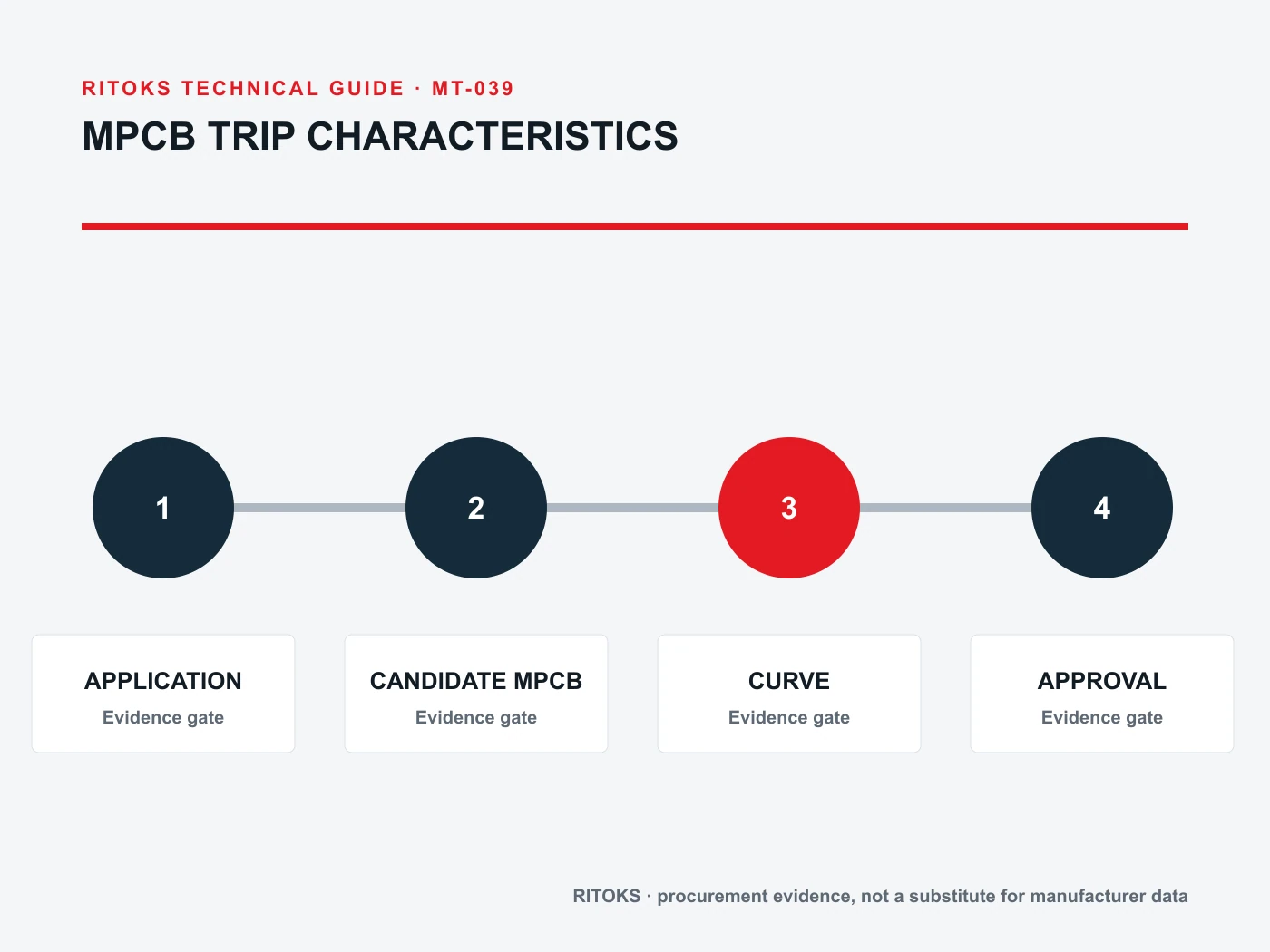
Normalize every MPCB offer to the same application record. Keep document revisions, test conditions, included accessories and open questions beside each value. This makes differences in delivered scope visible and prevents a lower-cost but narrower offer from appearing equivalent to a complete solution.
Decision Workflow
- Record motor current, starting method and acceleration profile.
- Identify the exact MPCB order code and adjustment range.
- Obtain thermal time-current and trip-class information.
- Obtain magnetic response and tolerance information.
- Check ambient, mounting and grouping conditions.
- Verify breaking capacity against the fault study.
- Verify the exact starter coordination record.
At each step, stop when a critical application input is unknown, the quoted model is ambiguous, a required claim is supported only by another manufacturer or another order code, or the installation falls outside the available evidence. These are engineering gaps, not editorial details.
RFQ Preparation Checklist
A useful RFQ for mpcb trip class is concise enough to answer and complete enough to prevent silent assumptions. Identify unknown values as questions and require a full orderable code rather than a generic family recommendation.
- Motor rated current and supply
- Starting method, inrush profile and acceleration time
- Starts per hour and abnormal-load conditions
- Required adjustment range
- Required thermal trip evidence
- Required magnetic response evidence
- Prospective fault current and breaking-capacity requirement
- Contactor combination, accessories, quantity and destination
Request the current datasheet revision and the exact scope of any certification, compatibility, coordination or performance claim. Record quantity and destination after the technical inputs so commercial terms do not obscure unresolved engineering questions.
Frequently Asked Questions
Is MPCB trip class the same as magnetic trip setting?
No. Thermal overload response and magnetic high-current response are different evidence items.
Can two MPCBs with the same class be substituted automatically?
No. Curves, tolerances, breaking capacity, mounting and coordination can differ.
Does an MPCB trip curve approve a contactor combination?
No. Exact starter coordination evidence is still required.
Related RITOKS Products and Guidance
These links provide product-family context only. A contextual link does not claim interchangeability, compatibility or an approved system combination.
GYMP7 three-phase motor protection circuit breakers
Technical References
These primary manufacturer sources support only the general engineering concepts described below. Their product ratings, circuit diagrams, approvals and coordination results do not transfer to RITOKS products.
ABB, Control Catalog: IEC Manual Motor Starters
Supports separating thermal overload behavior, magnetic short-circuit response, trip information and coordination evidence. Exact ABB characteristics do not describe a RITOKS MPCB.
ABB, Contactors and Overload Relays Guide
Supports general overload-relay selection inputs, reset and auxiliary-control concepts, and the need for coordinated motor-control documentation. ABB ratings and combinations do not transfer to RITOKS products.
Request an Exact-Model Review
Send the application requirements, exact-document questions, quantity and destination through the RITOKS contact form. An RFQ requests an exact-model review; this guide does not approve a circuit, installation or automatic substitute.