
Recursos técnicos · Explicação técnica
Current Transformer Ratio Selection: Primary Current and Secondary Output
Specify a current transformer ratio from the primary circuit, secondary measurement input and exact burden and accuracy evidence. A useful buyer review connects the project requirement to one exact orderable product and preserves the evidence used for approval.
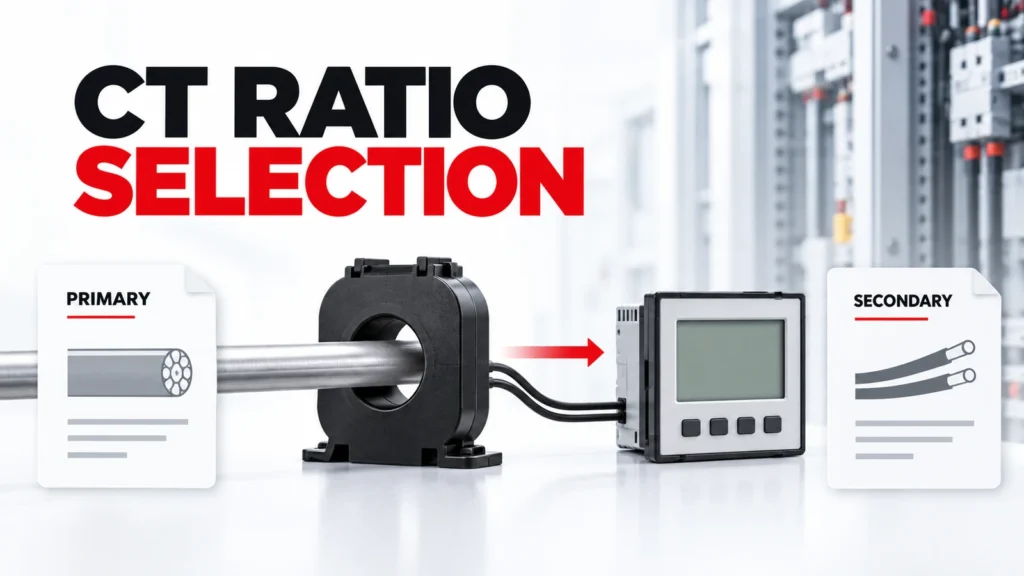
This guide explains the evidence chain for a current-transformer ratio. It does not calculate a project ratio, declare compatibility with a meter or protection relay, or provide secondary wiring or safety instructions.
Visão geral dos dados de base para a tomada de decisão
| Campo de revisão | O comprador deve definir | Provas a serem solicitadas |
|---|---|---|
| Primary current | Normal, maximum and relevant operating range | Project load study |
| Saída secundária | Exact input required by the receiving meter or relay | Receiving-device manual |
| Relação | Declared primary-to-secondary relationship | Exact CT model row |
| Measurement performance | Accuracy and burden under documented conditions | Manufacturer data and system calculation |
| Ajuste mecânico | Window, conductor, mounting and installation constraints | Drawing and installation review |
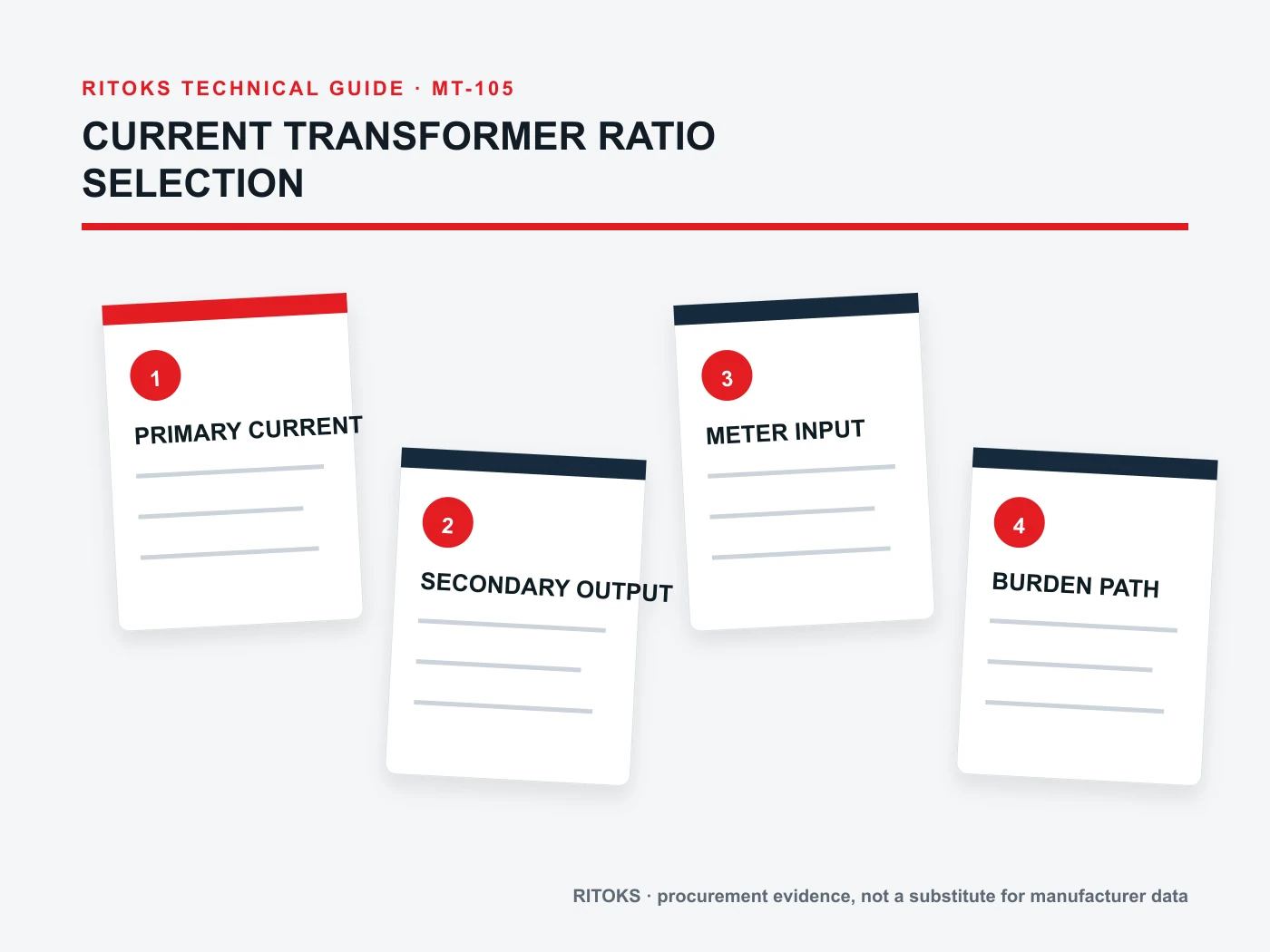
Start With the Real Primary Current Range
The primary side should be described by the expected operating current, maximum normal condition and any meaningful variation that affects measurement. Selecting from conductor ampacity or protective-device frame size alone can place normal readings in an unsuitable part of the measurement range.
Record how the current estimate was obtained and whether future operating modes change it. The buyer does not need to force a final ratio before the receiving-device input and measurement objective are known.
Match the Secondary Output to the Receiving Device
A current transformer and a meter form an interface. The CT secondary declaration must match the exact input expected by the meter, transducer or relay. A familiar ratio notation is not enough to establish that relationship. Request both documents and review them together.
Do not use a product family page to infer input compatibility. Neighboring meter variants may accept different sensors or secondary signals. The approval record must name the exact receiving device and its terminal documentation.
Understand What the Ratio Expresses
The ratio states the declared relationship between primary current and secondary output under the product's defined conditions. It does not by itself establish accuracy across the required operating range, available burden, saturation behavior or suitability for protection. Those are separate evidence fields.
When quotations offer different ratios, compare the resulting measurement use rather than treating the values as catalog alternatives. Each proposal should explain how the ratio aligns with the project's primary-current range and receiving input.
Review Burden and Accuracy as a System
The connected input, lead path and terminals contribute to the secondary circuit seen by the transformer. The responsible engineer should calculate and verify that complete circuit against the exact CT and receiving-device documents. Procurement should preserve the inputs rather than guessing from a headline accuracy class.
Ask where accuracy is declared, at which conditions and for which order code. Never combine the ratio of one model, burden data from another and dimensions from a third. If the system calculation is missing, mark the proposal incomplete.
Confirm Frequency, Purpose and Operating Context
State whether the measurement supports indication, energy monitoring, control, protection or another purpose. These uses can demand different evidence. Also record the system frequency and waveform context that the manufacturer requires for its declaration.
This guide deliberately avoids treating a measurement CT as a protection CT or vice versa. The proposed device must be documented for the intended role, and any special behavior must be evaluated by the system designer.
Verify Window Size and Installation Constraints
The primary conductor, bar arrangement, insulation, bending space and access determine whether the CT can be installed. A ratio match does not prove mechanical fit. Request the exact outline drawing and confirm that the window accommodates the real conductor without unsupported modification.
For retrofit work, a split-core construction may change installation access, but it does not remove the need to review ratio, output, burden, accuracy and environmental conditions. Keep construction choice separate from electrical approval.
Criar um arquivo de evidências com modelo exato
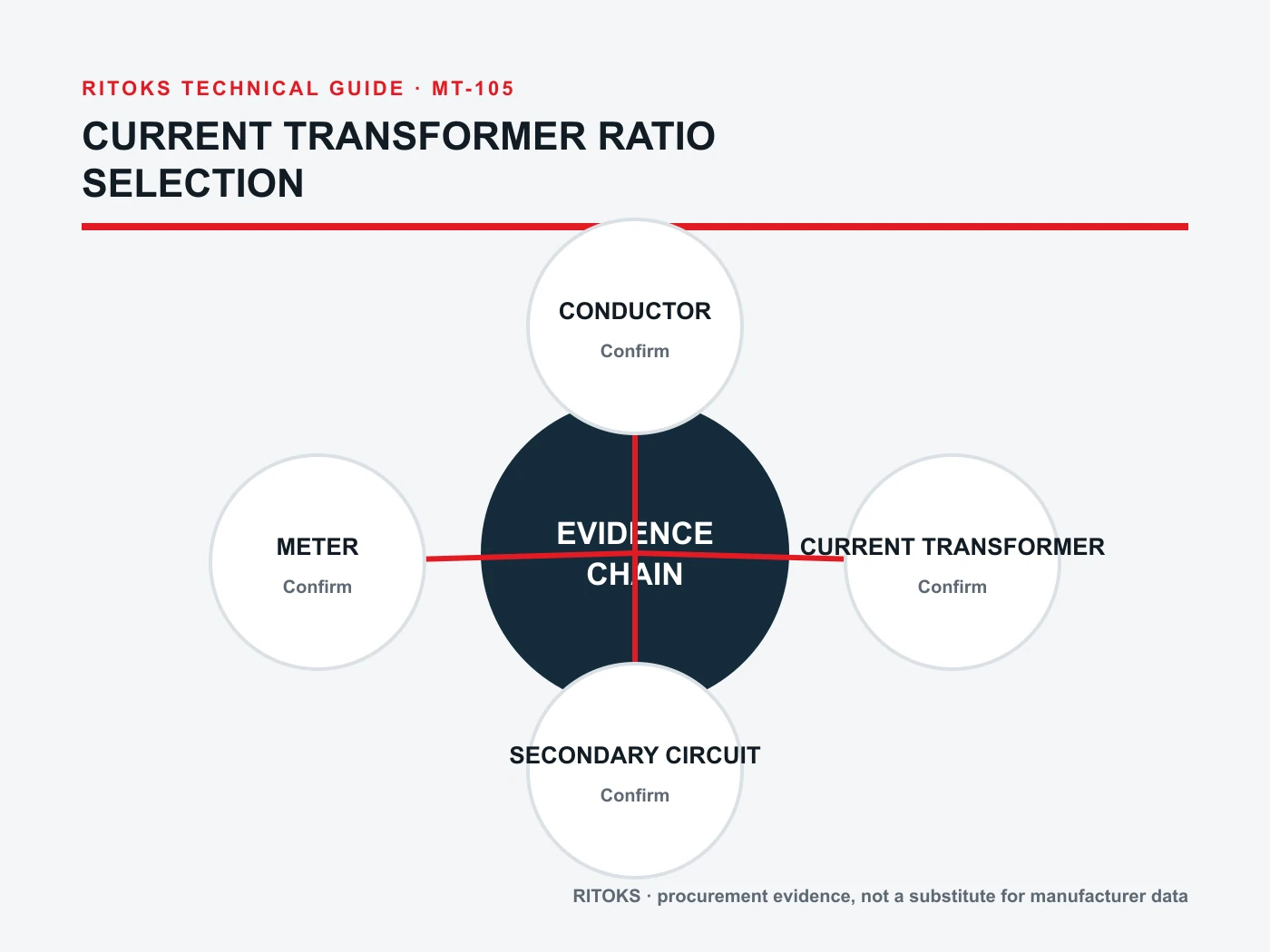
Create one approval record for the proposed Current Transformer order code. Put each project requirement beside the supplier document that answers it. Preserve the exact datasheet, drawing, table, instruction or selection output used, including its revision or retrieval date. A category page can establish family context, but it cannot prove an exact rating, terminal arrangement or system combination.
Verifique se cada descrição aceita se refere ao mesmo item que pode ser encomendado. Caixas semelhantes podem conter circuitos, fontes de alimentação, terminais, acessórios ou funções diferentes. Não combine o limite máximo da família de uma variante, um diagrama de outra e um recurso opcional de uma terceira. Marque explicitamente os campos não preenchidos para que permaneçam visíveis na revisão comercial.
Mantenha os dados de entrada do projeto separados das evidências do produto
The project team defines the application: source, load, duty, environment, controls, mechanical limits and required functions. The supplier identifies an exact Current Transformer and supports it with exact documents. Neither side should fill a gap by inference from appearance, a shared family name or one matching headline value.
Congele o registro da solicitação enquanto as cotações estiverem sendo comparadas. Se houver alterações na topologia, na fonte, na carga, no ambiente, no gabinete ou na saída exigida, emita um registro revisado e solicite a cada fornecedor que reconfirme a proposta. Caso contrário, cotações aparentemente comparáveis podem estar atendendo a requisitos técnicos diferentes.
Erros comuns em processos de compras
Avoid selecting a Current Transformer from one headline value while the application context remains incomplete. Do not use a circuit, curve, terminal drawing or performance claim from a neighboring model. A product photograph and a family page can support discovery, but neither is exact technical evidence.
Evite também presumir que um acessório, uma função de comunicação, uma função de proteção ou um resultado coordenado esteja incluído, a menos que conste na cotação e nos documentos do modelo exato. Um substituto deve apresentar a mesma topologia, classificação, montagem e análise de evidências que o candidato original.
Como comparar propostas de fornecedores
Normalize every Current Transformer offer to the same application record. Keep document revisions, stated conditions, included accessories and open questions beside each value. This makes differences in delivered scope visible and prevents a lower-cost but narrower offer from appearing equivalent to a complete solution.
Interrompa a comparação quando um dado de entrada essencial do aplicativo for desconhecido, o modelo citado for ambíguo, uma especificação exigida for comprovada apenas por outro fabricante ou código de pedido, ou a instalação estiver fora do escopo das evidências disponíveis. Trata-se de lacunas de engenharia, não de detalhes editoriais.
Controle de revisões e substituições
Give the approved Current Transformer record a revision identifier and keep it with the project file. If the supplier changes the order code, accessory, firmware, drawing or stated operating condition, identify the change before accepting it. A substitution is a new technical proposal even when its price, housing or product-family name looks familiar.
Repita apenas as verificações afetadas, mas não as dispense. Confirme se o candidato revisado ainda corresponde à solicitação congelada, se todos os documentos referenciados pertencem a ela e se todas as exceções em aberto têm um responsável. Essa pequena etapa de controle de mudanças evita que uma seleção revisada tecnicamente seja substituída por um equivalente comercial não revisado.
Fluxo de trabalho de decisão
- Congele o registro do aplicativo e do sistema antes de selecionar um código de catálogo.
- Identifique a função exata e todas as interfaces que exigem comprovação.
- Solicite um código de pedido completo, acompanhado da ficha técnica e dos desenhos atualizados.
- Mapeie cada requisito do projeto a uma declaração específica do fabricante.
- Registre desvios, acessórios, revisões de documentos e questões não resolvidas.
- Repita a revisão sempre que houver alterações no pedido ou no produto proposto.
Use this workflow as a procurement and evidence discipline. It does not replace qualified design, installation instructions or the responsible engineer's approval for the Current Transformer application.
Lista de verificação para a preparação de uma solicitação de cotação
A practical current transformer ratio selection should be concise enough for a supplier to answer and complete enough to prevent silent assumptions. Identify unknown values as questions rather than allowing them to become undocumented selections.
- Primary current: Normal, maximum and relevant operating range.
- Secondary output: Exact input required by the receiving meter or relay.
- Ratio: Declared primary-to-secondary relationship.
- Measurement performance: Accuracy and burden under documented conditions.
- Mechanical fit: Window, conductor, mounting and installation constraints.
- Código exato do produto, acessórios incluídos e versão da documentação
- Quantidade, destino, aprovações necessárias e escopo comercial
Solicite o escopo exato de qualquer especificação de classificação, compatibilidade, coordenação ou desempenho. Registre a quantidade e o destino após os dados técnicos, para que os termos comerciais não ocultem questões de engenharia ainda não resolvidas.
Perguntas frequentes
Can CT ratio be selected from breaker size alone?
No. Use the real current range, receiving-device input and measurement objective.
Does a matching secondary value prove compatibility?
No. Burden, accuracy, frequency, terminals and the exact interface still require review.
Can a current transformer secondary be treated as an ordinary signal?
No. Follow qualified design practices and the exact manufacturer safety instructions.
Produtos e orientações relacionados da RITOKS
Esses links fornecem apenas informações sobre o contexto da família de produtos. Um link contextual não implica em intercambiabilidade, compatibilidade ou combinação de sistemas aprovada.
Current Transformer product category
BH-0.66-60I current transformer family
Transformador de corrente com núcleo dividido da série DP
GTA20L precision current transformer
Referências técnicas
Essas fontes dos fabricantes servem apenas para respaldar os conceitos gerais de engenharia descritos a seguir. As especificações dos produtos, os diagramas de circuitos, as homologações e os resultados de coordenação apresentados por elas não se aplicam aos produtos da RITOKS.
Schneider Electric, Medidores de Potência Multifuncionais PowerLogic
Supports treating the meter input and measurement architecture as part of the complete system record. Schneider meter inputs do not establish compatibility with RITOKS CTs.
Solicite uma análise do modelo específico
Envie os requisitos da solicitação, as perguntas específicas sobre os documentos, a quantidade e o destino por meio do formulário de contato da RITOKS. Uma solicitação de cotação (RFQ) exige uma análise do modelo exato; este guia não aprova um circuito, instalação ou substituto automático.