
Technical Resources · Technical Explainer
Current Transformer Ratio Selection: Primary Current and Secondary Output
Specify a current transformer ratio from the primary circuit, secondary measurement input and exact burden and accuracy evidence. A useful buyer review connects the project requirement to one exact orderable product and preserves the evidence used for approval.
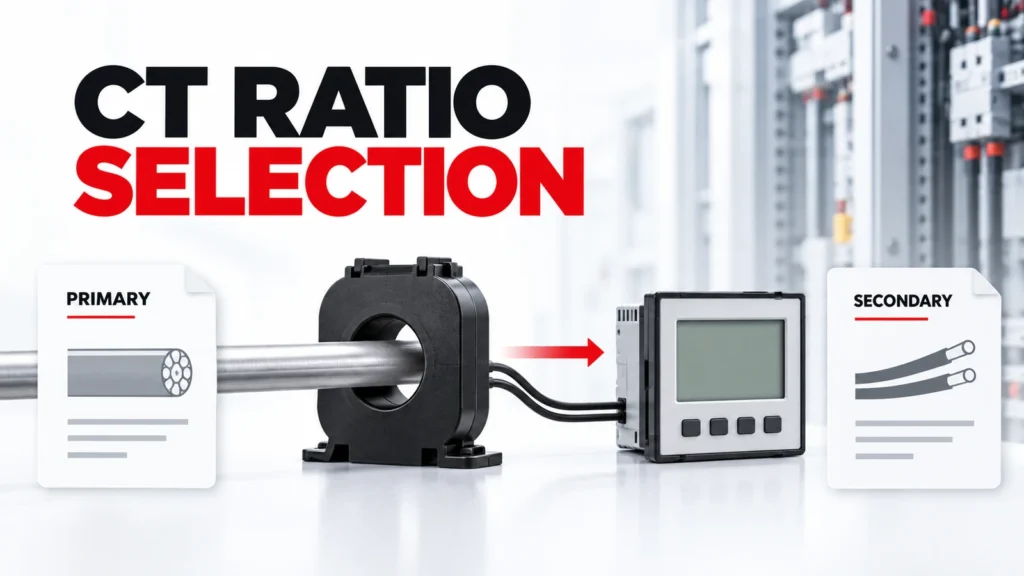
This guide explains the evidence chain for a current-transformer ratio. It does not calculate a project ratio, declare compatibility with a meter or protection relay, or provide secondary wiring or safety instructions.
Decision Inputs at a Glance
| Review field | Buyer must define | Evidence to request |
|---|---|---|
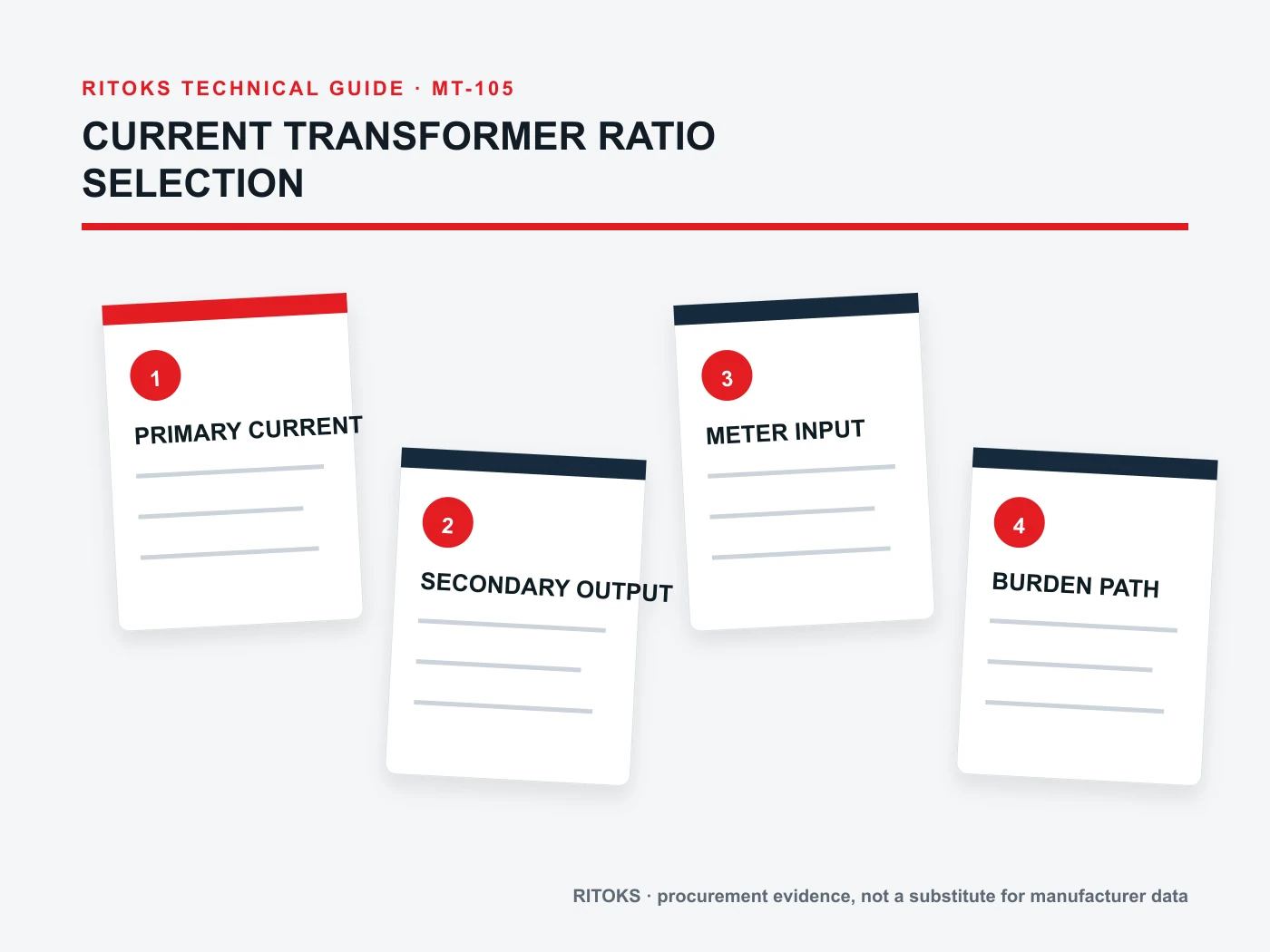
| Primary current | Normal, maximum and relevant operating range | Project load study |
| Secondary output | Exact input required by the receiving meter or relay | Receiving-device manual |
| Ratio | Declared primary-to-secondary relationship | Exact CT model row |
| Measurement performance | Accuracy and burden under documented conditions | Manufacturer data and system calculation |
| Mechanical fit | Window, conductor, mounting and installation constraints | Drawing and installation review |
Start With the Real Primary Current Range
The primary side should be described by the expected operating current, maximum normal condition and any meaningful variation that affects measurement. Selecting from conductor ampacity or protective-device frame size alone can place normal readings in an unsuitable part of the measurement range.
Record how the current estimate was obtained and whether future operating modes change it. The buyer does not need to force a final ratio before the receiving-device input and measurement objective are known.
Match the Secondary Output to the Receiving Device
A current transformer and a meter form an interface. The CT secondary declaration must match the exact input expected by the meter, transducer or relay. A familiar ratio notation is not enough to establish that relationship. Request both documents and review them together.
Do not use a product family page to infer input compatibility. Neighboring meter variants may accept different sensors or secondary signals. The approval record must name the exact receiving device and its terminal documentation.
Understand What the Ratio Expresses
The ratio states the declared relationship between primary current and secondary output under the product's defined conditions. It does not by itself establish accuracy across the required operating range, available burden, saturation behavior or suitability for protection. Those are separate evidence fields.
When quotations offer different ratios, compare the resulting measurement use rather than treating the values as catalog alternatives. Each proposal should explain how the ratio aligns with the project's primary-current range and receiving input.
Review Burden and Accuracy as a System
The connected input, lead path and terminals contribute to the secondary circuit seen by the transformer. The responsible engineer should calculate and verify that complete circuit against the exact CT and receiving-device documents. Procurement should preserve the inputs rather than guessing from a headline accuracy class.
Ask where accuracy is declared, at which conditions and for which order code. Never combine the ratio of one model, burden data from another and dimensions from a third. If the system calculation is missing, mark the proposal incomplete.
Confirm Frequency, Purpose and Operating Context
State whether the measurement supports indication, energy monitoring, control, protection or another purpose. These uses can demand different evidence. Also record the system frequency and waveform context that the manufacturer requires for its declaration.
This guide deliberately avoids treating a measurement CT as a protection CT or vice versa. The proposed device must be documented for the intended role, and any special behavior must be evaluated by the system designer.
Verify Window Size and Installation Constraints
The primary conductor, bar arrangement, insulation, bending space and access determine whether the CT can be installed. A ratio match does not prove mechanical fit. Request the exact outline drawing and confirm that the window accommodates the real conductor without unsupported modification.
For retrofit work, a split-core construction may change installation access, but it does not remove the need to review ratio, output, burden, accuracy and environmental conditions. Keep construction choice separate from electrical approval.
Build an Exact-Model Evidence File
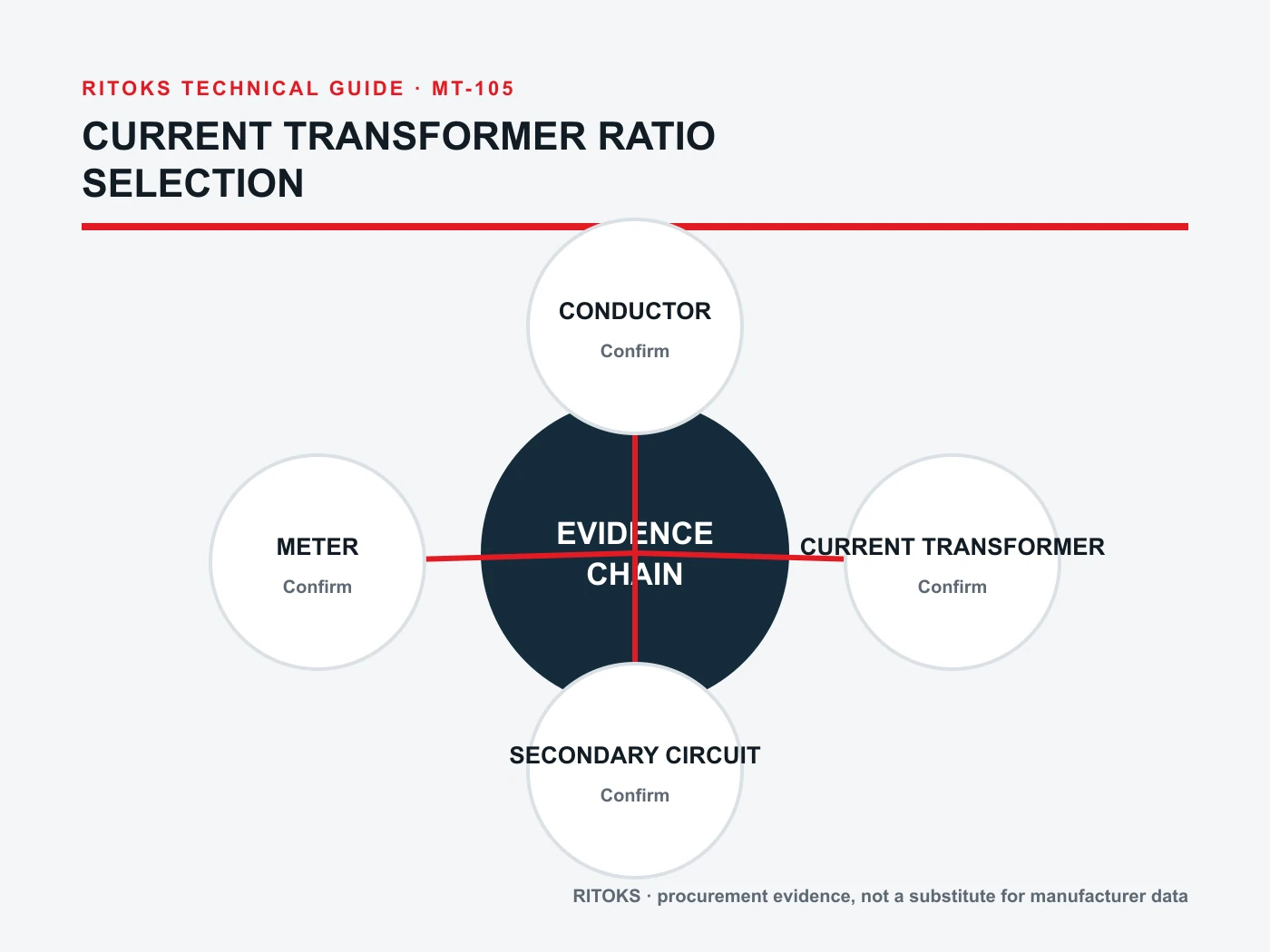
Create one approval record for the proposed Current Transformer order code. Put each project requirement beside the supplier document that answers it. Preserve the exact datasheet, drawing, table, instruction or selection output used, including its revision or retrieval date. A category page can establish family context, but it cannot prove an exact rating, terminal arrangement or system combination.
Check that every accepted statement describes the same orderable item. Similar housings can contain different circuits, supplies, terminals, accessories or functions. Do not combine a family maximum from one variant, a diagram from another and an optional feature from a third. Mark unresolved fields explicitly so they remain visible in the commercial review.
Keep Project Inputs Separate From Product Evidence
The project team defines the application: source, load, duty, environment, controls, mechanical limits and required functions. The supplier identifies an exact Current Transformer and supports it with exact documents. Neither side should fill a gap by inference from appearance, a shared family name or one matching headline value.
Freeze the application record while quotations are being compared. If the topology, source, load, environment, enclosure or required output changes, issue a revised record and ask each supplier to reconfirm the candidate. Otherwise apparently comparable quotations may be answering different technical requirements.
Common Procurement Errors
Avoid selecting a Current Transformer from one headline value while the application context remains incomplete. Do not use a circuit, curve, terminal drawing or performance claim from a neighboring model. A product photograph and a family page can support discovery, but neither is exact technical evidence.
Also avoid assuming that an accessory, communication function, protection role or coordinated result is included unless it appears in the quotation and exact-model documents. A substitute requires the same topology, rating, mounting and evidence review as the original candidate.
How to Compare Supplier Offers
Normalize every Current Transformer offer to the same application record. Keep document revisions, stated conditions, included accessories and open questions beside each value. This makes differences in delivered scope visible and prevents a lower-cost but narrower offer from appearing equivalent to a complete solution.
Stop the comparison when a critical application input is unknown, the quoted model is ambiguous, a required claim is supported only by another manufacturer or order code, or the installation falls outside the available evidence. These are engineering gaps, not editorial details.
Control Revisions and Substitutions
Give the approved Current Transformer record a revision identifier and keep it with the project file. If the supplier changes the order code, accessory, firmware, drawing or stated operating condition, identify the change before accepting it. A substitution is a new technical proposal even when its price, housing or product-family name looks familiar.
Repeat only the affected checks, but do not waive them. Confirm that the revised candidate still answers the frozen application, that every referenced document belongs to it and that all open exceptions have an owner. This small change-control step prevents a technically reviewed selection from being replaced by an unreviewed commercial equivalent.
Decision Workflow
- Freeze the application and system record before choosing a catalog code.
- Identify the exact function and every interface that requires evidence.
- Request one complete order code with its current datasheet and drawings.
- Map each project requirement to a specific manufacturer statement.
- Record deviations, accessories, document revisions and unresolved questions.
- Repeat the review whenever the application or proposed product changes.
Use this workflow as a procurement and evidence discipline. It does not replace qualified design, installation instructions or the responsible engineer's approval for the Current Transformer application.
RFQ Preparation Checklist
A practical current transformer ratio selection should be concise enough for a supplier to answer and complete enough to prevent silent assumptions. Identify unknown values as questions rather than allowing them to become undocumented selections.
- Primary current: Normal, maximum and relevant operating range.
- Secondary output: Exact input required by the receiving meter or relay.
- Ratio: Declared primary-to-secondary relationship.
- Measurement performance: Accuracy and burden under documented conditions.
- Mechanical fit: Window, conductor, mounting and installation constraints.
- Exact product code, included accessories and documentation revision
- Quantity, destination, required approvals and commercial scope
Request the exact scope of any classification, compatibility, coordination or performance claim. Record quantity and destination after the technical inputs so commercial terms do not obscure unresolved engineering questions.
Frequently Asked Questions
Can CT ratio be selected from breaker size alone?
No. Use the real current range, receiving-device input and measurement objective.
Does a matching secondary value prove compatibility?
No. Burden, accuracy, frequency, terminals and the exact interface still require review.
Can a current transformer secondary be treated as an ordinary signal?
No. Follow qualified design practices and the exact manufacturer safety instructions.
Related RITOKS Products and Guidance
These links provide product-family context only. A contextual link does not claim interchangeability, compatibility or an approved system combination.
Current Transformer product category
BH-0.66-60I current transformer family
DP series split-core current transformer
GTA20L precision current transformer
Technical References
These manufacturer sources support only the general engineering concepts described below. Their product ratings, circuit diagrams, approvals and coordination results do not transfer to RITOKS products.
Schneider Electric, PowerLogic Multifunction Power Meters
Supports treating the meter input and measurement architecture as part of the complete system record. Schneider meter inputs do not establish compatibility with RITOKS CTs.
Request an Exact-Model Review
Send the application requirements, exact-document questions, quantity and destination through the RITOKS contact form. An RFQ requests an exact-model review; this guide does not approve a circuit, installation or automatic substitute.