
技術資源 · 技術解說
Current Transformer Ratio Selection: Primary Current and Secondary Output
Specify a current transformer ratio from the primary circuit, secondary measurement input and exact burden and accuracy evidence. A useful buyer review connects the project requirement to one exact orderable product and preserves the evidence used for approval.
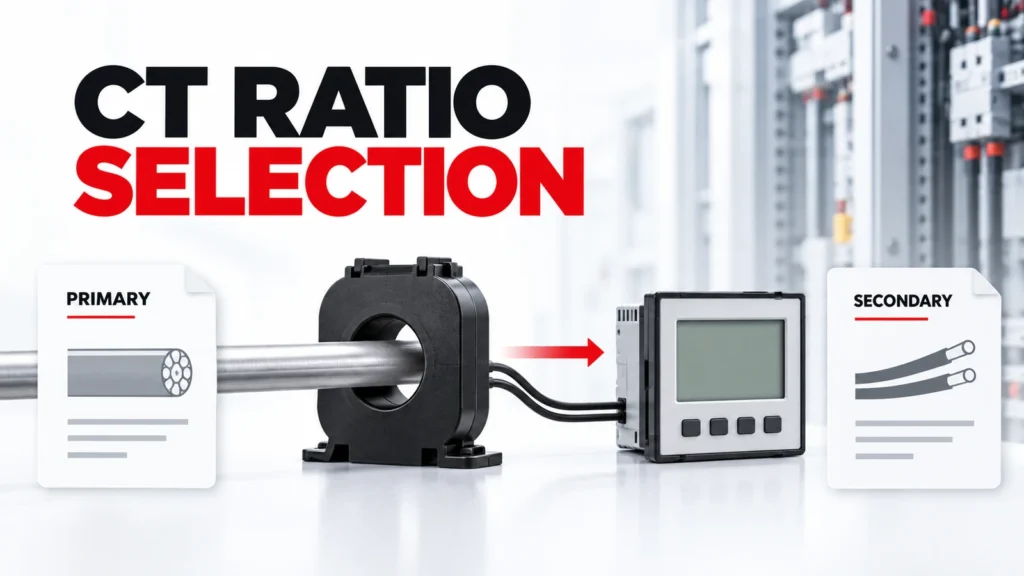
This guide explains the evidence chain for a current-transformer ratio. It does not calculate a project ratio, declare compatibility with a meter or protection relay, or provide secondary wiring or safety instructions.
決策輸入要素一覽
| 評論欄位 | 買方必須界定 | 應索取的證據 |
|---|---|---|
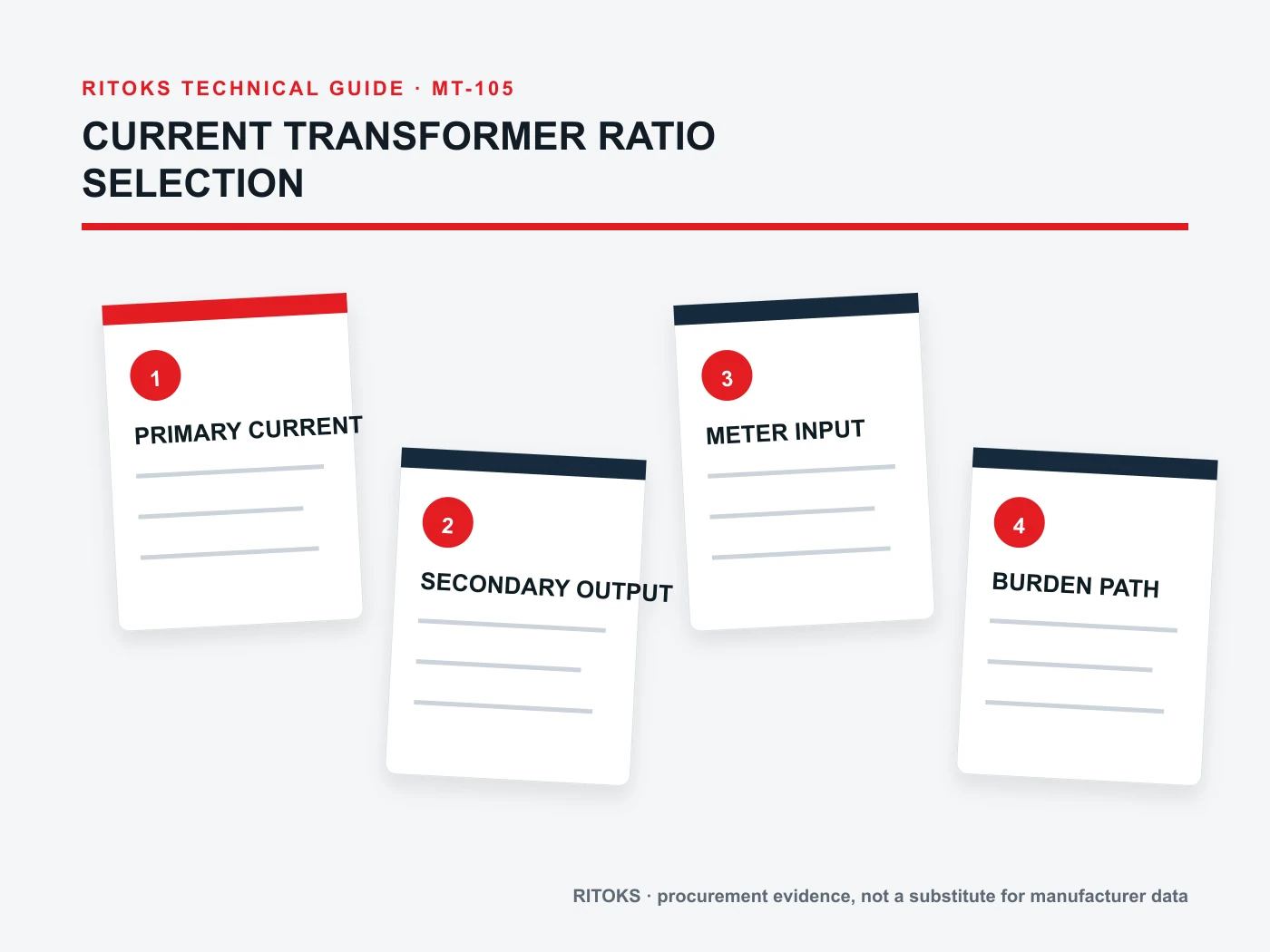
| Primary current | Normal, maximum and relevant operating range | Project load study |
| 次級輸出 | Exact input required by the receiving meter or relay | Receiving-device manual |
| 比率 | Declared primary-to-secondary relationship | Exact CT model row |
| Measurement performance | Accuracy and burden under documented conditions | Manufacturer data and system calculation |
| 機械配合 | Window, conductor, mounting and installation constraints | Drawing and installation review |
Start With the Real Primary Current Range
The primary side should be described by the expected operating current, maximum normal condition and any meaningful variation that affects measurement. Selecting from conductor ampacity or protective-device frame size alone can place normal readings in an unsuitable part of the measurement range.
Record how the current estimate was obtained and whether future operating modes change it. The buyer does not need to force a final ratio before the receiving-device input and measurement objective are known.
Match the Secondary Output to the Receiving Device
A current transformer and a meter form an interface. The CT secondary declaration must match the exact input expected by the meter, transducer or relay. A familiar ratio notation is not enough to establish that relationship. Request both documents and review them together.
Do not use a product family page to infer input compatibility. Neighboring meter variants may accept different sensors or secondary signals. The approval record must name the exact receiving device and its terminal documentation.
Understand What the Ratio Expresses
The ratio states the declared relationship between primary current and secondary output under the product's defined conditions. It does not by itself establish accuracy across the required operating range, available burden, saturation behavior or suitability for protection. Those are separate evidence fields.
When quotations offer different ratios, compare the resulting measurement use rather than treating the values as catalog alternatives. Each proposal should explain how the ratio aligns with the project's primary-current range and receiving input.
Review Burden and Accuracy as a System
The connected input, lead path and terminals contribute to the secondary circuit seen by the transformer. The responsible engineer should calculate and verify that complete circuit against the exact CT and receiving-device documents. Procurement should preserve the inputs rather than guessing from a headline accuracy class.
Ask where accuracy is declared, at which conditions and for which order code. Never combine the ratio of one model, burden data from another and dimensions from a third. If the system calculation is missing, mark the proposal incomplete.
Confirm Frequency, Purpose and Operating Context
State whether the measurement supports indication, energy monitoring, control, protection or another purpose. These uses can demand different evidence. Also record the system frequency and waveform context that the manufacturer requires for its declaration.
This guide deliberately avoids treating a measurement CT as a protection CT or vice versa. The proposed device must be documented for the intended role, and any special behavior must be evaluated by the system designer.
Verify Window Size and Installation Constraints
The primary conductor, bar arrangement, insulation, bending space and access determine whether the CT can be installed. A ratio match does not prove mechanical fit. Request the exact outline drawing and confirm that the window accommodates the real conductor without unsupported modification.
For retrofit work, a split-core construction may change installation access, but it does not remove the need to review ratio, output, burden, accuracy and environmental conditions. Keep construction choice separate from electrical approval.
建立精確模型證據檔案
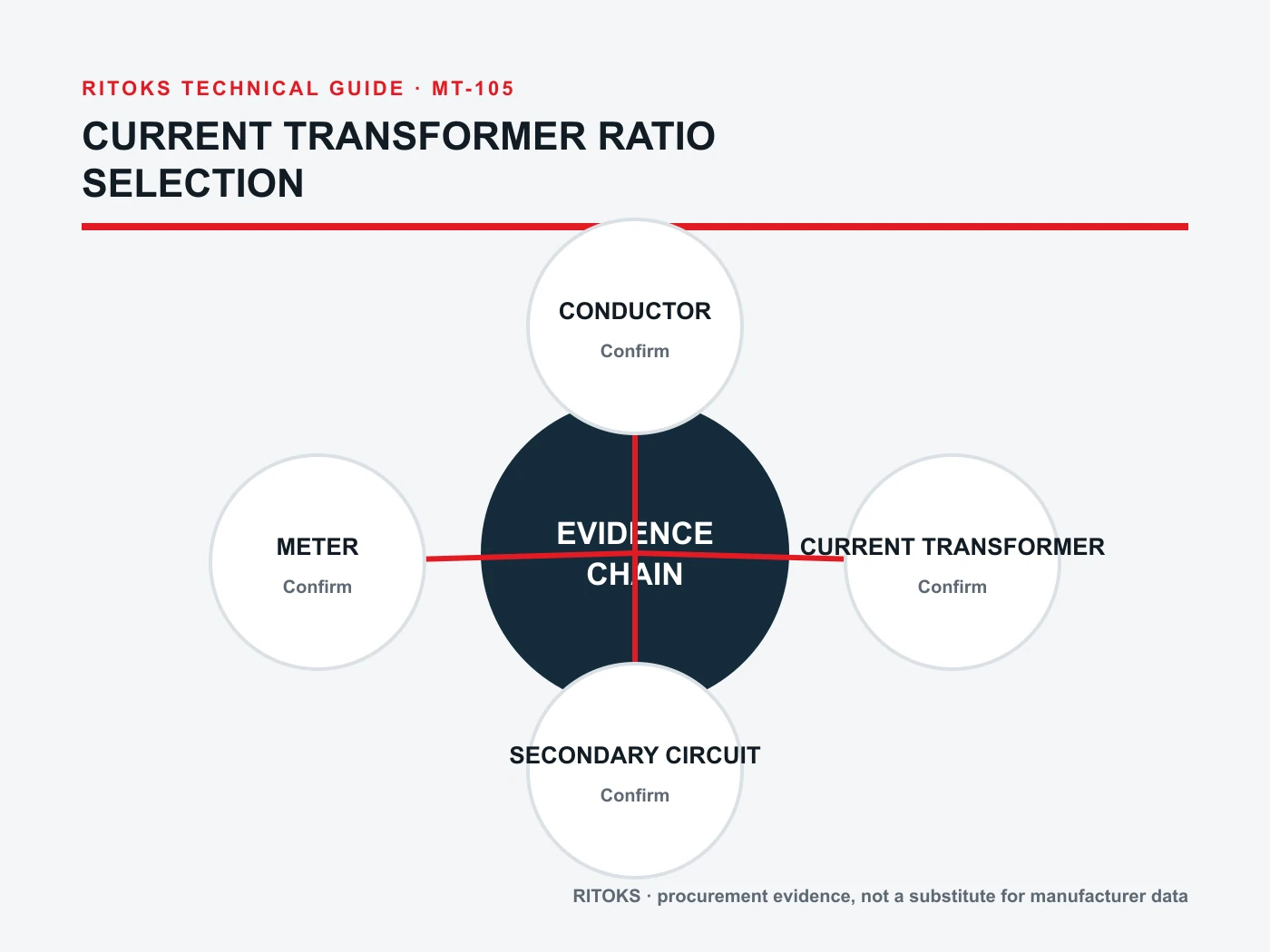
Create one approval record for the proposed Current Transformer order code. Put each project requirement beside the supplier document that answers it. Preserve the exact datasheet, drawing, table, instruction or selection output used, including its revision or retrieval date. A category page can establish family context, but it cannot prove an exact rating, terminal arrangement or system combination.
請確認每項已接受的陳述皆描述同一項可訂購商品。外觀相似的產品可能包含不同的電路、電源、端子、配件或功能。請勿將某個變體的「產品系列最大值」、另一個變體的「示意圖」以及第三個變體的「選配功能」混為一談。請明確標示尚未解決的欄位,以便在商業審查階段仍能清晰可見。.
將專案輸入與產品證據分開處理
The project team defines the application: source, load, duty, environment, controls, mechanical limits and required functions. The supplier identifies an exact Current Transformer and supports it with exact documents. Neither side should fill a gap by inference from appearance, a shared family name or one matching headline value.
在比對報價期間,請暫停申請紀錄。若拓撲結構、電源、負載、環境、機櫃或所需輸出有所變更,請發布修訂版紀錄,並請各供應商重新確認候選方案。否則,表面上看似可比的報價,實際上可能針對不同的技術要求所作出的回應。.
常見的採購錯誤
Avoid selecting a Current Transformer from one headline value while the application context remains incomplete. Do not use a circuit, curve, terminal drawing or performance claim from a neighboring model. A product photograph and a family page can support discovery, but neither is exact technical evidence.
此外,請勿假設某項配件、通訊功能、防護作用或協作結果已包含在內,除非其明確列於報價單及確切型號文件中。替代品須與原始候選方案具備相同的拓撲結構、額定值、安裝方式,並需經過相同的證據審查。.
如何比較供應商的報價
Normalize every Current Transformer offer to the same application record. Keep document revisions, stated conditions, included accessories and open questions beside each value. This makes differences in delivered scope visible and prevents a lower-cost but narrower offer from appearing equivalent to a complete solution.
當關鍵應用輸入值未知、所引用的型號含糊不清、必要聲明僅由其他製造商或訂購代碼支持,或安裝情況超出現有證據範圍時,請停止進行比較。這些屬於工程上的缺口,而非編輯上的細節。.
控制修訂與替換
Give the approved Current Transformer record a revision identifier and keep it with the project file. If the supplier changes the order code, accessory, firmware, drawing or stated operating condition, identify the change before accepting it. A substitution is a new technical proposal even when its price, housing or product-family name looks familiar.
僅需重做受影響的檢查項目,但切勿豁免這些檢查。請確認修訂後的候選方案仍符合「凍結申請」的要求,所有被引用的文件均屬該申請範圍,且所有未解決的例外情況均有負責人。此項簡短的變更控制步驟,可防止經技術審查的選定方案被未經審查的商業替代方案所取代。.
決策工作流程
- 在選擇目錄代碼之前,請先凍結應用程式與系統記錄。.
- 請列出需要提供憑證的每一項函式及其所有介面。.
- 請提供一個完整的訂單編號,並附上其最新資料表與圖面。.
- 將每個專案需求與特定的製造商聲明進行對應。.
- 記錄偏差、附件、文件修訂及未解決的問題。.
- 每當應用程式或擬推出之產品有所變更時,應重新進行審查。.
Use this workflow as a procurement and evidence discipline. It does not replace qualified design, installation instructions or the responsible engineer's approval for the Current Transformer application.
詢價單(RFQ)準備檢查清單
A practical current transformer ratio selection should be concise enough for a supplier to answer and complete enough to prevent silent assumptions. Identify unknown values as questions rather than allowing them to become undocumented selections.
- Primary current: Normal, maximum and relevant operating range.
- Secondary output: Exact input required by the receiving meter or relay.
- Ratio: Declared primary-to-secondary relationship.
- Measurement performance: Accuracy and burden under documented conditions.
- Mechanical fit: Window, conductor, mounting and installation constraints.
- 確切的產品代碼、隨附配件及文件版本
- 數量、目的地、所需核准事項及商業範圍
請要求提供任何分類、相容性、協調性或性能聲明之確切範圍。請在技術輸入項之後記錄數量與目的地,以免商業條款掩蓋尚未解決的工程問題。.
常見問題
Can CT ratio be selected from breaker size alone?
No. Use the real current range, receiving-device input and measurement objective.
Does a matching secondary value prove compatibility?
No. Burden, accuracy, frequency, terminals and the exact interface still require review.
Can a current transformer secondary be treated as an ordinary signal?
No. Follow qualified design practices and the exact manufacturer safety instructions.
相關 RITOKS 產品與指引
這些連結僅提供產品系列的背景資訊。此類背景連結並不表示產品可互換、相容,或構成經核准的系統組合。.
BH-0.66-60I current transformer family
GTA20L precision current transformer
技術參考資料
這些製造商來源僅用於支持下文所述的一般工程概念。其產品規格、電路圖、認證及協調結果均不適用於 RITOKS 產品。.
Supports treating the meter input and measurement architecture as part of the complete system record. Schneider meter inputs do not establish compatibility with RITOKS CTs.
申請精確型號審查
請透過 RITOKS 聯絡表單提交申請要求、具體文件相關問題、數量及目的地。詢價單(RFQ)需進行確切型號的審查;本指南不核准任何電路、安裝方式或自動替代方案。.