
Thermal Overload Relays for Motor Protection · RFQ Checklist
Thermal Overload Relay RFQ Checklist
A useful thermal overload relay RFQ does more than name a motor power or request a familiar relay series. It defines the motor operating current, starting duty, relay adjustment range, reset behavior, auxiliary-control needs, installation arrangement and the evidence required for the complete starter architecture. These inputs allow suppliers to quote an exact orderable item instead of guessing from one headline value.
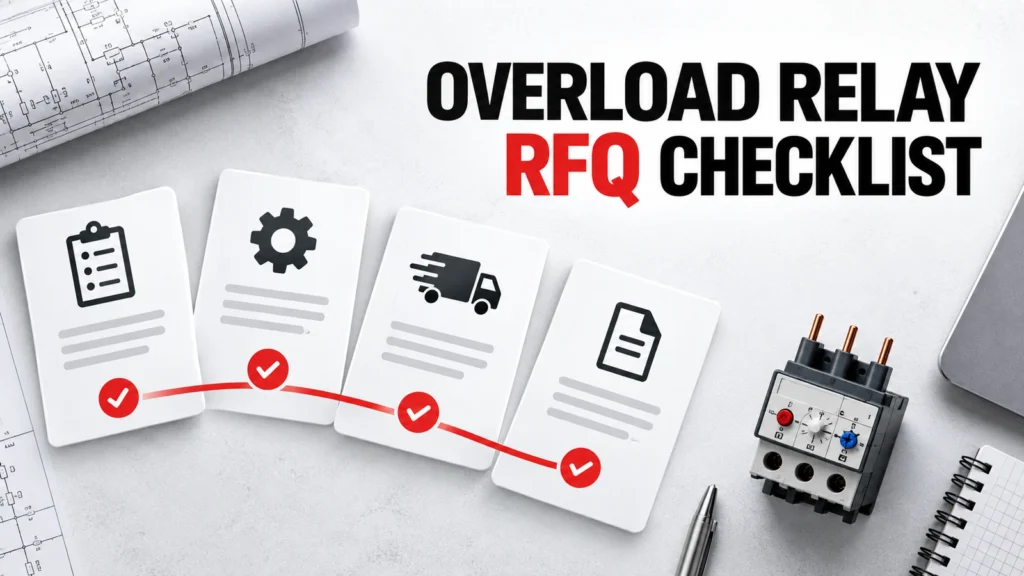
This checklist organizes buyer inputs for a thermal overload relay. It does not set a relay for a specific motor, prescribe a starter circuit, or claim that a ZS3RU relay coordinates with any contactor, fuse, circuit breaker or MPCB without exact documentation for that combination.
Decision Inputs at a Glance
| Decision input | Buyer must confirm | Evidence required |
|---|---|---|
| Motor load | Nameplate current, supply, phase arrangement and operating duty | Motor data and project load record |
| Relay range | Required current-adjustment range around the documented setting basis | Exact relay range and setting instructions |
| Starting behavior | Starting method, acceleration time and restart frequency | Trip behavior suitable for the application |
| Control interface | Reset mode and required auxiliary contacts | Exact contact and control diagram |
| Assembly | Mounting method, contactor interface and upstream protection | Exact mechanical and coordination documents |
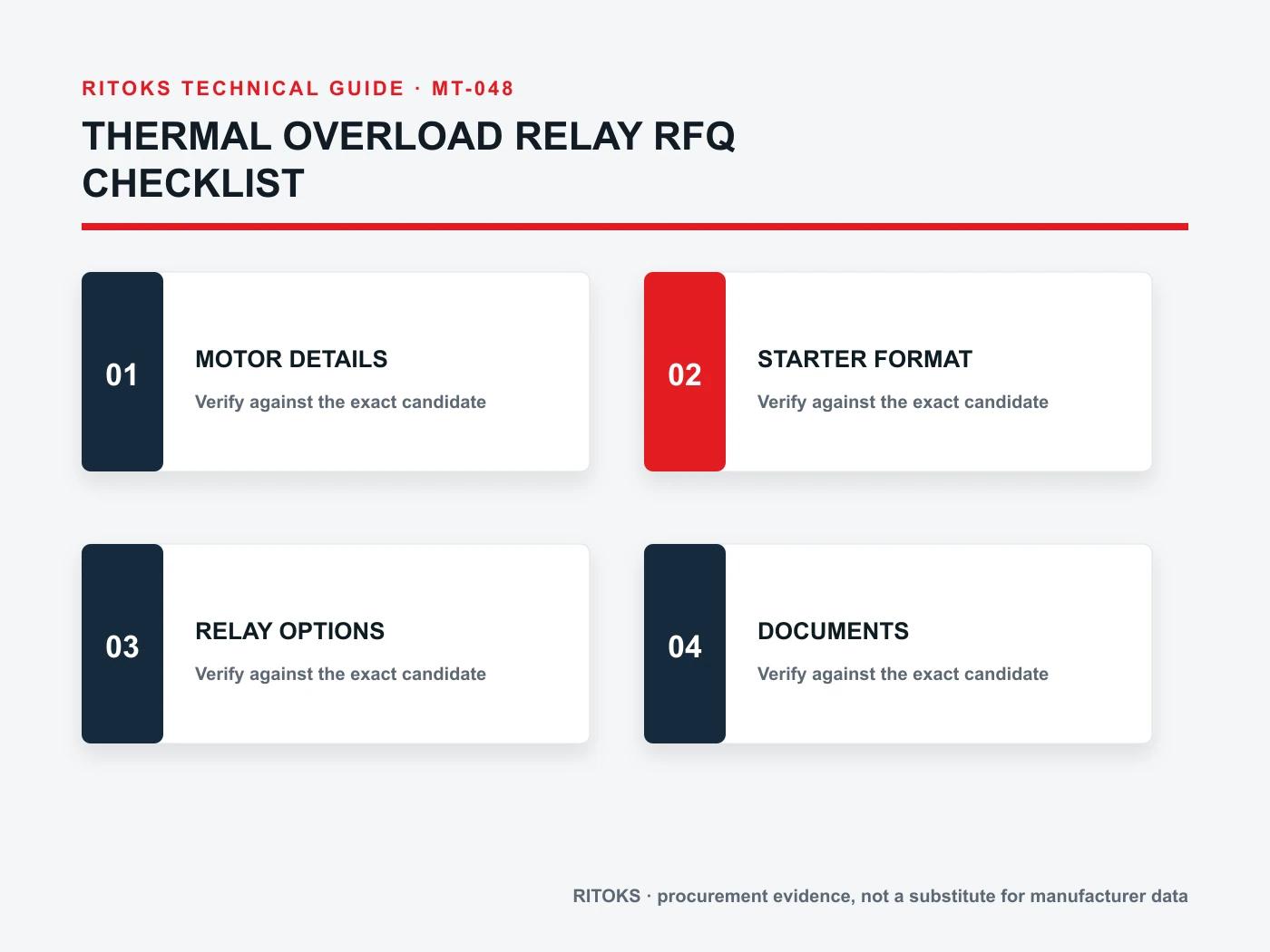
Start With the Motor and Supply Record
Provide the motor nameplate data that directly affects overload selection, including rated current, supply arrangement, frequency and operating mode. Add the driven-load description, because a lightly loaded fan and a high-inertia machine can impose very different starting and thermal patterns even when their motor power is similar.
Do not ask the supplier to infer full-load current from kilowatts alone. Efficiency, power factor, voltage and design details affect the current. If the motor has multiple ratings or connection options, identify the exact operating connection and the rating that applies to the panel.
Define Starting and Duty Conditions
State whether the motor starts direct-on-line, through another starting method, or under a mechanically loaded condition. Record expected acceleration time, starts per hour, jogging or plugging behavior, and any process condition that can hold the motor near overload without immediately creating a short circuit.
The relay must tolerate legitimate starting while responding to sustained overload according to the selected protection strategy. A generic request for a slow or fast relay is not enough. Ask for the exact trip information and the conditions under which it is valid.
Specify the Adjustment and Reset Requirements
Give the required current range as an engineering input, not merely a preferred catalog code. The exact setting method must follow the motor data, relay documentation and applicable design rules. If ambient compensation, phase-failure sensitivity or another function matters, require it explicitly and ask where it is documented.
Choose manual or automatic reset deliberately. Automatic reset can create unexpected restart risk when the control circuit permits it. The RFQ should identify the required reset method, remote or local reset needs, and how a trip must be indicated or latched in the control logic.
Describe Auxiliary Contacts and Control Logic
List the normally closed and normally open auxiliary-contact functions needed for contactor dropout, alarm indication, PLC status or maintenance diagnostics. Define the control voltage and the circuit role, but leave terminal assignment to the exact approved diagram.
An auxiliary contact is a control signal, not proof of a complete safety function. If the machine requires a safety-rated stop, monitored restart or another protective function, handle that in the system design and request the relevant certified components separately.
Verify Contactor and Protection Coordination
Identify the intended contactor family, mounting interface and upstream short-circuit protective device. An overload relay addresses sustained overcurrent in its documented role; it does not automatically provide the interrupting function required for a fault.
Ask the supplier for exact coordination or compatibility documentation when a combined starter is proposed. Matching a physical footprint or current range does not prove thermal, mechanical or short-circuit coordination. Keep the exact order codes and document revisions together.
Record Installation and Environment
State enclosure conditions, mounting orientation, internal temperature range, altitude when relevant, vibration exposure and contamination. These conditions can affect device selection, terminal practices and derating requirements.
Also record conductor type and size, terminal-access constraints, required accessories and available panel space. Do not assume that a relay photographed beneath a contactor includes the connection kit or fits the planned assembly.
Build an Exact-Model Evidence File
Create one approval record for the proposed Thermal Overload Relay order code. Put each project requirement beside the supplier document that answers it. Preserve the exact datasheet, drawing, curve, table or selection output used, including its revision or retrieval date. A category page can establish family context, but it cannot prove an exact rating, terminal arrangement or system combination.
Check that every accepted statement describes the same orderable item. Similar housings can contain different circuits, supplies, terminals, accessories or protection functions. Do not combine a family maximum from one variant, a diagram from another and an optional feature from a third. Mark unresolved fields explicitly so they remain visible in the commercial review.
Keep Project Inputs Separate From Product Evidence
The project team defines the application: source, load, duty, environment, controls, mechanical limits and required functions. The supplier identifies an exact Thermal Overload Relay and supports it with exact documents. Neither side should fill a gap by inference from appearance, a shared family name or one matching headline value.
Freeze the application record while quotations are being compared. If the load, voltage, duty, environment, cooling method, enclosure or required output changes, issue a revised record and ask each supplier to reconfirm the candidate. Otherwise apparently comparable quotations may be answering different technical requirements.
Common Procurement Errors
- Selecting Thermal Overload Relay from one headline rating while the application context remains incomplete.
- Using a circuit, curve, terminal drawing or performance claim from a neighboring model.
- Treating a family page or product photograph as exact technical evidence.
- Assuming an accessory, system function or coordination result is included without documentation.
- Approving a substitute without repeating the topology, rating, mounting and evidence review.
Resolve these gaps before comparing price and lead time. The reviewer should be able to trace every accepted statement either to the project requirement or to the exact candidate document. A proposal may remain commercially interesting while technically incomplete, but missing evidence must not disappear inside the quotation.
How to Compare Supplier Offers
| Comparison point | Required evidence | Do not accept |
|---|---|---|
| Motor data | Rated current, voltage, phase and duty recorded | Motor power alone |
| Trip behavior | Exact curve/class information under stated conditions | Generic “motor protection” wording |
| Reset | Manual or automatic behavior deliberately selected | Factory default assumed |
| Contacts | Required NC/NO functions and ratings documented | Contact symbols inferred from a photograph |
| Coordination | Exact contactor and upstream device evidence | Same brand or matching width treated as proof |
| Installation | Mounting, terminals and environment defined | Panel fit checked after purchase |
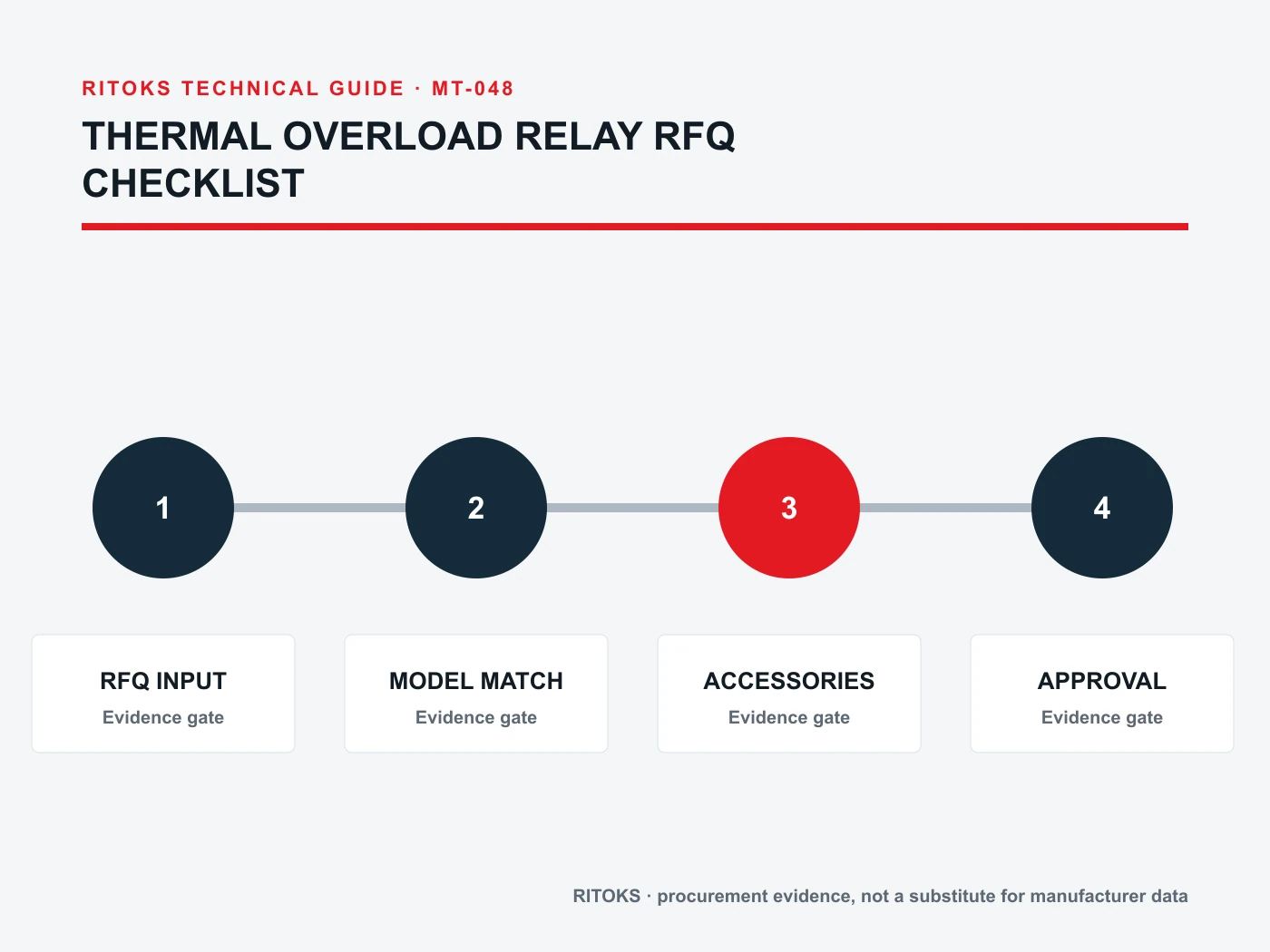
Normalize every Thermal Overload Relay offer to the same application record. Keep document revisions, test conditions, included accessories and open questions beside each value. This makes differences in delivered scope visible and prevents a lower-cost but narrower offer from appearing equivalent to a complete solution.
Decision Workflow
- Freeze the motor and driven-load record.
- Document starting time, starts per hour and abnormal-load scenarios.
- Define the required current range and reset method.
- List auxiliary-contact and control-circuit functions.
- Identify the contactor and upstream protective-device architecture.
- Request exact-model trip, mounting and coordination documents.
- Resolve all exceptions before releasing the order.
At each step, stop when a critical application input is unknown, the quoted model is ambiguous, a required claim is supported only by another manufacturer or another order code, or the installation falls outside the available evidence. These are engineering gaps, not editorial details.
RFQ Preparation Checklist
Keep the RFQ concise enough for suppliers to answer, but complete enough to prevent silent assumptions. Identify unknown values as questions and require a full orderable code rather than a generic family recommendation.
- Motor nameplate and full-load current
- Supply voltage, frequency and phase arrangement
- Starting method, acceleration time and starts per hour
- Required adjustment range and setting basis
- Manual or automatic reset requirement
- Required auxiliary contacts and control voltage
- Contactor interface and upstream protection details
- Mounting, terminal, environment, quantity and destination
Request the current datasheet revision and the exact scope of any certification, compatibility, coordination or performance claim. Record quantity and destination after the technical inputs so commercial terms do not obscure unresolved engineering questions.
Frequently Asked Questions
Can I select an overload relay from motor kilowatts alone?
No. Use the exact motor current and application duty together with the relay documentation.
Does an overload relay replace short-circuit protection?
No. Its role and the upstream fault-protection arrangement must be documented separately.
Should an RFQ specify automatic reset?
Only when the risk assessment and control design permit it. The restart behavior must be explicit.
Related RITOKS Products and Guidance
These links provide product-family context only. A contextual link does not claim interchangeability, compatibility or an approved system combination.
Thermal Overload Relay product category
Thermal overload relay vs circuit breaker
Technical References
These primary manufacturer sources support only the general engineering concepts described below. Their product ratings, circuit diagrams, approvals and coordination results do not transfer to RITOKS products.
ABB, Contactors and Overload Relays Guide
Supports general overload-relay selection inputs, reset and auxiliary-control concepts, and the need for coordinated motor-control documentation. ABB ratings and combinations do not transfer to RITOKS products.
ABB, Control Catalog: IEC Manual Motor Starters
Supports separating thermal overload behavior, magnetic short-circuit response, trip information and coordination evidence. Exact ABB characteristics do not describe a RITOKS MPCB.
Request an Exact-Model Review
Send the application requirements, exact-document questions, quantity and destination through the RITOKS contact form. An RFQ requests an exact-model review; this guide does not approve a circuit, installation or automatic substitute.