
Cabinet Cooling Fans · Technical Explainer
Control Cabinet Ventilation: Air Path and Filter Maintenance Context
Control cabinet ventilation is an enclosure-level airflow problem, not simply a fan purchase. A useful design defines the internal heat load, permitted temperature rise, ambient air quality, inlet position, outlet position, resistance through filters and grilles, and the maintenance work required to keep the path open.

This application guide explains how to review the ventilation context before an RFQ. It does not calculate final airflow for an unknown cabinet, prescribe a wiring design or claim that one airflow, protection class or filter interval applies to every RITOKS cabinet fan.
Buying Decision at a Glance
| Decision input | Buyer must confirm | Evidence required |
|---|---|---|
| Thermal objective | Internal heat loss and permitted rise above ambient | Heat-loss record and project temperature limit |
| Ambient air | Temperature, dust, oil mist, humidity and corrosive exposure | Site condition record |
| Air path | Inlet, heated components, obstructions and outlet | Marked enclosure layout |
| Resistance | Filter, grille, louvre and internal pressure loss | Operating-point airflow evidence |
| Maintenance | Filter access, inspection trigger and replacement method | Service plan and exact instructions |
Start With the Heat and Ambient Boundary
List the losses released inside the cabinet by drives, power supplies, transformers, contactors and other equipment at the defined duty. The required air exchange depends on this heat and on how much warmer the internal air may become than the air entering the cabinet. Cabinet volume or fan frame size alone cannot answer that question.
Ambient-air cooling also depends on the surrounding air being suitable. If ambient temperature is already above the permitted cabinet temperature, ventilation cannot create a colder internal condition. Heavy dust, conductive particles, oil mist, corrosive gas or high humidity can make open-loop ventilation unsuitable or can increase the filtration and maintenance burden.
Lay Out One Continuous Air Path
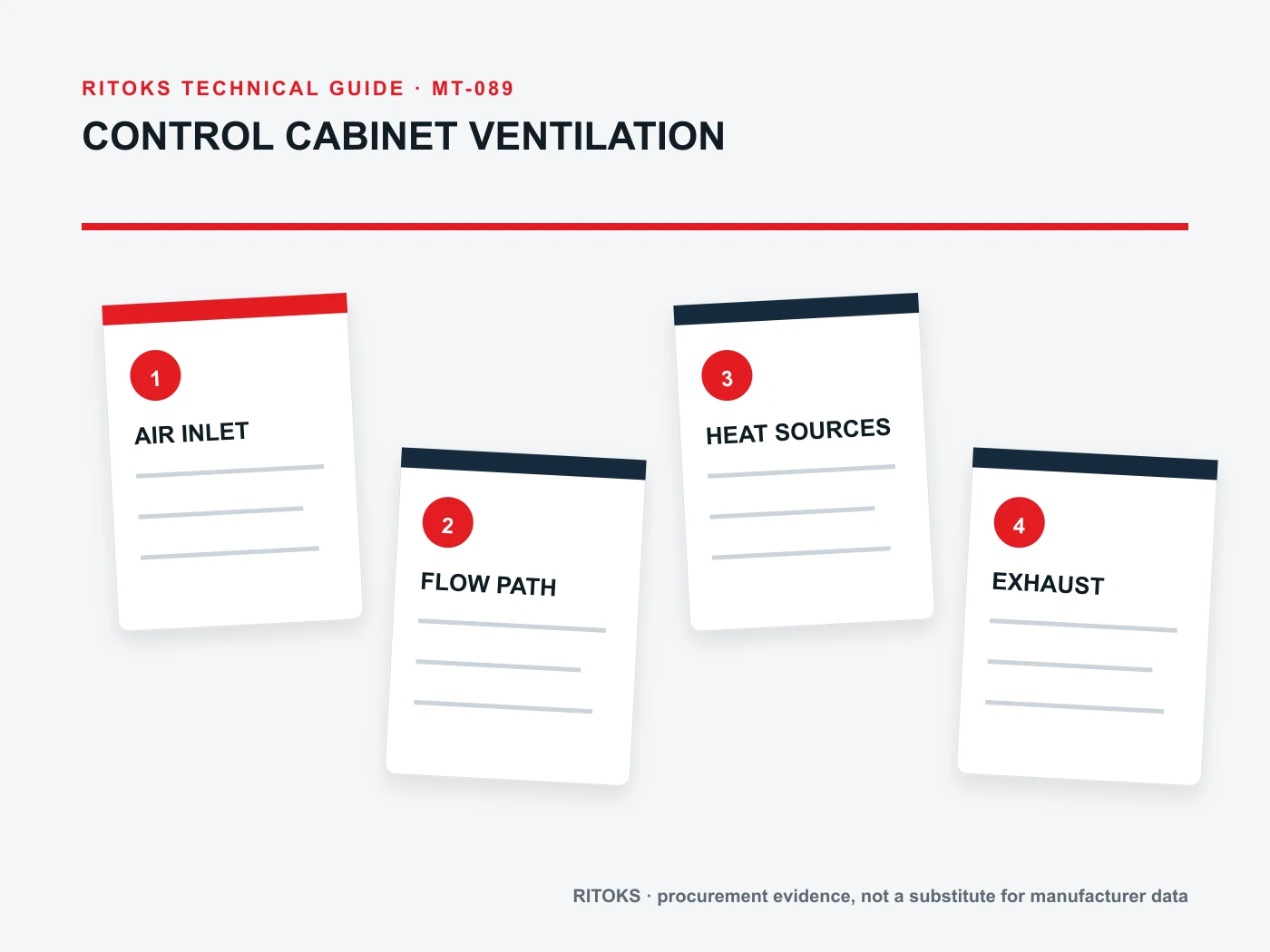
Mark the intended inlet and outlet on the cabinet drawing, then trace how air reaches each major heat source. Cable ducts, densely packed devices, internal partitions and unused dead spaces can redirect or block flow. The arrangement should avoid a short path that sends fresh air directly from inlet to outlet while hot components remain in stagnant zones.
A lower filtered inlet and a separated upper outlet can support natural buoyancy, but that pattern is not universal. Door construction, component placement and site constraints matter. State whether the design intends positive or negative cabinet pressure and where unfiltered leakage could occur.
Compare Airflow at System Resistance
A free-air airflow value describes a fan without the resistance of the installed system. Filters, grilles, louvres, guards and internal obstructions add pressure loss, while filter loading can increase it over time. Ask for performance evidence that is relevant to the assembled path rather than treating the largest free-air value as the winner.
If a fan curve or filtered-air rating is available, preserve the test condition beside the number. Do not combine the airflow of one model with the filter or grille of another. A fan-only quotation and a complete cabinet filter-fan assembly are different purchasing scopes unless all missing parts and engineering responsibilities are identified.
Control Recirculation and Hot Spots
Internal circulation fans may improve air movement across a local device but do not automatically exchange cabinet air with the room. Conversely, a high enclosure exchange rate does not prove that air passes through a restricted heatsink or around a blocked drive. Separate local component airflow from whole-cabinet ventilation in the review.
Temperature measurement points should reflect the equipment at risk, not only the coolest location near the inlet. During validation, record load, ambient temperature, door state, fan state and stabilization time so the result can be repeated. A thermal image can help locate hot areas, but it does not replace accurate surface and air-temperature measurement.
Make Filter Maintenance Part of the Design
A filter is a consumable resistance element. Define how the site will inspect it, what condition triggers cleaning or replacement, and how service can occur safely. The interval should follow actual contamination and thermal consequence rather than an unsupported universal calendar value.
Provide front access, replacement clearance and a way to identify the correct medium. If maintenance is likely to be skipped because the grille is obstructed or the spare is ambiguous, the ventilation design is incomplete. Record the effect of a loaded filter in commissioning or maintenance acceptance criteria.
Build an Exact-Configuration Evidence File
Create one review sheet for the proposed Cabinet Fan order code. Put project inputs in one column and supplier evidence in the other. Preserve the exact datasheets, drawings, curves, tables and manuals used in the decision, including their revision or retrieval date. A category page can establish family context, but an exact rating, setting, protocol or connection claim must trace to the quoted configuration.
Check that every accepted value describes the same orderable item. Similar housings and family names can hide different circuits, supplies, terminals, controls, mounting details or accessories. Do not combine a family maximum from one variant, a drawing from another and an optional feature from a third. Keep unresolved fields visible in the technical comparison.
Control Changes During Sourcing
Freeze the application record while suppliers respond. If the load, voltage, environment, duty, enclosure, control method or required output changes, issue a revised record and ask each supplier to reconfirm the candidate. Otherwise quotations can appear comparable while answering different technical requirements.
A proposed substitute returns to the same evidence gate. Matching dimensions, a similar product photograph or one equal headline rating is not enough. The substitute must satisfy the required functions and conditions using its own exact documentation.
Common Procurement Errors
- Selecting a Cabinet Fan from one headline value while leaving the application context undefined.
- Using a curve, setting table, register map or connection diagram from a neighboring model.
- Treating a family maximum or ideal test condition as the application operating point.
- Assuming included accessories, controls and system functions from the product name or photograph.
- Approving a substitution without reopening the technical evidence review.
A fan's free-air airflow is not the flow through loaded filters, grilles and crowded cable ducts. An inlet-to-outlet layout that bypasses heat sources can leave hot spots even when a catalog flow number looks sufficient.
How to Compare Supplier Offers
| Comparison point | Required evidence | Do not accept |
|---|---|---|
| Heat basis | Loss schedule and permissible temperature rise | Fan chosen by cabinet size only |
| Air path | Inlet, components and outlet marked on drawing | Fan position without flow review |
| Airflow | Evidence at relevant resistance | Free-air value alone |
| Contamination | Site conditions and filter strategy recorded | Generic “dusty area” note |
| Service | Accessible filter and inspection method | Undefined replacement interval |
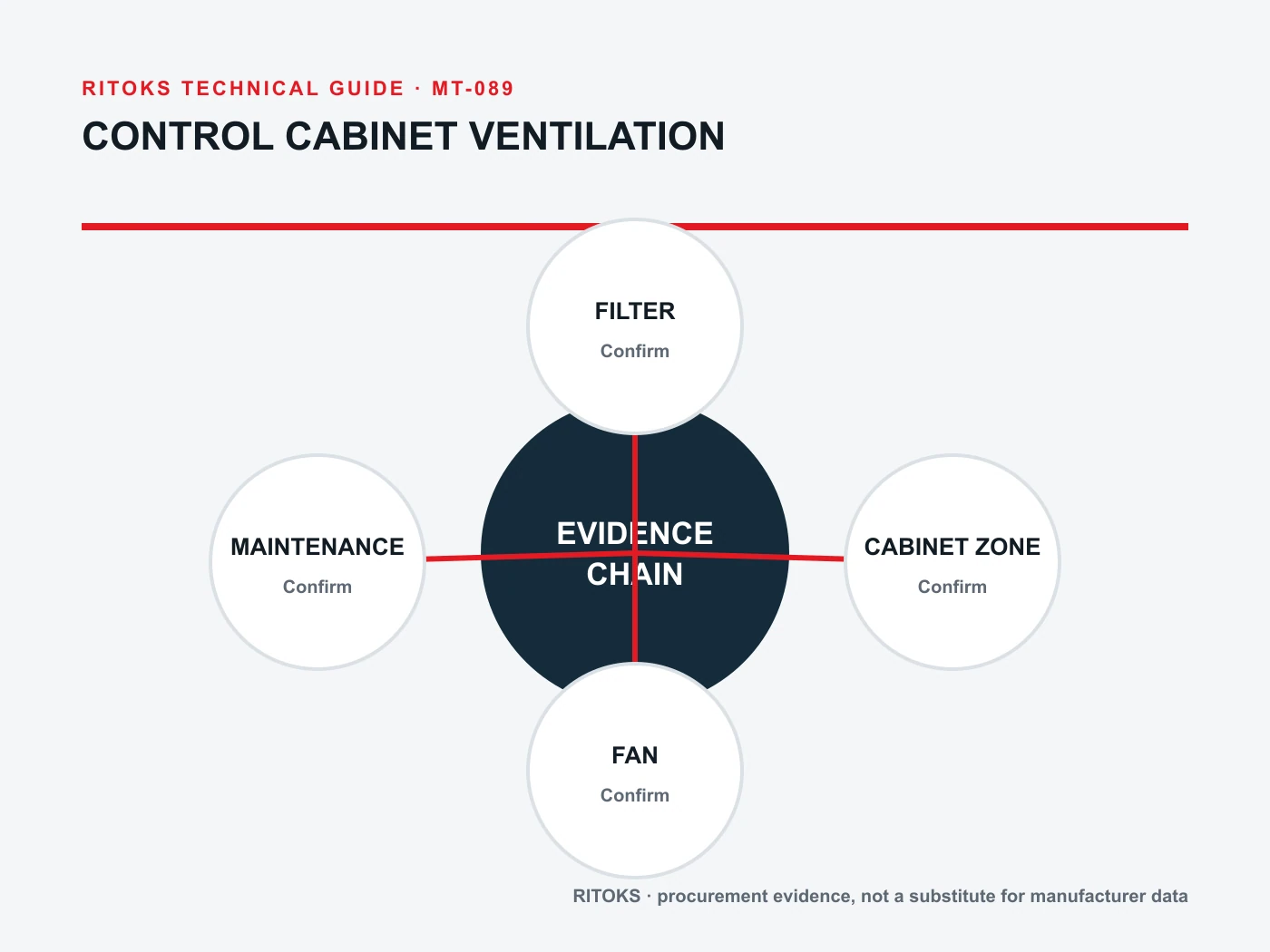
Normalize every Cabinet Fan offer to the same application record. Keep document revisions, test conditions and open questions beside each value. A proposal can remain commercially interesting while technically incomplete, but missing evidence should stay visible until resolved.
Decision Workflow
- Freeze the cabinet layout and equipment heat-loss record.
- Confirm maximum ambient and air-contamination conditions.
- Draw the complete inlet-to-outlet path.
- Identify filter, grille and obstruction resistance.
- Compare exact fan or assembly evidence at relevant conditions.
- Define temperature verification and filter maintenance before order release.
Map internal heat sources and ambient-air suitability, then mark one continuous inlet-to-outlet path on the cabinet drawing. Compare fan performance at system resistance and define filter inspection access before accepting the ventilation proposal.
RFQ Preparation Checklist
A useful RFQ for control cabinet ventilation is concise enough to answer and complete enough to prevent silent assumptions. Identify unknown values as questions and require an exact orderable code rather than a generic family recommendation.
- Cabinet dimensions and internal layout
- Heat-loss estimate and operating duty
- Maximum ambient and permitted internal temperature
- Dust, oil mist, moisture and corrosive exposure
- Required airflow evidence and pressure-loss context
- Inlet, outlet and cutout constraints
- Supply, control, quantity, destination and maintenance requirements
Request the current datasheet and manual revisions and the scope of any certification, compatibility or performance claim. Record quantity and destination after the technical inputs so commercial terms do not obscure unresolved engineering questions.
Stop Conditions Before Order Release
Do not release the order while a critical application input is unknown, the quoted model is ambiguous, a required claim is supported only by another product document, or installation conditions fall outside the available evidence. These are engineering gaps, not editorial details.
The approval record should state what the selected item does, what remains outside its scope and which exact documents support the decision. If the application or candidate changes, reopen the affected checks rather than carrying the previous conclusion forward.
Frequently Asked Questions
Can a larger fan fix every cabinet hot spot?
No. Air path, system resistance, component blockage and ambient temperature can limit cooling even when the fan is larger.
Is free-air airflow enough for comparison?
No. Compare performance under the resistance created by the filter, grille and installed path.
How often should a cabinet filter be replaced?
Set the interval from contamination, pressure or temperature evidence and the exact filter instructions. There is no universal interval.
Related RITOKS Products and Guidance
Use these destinations as separate category, product and guidance records. A contextual link does not claim interchangeability, coordination, compatibility or approval for a particular application.
Industrial AC axial cooling fans
Technical References
These primary standards or manufacturer sources support only the general concepts identified below. Their product values, diagrams, approvals and tested combinations do not transfer to RITOKS products.
Rittal, Technical System Catalogue: Cooling with Ambient Air
Supports enclosure heat-load, temperature-rise, airflow and ambient-air cooling concepts. Rittal formulas and product values apply only under their stated conditions and do not describe RITOKS products.
Request an Exact-Model Review
Send the application requirements, exact documentation questions, quantity and destination through the RITOKS contact form. An RFQ requests an exact-model review; this guide does not approve a wiring design, protection setting, installation or automatic substitute.