
Recursos técnicos · Guía técnica
Current Transformer Ratio Selection: Primary Current and Secondary Output
Specify a current transformer ratio from the primary circuit, secondary measurement input and exact burden and accuracy evidence. A useful buyer review connects the project requirement to one exact orderable product and preserves the evidence used for approval.
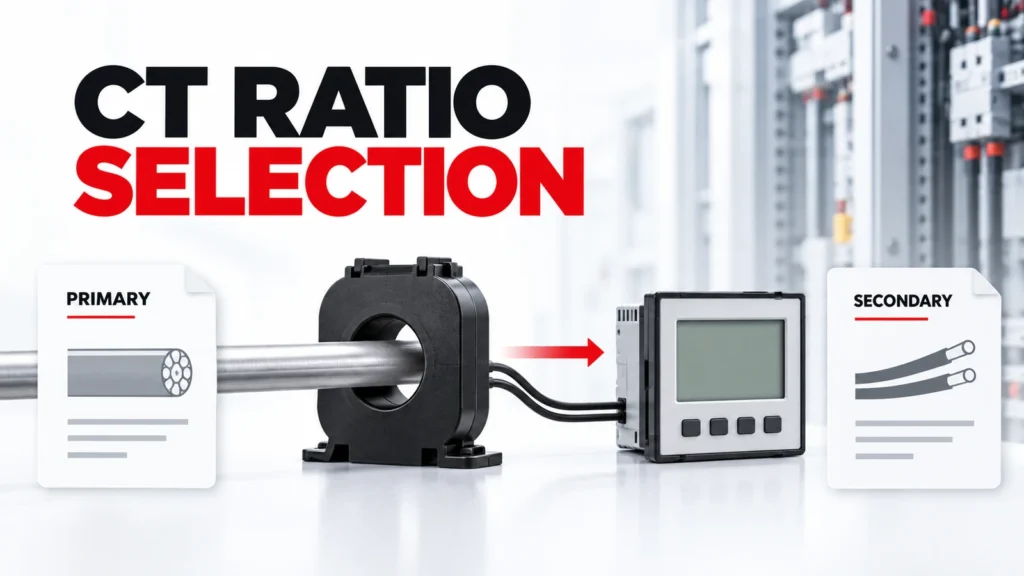
This guide explains the evidence chain for a current-transformer ratio. It does not calculate a project ratio, declare compatibility with a meter or protection relay, or provide secondary wiring or safety instructions.
Resumen de los datos para la toma de decisiones
| Campo de revisión | El comprador debe definir | Documentación que hay que solicitar |
|---|---|---|
| Primary current | Normal, maximum and relevant operating range | Project load study |
| Salida secundaria | Exact input required by the receiving meter or relay | Receiving-device manual |
| Proporción | Declared primary-to-secondary relationship | Exact CT model row |
| Measurement performance | Accuracy and burden under documented conditions | Manufacturer data and system calculation |
| Ajuste mecánico | Window, conductor, mounting and installation constraints | Drawing and installation review |
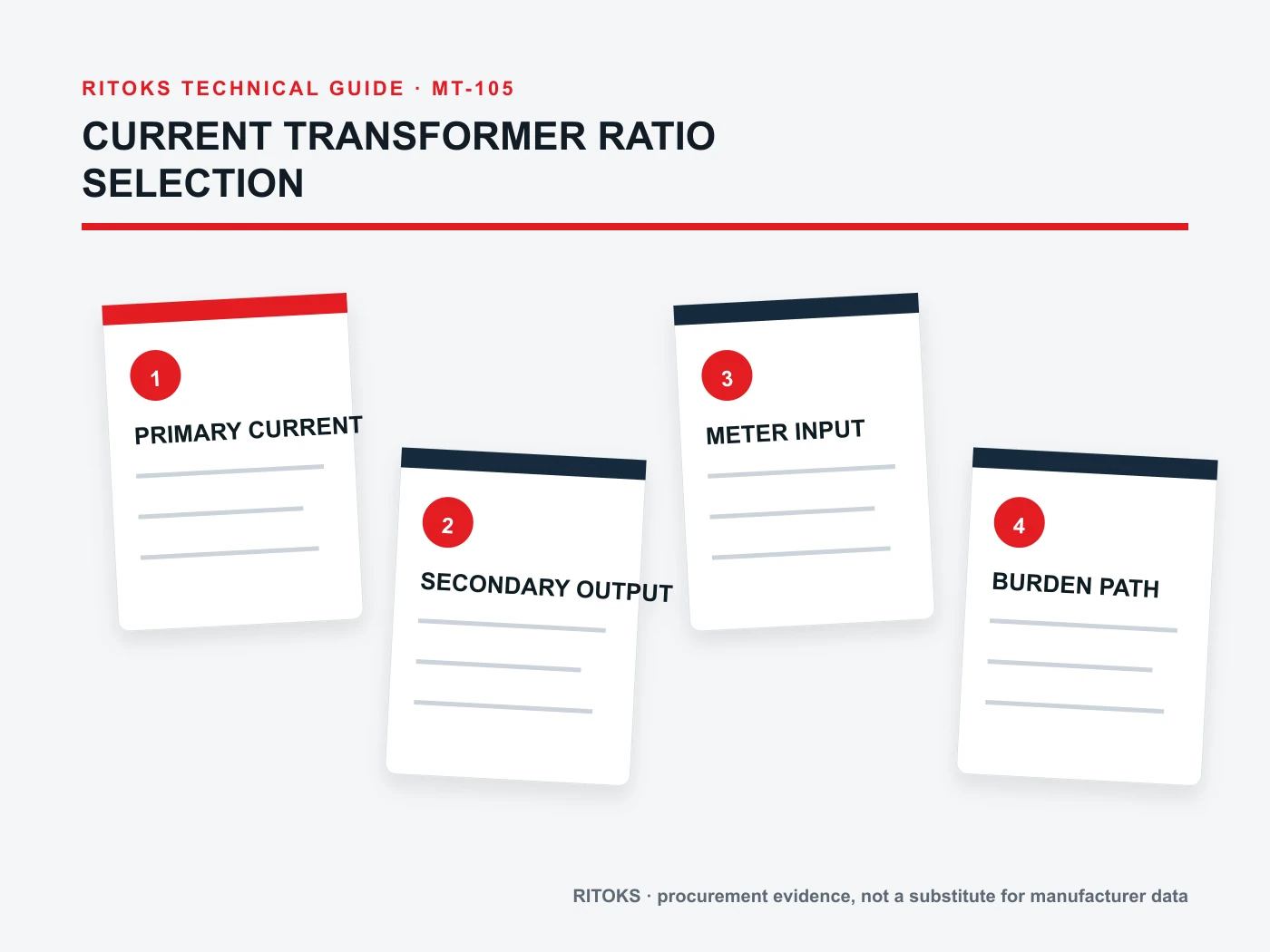
Start With the Real Primary Current Range
The primary side should be described by the expected operating current, maximum normal condition and any meaningful variation that affects measurement. Selecting from conductor ampacity or protective-device frame size alone can place normal readings in an unsuitable part of the measurement range.
Record how the current estimate was obtained and whether future operating modes change it. The buyer does not need to force a final ratio before the receiving-device input and measurement objective are known.
Match the Secondary Output to the Receiving Device
A current transformer and a meter form an interface. The CT secondary declaration must match the exact input expected by the meter, transducer or relay. A familiar ratio notation is not enough to establish that relationship. Request both documents and review them together.
Do not use a product family page to infer input compatibility. Neighboring meter variants may accept different sensors or secondary signals. The approval record must name the exact receiving device and its terminal documentation.
Understand What the Ratio Expresses
The ratio states the declared relationship between primary current and secondary output under the product's defined conditions. It does not by itself establish accuracy across the required operating range, available burden, saturation behavior or suitability for protection. Those are separate evidence fields.
When quotations offer different ratios, compare the resulting measurement use rather than treating the values as catalog alternatives. Each proposal should explain how the ratio aligns with the project's primary-current range and receiving input.
Review Burden and Accuracy as a System
The connected input, lead path and terminals contribute to the secondary circuit seen by the transformer. The responsible engineer should calculate and verify that complete circuit against the exact CT and receiving-device documents. Procurement should preserve the inputs rather than guessing from a headline accuracy class.
Ask where accuracy is declared, at which conditions and for which order code. Never combine the ratio of one model, burden data from another and dimensions from a third. If the system calculation is missing, mark the proposal incomplete.
Confirm Frequency, Purpose and Operating Context
State whether the measurement supports indication, energy monitoring, control, protection or another purpose. These uses can demand different evidence. Also record the system frequency and waveform context that the manufacturer requires for its declaration.
This guide deliberately avoids treating a measurement CT as a protection CT or vice versa. The proposed device must be documented for the intended role, and any special behavior must be evaluated by the system designer.
Verify Window Size and Installation Constraints
The primary conductor, bar arrangement, insulation, bending space and access determine whether the CT can be installed. A ratio match does not prove mechanical fit. Request the exact outline drawing and confirm that the window accommodates the real conductor without unsupported modification.
For retrofit work, a split-core construction may change installation access, but it does not remove the need to review ratio, output, burden, accuracy and environmental conditions. Keep construction choice separate from electrical approval.
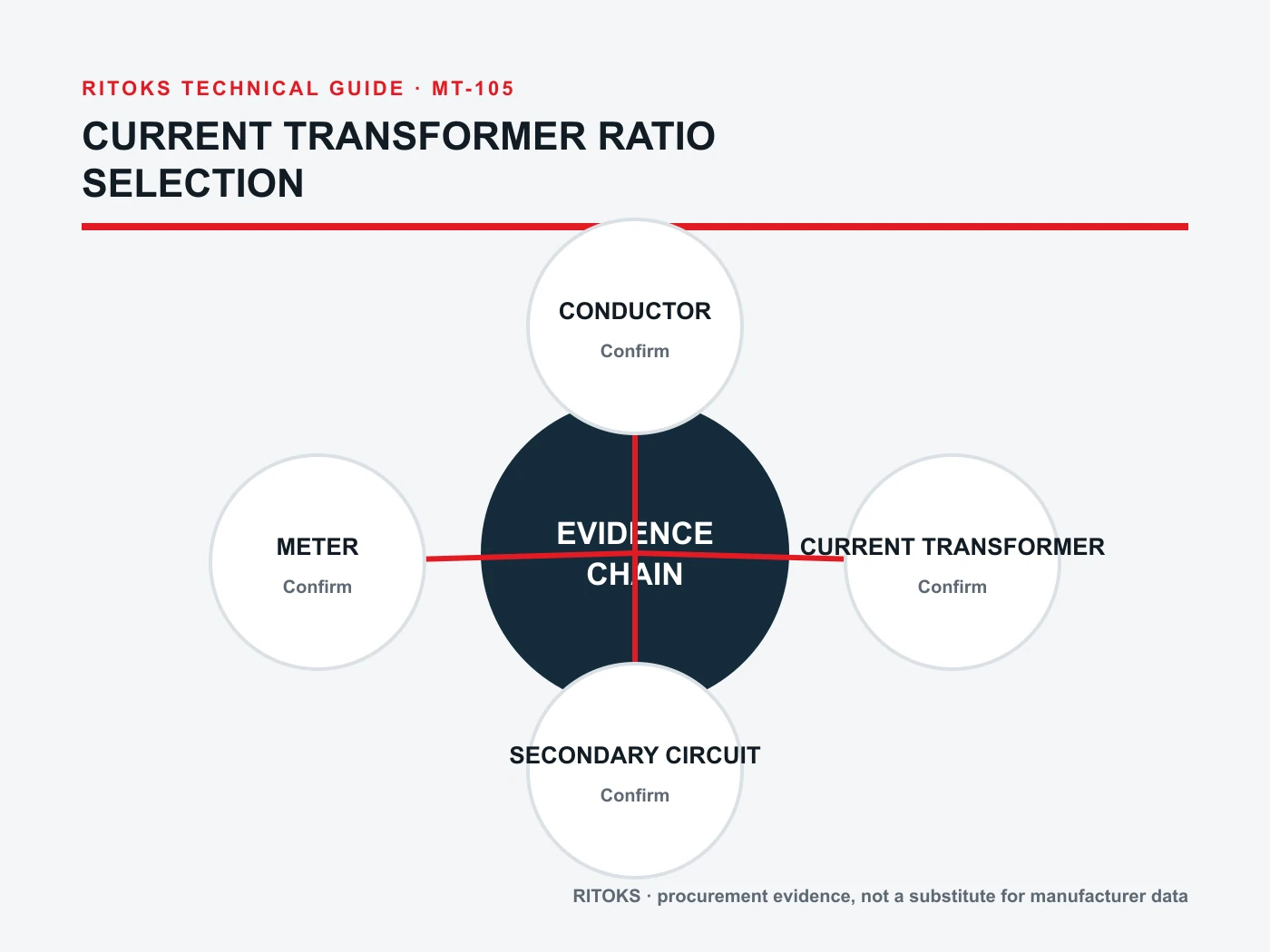
Crear un archivo de pruebas con un modelo exacto
Create one approval record for the proposed Current Transformer order code. Put each project requirement beside the supplier document that answers it. Preserve the exact datasheet, drawing, table, instruction or selection output used, including its revision or retrieval date. A category page can establish family context, but it cannot prove an exact rating, terminal arrangement or system combination.
Comprueba que todas las especificaciones aceptadas describan el mismo artículo que se puede pedir. Las carcasas similares pueden contener diferentes circuitos, fuentes de alimentación, terminales, accesorios o funciones. No combines el número máximo por familia de una variante, un esquema de otra y una característica opcional de una tercera. Marca explícitamente los campos sin resolver para que sigan siendo visibles en la revisión comercial.
Mantén separadas las aportaciones al proyecto de las pruebas del producto
The project team defines the application: source, load, duty, environment, controls, mechanical limits and required functions. The supplier identifies an exact Current Transformer and supports it with exact documents. Neither side should fill a gap by inference from appearance, a shared family name or one matching headline value.
Congela el expediente de la solicitud mientras se comparan los presupuestos. Si cambian la topología, la fuente, la carga, el entorno, la carcasa o la salida requerida, emite un expediente revisado y pide a cada proveedor que vuelva a confirmar la propuesta. De lo contrario, unos presupuestos aparentemente comparables podrían estar respondiendo a requisitos técnicos diferentes.
Errores habituales en las compras
Avoid selecting a Current Transformer from one headline value while the application context remains incomplete. Do not use a circuit, curve, terminal drawing or performance claim from a neighboring model. A product photograph and a family page can support discovery, but neither is exact technical evidence.
Evita también dar por sentado que se incluye un accesorio, una función de comunicación, una función de protección o un resultado coordinado, a menos que figure en el presupuesto y en la documentación del modelo exacto. Cualquier sustituto debe cumplir los mismos requisitos en cuanto a topología, características técnicas, montaje y revisión de la documentación que el candidato original.
Cómo comparar las ofertas de los proveedores
Normalize every Current Transformer offer to the same application record. Keep document revisions, stated conditions, included accessories and open questions beside each value. This makes differences in delivered scope visible and prevents a lower-cost but narrower offer from appearing equivalent to a complete solution.
Deje de realizar la comparación cuando se desconozca un dato de entrada crítico de la aplicación, el modelo citado sea ambiguo, una especificación requerida solo esté respaldada por otro fabricante o código de pedido, o la instalación no se ajuste a la información disponible. Se trata de lagunas de ingeniería, no de detalles editoriales.
Control de revisiones y sustituciones
Give the approved Current Transformer record a revision identifier and keep it with the project file. If the supplier changes the order code, accessory, firmware, drawing or stated operating condition, identify the change before accepting it. A substitution is a new technical proposal even when its price, housing or product-family name looks familiar.
Repite únicamente las comprobaciones afectadas, pero no las omitas. Confirma que el candidato revisado siga respondiendo a la solicitud congelada, que todos los documentos a los que se hace referencia pertenezcan a la misma y que todas las excepciones pendientes tengan un responsable. Este pequeño paso de control de cambios evita que una selección revisada técnicamente sea sustituida por un equivalente comercial no revisado.
Flujo de trabajo de toma de decisiones
- Congela el registro de la aplicación y del sistema antes de seleccionar un código de catálogo.
- Identifica la función exacta y todas las interfaces que requieran justificación.
- Solicite un código de pedido completo con su ficha técnica y planos actuales.
- Asigna cada requisito del proyecto a una declaración específica del fabricante.
- Anota las desviaciones, los accesorios, las revisiones de los documentos y las cuestiones pendientes.
- Repite la revisión cada vez que se produzcan cambios en la solicitud o en el producto propuesto.
Use this workflow as a procurement and evidence discipline. It does not replace qualified design, installation instructions or the responsible engineer's approval for the Current Transformer application.
Lista de comprobación para la preparación de una solicitud de presupuesto
A practical current transformer ratio selection should be concise enough for a supplier to answer and complete enough to prevent silent assumptions. Identify unknown values as questions rather than allowing them to become undocumented selections.
- Primary current: Normal, maximum and relevant operating range.
- Secondary output: Exact input required by the receiving meter or relay.
- Ratio: Declared primary-to-secondary relationship.
- Measurement performance: Accuracy and burden under documented conditions.
- Mechanical fit: Window, conductor, mounting and installation constraints.
- Código exacto del producto, accesorios incluidos y versión de la documentación
- Cantidad, destino, autorizaciones necesarias y alcance comercial
Solicita el alcance exacto de cualquier especificación relativa a la clasificación, la compatibilidad, la coordinación o el rendimiento. Anota la cantidad y el destino tras los datos técnicos, para que las condiciones comerciales no oculten cuestiones de ingeniería sin resolver.
Preguntas frecuentes
Can CT ratio be selected from breaker size alone?
No. Use the real current range, receiving-device input and measurement objective.
Does a matching secondary value prove compatibility?
No. Burden, accuracy, frequency, terminals and the exact interface still require review.
Can a current transformer secondary be treated as an ordinary signal?
No. Follow qualified design practices and the exact manufacturer safety instructions.
Productos y orientación relacionados de RITOKS
Estos enlaces solo ofrecen información sobre la familia de productos. Un enlace contextual no implica intercambiabilidad, compatibilidad ni una combinación de sistemas homologada.
Current Transformer product category
BH-0.66-60I current transformer family
Transformador de corriente de núcleo dividido de la serie DP
GTA20L precision current transformer
Referencias técnicas
Estas fuentes de los fabricantes solo respaldan los conceptos generales de ingeniería que se describen a continuación. Las especificaciones de sus productos, los esquemas eléctricos, las homologaciones y los resultados de coordinación no son aplicables a los productos de RITOKS.
Schneider Electric, medidores de potencia multifunción PowerLogic
Supports treating the meter input and measurement architecture as part of the complete system record. Schneider meter inputs do not establish compatibility with RITOKS CTs.
Solicitar una revisión del modelo exacto
Envía los requisitos de la solicitud, las preguntas concretas sobre la documentación, la cantidad y el destino a través del formulario de contacto de RITOKS. Una solicitud de presupuesto (RFQ) requiere una revisión del modelo exacto; esta guía no aprueba ningún circuito, instalación ni sustituto automático.