
Current Transformers · Technical Explainer
Current Transformer Accuracy Class and Burden: Verification Guide
Current transformer accuracy class and burden describe a measurement system, not a standalone quality score. A CT specified for a particular class is assessed under defined conditions. The connected meter, cable and terminals impose a real secondary burden that must fit the evidence for the exact CT.
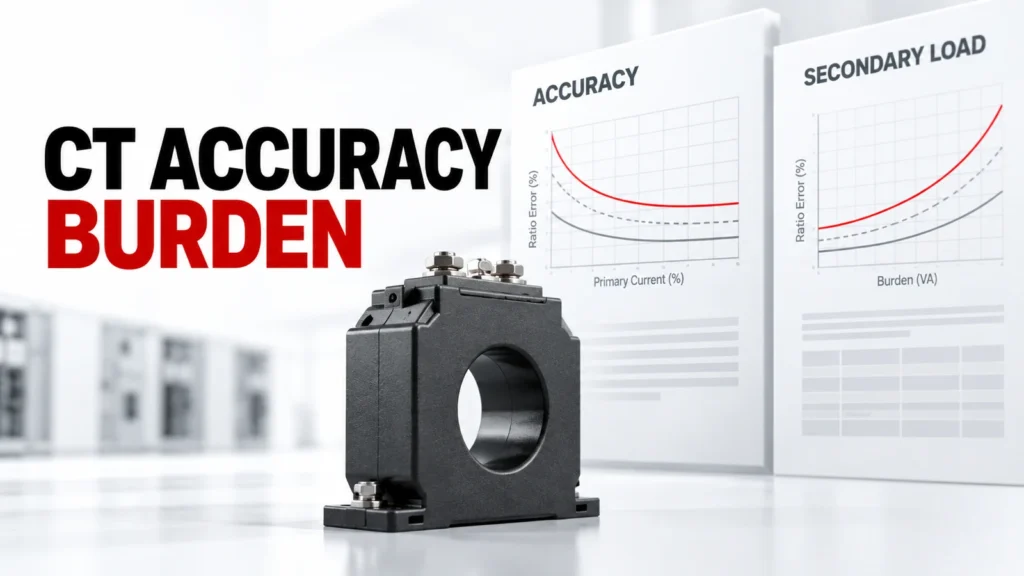
This guide explains the questions a buyer should put in the technical file. It does not assign universal accuracy to a CT family or prescribe a ratio from the equipment name alone.
Resumen de los datos para la toma de decisiones
| Área de revisión | Lo que anota el comprador | Documentación que hay que solicitar |
|---|---|---|
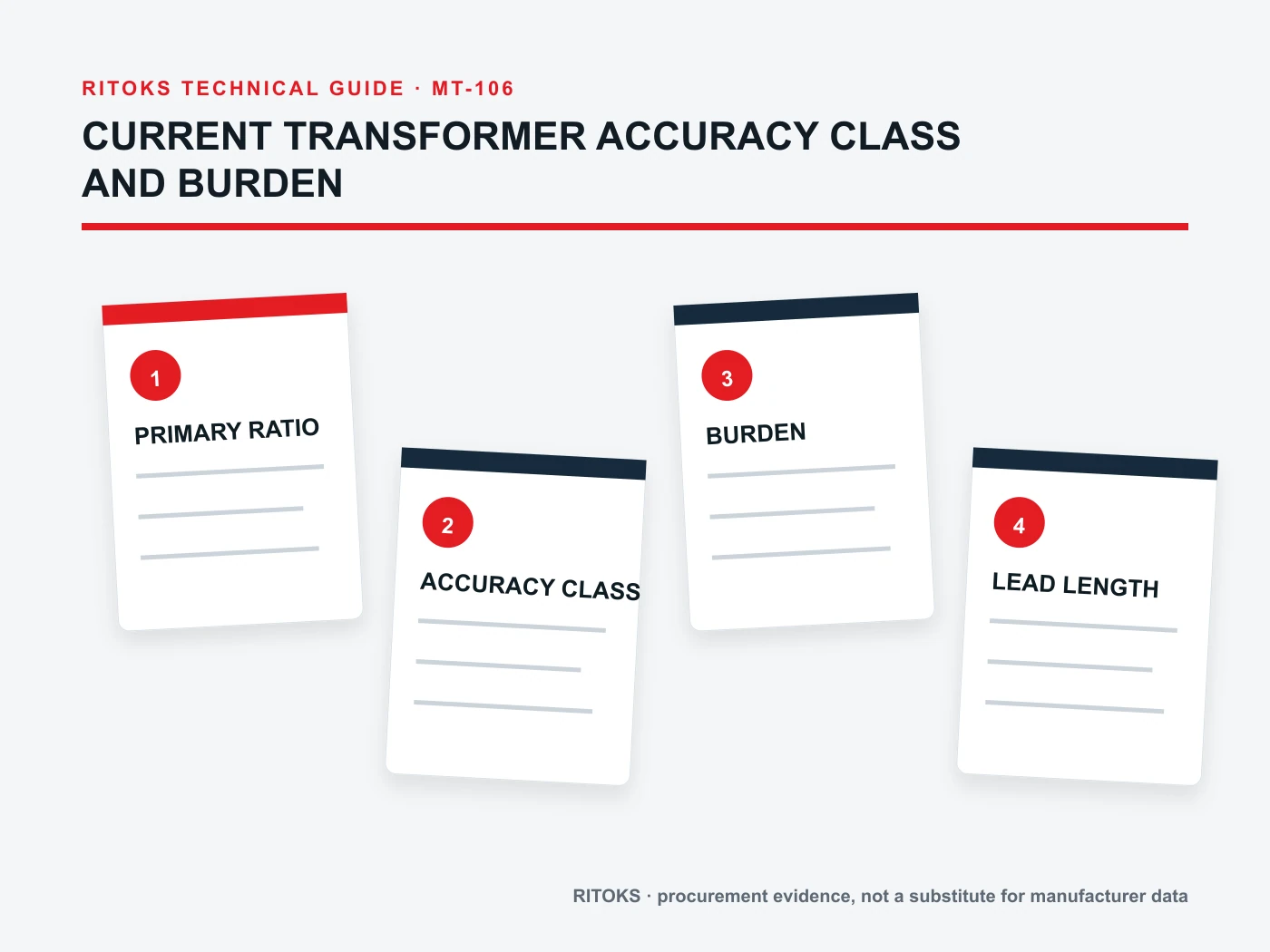
| Primary side | Expected current range and conductor arrangement | Load record and installation drawing |
| Secondary side | Output expected by receiving device | CT and meter input documents |
| Carga | Meter input plus lead and connection contribution | Circuit estimate and exact CT data |
| Precisión | Required class under relevant conditions | Exact CT datasheet and test basis |
Define the measurement purpose
A monitoring display, energy accounting function and control input may demand different evidence. State what the reading will be used for, its relevant operating range and the consequences of error. The CT ratio and class should follow that purpose.
If the circuit rarely operates near its nominal maximum, consider performance over the actual range rather than selecting from one full-scale number. Ask the supplier for the exact conditions to which its accuracy statement applies.
Understand class as a conditional statement
An accuracy class describes performance under a defined standard or test basis. It is not a promise that the installed meter will show that error under every current, frequency, temperature or burden.
Read the complete CT datasheet, including the specified output, rated burden and class conditions. Do not transfer a class label from one variant, core size or ratio to another.
Calculate the complete secondary burden
The receiving meter input is only part of the load seen by the CT secondary. Lead resistance, terminals and other connected devices can contribute. Longer runs and multiple instruments may materially change the burden.
Document the secondary route and the actual devices attached to it. Compare the resulting burden with the exact CT evidence; if the circuit changes, update the assessment. Avoid treating a catalog burden value as a measurement of the installed circuit.
Match ratio and output to the meter
The CT primary ratio should represent the expected current range, while the secondary output must match the meter input. A number in the product title does not prove the output of every order code or compatibility with every panel meter.
Obtain both connection diagrams and the meter configuration method. Record any programmable ratio in the commissioning file so the display and exported data use the same scaling.
Check physical installation
Solid-core and split-core devices may solve different installation constraints. Confirm conductor or busbar dimensions, window space, mounting access and orientation. The choice of housing also affects how the secondary circuit can be routed and inspected.
If retrofitting a live panel is proposed, the work method needs a separate safety review by qualified personnel. Do not infer installation permission from the split-core label.
Verify the system, not only the CT
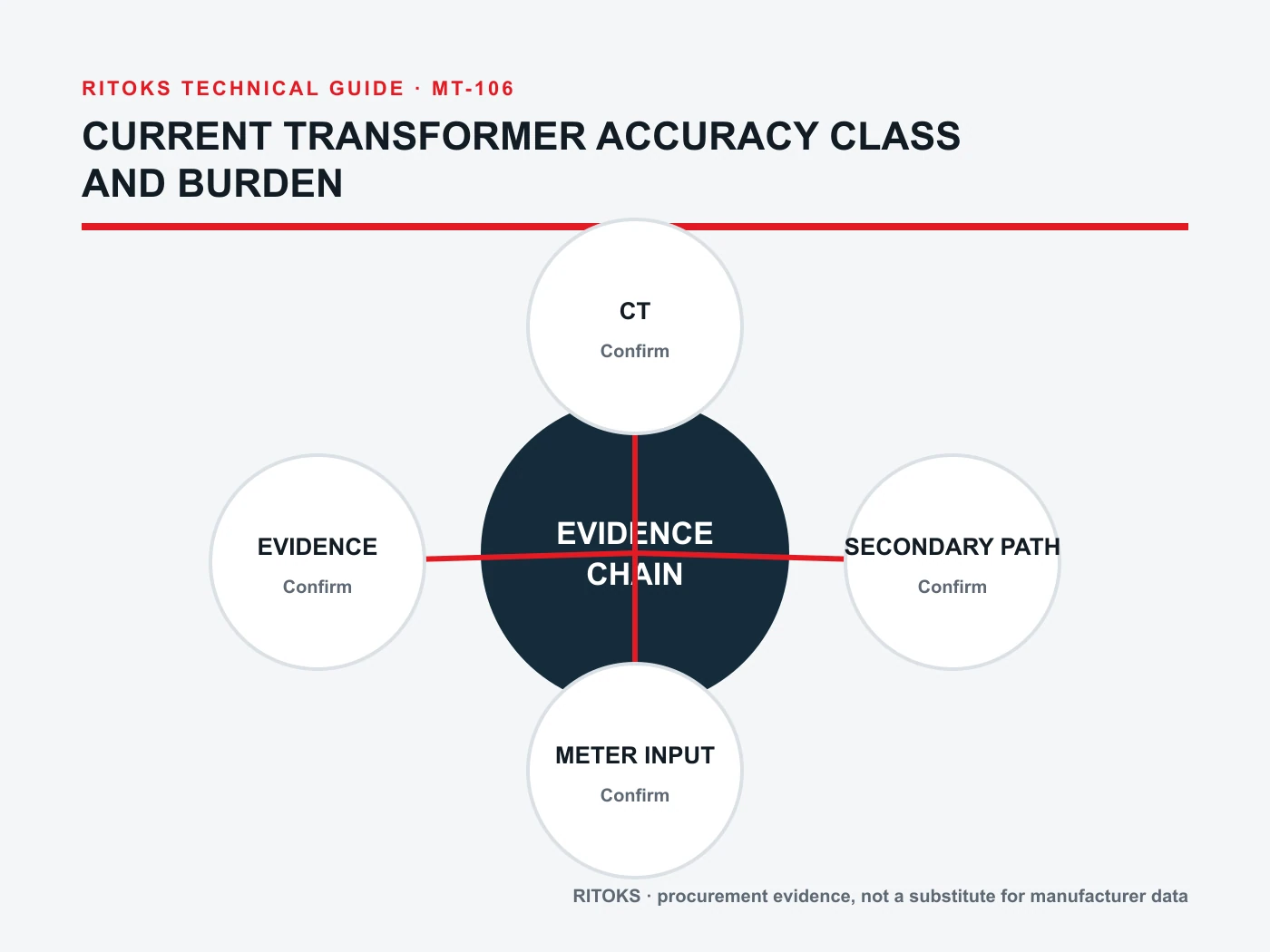
A CT, meter, wiring path and configured ratio form one measurement chain. Commissioning should check polarity or direction where relevant, expected response and scaling under known conditions.
Keep the as-built secondary diagram and configuration alongside the selected CT order code. This makes it possible to diagnose a discrepancy between the meter display and another measurement without guessing which component changed.
Request evidence that matches the quoted item
Ask for exact ratio, output, rated burden, accuracy basis, physical drawing and installation instructions for the proposed CT. Separate what the product page shows from what the order-specific documents prove.
A proposal remains open if the accuracy class is visible but the burden or operating conditions are not. Resolve those fields before approval, especially when the reading supports a commercial or control decision.
Crear un archivo de pruebas con un modelo exacto
A category or product-family page helps locate relevant options; it does not by itself approve one variant. For current transformers, keep the full proposed order code, current datasheet, terminal or mounting drawing, operating instructions and any project calculation together. Read the conditions attached to each rating or function. If the evidence belongs to a neighboring model, request the correct document instead of carrying the claim across.
El equipo del proyecto es responsable de los datos de entrada del sistema y de los criterios de aceptación. El proveedor es responsable de la documentación acreditativa del artículo ofrecido. En la revisión técnica, indica junto a cada requisito obligatorio el documento y la revisión exactos que lo cumplen. Marca los campos que falten como «pendientes», «condicionales» o «no compatibles». De este modo, se crea una decisión trazable y se evita que un valor nominal favorable oculte una conexión o una condición de instalación incompatible.
Compara todas las ofertas
| Artículo | Dato en la comparación | Motivo |
|---|---|---|
| Artículo disponible para pedido | Código completo, variante y accesorios incluidos | Evita las suposiciones a nivel familiar |
| Coincidencia de aplicaciones | Respuesta por escrito a cada aportación al proyecto | Mantiene visibles las excepciones |
| Documentación | Ficha técnica, plano, instrucciones y revisiones | Enlaces relacionados con el artículo ofrecido |
| Puntos pendientes | Propietario y fecha límite para la aclaración | Evita la aceptación tácita |
Utiliza el mismo pliego de condiciones para cada presupuesto. Las condiciones comerciales, como el precio y el plazo de entrega, se pueden comparar una vez que se haya estandarizado el alcance técnico. No consideres que los accesorios omitidos, las potencias no especificadas o una hipótesis de cableado sin resolver equivalen a una oferta documentada. Si se propone una alternativa, pregunta qué datos cambian y repite la revisión correspondiente.
Revisión de la instalación y la recepción
Antes de la instalación, compruebe que la etiqueta suministrada, el código completo y los accesorios coincidan con el registro homologado. Compare los terminales, el montaje, el acceso a los conductores y cualquier orientación indicada con las instrucciones exactas. Un producto que parezca físicamente similar a la versión homologada puede tener, no obstante, una configuración eléctrica, una opción de control o unos criterios de ensayo diferentes.
Planifica una comprobación de la instalación final que aborde los riesgos reales del proyecto. Esto puede implicar comprobar el cableado según el esquema aprobado, la respuesta funcional, las mediciones en condiciones de funcionamiento representativas y la confirmación de cualquier función de comunicación o alarma. Registra las condiciones y los resultados. El plan de aceptación debe basarse en la documentación de la aplicación y en las pruebas aportadas por el proveedor, no en una lista de comprobación genérica.
Lista de comprobación para la solicitud de presupuesto
- Identify the circuit, equipment and location that current transformers must serve.
- Adjunta el esquema del sistema y los estados de funcionamiento que definen la aplicación.
- Record primary range and its source document.
- Record secondary output and its source document.
- Record accuracy class and its source document.
- Record rated burden and its source document.
- Confirm the exact-model evidence for meter input.
- Confirm the exact-model evidence for lead length.
- Confirm the exact-model evidence for connection.
- Confirm the exact-model evidence for test record.
- Solicita el código de pedido completo, los accesorios, los planos y la revisión de la ficha técnica.
- Pregunta por las exclusiones, las hipótesis, los sustitutos y los aspectos técnicos pendientes de resolver.
La solicitud de presupuesto debe ser lo suficientemente concreta como para que un proveedor pueda responderla sin tener que inventarse los valores que faltan del proyecto. Si aún se desconoce algún dato esencial, indícalo como una pregunta e identifica quién lo determinará. No conviertas una suposición en una calificación, una declaración de conformidad o un método de instalación aprobado.
¿Qué influye en la decisión?
A decision can change when the source arrangement, load behavior, environment, installation geometry or required function changes. Revisit the selected current transformers whenever one of those inputs moves outside the approved brief. Recheck the order code and the exact evidence affected by the change; do not rely on a previous approval for a circuit that now asks the component to do different work.
Mantén un breve historial de revisiones del pliego de condiciones del proyecto, la respuesta del proveedor y la lista de excepciones aceptadas. Este registro ayuda a los departamentos de ingeniería, compras y puesta en marcha a trabajar con la misma versión. Resulta especialmente útil cuando se revisa un presupuesto, se ofrece un producto sustitutivo o cambia el diseño del cuadro eléctrico tras la primera comparación.
Cuestiones que deben resolverse antes de la aprobación
Ask who owns each remaining technical question for the proposed current transformers. The buyer should confirm the system inputs and installation constraints; the supplier should confirm the exact item, included options and applicable documentation. Put the answer and document revision beside the question. An unanswered point should remain visible in the comparison rather than being converted into an assumed feature.
Cuando un presupuesto ofrezca una alternativa, solicita una explicación por escrito sobre los cambios en el circuito, el montaje o las especificaciones de rendimiento. Revisa cualquier nuevo plano con el ingeniero del proyecto y deja constancia de si el cambio propuesto es aceptable. Una sustitución constituye una nueva decisión técnica, aunque parezca equivalente desde el punto de vista comercial. Esto es especialmente importante cuando varios proveedores utilizan denominaciones de familia similares para configuraciones diferentes.
Preguntas frecuentes
Does a higher accuracy class guarantee an accurate installation?
No. The connected burden, current range, meter input, wiring and configuration also matter.
Can I connect any CT to any panel meter?
No. Verify secondary output, input requirements, ratio configuration and wiring.
Is rated burden the same as actual burden?
No. Rated burden is a product condition; actual burden is created by the installed secondary circuit.
Páginas relevantes de RITOKS
Para obtener información sobre la familia de productos, consulta Medición y supervisión eléctrica. Las páginas de productos publicadas relacionadas incluyen: Bh 0 66 60i Current Transformer 200 5a 1500 5a, Dp Series Split Core Current Transformer, Gta20l Precision Current Transformer 10a 100a. Utiliza los documentos correspondientes al modelo exacto actual a la hora de comparar un artículo propuesto.
Para solicitar un presupuesto específico para su aplicación, Envía el resumen del proyecto a RITOKS junto con los diagramas y las preguntas abiertas anteriores.