
Current Transformers · Technical Explainer
Current Transformer Accuracy Class and Burden: Verification Guide
Current transformer accuracy class and burden describe a measurement system, not a standalone quality score. A CT specified for a particular class is assessed under defined conditions. The connected meter, cable and terminals impose a real secondary burden that must fit the evidence for the exact CT.
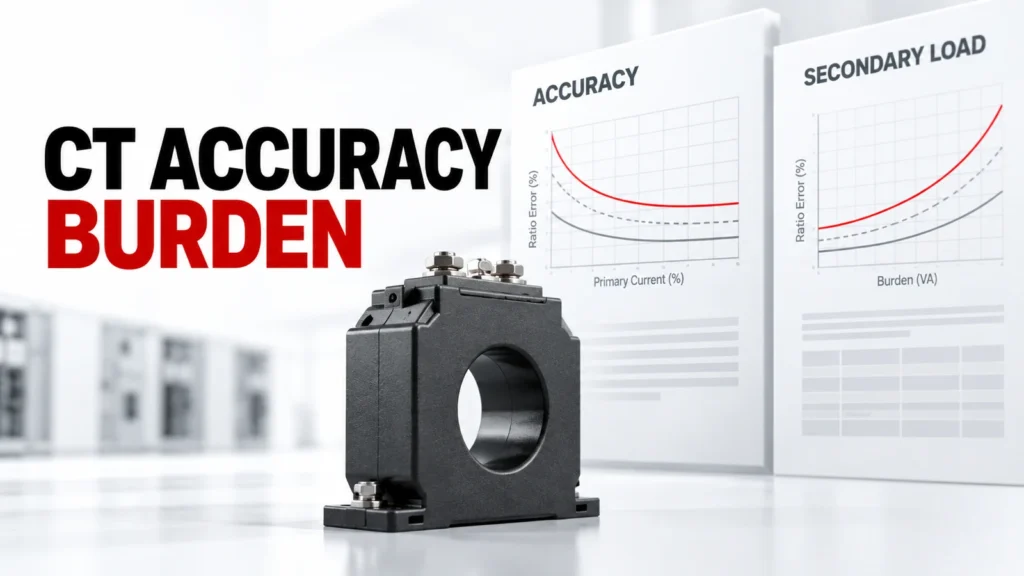
This guide explains the questions a buyer should put in the technical file. It does not assign universal accuracy to a CT family or prescribe a ratio from the equipment name alone.
Panoramica dei dati di input per la decisione
| Area recensioni | Cosa registra l'acquirente | Documenti da richiedere |
|---|---|---|
| Primary side | Expected current range and conductor arrangement | Load record and installation drawing |
| Secondary side | Output expected by receiving device | CT and meter input documents |
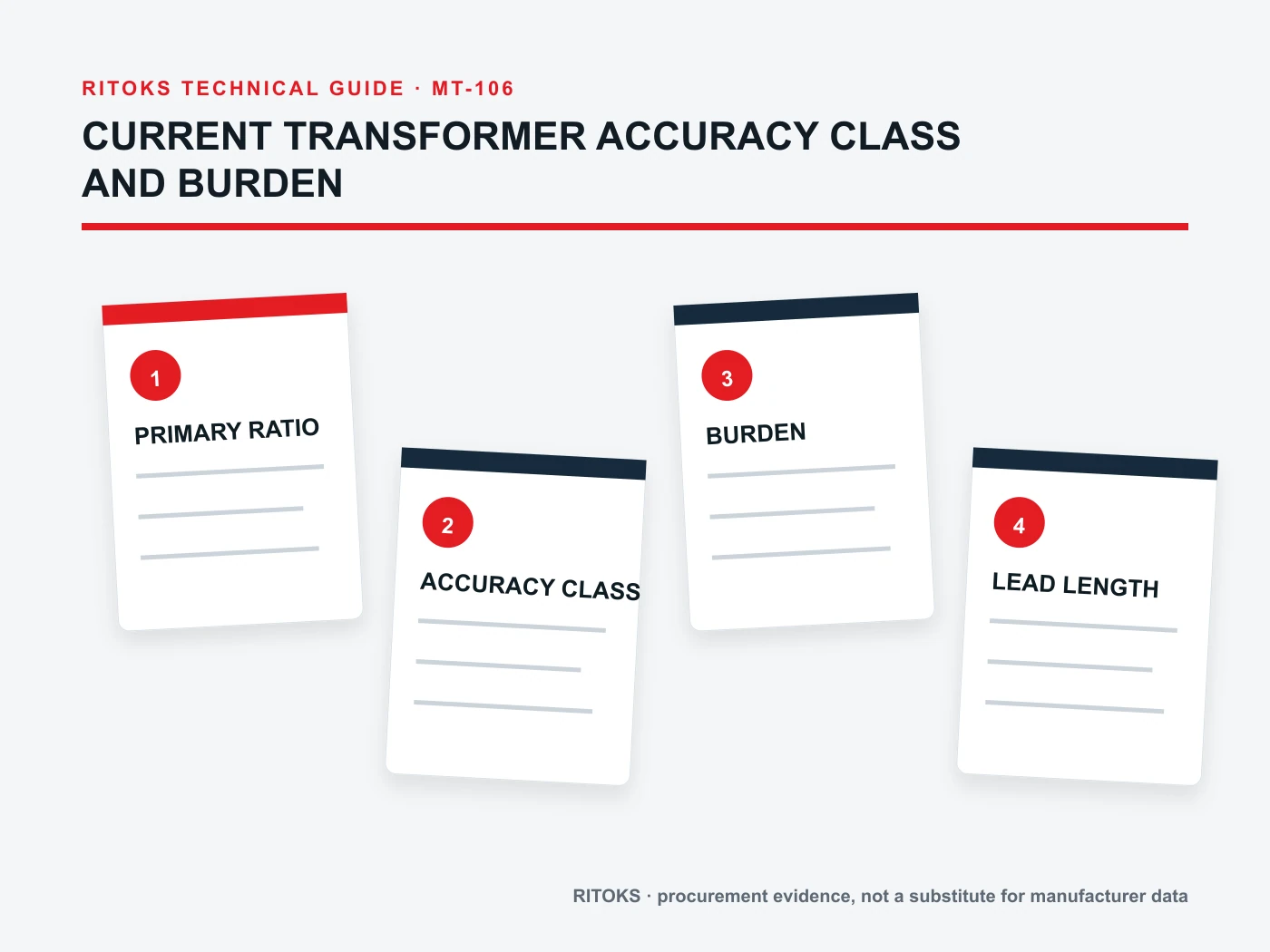
| Onere | Meter input plus lead and connection contribution | Circuit estimate and exact CT data |
| Precisione | Required class under relevant conditions | Exact CT datasheet and test basis |
Define the measurement purpose
A monitoring display, energy accounting function and control input may demand different evidence. State what the reading will be used for, its relevant operating range and the consequences of error. The CT ratio and class should follow that purpose.
If the circuit rarely operates near its nominal maximum, consider performance over the actual range rather than selecting from one full-scale number. Ask the supplier for the exact conditions to which its accuracy statement applies.
Understand class as a conditional statement
An accuracy class describes performance under a defined standard or test basis. It is not a promise that the installed meter will show that error under every current, frequency, temperature or burden.
Read the complete CT datasheet, including the specified output, rated burden and class conditions. Do not transfer a class label from one variant, core size or ratio to another.
Calculate the complete secondary burden
The receiving meter input is only part of the load seen by the CT secondary. Lead resistance, terminals and other connected devices can contribute. Longer runs and multiple instruments may materially change the burden.
Document the secondary route and the actual devices attached to it. Compare the resulting burden with the exact CT evidence; if the circuit changes, update the assessment. Avoid treating a catalog burden value as a measurement of the installed circuit.
Match ratio and output to the meter
The CT primary ratio should represent the expected current range, while the secondary output must match the meter input. A number in the product title does not prove the output of every order code or compatibility with every panel meter.
Obtain both connection diagrams and the meter configuration method. Record any programmable ratio in the commissioning file so the display and exported data use the same scaling.
Check physical installation
Solid-core and split-core devices may solve different installation constraints. Confirm conductor or busbar dimensions, window space, mounting access and orientation. The choice of housing also affects how the secondary circuit can be routed and inspected.
If retrofitting a live panel is proposed, the work method needs a separate safety review by qualified personnel. Do not infer installation permission from the split-core label.
Verify the system, not only the CT
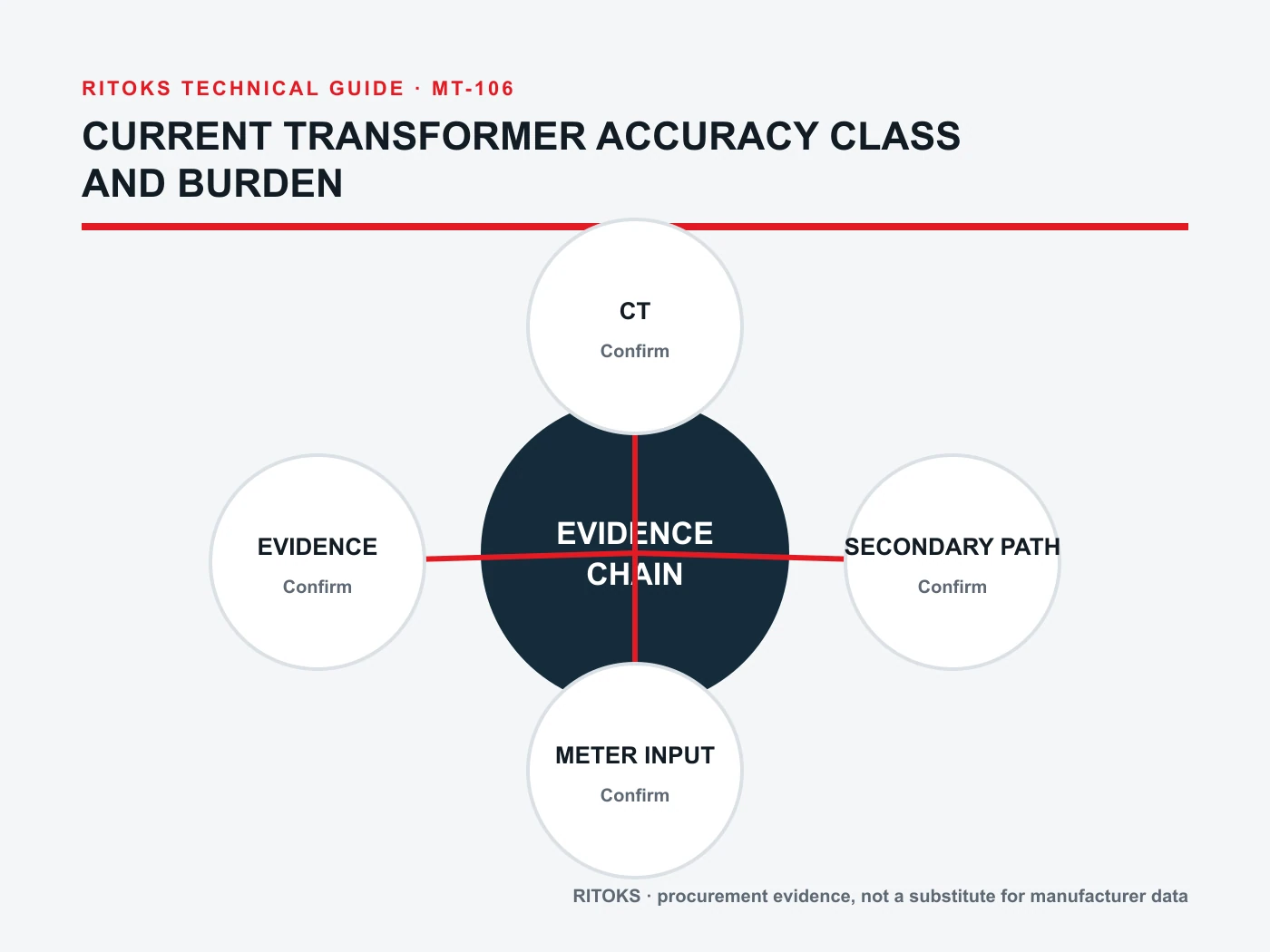
A CT, meter, wiring path and configured ratio form one measurement chain. Commissioning should check polarity or direction where relevant, expected response and scaling under known conditions.
Keep the as-built secondary diagram and configuration alongside the selected CT order code. This makes it possible to diagnose a discrepancy between the meter display and another measurement without guessing which component changed.
Request evidence that matches the quoted item
Ask for exact ratio, output, rated burden, accuracy basis, physical drawing and installation instructions for the proposed CT. Separate what the product page shows from what the order-specific documents prove.
A proposal remains open if the accuracy class is visible but the burden or operating conditions are not. Resolve those fields before approval, especially when the reading supports a commercial or control decision.
Creare un file di prove basato su un modello esatto
A category or product-family page helps locate relevant options; it does not by itself approve one variant. For current transformers, keep the full proposed order code, current datasheet, terminal or mounting drawing, operating instructions and any project calculation together. Read the conditions attached to each rating or function. If the evidence belongs to a neighboring model, request the correct document instead of carrying the claim across.
Il team di progetto è responsabile degli input di sistema e dei criteri di accettazione. Il fornitore è responsabile della documentazione a supporto dell’articolo offerto. Durante la revisione tecnica, abbinare ogni requisito obbligatorio al documento e alla revisione esatti che lo soddisfano. Contrassegnare un campo mancante come “aperto”, “condizionato” o “non supportato”. Ciò garantisce la tracciabilità delle decisioni ed evita che un valore nominale favorevole nasconda una connessione o una condizione di installazione incompatibile.
Confronta le offerte complete
| Articolo | Dato nel confronto | Motivo |
|---|---|---|
| Articolo disponibile | Codice completo, varianti e accessori inclusi | Evita supposizioni a livello familiare |
| Corrispondenza dell'applicazione | Risposta scritta a ciascun contributo al progetto | Mantiene visibili le eccezioni |
| Documentazione | Scheda tecnica, disegno, istruzioni e revisioni | Collegamenti relativi all'articolo offerto |
| Punti in sospeso | Proprietario e data di scadenza per chiarimenti | Evita l’accettazione tacita |
Utilizza lo stesso brief di progetto per ogni preventivo. Una volta standardizzato l’ambito tecnico, sarà possibile confrontare le condizioni commerciali quali prezzo e tempi di consegna. Non considerare gli accessori omessi, i valori nominali non supportati o un’ipotesi di cablaggio non chiarita come equivalenti a un’offerta documentata. Se viene proposta un’alternativa, chiedi quali parametri cambiano e ripeti la revisione relativa agli aspetti interessati.
Verifica dell'installazione e del collaudo
Prima dell'installazione, verificare che l'etichetta fornita, il codice completo e gli accessori corrispondano alla documentazione approvata. Confrontare i terminali, il sistema di montaggio, l'accesso ai conduttori e qualsiasi orientamento specificato con le istruzioni precise. Un prodotto che appare fisicamente simile alla versione approvata potrebbe comunque presentare una configurazione elettrica, un'opzione di controllo o criteri di collaudo diversi.
Pianificate un controllo “as-built” che tenga conto dei rischi effettivi del progetto. Ciò può comportare la verifica del cablaggio rispetto allo schema approvato, la risposta funzionale, le misurazioni in condizioni operative rappresentative e la conferma del corretto funzionamento di eventuali funzioni di comunicazione o di allarme. Registrate le condizioni e i risultati. Il piano di collaudo dovrebbe basarsi sulla documentazione relativa all’applicazione e sulle prove fornite dal fornitore, non su una generica lista di controllo.
Lista di controllo per la richiesta di preventivo
- Identify the circuit, equipment and location that current transformers must serve.
- Allegare il disegno di sistema e gli stati operativi che definiscono l'applicazione.
- Record primary range and its source document.
- Record secondary output and its source document.
- Record accuracy class and its source document.
- Record rated burden and its source document.
- Confirm the exact-model evidence for meter input.
- Confirm the exact-model evidence for lead length.
- Confirm the exact-model evidence for connection.
- Confirm the exact-model evidence for test record.
- Richiedere il codice ordine completo, gli accessori, i disegni e la versione aggiornata della scheda tecnica.
- Chiedete informazioni su esclusioni, ipotesi, sostituzioni e questioni tecniche irrisolte.
La richiesta di offerta (RFQ) deve essere sufficientemente specifica da consentire al fornitore di rispondere senza dover inventare i valori mancanti relativi al progetto. Se un dato essenziale non è ancora noto, indicarlo come domanda e specificare chi lo determinerà. Non trasformare un’ipotesi in un criterio di valutazione, in una dichiarazione di conformità o in un metodo di installazione approvato.
Cosa influenza la decisione
A decision can change when the source arrangement, load behavior, environment, installation geometry or required function changes. Revisit the selected current transformers whenever one of those inputs moves outside the approved brief. Recheck the order code and the exact evidence affected by the change; do not rely on a previous approval for a circuit that now asks the component to do different work.
Conservare un breve storico delle revisioni del brief di progetto, della risposta del fornitore e dell'elenco delle eccezioni accettate. Questo documento aiuta i reparti di ingegneria, acquisti e messa in servizio a lavorare sulla stessa versione. È particolarmente utile quando un preventivo viene rivisto, viene proposto un prodotto sostitutivo o il progetto del quadro elettrico subisce modifiche dopo il primo confronto.
Questioni da risolvere prima dell'approvazione
Ask who owns each remaining technical question for the proposed current transformers. The buyer should confirm the system inputs and installation constraints; the supplier should confirm the exact item, included options and applicable documentation. Put the answer and document revision beside the question. An unanswered point should remain visible in the comparison rather than being converted into an assumed feature.
Quando un preventivo propone un’alternativa, richiedere una spiegazione scritta relativa alle modifiche apportate al circuito, al montaggio o alle prestazioni. Esaminare eventuali nuovi disegni insieme al responsabile tecnico del progetto e indicare se la modifica proposta è accettabile. Una sostituzione rappresenta una nuova decisione tecnica, anche se appare equivalente dal punto di vista commerciale. Ciò è particolarmente importante quando più fornitori utilizzano denominazioni simili per configurazioni diverse.
Domande frequenti
Does a higher accuracy class guarantee an accurate installation?
No. The connected burden, current range, meter input, wiring and configuration also matter.
Can I connect any CT to any panel meter?
No. Verify secondary output, input requirements, ratio configuration and wiring.
Is rated burden the same as actual burden?
No. Rated burden is a product condition; actual burden is created by the installed secondary circuit.
Pagine RITOKS pertinenti
Per il contesto relativo alla famiglia di prodotti, si veda Misurazione e monitoraggio elettrico. Le pagine relative ai prodotti pubblicate includono Bh 0 66 60i Current Transformer 200 5a 1500 5a, Dp Series Split Core Current Transformer, Gta20l Precision Current Transformer 10a 100a. Quando si confronta un articolo proposto, utilizzare i documenti relativi al modello esatto attualmente in uso.
Per un preventivo specifico per la vostra applicazione, inviare il brief del progetto a RITOKS insieme ai diagrammi e alle domande aperte riportati sopra.