
Current Transformers · Technical Explainer
Current Transformer Accuracy Class and Burden: Verification Guide
Current transformer accuracy class and burden describe a measurement system, not a standalone quality score. A CT specified for a particular class is assessed under defined conditions. The connected meter, cable and terminals impose a real secondary burden that must fit the evidence for the exact CT.
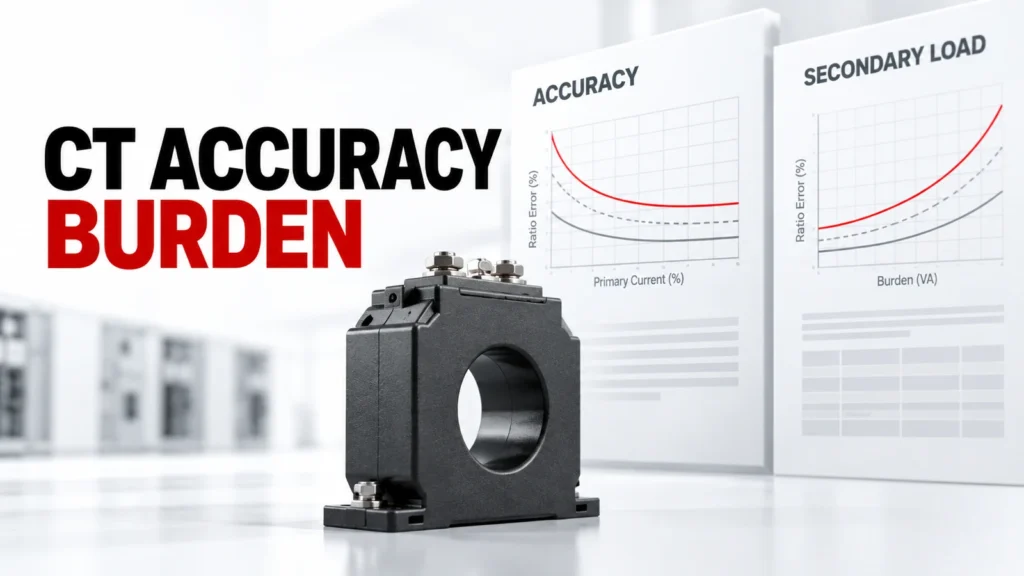
This guide explains the questions a buyer should put in the technical file. It does not assign universal accuracy to a CT family or prescribe a ratio from the equipment name alone.
決策輸入要素一覽
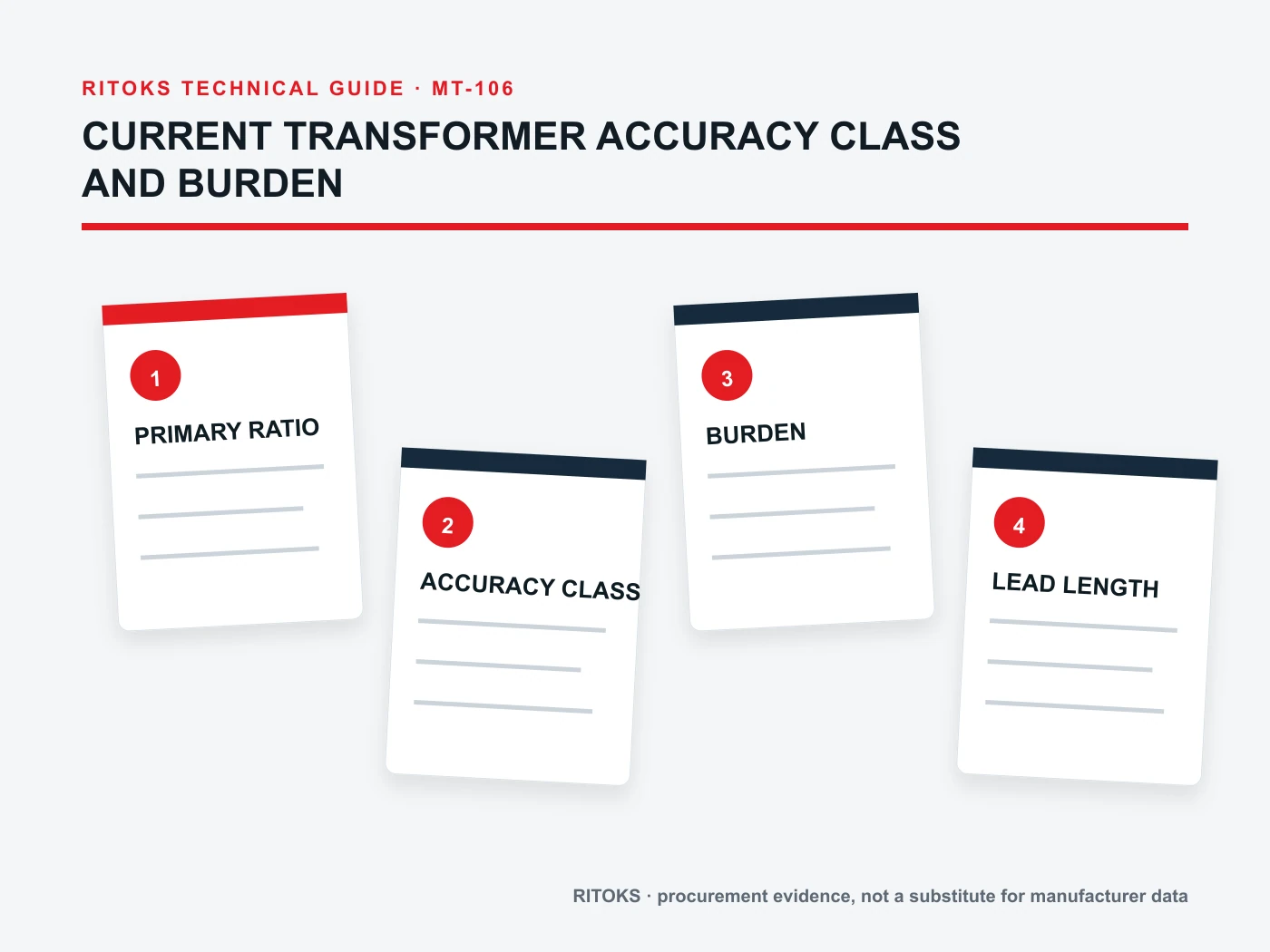
| 評論區 | 買方記錄的內容 | 應索取的證據 |
|---|---|---|
| Primary side | Expected current range and conductor arrangement | Load record and installation drawing |
| Secondary side | Output expected by receiving device | CT and meter input documents |
| 負擔 | Meter input plus lead and connection contribution | Circuit estimate and exact CT data |
| 準確度 | Required class under relevant conditions | Exact CT datasheet and test basis |
Define the measurement purpose
A monitoring display, energy accounting function and control input may demand different evidence. State what the reading will be used for, its relevant operating range and the consequences of error. The CT ratio and class should follow that purpose.
If the circuit rarely operates near its nominal maximum, consider performance over the actual range rather than selecting from one full-scale number. Ask the supplier for the exact conditions to which its accuracy statement applies.
Understand class as a conditional statement
An accuracy class describes performance under a defined standard or test basis. It is not a promise that the installed meter will show that error under every current, frequency, temperature or burden.
Read the complete CT datasheet, including the specified output, rated burden and class conditions. Do not transfer a class label from one variant, core size or ratio to another.
Calculate the complete secondary burden
The receiving meter input is only part of the load seen by the CT secondary. Lead resistance, terminals and other connected devices can contribute. Longer runs and multiple instruments may materially change the burden.
Document the secondary route and the actual devices attached to it. Compare the resulting burden with the exact CT evidence; if the circuit changes, update the assessment. Avoid treating a catalog burden value as a measurement of the installed circuit.
Match ratio and output to the meter
The CT primary ratio should represent the expected current range, while the secondary output must match the meter input. A number in the product title does not prove the output of every order code or compatibility with every panel meter.
Obtain both connection diagrams and the meter configuration method. Record any programmable ratio in the commissioning file so the display and exported data use the same scaling.
Check physical installation
Solid-core and split-core devices may solve different installation constraints. Confirm conductor or busbar dimensions, window space, mounting access and orientation. The choice of housing also affects how the secondary circuit can be routed and inspected.
If retrofitting a live panel is proposed, the work method needs a separate safety review by qualified personnel. Do not infer installation permission from the split-core label.
Verify the system, not only the CT
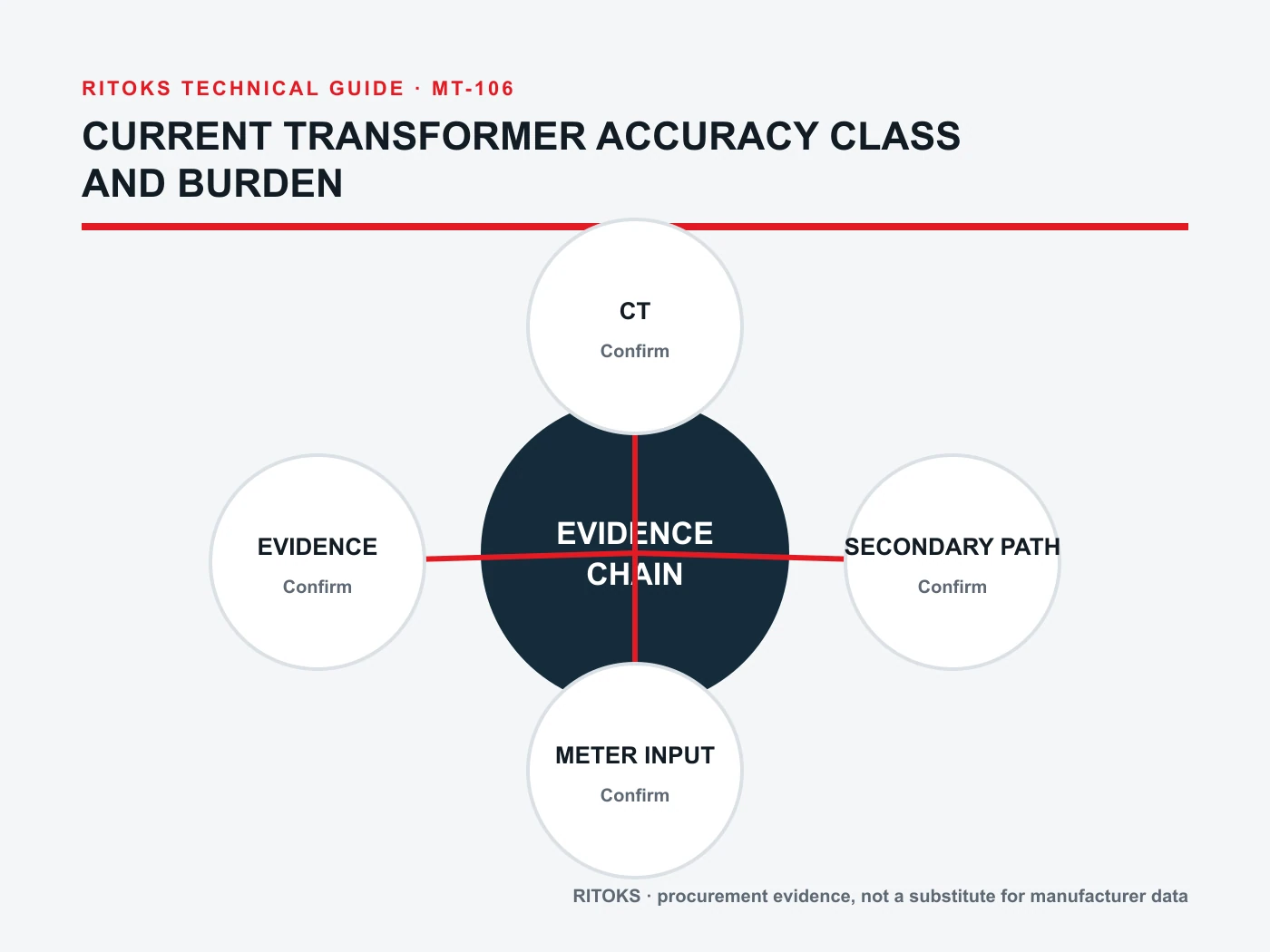
A CT, meter, wiring path and configured ratio form one measurement chain. Commissioning should check polarity or direction where relevant, expected response and scaling under known conditions.
Keep the as-built secondary diagram and configuration alongside the selected CT order code. This makes it possible to diagnose a discrepancy between the meter display and another measurement without guessing which component changed.
Request evidence that matches the quoted item
Ask for exact ratio, output, rated burden, accuracy basis, physical drawing and installation instructions for the proposed CT. Separate what the product page shows from what the order-specific documents prove.
A proposal remains open if the accuracy class is visible but the burden or operating conditions are not. Resolve those fields before approval, especially when the reading supports a commercial or control decision.
建立精確模型證據檔案
A category or product-family page helps locate relevant options; it does not by itself approve one variant. For current transformers, keep the full proposed order code, current datasheet, terminal or mounting drawing, operating instructions and any project calculation together. Read the conditions attached to each rating or function. If the evidence belongs to a neighboring model, request the correct document instead of carrying the claim across.
專案團隊負責系統輸入項目與驗收標準;供應商則負責所提供項目的相關證明文件。在技術審查過程中,請將每項強制性要求與能滿足該要求的具體文件及其修訂版本並列。若某個欄位缺失,請標記為「待處理」、「有條件」或「不支援」。此舉可建立可追溯的決策,並避免因頭條數值看似理想,而掩蓋了不相容的連接或安裝條件。.
比較完整方案
| 項目 | 比較中的記錄 | 理由 |
|---|---|---|
| 可訂購商品 | 完整型號、變體及隨附配件 | 避免基於家庭層級的假設 |
| 應用程式匹配 | 針對每個專案輸入的書面回覆 | 讓例外情況保持可見 |
| 文件 | 資料表、圖面、說明書及修訂版本 | 與所提供商品相關的聲明連結 |
| 待議事項 | 所有者及需釐清的截止日期 | 避免默許 |
每次報價時均應採用相同的專案簡報。一旦技術範圍標準化,即可對價格和交期等商業條款進行比較。切勿將遺漏的配件、未獲支援的額定值或未釐清的接線假設,視同已文件化的報價。若提出替代方案,請詢問哪些輸入參數有所變更,並重新進行受影響部分的審查。.
安裝與驗收審查
安裝前,請確認所交付的標籤、完整型號及配件是否與核准記錄相符。請將端子、安裝方式、導體接線方式及任何標示的安裝方向與確切的說明進行比對。即使產品的外觀與核准版本相似,其電氣配置、控制選項或測試依據仍可能有所不同。.
規劃一項針對專案實際風險的實測驗收檢查。這可能包括依據核准圖紙檢查配線、功能響應測試、在具代表性的運作狀態下進行量測,以及確認任何通訊或警報功能。請記錄實際狀況與檢測結果。驗收計畫應基於實際應用需求及供應商提供的證明文件,而非採用通用的項目清單。.
報價請求檢查清單
- Identify the circuit, equipment and location that current transformers must serve.
- 請附上定義該應用程式的系統圖及運作狀態。.
- Record primary range and its source document.
- Record secondary output and its source document.
- Record accuracy class and its source document.
- Record rated burden and its source document.
- Confirm the exact-model evidence for meter input.
- Confirm the exact-model evidence for lead length.
- Confirm the exact-model evidence for connection.
- Confirm the exact-model evidence for test record.
- 請提供完整的訂購編號、配件、圖面及資料表的修訂版本。.
- 請詢問有關排除事項、假設、替代方案及尚未解決的工程問題。.
詢價單(RFQ)應具體明確,使供應商能直接回應,而無需自行填補專案中未明確的數值。若某項關鍵輸入值尚未確定,應將其標示為問題,並指明由誰來決定該數值。切勿將假設轉化為評分標準、符合性聲明或經核准的安裝方法。.
什麼會影響決策
A decision can change when the source arrangement, load behavior, environment, installation geometry or required function changes. Revisit the selected current transformers whenever one of those inputs moves outside the approved brief. Recheck the order code and the exact evidence affected by the change; do not rely on a previous approval for a circuit that now asks the component to do different work.
請針對專案簡報、供應商回覆及已接受的例外清單,建立簡短的修訂歷史紀錄。此紀錄有助於工程、採購及調試部門依據同一版本進行作業。當報價單經修訂、提出替代方案,或於首次比對後控制櫃設計有所變更時,此紀錄尤為實用。.
核准前須解決的問題
Ask who owns each remaining technical question for the proposed current transformers. The buyer should confirm the system inputs and installation constraints; the supplier should confirm the exact item, included options and applicable documentation. Put the answer and document revision beside the question. An unanswered point should remain visible in the comparison rather than being converted into an assumed feature.
當報價單提供替代方案時,請要求供應商就變更後的電路、安裝方式或性能基準提供書面說明。請與專案工程師共同審閱任何新圖面,並記錄所提議的變更是否可接受。即使替代方案在商業上看似等同,它仍屬一項新的技術決策。當多家供應商針對不同配置使用相似的產品系列標籤時,這一點尤為重要。.
常見問題
Does a higher accuracy class guarantee an accurate installation?
No. The connected burden, current range, meter input, wiring and configuration also matter.
Can I connect any CT to any panel meter?
No. Verify secondary output, input requirements, ratio configuration and wiring.
Is rated burden the same as actual burden?
No. Rated burden is a product condition; actual burden is created by the installed secondary circuit.
相關的 RITOKS 頁面
有關產品系列的背景資訊,請參閱 電氣測量與監測. 相關的已發布產品頁面包括 Bh 0 66 60i Current Transformer 200 5a 1500 5a, Dp Series Split Core Current Transformer, Gta20l Precision Current Transformer 10a 100a. 在比較擬議項目時,請使用其現行確切型號的文件。.
如需針對特定應用場合的報價,, 將專案簡報發送給 RITOKS 連同上述圖表與待解答的問題。.