
Current Transformers · Technical Explainer
Current Transformer Accuracy Class and Burden: Verification Guide
Current transformer accuracy class and burden describe a measurement system, not a standalone quality score. A CT specified for a particular class is assessed under defined conditions. The connected meter, cable and terminals impose a real secondary burden that must fit the evidence for the exact CT.
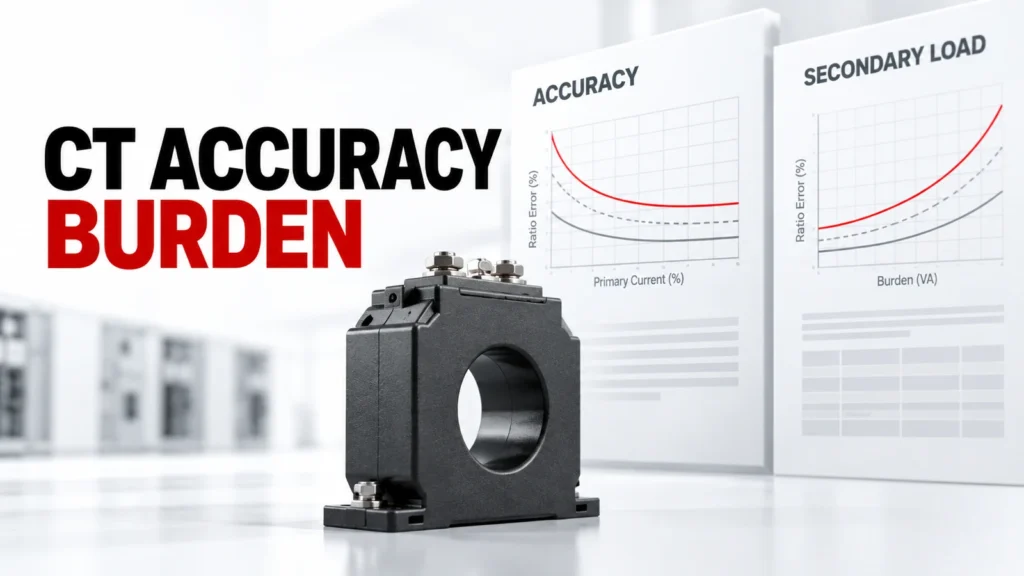
This guide explains the questions a buyer should put in the technical file. It does not assign universal accuracy to a CT family or prescribe a ratio from the equipment name alone.
Visão geral dos dados de base para a tomada de decisão
| Área de revisão | O que o comprador registra | Provas a serem solicitadas |
|---|---|---|
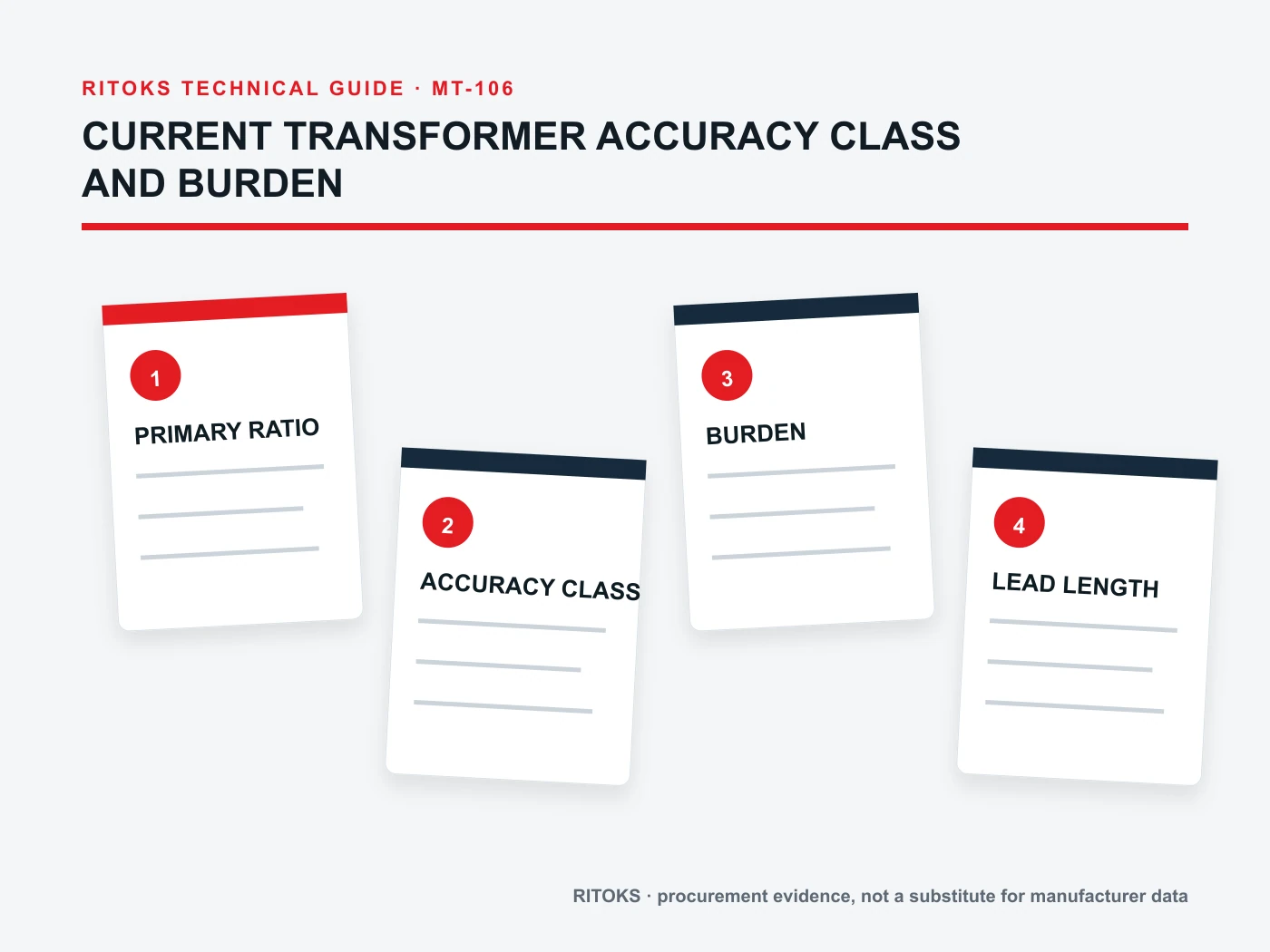
| Primary side | Expected current range and conductor arrangement | Load record and installation drawing |
| Secondary side | Output expected by receiving device | CT and meter input documents |
| Fardo | Meter input plus lead and connection contribution | Circuit estimate and exact CT data |
| Precisão | Required class under relevant conditions | Exact CT datasheet and test basis |
Define the measurement purpose
A monitoring display, energy accounting function and control input may demand different evidence. State what the reading will be used for, its relevant operating range and the consequences of error. The CT ratio and class should follow that purpose.
If the circuit rarely operates near its nominal maximum, consider performance over the actual range rather than selecting from one full-scale number. Ask the supplier for the exact conditions to which its accuracy statement applies.
Understand class as a conditional statement
An accuracy class describes performance under a defined standard or test basis. It is not a promise that the installed meter will show that error under every current, frequency, temperature or burden.
Read the complete CT datasheet, including the specified output, rated burden and class conditions. Do not transfer a class label from one variant, core size or ratio to another.
Calculate the complete secondary burden
The receiving meter input is only part of the load seen by the CT secondary. Lead resistance, terminals and other connected devices can contribute. Longer runs and multiple instruments may materially change the burden.
Document the secondary route and the actual devices attached to it. Compare the resulting burden with the exact CT evidence; if the circuit changes, update the assessment. Avoid treating a catalog burden value as a measurement of the installed circuit.
Match ratio and output to the meter
The CT primary ratio should represent the expected current range, while the secondary output must match the meter input. A number in the product title does not prove the output of every order code or compatibility with every panel meter.
Obtain both connection diagrams and the meter configuration method. Record any programmable ratio in the commissioning file so the display and exported data use the same scaling.
Check physical installation
Solid-core and split-core devices may solve different installation constraints. Confirm conductor or busbar dimensions, window space, mounting access and orientation. The choice of housing also affects how the secondary circuit can be routed and inspected.
If retrofitting a live panel is proposed, the work method needs a separate safety review by qualified personnel. Do not infer installation permission from the split-core label.
Verify the system, not only the CT
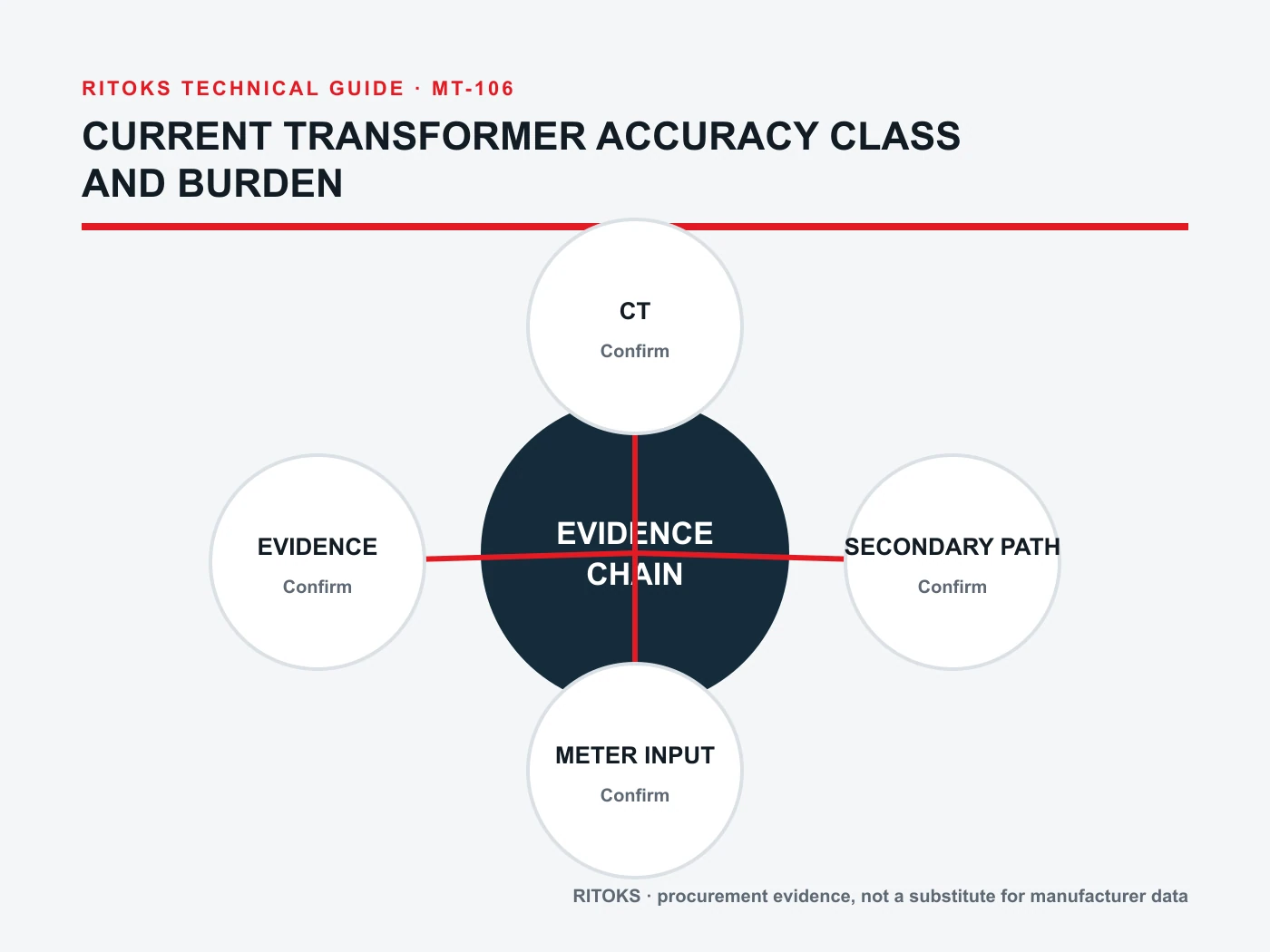
A CT, meter, wiring path and configured ratio form one measurement chain. Commissioning should check polarity or direction where relevant, expected response and scaling under known conditions.
Keep the as-built secondary diagram and configuration alongside the selected CT order code. This makes it possible to diagnose a discrepancy between the meter display and another measurement without guessing which component changed.
Request evidence that matches the quoted item
Ask for exact ratio, output, rated burden, accuracy basis, physical drawing and installation instructions for the proposed CT. Separate what the product page shows from what the order-specific documents prove.
A proposal remains open if the accuracy class is visible but the burden or operating conditions are not. Resolve those fields before approval, especially when the reading supports a commercial or control decision.
Criar um arquivo de evidências com modelo exato
A category or product-family page helps locate relevant options; it does not by itself approve one variant. For current transformers, keep the full proposed order code, current datasheet, terminal or mounting drawing, operating instructions and any project calculation together. Read the conditions attached to each rating or function. If the evidence belongs to a neighboring model, request the correct document instead of carrying the claim across.
A equipe do projeto é responsável pelos dados de entrada do sistema e pelos critérios de aceitação. O fornecedor é responsável pelas evidências relativas ao item oferecido. Na revisão técnica, associe cada requisito obrigatório ao documento e à revisão exatos que o atendem. Marque um campo ausente como “em aberto”, “condicional” ou “não suportado”. Isso gera uma decisão rastreável e evita que um valor nominal favorável oculte uma conexão ou condição de instalação incompatível.
Compare as ofertas completas
| Item | Registro na comparação | Motivo |
|---|---|---|
| Item disponível para encomenda | Código completo, variantes e acessórios incluídos | Evita suposições em nível familiar |
| Correspondência de aplicativos | Resposta por escrito a cada contribuição do projeto | Mantém as exceções visíveis |
| Documentação | Ficha técnica, desenho, instruções e revisões | Links relacionados ao item oferecido |
| Questões pendentes | Responsável e prazo para esclarecimento | Evita a aceitação passiva |
Utilize o mesmo briefing do projeto para todos os orçamentos. Condições comerciais, como preço e prazo de entrega, podem ser comparadas assim que o escopo técnico for padronizado. Não considere acessórios omitidos, classificações não comprovadas ou uma suposição de fiação não esclarecida como equivalentes a uma proposta documentada. Se for proposta uma alternativa, pergunte quais parâmetros se alteram e repita a análise dos itens afetados.
Revisão da instalação e aceitação
Antes da instalação, verifique se a etiqueta fornecida, o código completo e os acessórios correspondem ao registro aprovado. Compare os terminais, a montagem, o acesso aos condutores e qualquer orientação indicada com as instruções exatas. Um produto que pareça fisicamente semelhante à versão aprovada pode, ainda assim, apresentar uma configuração elétrica, opção de controle ou critérios de teste diferentes.
Planeje uma verificação de conformidade com o projeto que aborde os riscos reais do projeto. Isso pode envolver a verificação da instalação elétrica em relação ao esquema aprovado, a resposta funcional, medições em condições operacionais representativas e a confirmação de qualquer recurso de comunicação ou alarme. Registre as condições e os resultados. O plano de aceitação deve basear-se nas evidências da aplicação e do fornecedor, e não em uma lista de verificação genérica de itens.
Lista de verificação para solicitação de cotação
- Identify the circuit, equipment and location that current transformers must serve.
- Anexe o desenho do sistema e os estados operacionais que definem a aplicação.
- Record primary range and its source document.
- Record secondary output and its source document.
- Record accuracy class and its source document.
- Record rated burden and its source document.
- Confirm the exact-model evidence for meter input.
- Confirm the exact-model evidence for lead length.
- Confirm the exact-model evidence for connection.
- Confirm the exact-model evidence for test record.
- Solicite o código completo do pedido, os acessórios, os desenhos e a versão atualizada da ficha técnica.
- Pergunte sobre exclusões, premissas, substitutos e questões de engenharia ainda não resolvidas.
A solicitação de cotação deve ser suficientemente específica para que um fornecedor possa respondê-la sem precisar inventar valores ausentes do projeto. Se um dado essencial ainda não for conhecido, indique-o como uma pergunta e identifique quem irá determiná-lo. Não transforme uma suposição em uma classificação, uma declaração de conformidade ou um método de instalação aprovado.
O que influencia a decisão
A decision can change when the source arrangement, load behavior, environment, installation geometry or required function changes. Revisit the selected current transformers whenever one of those inputs moves outside the approved brief. Recheck the order code and the exact evidence affected by the change; do not rely on a previous approval for a circuit that now asks the component to do different work.
Mantenha um breve histórico de revisões do briefing do projeto, da resposta do fornecedor e da lista de exceções aceitas. Esse registro ajuda as equipes de engenharia, compras e comissionamento a trabalharem com a mesma versão. É especialmente útil quando uma cotação é revisada, é oferecido um substituto ou o projeto do painel sofre alterações após a primeira comparação.
Questões a serem resolvidas antes da aprovação
Ask who owns each remaining technical question for the proposed current transformers. The buyer should confirm the system inputs and installation constraints; the supplier should confirm the exact item, included options and applicable documentation. Put the answer and document revision beside the question. An unanswered point should remain visible in the comparison rather than being converted into an assumed feature.
Quando uma cotação oferecer uma alternativa, solicite uma explicação por escrito sobre as alterações no circuito, na montagem ou nos parâmetros de desempenho. Analise qualquer novo desenho com o engenheiro do projeto e registre se a alteração proposta é aceitável. Uma substituição constitui uma nova decisão técnica, mesmo que pareça comercialmente equivalente. Isso é especialmente importante quando vários fornecedores utilizam denominações de família semelhantes para configurações diferentes.
Perguntas frequentes
Does a higher accuracy class guarantee an accurate installation?
No. The connected burden, current range, meter input, wiring and configuration also matter.
Can I connect any CT to any panel meter?
No. Verify secondary output, input requirements, ratio configuration and wiring.
Is rated burden the same as actual burden?
No. Rated burden is a product condition; actual burden is created by the installed secondary circuit.
Páginas relevantes do RITOKS
Para obter informações sobre a família de produtos, consulte Medição e monitoramento elétricos. As páginas de produtos publicadas relacionadas incluem Bh 0 66 60i Current Transformer 200 5a 1500 5a, Dp Series Split Core Current Transformer, Gta20l Precision Current Transformer 10a 100a. Utilize os documentos atuais referentes ao modelo exato ao comparar um item proposto.
Para obter um orçamento específico para sua aplicação, enviar o briefing do projeto para a RITOKS com os diagramas e as questões em aberto acima.