
Warmtebeheer · Technische uitleg
Thermal Management for Outdoor Electrical Cabinets
Thermal Management for Outdoor Electrical Cabinets starts with the system question: Which solar, ambient, ingress and duty conditions change the approach? A useful selection brief connects the equipment duty, installation and receiving system to a specific orderable product. The article below separates project inputs from product evidence so that a familiar product name does not quietly become a technical approval.
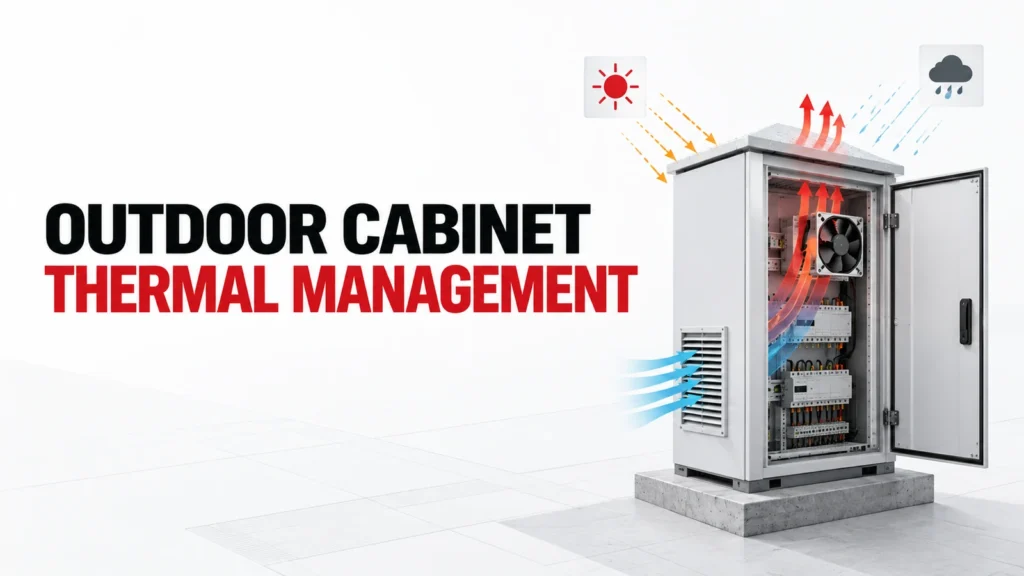
This guide defines outdoor cabinet thermal inputs and solution roles. It does not claim that an indoor-rated air conditioner, fan or heater is suitable outdoors; suitability must be established for the exact product and assembled enclosure.
De beslissingsfactoren in één oogopslag
| Beoordelingsgebied | Projectbijdrage | Te vragen bewijsstukken |
|---|---|---|
| SOLAR GAIN | De feitelijke bedrijfstoestand en de systeemgrenzen vaststellen | Goedgekeurde systeemtekening of dienstrooster |
| DEVICE LOSSES | Geef de naam van de interface, geometrie of besturingsverwachting op | Een gedetailleerd document over de apparatuur of het product |
| AMBIENT | Toestand van de omgeving en de installatie | Plattegrond of paneeltekening |
| DUTY | Beschrijf de service- en acceptatie-eisen | Gedetailleerde instructies en testplan |
Outdoor exposure changes the problem
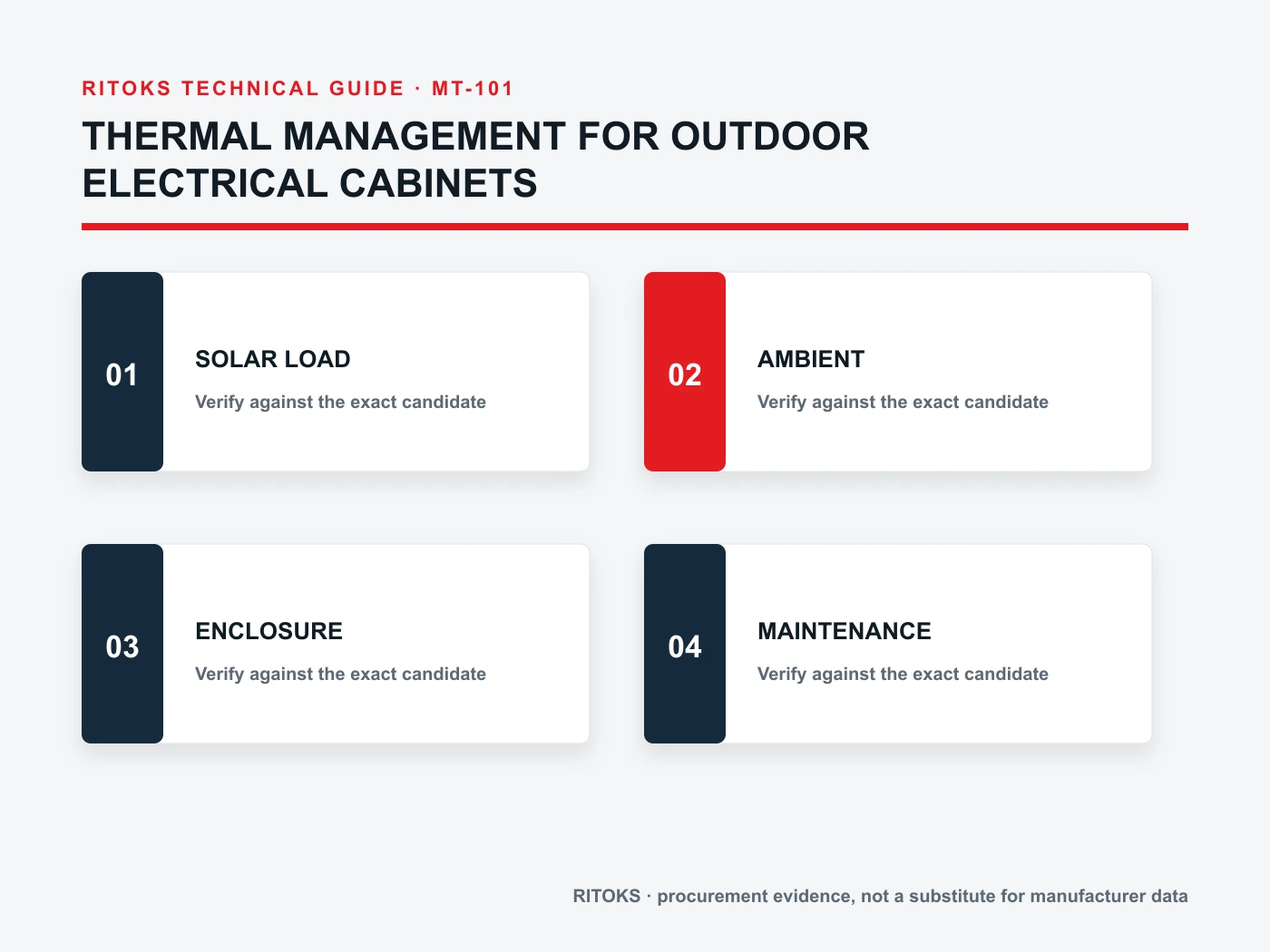
An outdoor electrical cabinet sees the heat produced by its own equipment and the conditions surrounding the enclosure. Sunlight, ambient temperature, wind, rain, dust and duty cycle can change across the day and season. A cooling method selected from an indoor cabinet example may not address these combined conditions.
The first deliverable is a site and equipment profile, not a model number. Record cabinet location, orientation, shade, material, dimensions, internal losses and acceptable component temperatures. Identify the limiting operating state so the selected approach is evaluated against a real case rather than a comfortable average.
Account for solar and external heat
Solar gain can warm a cabinet wall and raise the thermal burden, particularly when exposed surfaces and internal components are close. The effect depends on orientation, color, shading and local weather. Request a project-specific assumption or measurement rather than applying a universal percentage to every enclosure.
Nearby process equipment, ground surfaces and trapped air can also affect local ambient. Record the temperature at the cabinet installation, not only a regional weather headline. If the cabinet will be relocated or installed in multiple climates, define a separate design envelope for each case.
Map internal losses and operating states
Create a heat-load list for drives, power supplies, contactors, communication devices and other installed equipment using applicable exact data. Include continuous and intermittent duty, standby states and any future equipment that is actually committed to the design. A device’s electrical input is not necessarily its heat loss inside the cabinet.
Place major heat sources on the layout. Component separation, airflow path and sensors influence local hot spots even when the total loss is unchanged. Where supplier loss data is missing, mark the estimate as provisional and identify the test or document needed to close it.
Choose between exchange and isolation of air
Filtered ventilation exchanges internal and outside air. It may be suitable only when external air conditions and ingress needs allow it, and when the achievable temperature condition meets component limits. A heat exchanger or air conditioner can maintain a more controlled boundary, but each has its own ambient, mounting, drainage, power and maintenance requirements.
Do not treat a cabinet fan as a universal outdoor solution or an air conditioner as an automatic answer. Compare the selected method with dust, water, corrosive exposure and the enclosure’s required protective function. Verify the rating of the assembled installation, including penetrations and accessories.
Separate overheating from condensation control
An enclosure can have a moisture problem when surfaces cool below the relevant dew point, even if it does not overheat. A heater may support condensation control in defined conditions, but it adds heat and requires controls. A cooling device may also have condensate behavior that must be handled. The two objectives should be written separately.
Record humidity conditions, off-cycle periods, ventilation openings and drain strategy. Ask which device handles each operating state and how sensors are placed. Do not infer that a product labeled “heater” or “cooler” solves both problems without a complete control and environmental design.
Check product location and assembly rating
An indoor air conditioner is not made outdoor-suitable by mounting it on an outdoor cabinet. Require the exact device environmental rating, installation orientation, sealing instructions and exposure limits. The same review applies to fans, filters, heaters, thermostats, cable entries and doors.
The enclosure’s protective function belongs to the assembled result. Cutting an opening, adding a cooling unit or changing a gasket can alter that result. Preserve the approved cutout drawing and mounting instructions, then inspect the built cabinet for the same arrangement.
Plan maintenance in the real location
Outdoor cabinets may be remote, elevated or difficult to service. Define filter cleaning, fan replacement, condensate management, sensor checks and access clearance before the equipment is ordered. A method that works in a laboratory but cannot be maintained at the site may not be the right choice.
Where cooling depends on power or moving parts, define alarm and failure response. The project should identify which electrical loads remain active, what the controller does and how the operator learns of a fault. Record the selected behavior in commissioning tests.
Een bewijsmap op basis van een exact model samenstellen
For the proposed Enclosure Cooling Strategy, create one approval record with the complete order code, the exact datasheet, the relevant drawing, installation instructions and any curve or test report used for the decision. Date each file or record its revision. A product-family page is useful for discovery, but it does not prove that a particular configuration includes an optional feature or meets a system condition.
Vergelijk elke eis met de documentatie voor hetzelfde bestelbare artikel. Combineer het maximale aantal per productfamilie van de ene variant niet met een schakelschema, een lijst met accessoires of een thermische curve van een andere variant. Zet onduidelijke velden in een zichtbare kolom voor verduidelijking. Als een leverancier een vervangend product voorstelt, herhaal dan de betreffende beoordeling voordat je de technische gelijkwaardigheid ervan goedkeurt.
Houd projectbijdragen gescheiden van facturen van leveranciers
Het projectteam is verantwoordelijk voor het applicatiedossier: bron en belasting, bedrijfsstatussen, omgeving, montage, bedieningselementen, onderhouds- en acceptatiecriteria. De leverancier is verantwoordelijk voor de voorgestelde bestelcode en de bijbehorende documentatie van het apparaat. Geen van beide partijen mag een leemte opvullen door conclusies te trekken op basis van het uiterlijk of een bekende familienaam. Een bruikbaar antwoord kan zijn “gegevens nog niet beschikbaar”, mits het ontbrekende item een verantwoordelijke en een afsluitdatum heeft.
Bevries die specificatie terwijl de offertes worden vergeleken. Als de bedrijfsomstandigheden, de behuizing, de stroombron, de meter, de motor of de beveiligingsarchitectuur veranderen, stel dan een bijgewerkt specificatieblad op en vraag elke leverancier om zijn voorstel opnieuw te bevestigen. Zo voorkom je dat een eerdere offerte wordt beschouwd als goedkeuring voor een later ontwerp.
Hoe vergelijk je offertes van leveranciers?
| Aanbiedingsartikel | Wat moet je vergelijken? | Bewijs van goedkeuring |
|---|---|---|
| Bestelbare omvang | Volledige set inclusief toebehoren | Exacte offerte en stuklijst |
| Elektrische aansluiting | Alle relevante bedrijfstoestanden | Document met exacte classificatie, circuit of curve |
| Mechanische passing | Bevestiging, aansluitingen en toegang | Teken- en montage-instructies |
| Serviceplan | Inspectie- en vervangingsmethode | Onderhoudsinstructies |
| Openstaande posten | Aannames, uitsluitingen en uitzonderingen | Register van schriftelijke verduidelijkingen |
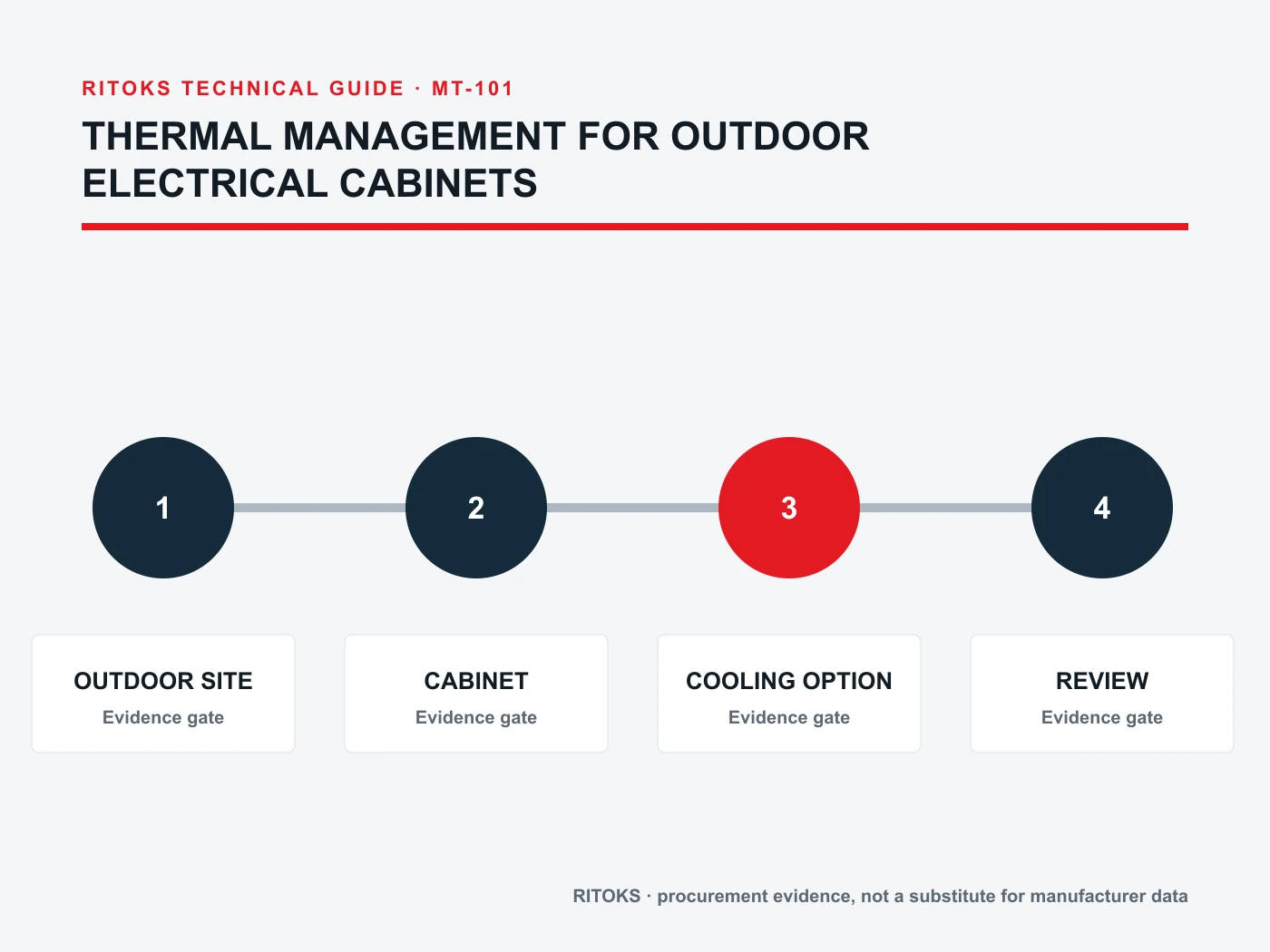
Normalize each Enclosure Cooling Strategy offer to the same application record. A shorter lead time or lower price is meaningful only after the technical scope is comparable. Record whether each supplier included the required accessories, documents and support for commissioning. Keep exceptions explicit, especially when the candidate needs a change to the panel or control design.
Controlepunten bij de aanschaf en inbedrijfstelling
- Bevestig de systeemgrenzen, de bedrijfstoestanden en de acceptatiecriteria.
- Controleer één volledige bestelcode aan de hand van de documenten met de exacte modellen.
- Elektrische, mechanische, omgevings- en servicegerelateerde afwijkingen oplossen.
- Vergelijk de geleverde omvang en de wijzigingen in de documenten tussen de verschillende offertes.
- Controleer het ontvangen artikel aan de hand van het goedgekeurde document.
- Test de voltooide assemblage volgens de goedgekeurde procedure van het project.
Bij de ontvangstcontrole moeten het geleverde etiket, de aansluitingen, de meegeleverde accessoires en documenten worden vergeleken met de goedgekeurde bestelling. Een vervangend onderdeel uit dezelfde productfamilie wordt niet automatisch geaccepteerd. Controleer bij de inbedrijfstelling de toepassingsspecifieke functies die niet uitsluitend aan de hand van de documentatie van het onderdeel kunnen worden vastgesteld. In het testplan moeten representatieve toestanden en acceptatiecriteria worden vermeld, zonder dat er algemene grenswaarden worden vastgesteld.
Checklist voor het opstellen van een offerteaanvraag
A useful request for quotation on thermal management for outdoor cabinets is concise but complete. Ask for the exact orderable configuration and list unknown values as questions. Do not let the sales description silently answer a technical question that belongs to a calculation, a drawing or a test.
- SOLAR GAIN
- DEVICE LOSSES
- AMBIENT
- DUTY
- INGRESS
- CONDENSATION
- KOELING
- SERVICE
- Toepasselijke documentversies
- Hoeveelheid, bestemming en leveringsomvang
Vraag de leverancier om uitsluitingen, aannames en optionele posten afzonderlijk te vermelden. Bewaar het verslag van de technische toelichting bij de offerte, zodat de afdelingen Inkoop en Engineering dezelfde scope beoordelen. Als een cruciale input nog steeds ontbreekt, kan de kandidaat commercieel gezien interessant blijven, maar blijft de technische goedkeuring in het ongewisse.
Veelgestelde vragen
Can a Enclosure Cooling Strategy be chosen from one headline rating?
Nee. De toepassing, de exacte configuratie en de relevante elektrische, mechanische, thermische en omgevingsomstandigheden moeten gezamenlijk worden beoordeeld. Een catalogustitel is een uitgangspunt voor onderzoek, geen volledig goedkeuringsdossier.
Bewijst een familiepagina een exacte verwantschap of een band?
Nee. Gebruik de voorgestelde bestelcode en de bijbehorende actuele tekening, het gegevensblad en de installatie-instructies. Optionele functies of alternatieve aansluitconfiguraties kunnen binnen een productfamilie verschillen.
Wat als de leverancier één van de vereiste waarden niet kan verstrekken?
Markeer de waarde als ‘onopgelost’, bepaal wie deze zal verkrijgen en zet het betreffende besluit tijdelijk in de wacht. Zet een aanname niet om in een bewezen bewering, louter omdat de aankoopdatum nadert.
Waar gaat de recensie verder?
Bekijk de Enclosure Cooling Strategy category voor de beschikbare productfamilie, bekijk vervolgens de pagina met gerelateerde producten als mogelijk uitgangspunt. Op deze pagina’s wordt de commerciële bestemming aangegeven; de exacte modeldocumenten bepalen of de toepassing geschikt is. Voor een projectspecifieke vergelijking kunt u de systeemgegevens en openstaande vragen doorsturen via de RITOKS-pagina voor vragen.
Mocht na bestudering van het bewijsmateriaal blijken dat een ander apparaat of een andere methode geschikter is, pas dan de ontwerpopdracht aan voordat je om een vervanging vraagt. Zorg ervoor dat de documentatie betrekking heeft op het uiteindelijke circuit en de uiteindelijke installatie, en niet alleen op de productfamilie die aanvankelijk de aandacht trok.