
Materiały techniczne · Objaśnienia techniczne
Current Transformer Ratio Selection: Primary Current and Secondary Output
Specify a current transformer ratio from the primary circuit, secondary measurement input and exact burden and accuracy evidence. A useful buyer review connects the project requirement to one exact orderable product and preserves the evidence used for approval.
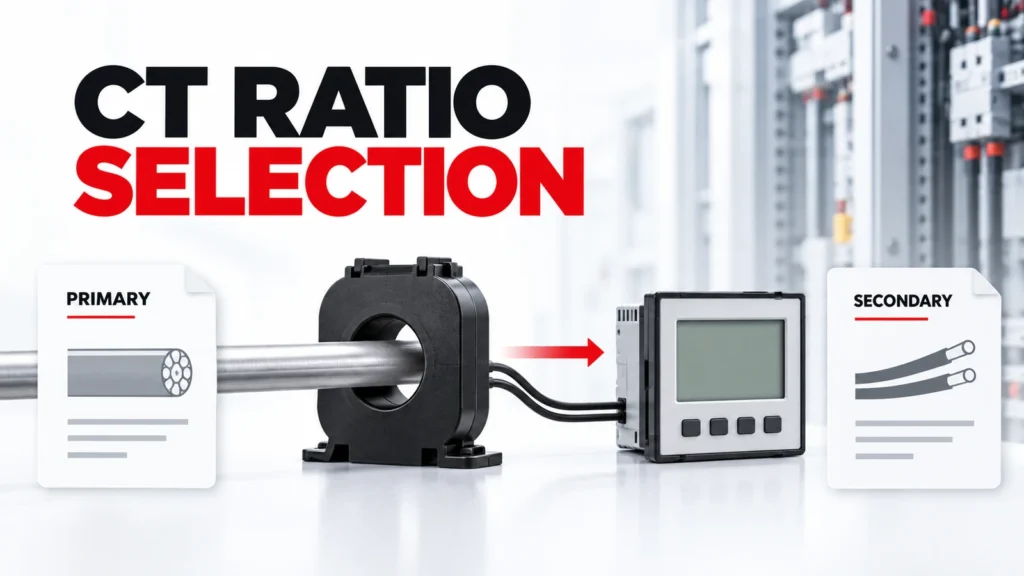
This guide explains the evidence chain for a current-transformer ratio. It does not calculate a project ratio, declare compatibility with a meter or protection relay, or provide secondary wiring or safety instructions.
Podsumowanie danych wejściowych do decyzji
| Pole recenzji | Kupujący musi określić | Dokumenty, o których udostępnienie należy wystąpić |
|---|---|---|
| Primary current | Normal, maximum and relevant operating range | Project load study |
| Wyjście wtórne | Exact input required by the receiving meter or relay | Receiving-device manual |
| Współczynnik | Declared primary-to-secondary relationship | Exact CT model row |
| Measurement performance | Accuracy and burden under documented conditions | Manufacturer data and system calculation |
| Pasowanie mechaniczne | Window, conductor, mounting and installation constraints | Drawing and installation review |
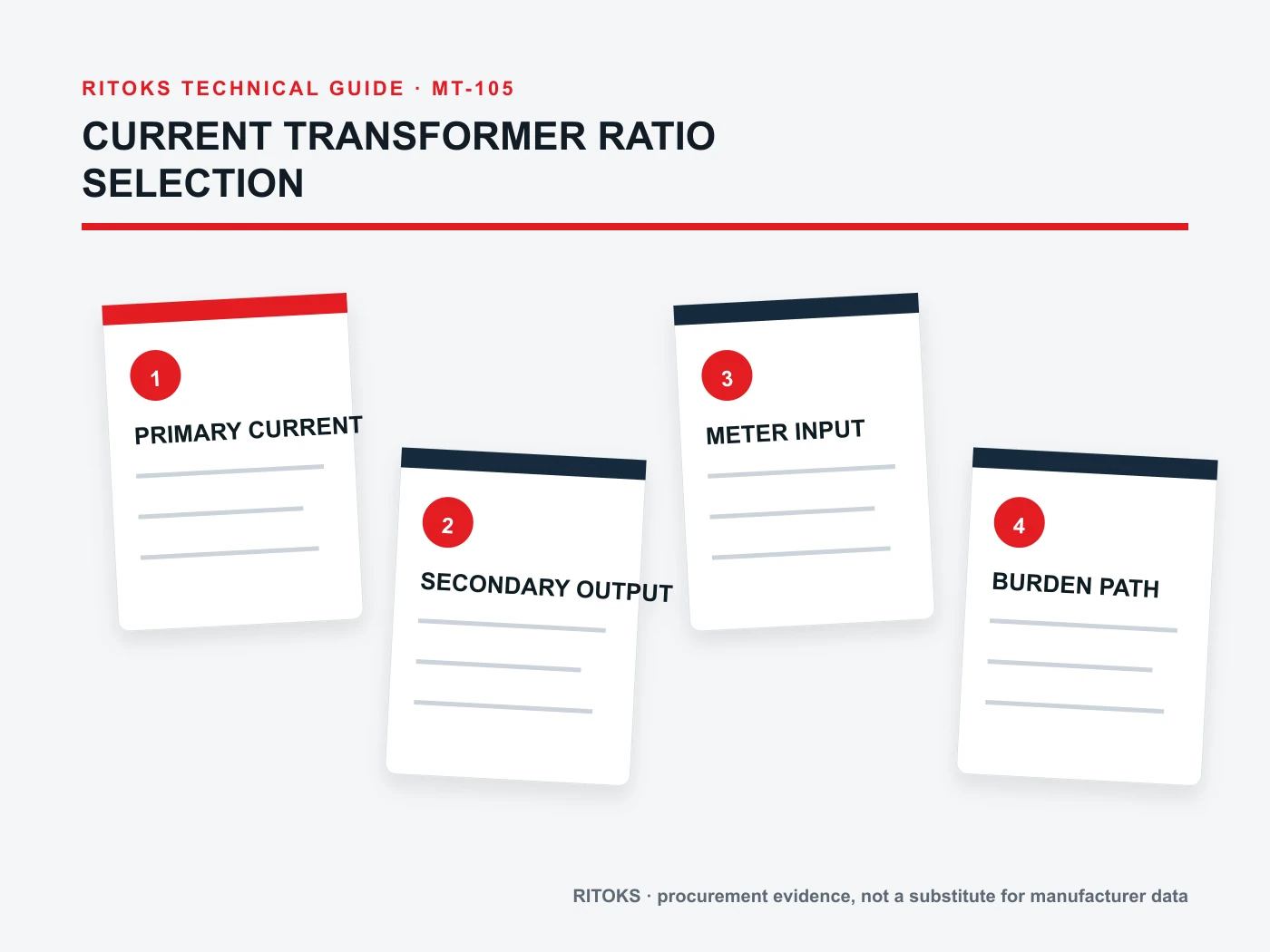
Start With the Real Primary Current Range
The primary side should be described by the expected operating current, maximum normal condition and any meaningful variation that affects measurement. Selecting from conductor ampacity or protective-device frame size alone can place normal readings in an unsuitable part of the measurement range.
Record how the current estimate was obtained and whether future operating modes change it. The buyer does not need to force a final ratio before the receiving-device input and measurement objective are known.
Match the Secondary Output to the Receiving Device
A current transformer and a meter form an interface. The CT secondary declaration must match the exact input expected by the meter, transducer or relay. A familiar ratio notation is not enough to establish that relationship. Request both documents and review them together.
Do not use a product family page to infer input compatibility. Neighboring meter variants may accept different sensors or secondary signals. The approval record must name the exact receiving device and its terminal documentation.
Understand What the Ratio Expresses
The ratio states the declared relationship between primary current and secondary output under the product's defined conditions. It does not by itself establish accuracy across the required operating range, available burden, saturation behavior or suitability for protection. Those are separate evidence fields.
When quotations offer different ratios, compare the resulting measurement use rather than treating the values as catalog alternatives. Each proposal should explain how the ratio aligns with the project's primary-current range and receiving input.
Review Burden and Accuracy as a System
The connected input, lead path and terminals contribute to the secondary circuit seen by the transformer. The responsible engineer should calculate and verify that complete circuit against the exact CT and receiving-device documents. Procurement should preserve the inputs rather than guessing from a headline accuracy class.
Ask where accuracy is declared, at which conditions and for which order code. Never combine the ratio of one model, burden data from another and dimensions from a third. If the system calculation is missing, mark the proposal incomplete.
Confirm Frequency, Purpose and Operating Context
State whether the measurement supports indication, energy monitoring, control, protection or another purpose. These uses can demand different evidence. Also record the system frequency and waveform context that the manufacturer requires for its declaration.
This guide deliberately avoids treating a measurement CT as a protection CT or vice versa. The proposed device must be documented for the intended role, and any special behavior must be evaluated by the system designer.
Verify Window Size and Installation Constraints
The primary conductor, bar arrangement, insulation, bending space and access determine whether the CT can be installed. A ratio match does not prove mechanical fit. Request the exact outline drawing and confirm that the window accommodates the real conductor without unsupported modification.
For retrofit work, a split-core construction may change installation access, but it does not remove the need to review ratio, output, burden, accuracy and environmental conditions. Keep construction choice separate from electrical approval.
Stwórz plik dowodów oparty na modelu dokładnym
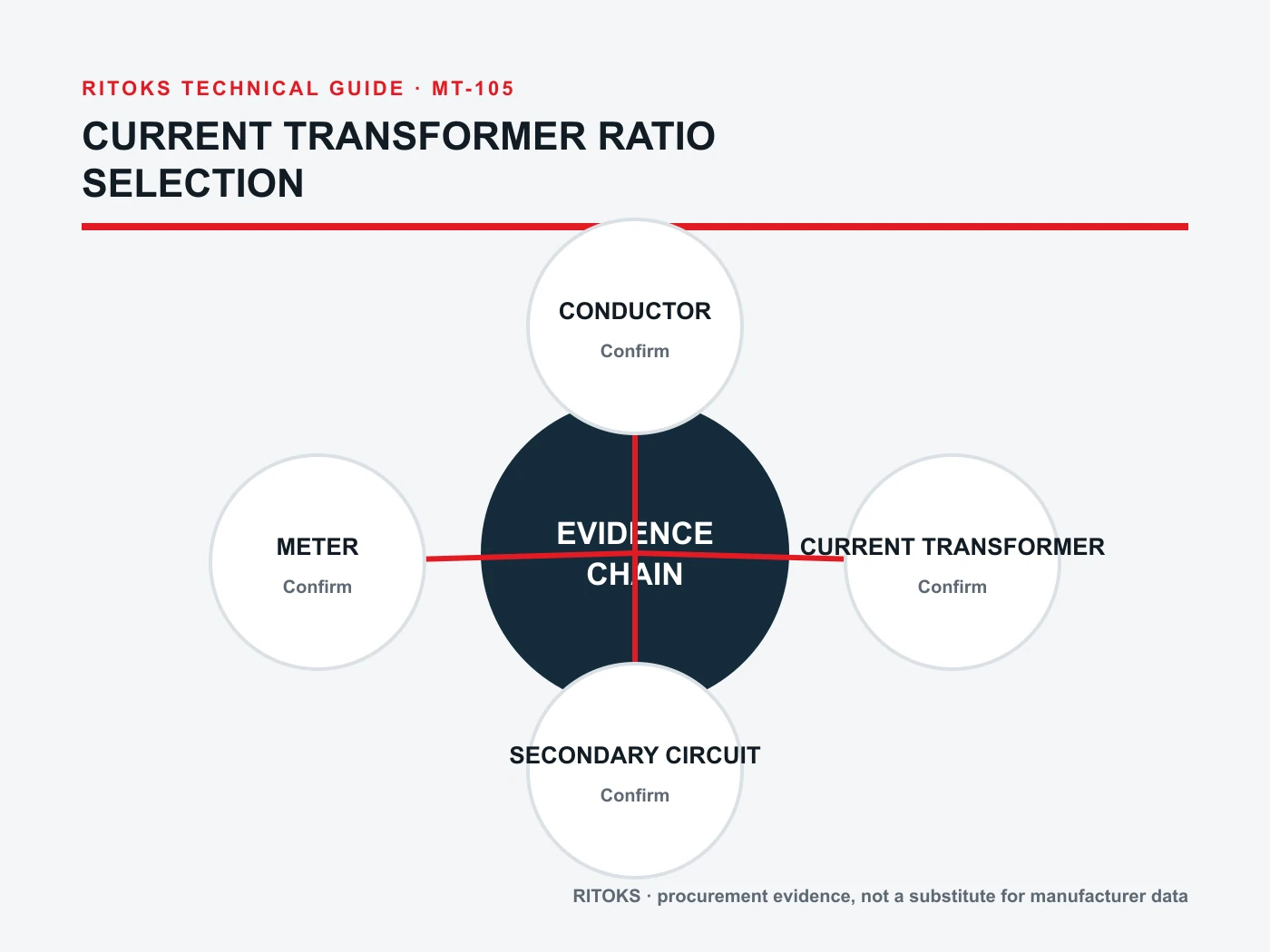
Create one approval record for the proposed Current Transformer order code. Put each project requirement beside the supplier document that answers it. Preserve the exact datasheet, drawing, table, instruction or selection output used, including its revision or retrieval date. A category page can establish family context, but it cannot prove an exact rating, terminal arrangement or system combination.
Należy sprawdzić, czy każda zaakceptowana specyfikacja dotyczy tej samej pozycji dostępnej w ofercie. Podobne obudowy mogą zawierać różne układy elektroniczne, zasilacze, zaciski, akcesoria lub funkcje. Nie należy łączyć maksymalnej liczby sztuk z jednej rodziny z wariantem, schematem z innego wariantu oraz opcjonalną funkcją z trzeciego. Należy wyraźnie oznaczyć pola, które nie zostały jeszcze wypełnione, tak aby pozostały widoczne podczas przeglądu handlowego.
Należy oddzielać dane wejściowe projektu od dowodów dotyczących produktu
The project team defines the application: source, load, duty, environment, controls, mechanical limits and required functions. The supplier identifies an exact Current Transformer and supports it with exact documents. Neither side should fill a gap by inference from appearance, a shared family name or one matching headline value.
Należy wstrzymać proces rozpatrywania wniosku na czas porównywania ofert. Jeśli zmienią się topologia, źródło, obciążenie, środowisko, obudowa lub wymagana moc wyjściowa, należy sporządzić zaktualizowany dokument i poprosić każdego dostawcę o ponowne potwierdzenie wybranego rozwiązania. W przeciwnym razie oferty, które na pierwszy rzut oka wydają się porównywalne, mogą odpowiadać na różne wymagania techniczne.
Typowe błędy związane z zamówieniami publicznymi
Avoid selecting a Current Transformer from one headline value while the application context remains incomplete. Do not use a circuit, curve, terminal drawing or performance claim from a neighboring model. A product photograph and a family page can support discovery, but neither is exact technical evidence.
Należy również unikać zakładania, że dany element wyposażenia, funkcja komunikacyjna, rola ochronna lub skoordynowany wynik są uwzględnione, o ile nie zostały one wymienione w ofercie cenowej i dokumentacji dotyczącej konkretnego modelu. Produkt zastępczy musi spełniać te same wymagania dotyczące topologii, parametrów znamionowych, sposobu montażu oraz weryfikacji dokumentacji, co pierwotnie rozważany produkt.
Jak porównać oferty dostawców
Normalize every Current Transformer offer to the same application record. Keep document revisions, stated conditions, included accessories and open questions beside each value. This makes differences in delivered scope visible and prevents a lower-cost but narrower offer from appearing equivalent to a complete solution.
Należy zaprzestać porównywania, gdy nieznane są kluczowe parametry aplikacji, podany model jest niejednoznaczny, wymagana specyfikacja jest poparta jedynie danymi innego producenta lub kodem zamówienia, albo gdy instalacja wykracza poza zakres dostępnych danych. Są to luki techniczne, a nie szczegóły redakcyjne.
Kontrola zmian i zamian
Give the approved Current Transformer record a revision identifier and keep it with the project file. If the supplier changes the order code, accessory, firmware, drawing or stated operating condition, identify the change before accepting it. A substitution is a new technical proposal even when its price, housing or product-family name looks familiar.
Powtórz tylko te kontrole, których dotyczy problem, ale nie rezygnuj z nich. Upewnij się, że zaktualizowana wersja wniosku nadal odpowiada zamrożonemu wnioskowi, że wszystkie dokumenty, do których się odwołuje, należą do niego oraz że wszystkie otwarte wyjątki mają wyznaczonego odpowiedzialnego. Ten niewielki etap kontroli zmian zapobiega zastąpieniu selekcji, która przeszła weryfikację techniczną, przez jej niepoddaną weryfikacji komercyjną wersję.
Proces podejmowania decyzji
- Przed wybraniem kodu katalogowego należy zablokować aplikację i zapis systemowy.
- Należy określić dokładną funkcję oraz każdy interfejs, który wymaga potwierdzenia.
- Proszę o przesłanie jednego kompletnego kodu zamówienia wraz z aktualną kartą katalogową i rysunkami technicznymi.
- Należy przyporządkować każde wymaganie projektowe do konkretnego oświadczenia producenta.
- Należy odnotować odchylenia, elementy dodatkowe, zmiany w dokumentacji oraz nierozstrzygnięte kwestie.
- Należy powtórzyć przegląd za każdym razem, gdy nastąpią zmiany w zastosowaniu lub w proponowanym produkcie.
Use this workflow as a procurement and evidence discipline. It does not replace qualified design, installation instructions or the responsible engineer's approval for the Current Transformer application.
Lista kontrolna dotycząca przygotowania zapytania ofertowego
A practical current transformer ratio selection should be concise enough for a supplier to answer and complete enough to prevent silent assumptions. Identify unknown values as questions rather than allowing them to become undocumented selections.
- Primary current: Normal, maximum and relevant operating range.
- Secondary output: Exact input required by the receiving meter or relay.
- Ratio: Declared primary-to-secondary relationship.
- Measurement performance: Accuracy and burden under documented conditions.
- Mechanical fit: Window, conductor, mounting and installation constraints.
- Dokładny kod produktu, zawarte w zestawie akcesoria oraz wersja dokumentacji
- Ilość, miejsce przeznaczenia, wymagane zezwolenia oraz zakres handlowy
Należy poprosić o dokładny zakres wszelkich oświadczeń dotyczących klasyfikacji, zgodności, koordynacji lub wydajności. Należy odnotować ilość i miejsce przeznaczenia po danych technicznych, aby warunki handlowe nie przesłaniały nierozstrzygniętych kwestii technicznych.
Najczęściej zadawane pytania
Can CT ratio be selected from breaker size alone?
No. Use the real current range, receiving-device input and measurement objective.
Does a matching secondary value prove compatibility?
No. Burden, accuracy, frequency, terminals and the exact interface still require review.
Can a current transformer secondary be treated as an ordinary signal?
No. Follow qualified design practices and the exact manufacturer safety instructions.
Powiązane produkty i wytyczne firmy RITOKS
Linki te służą wyłącznie do przedstawienia kontekstu rodziny produktów. Link kontekstowy nie oznacza zamienności, kompatybilności ani zatwierdzonej kombinacji systemów.
Current Transformer product category
BH-0.66-60I current transformer family
Przekładnik prądowy z dzielonym rdzeniem serii DP
GTA20L precision current transformer
Materiały techniczne
Powyższe źródła producenta służą wyłącznie do zilustrowania ogólnych zasad technicznych opisanych poniżej. Dane techniczne produktów, schematy obwodów, certyfikaty oraz wyniki koordynacji z tych źródeł nie mają zastosowania do produktów RITOKS.
Schneider Electric, wielofunkcyjne mierniki mocy PowerLogic
Supports treating the meter input and measurement architecture as part of the complete system record. Schneider meter inputs do not establish compatibility with RITOKS CTs.
Poproś o przegląd konkretnego modelu
Prosimy o przesłanie wymagań dotyczących zamówienia, szczegółowych pytań dotyczących dokumentacji, ilości i miejsca dostawy za pośrednictwem formularza kontaktowego RITOKS. Zapytanie ofertowe wymaga weryfikacji konkretnego modelu; niniejszy przewodnik nie zatwierdza obwodów, instalacji ani automatycznych zamienników.