
Current Transformers · Technical Explainer
Current Transformer Accuracy Class and Burden: Verification Guide
Current transformer accuracy class and burden describe a measurement system, not a standalone quality score. A CT specified for a particular class is assessed under defined conditions. The connected meter, cable and terminals impose a real secondary burden that must fit the evidence for the exact CT.
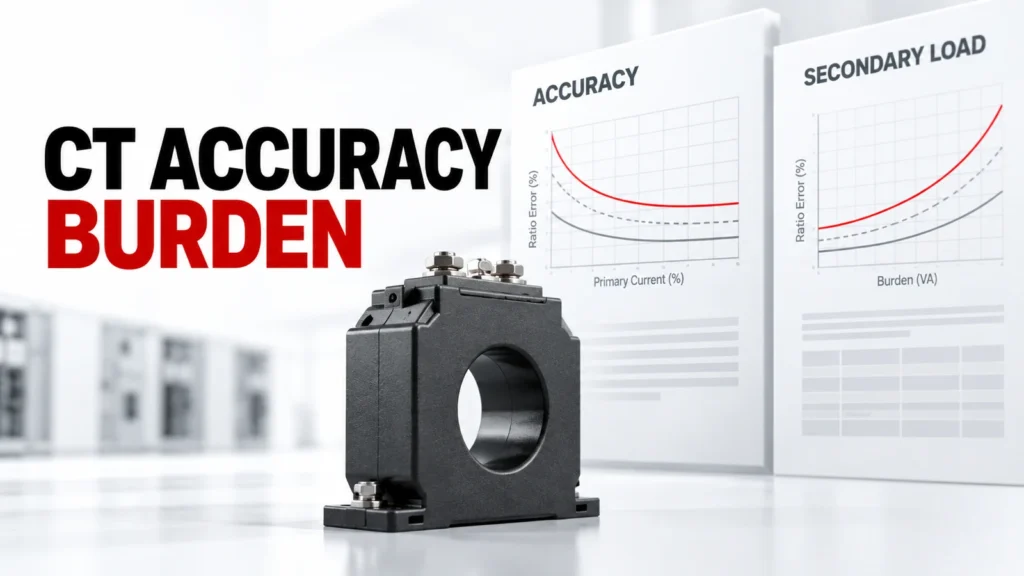
This guide explains the questions a buyer should put in the technical file. It does not assign universal accuracy to a CT family or prescribe a ratio from the equipment name alone.
Entscheidungsgrundlagen auf einen Blick
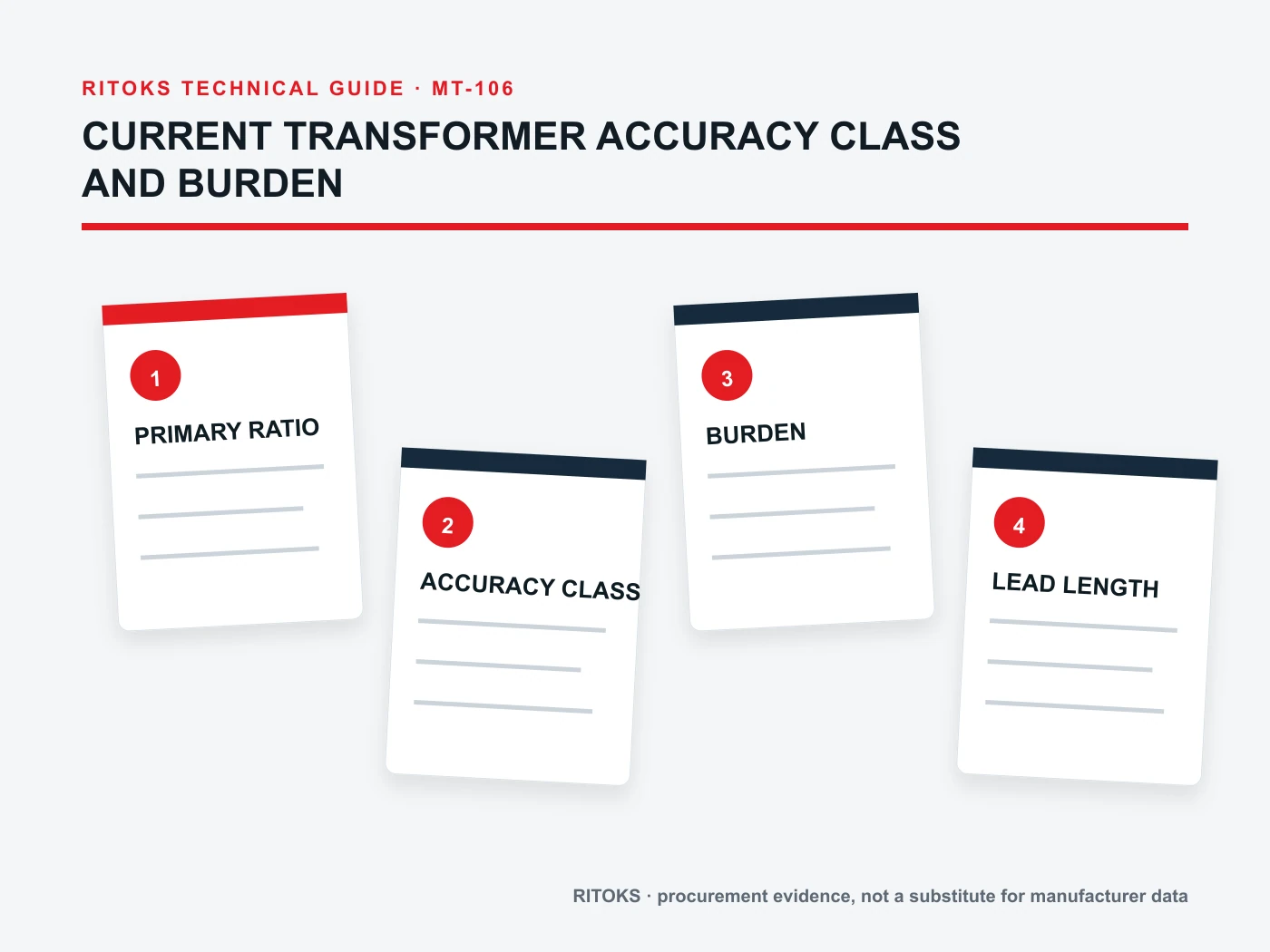
| Bewertungsbereich | Was der Käufer festhält | Anzufordernde Nachweise |
|---|---|---|
| Primary side | Expected current range and conductor arrangement | Load record and installation drawing |
| Secondary side | Output expected by receiving device | CT and meter input documents |
| Belastung | Meter input plus lead and connection contribution | Circuit estimate and exact CT data |
| Genauigkeit | Required class under relevant conditions | Exact CT datasheet and test basis |
Define the measurement purpose
A monitoring display, energy accounting function and control input may demand different evidence. State what the reading will be used for, its relevant operating range and the consequences of error. The CT ratio and class should follow that purpose.
If the circuit rarely operates near its nominal maximum, consider performance over the actual range rather than selecting from one full-scale number. Ask the supplier for the exact conditions to which its accuracy statement applies.
Understand class as a conditional statement
An accuracy class describes performance under a defined standard or test basis. It is not a promise that the installed meter will show that error under every current, frequency, temperature or burden.
Read the complete CT datasheet, including the specified output, rated burden and class conditions. Do not transfer a class label from one variant, core size or ratio to another.
Calculate the complete secondary burden
The receiving meter input is only part of the load seen by the CT secondary. Lead resistance, terminals and other connected devices can contribute. Longer runs and multiple instruments may materially change the burden.
Document the secondary route and the actual devices attached to it. Compare the resulting burden with the exact CT evidence; if the circuit changes, update the assessment. Avoid treating a catalog burden value as a measurement of the installed circuit.
Match ratio and output to the meter
The CT primary ratio should represent the expected current range, while the secondary output must match the meter input. A number in the product title does not prove the output of every order code or compatibility with every panel meter.
Obtain both connection diagrams and the meter configuration method. Record any programmable ratio in the commissioning file so the display and exported data use the same scaling.
Check physical installation
Solid-core and split-core devices may solve different installation constraints. Confirm conductor or busbar dimensions, window space, mounting access and orientation. The choice of housing also affects how the secondary circuit can be routed and inspected.
If retrofitting a live panel is proposed, the work method needs a separate safety review by qualified personnel. Do not infer installation permission from the split-core label.
Verify the system, not only the CT
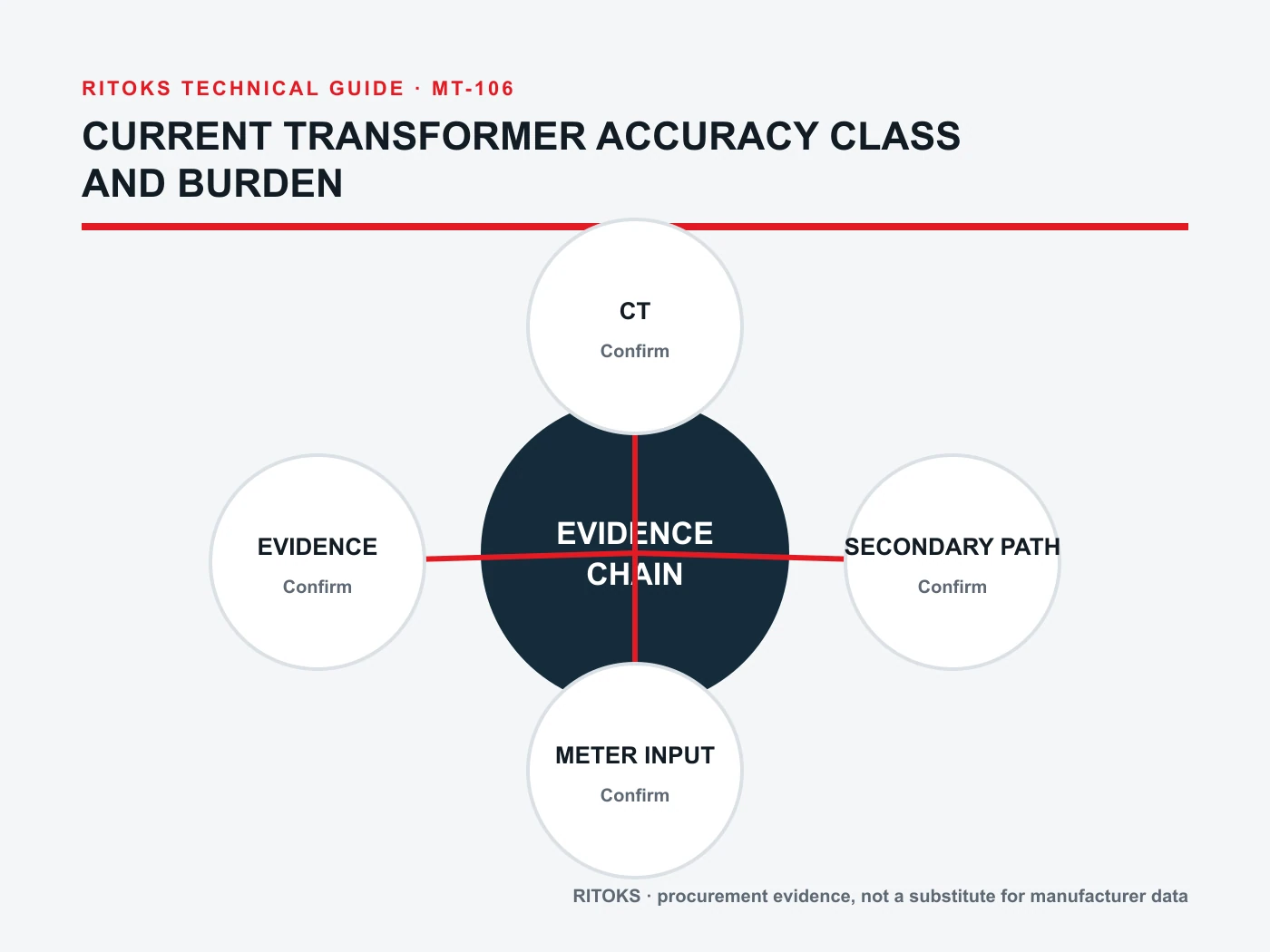
A CT, meter, wiring path and configured ratio form one measurement chain. Commissioning should check polarity or direction where relevant, expected response and scaling under known conditions.
Keep the as-built secondary diagram and configuration alongside the selected CT order code. This makes it possible to diagnose a discrepancy between the meter display and another measurement without guessing which component changed.
Request evidence that matches the quoted item
Ask for exact ratio, output, rated burden, accuracy basis, physical drawing and installation instructions for the proposed CT. Separate what the product page shows from what the order-specific documents prove.
A proposal remains open if the accuracy class is visible but the burden or operating conditions are not. Resolve those fields before approval, especially when the reading supports a commercial or control decision.
Erstellen Sie eine Beweisdatei nach dem Exaktmodell
A category or product-family page helps locate relevant options; it does not by itself approve one variant. For current transformers, keep the full proposed order code, current datasheet, terminal or mounting drawing, operating instructions and any project calculation together. Read the conditions attached to each rating or function. If the evidence belongs to a neighboring model, request the correct document instead of carrying the claim across.
Das Projektteam ist für die Systemvorgaben und Abnahmekriterien verantwortlich. Der Lieferant ist für die Nachweise zum angebotenen Produkt verantwortlich. Ordnen Sie bei der technischen Prüfung jede verbindliche Anforderung dem genauen Dokument und der jeweiligen Version zu, die diese erfüllt. Kennzeichnen Sie ein fehlendes Feld als „offen“, „bedingt“ oder „nicht unterstützt“. Dadurch entsteht eine nachvollziehbare Entscheidung und es wird verhindert, dass ein günstiger Nennwert eine inkompatible Verbindung oder Installationsbedingung verschleiert.
Vollständige Angebote vergleichen
| Artikel | Eintrag im Vergleich | Grund |
|---|---|---|
| Bestellbarer Artikel | Vollständige Artikelnummer, Variante und mitgeliefertes Zubehör | Verhindert Annahmen auf Familienebene |
| Anwendungsübereinstimmung | Schriftliche Stellungnahme zu jedem Projektbeitrag | Hält Ausnahmen sichtbar |
| Dokumentation | Datenblatt, Zeichnung, Anleitung und Überarbeitungen | Links zu Ansprüchen auf den angebotenen Artikel |
| Offene Punkte | Eigentümer und Fälligkeitsdatum zur Klärung | Verhindert stillschweigende Zustimmung |
Verwenden Sie für jedes Angebot dieselbe Projektbeschreibung. Kommerzielle Konditionen wie Preis und Lieferzeit lassen sich vergleichen, sobald der technische Umfang vereinheitlicht ist. Betrachten Sie ausgelassenes Zubehör, nicht unterstützte Nennleistungen oder eine ungeklärte Annahme zur Verkabelung nicht als gleichwertig mit einem dokumentierten Angebot. Wenn eine Alternative vorgeschlagen wird, fragen Sie nach, welche Eingaben sich ändern, und wiederholen Sie die betroffene Überprüfung.
Überprüfung der Installation und Abnahme
Vergewissern Sie sich vor der Installation, dass das mitgelieferte Etikett, der vollständige Code und das Zubehör mit den genehmigten Unterlagen übereinstimmen. Vergleichen Sie die Anschlüsse, die Befestigung, den Zugang zu den Leitern und die angegebene Ausrichtung mit den genauen Anweisungen. Ein Produkt, das äußerlich der genehmigten Version ähnelt, kann dennoch eine andere elektrische Konfiguration, Steuerungsoption oder Prüfgrundlage aufweisen.
Planen Sie eine Abnahmeprüfung, die auf die tatsächlichen Risiken des Projekts ausgerichtet ist. Dazu können unter anderem die Überprüfung der Verkabelung anhand des genehmigten Schaltplans, Funktionstests, Messungen unter repräsentativen Betriebsbedingungen sowie die Überprüfung aller Kommunikations- und Alarmfunktionen gehören. Halten Sie den Zustand und die Ergebnisse schriftlich fest. Der Abnahmeplan sollte sich aus den Anforderungen der Anwendung und den Nachweisen des Lieferanten ergeben und nicht auf einer allgemeinen Checkliste basieren.
Checkliste für Angebotsanfragen
- Identify the circuit, equipment and location that current transformers must serve.
- Fügen Sie die Systemzeichnung und die Betriebszustände bei, die die Anwendung definieren.
- Record primary range and its source document.
- Record secondary output and its source document.
- Record accuracy class and its source document.
- Record rated burden and its source document.
- Confirm the exact-model evidence for meter input.
- Confirm the exact-model evidence for lead length.
- Confirm the exact-model evidence for connection.
- Confirm the exact-model evidence for test record.
- Bitte fordern Sie die vollständige Bestellnummer, das Zubehör, die Zeichnungen und die aktuelle Version des Datenblatts an.
- Erkundigen Sie sich nach Ausschlüssen, Annahmen, Ersatzlösungen und noch offenen technischen Fragen.
Die Angebotsanfrage sollte so konkret sein, dass ein Lieferant sie beantworten kann, ohne fehlende Projektwerte selbst zu erfinden. Wenn eine wesentliche Angabe noch nicht bekannt ist, kennzeichnen Sie diese als Frage und geben Sie an, wer sie festlegen wird. Machen Sie aus einer Annahme keine Bewertung, keine Konformitätserklärung und keine genehmigte Installationsmethode.
Was beeinflusst die Entscheidung?
A decision can change when the source arrangement, load behavior, environment, installation geometry or required function changes. Revisit the selected current transformers whenever one of those inputs moves outside the approved brief. Recheck the order code and the exact evidence affected by the change; do not rely on a previous approval for a circuit that now asks the component to do different work.
Führen Sie ein kurzes Änderungsprotokoll über die Projektvorgabe, die Antwort des Lieferanten und die Liste der akzeptierten Ausnahmen. Diese Aufzeichnung hilft den Abteilungen Technik, Einkauf und Inbetriebnahme dabei, auf derselben Version zu arbeiten. Sie ist besonders nützlich, wenn ein Angebot überarbeitet wird, ein Ersatz angeboten wird oder sich die Schalttafelkonstruktion nach dem ersten Vergleich ändert.
Fragen, die vor der Genehmigung geklärt werden müssen
Ask who owns each remaining technical question for the proposed current transformers. The buyer should confirm the system inputs and installation constraints; the supplier should confirm the exact item, included options and applicable documentation. Put the answer and document revision beside the question. An unanswered point should remain visible in the comparison rather than being converted into an assumed feature.
Wenn ein Angebot eine Alternative enthält, bitten Sie um eine schriftliche Erläuterung der geänderten Schaltung, Montage oder Leistungsgrundlage. Prüfen Sie neue Zeichnungen gemeinsam mit dem Projektingenieur und halten Sie fest, ob die vorgeschlagene Änderung akzeptabel ist. Eine Substitution stellt eine neue technische Entscheidung dar, auch wenn sie wirtschaftlich gleichwertig erscheint. Dies ist besonders wichtig, wenn mehrere Lieferanten ähnliche Produktbezeichnungen für unterschiedliche Konfigurationen verwenden.
Häufig gestellte Fragen
Does a higher accuracy class guarantee an accurate installation?
No. The connected burden, current range, meter input, wiring and configuration also matter.
Can I connect any CT to any panel meter?
No. Verify secondary output, input requirements, ratio configuration and wiring.
Is rated burden the same as actual burden?
No. Rated burden is a product condition; actual burden is created by the installed secondary circuit.
Relevante RITOKS-Seiten
Informationen zum Kontext der Produktfamilie finden Sie unter Elektrische Messung und Überwachung. Zu den entsprechenden veröffentlichten Produktseiten gehören Bh 0 66 60i Current Transformer 200 5a 1500 5a, Dp Series Split Core Current Transformer, Gta20l Precision Current Transformer 10a 100a. Verwenden Sie beim Vergleich eines vorgeschlagenen Artikels die aktuellen Unterlagen zum genauen Modell.
Für ein anwendungsspezifisches Angebot, Senden Sie die Projektbeschreibung an RITOKS mit den obenstehenden Diagrammen und offenen Fragen.