
Solid State Relays for Electronic Switching · Comparison
Zero-Cross vs Random-Turn-On SSRs: Application Boundaries
The difference between zero-cross and random-turn-on solid state relays is not a quality ranking. It is a switching-timing choice that must fit the load, the control objective and the power circuit. A useful comparison therefore starts with what must happen at turn-on, not with a preference for one label.
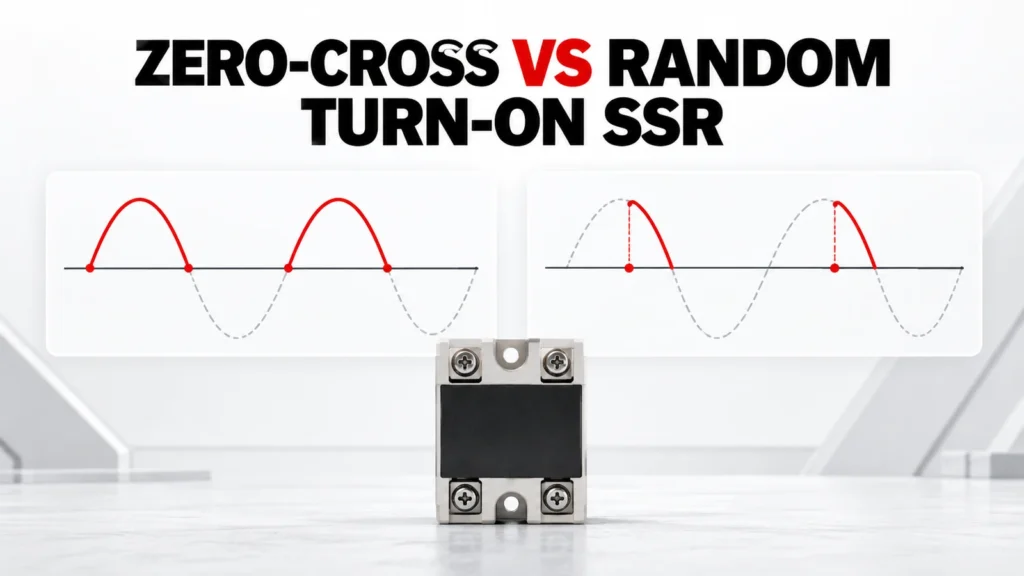
This guide explains the application boundary between zero-cross and random-turn-on AC solid state relay switching. It does not select a relay for an unknown load, state that either switching mode is universally better, or transfer trigger behavior and ratings between product variants.
意思決定の入力要素の概要
| 決定の根拠 | 購入者は確認する必要があります | 必要な証拠 |
|---|---|---|
| Load behavior | Resistive, inductive, transformer, lamp or other documented characteristic | Load datasheet and inrush profile |
| Control objective | Cycle-based regulation, phase-related control or simple on/off duty | Control sequence and timing requirement |
| Output circuit | AC output type and permitted operating envelope | Exact SSR datasheet |
| Switching cadence | Expected operations and minimum on/off timing | Machine duty record |
| 熱設計 | Loss, mounting surface, airflow and ambient | Exact-model loss data and thermal calculation |

Understand What the Trigger Label Describes
A zero-cross output is intended to begin conduction near a suitable point in the AC waveform after the control input is asserted. A random-turn-on output can respond without waiting for that crossing. The exact behavior, delay and conditions belong to the model datasheet.
These labels describe an output-switching behavior, not the entire relay. The buyer must still verify output type, load compatibility, control input, off-state behavior, thermal limits and mechanical arrangement.
Begin With the Load, Not the Relay
Record the load technology, steady-state current, starting or inrush behavior and any transformer or capacitive input stage. Two loads with the same nominal power can present very different switching conditions.
Ask the load manufacturer or equipment designer for a usable electrical profile. If the load behavior is unknown, mark the SSR selection incomplete rather than treating “resistive” or “inductive” as a guess.
Clarify the Control Objective
Simple temperature control, burst control, rapid cycling and phase-related control do not impose the same timing requirement. State whether the controller merely commands on and off or depends on conduction beginning at a particular point in the waveform.
Confirm that the controller output and the SSR input form a documented interface. Input voltage range, required current, logic polarity and response behavior must all be checked on the exact pair.
Treat Switching Mode and Protection as Separate Decisions
The trigger mode does not by itself solve short-circuit, overload or transient protection. Define the protective architecture for the semiconductor output and verify it through the applicable device and fuse documentation.
Do not infer coordination from a shared current label. Semiconductor protection depends on conditions and evidence that must identify the exact relay, protective device and circuit assumptions.
Complete the Thermal Design
An SSR dissipates heat while carrying load current. The acceptable current therefore depends on junction limits, loss data, thermal interfaces, mounting surface, ambient temperature and airflow.
Use the exact-model curves or loss information to build the thermal calculation. A current headline without its thermal conditions is a catalog-navigation value, not final approval evidence.
Check Off-State and Failure Behavior
Review leakage, minimum load implications, dv/dt susceptibility, isolation information and the expected failure response using the exact documentation. These factors can affect indication circuits, sensitive loads and safe maintenance.
The machine risk assessment should define the required safe state and whether additional isolation or monitoring is needed. Do not assume a semiconductor relay provides a visible or safety isolation function.
正確なモデルの証拠ファイルを作成する
Create one approval record for the proposed Solid State Relay order code. Put each project requirement beside the supplier document that answers it. Preserve the exact datasheet, dimensioned drawing, circuit diagram, performance curve or application note used, including its revision or retrieval date. A category page establishes family context but cannot prove an exact rating, terminal arrangement, optional feature or system combination.
承認されたすべての記述が、同一の注文可能品目を記述していることを確認してください。外観が類似している筐体であっても、内部の回路、端子、材質、ファームウェア、または付属品が異なる場合があります。あるバリエーションの最大値、別のバリエーションの図面、さらに別のバリエーションの特性を組み合わせて使用しないでください。未解決の項目については、設計レビューや商談レビューの過程でも確認できるよう、明確にマークを付けておいてください。.
プロジェクトのインプットと成果物の根拠は区別しておく
The project team defines the application: source, load, duty, environment, controls, mechanical limits and required functions. The supplier identifies an exact Solid State Relay and supports it with exact documents. Neither side should fill a gap by inference from appearance, a shared family name or one matching headline value.
見積書の比較中は、申請記録を凍結してください。回路、負荷、稼働条件、環境、筐体、放熱方法、または必要出力が変更された場合は、改訂版記録を作成し、各サプライヤーに候補品の再確認を依頼してください。そうしないと、一見比較可能な見積書であっても、実際には異なる技術要件に基づいている可能性があります。.
調達におけるよくあるミス
- Selecting Solid State Relay from one headline rating while the application context remains incomplete.
- 近隣モデルから回路、曲線、端子図、または性能に関する主張を使用すること。.
- 家族の写真や商品の写真を、厳密な技術的証拠として扱うこと。.
- 付属品、システム機能、または調整結果が、関連する文書なしに含まれていると仮定する。.
- 電気的、熱的、機械的および証拠に関する審査を繰り返し行わずに、代替案を承認すること。.
価格やリードタイムを比較する前に、こうした不備を解消してください。審査担当者は、受け入れられたすべての記述について、プロジェクト要件または具体的な候補文書に遡って確認できる必要があります。提案書は、技術的には不完全であっても商業的には魅力的なままである可能性がありますが、根拠となる情報が欠落している場合は、見積書の中にその不備が隠れていてはなりません。.
サプライヤーの提案を比較する方法
| 比較ポイント | 必要な証拠 | 承諾しないでください |
|---|---|---|
| 厳密な同一性 | 注文可能な全コードおよびバリエーションの説明 | 姓のみ |
| アプリケーションの適合性 | 凍結されたプロジェクトの投入要素に対する対応 | 一般的な適合性に関する声明 |
| 技術的証拠 | 改訂履歴付きの現在の正確なモデルに関する文書 | スクリーンショットまたは類似モデルのページ |
| 納入範囲 | 同梱の付属品、インターフェース、およびドキュメント | 定義されていない「標準パッケージ」“ |
| 未解決の質問 | 目視による逸脱事項および説明事項一覧 | 沈黙を承諾とみなす |
| 置換 | すべての要件に対する新たな見直し | “外観に基づく「同等」 |
Normalize every Solid State Relay offer to the same application record. Keep document revisions, test conditions, included accessories and open questions beside each value. This makes differences in delivered scope visible and prevents a lower-cost but narrower offer from appearing equivalent to a complete solution.
意思決定ワークフロー
- アプリケーションアーキテクチャと運用シナリオを確定する。.
- 環境、熱、および機械的な制約条件を記録する。.
- Identify the required Solid State Relay function without assuming a model.
- 完全な注文コードと正確な添付書類の提出を依頼してください。.
- 各請求事項について、その条件や定義と照らし合わせて確認してください。.
- 商業承認の前に、逸脱事項や調整に関する問題を解決しておくこと。.
- 受理された証拠書類を、最終部品表とともに保管してください。.
重要なアプリケーション入力が不明な場合、引用されたモデルが曖昧な場合、必須の主張が他のメーカーまたは別の注文コードによってのみ裏付けられている場合、あるいは設置状況が利用可能な証拠の範囲外である場合は、審査を中止してください。これらは編集上の細部ではなく、技術的な不備です。.
見積依頼書(RFQ)作成チェックリスト
A useful RFQ for zero crossing vs random turn on ssr is concise enough to answer and complete enough to prevent silent assumptions. Identify unknown values as questions and require a full orderable code rather than a generic family recommendation.
- Load behavior
- Turn-on objective
- Control method
- Switching cadence
- 熱経路
- Output type
- トリガーモード
- Leakage behavior
- Protection plan
- Exact datasheet
- 数量、仕向地、および必要書類の言語
最新のデータシートの改訂版、および認証、互換性、連携、性能に関する主張の正確な範囲を照会してください。技術的な情報の後に数量と仕向地を明記し、商取引上の条件によって未解決の技術的な疑問が覆い隠されないようにしてください。.
エンジニアリング部門から購買部門への引き継ぎ
Engineering approval should identify the exact Solid State Relay code, accepted document revisions, unresolved deviations and the application record used for the decision. Purchasing can then compare commercial offers without silently changing the technical basis. If a supplier proposes another code, different accessory or revised configuration, route it back through the same review instead of treating it as an administrative substitution.
承認済みの証拠書類は、発注書および最終部品表とともに保管してください。受入チームおよび生産チームは、承認された品目を識別し、ラベル、端子の配置、付属品、または書類に相違がある場合に作業を中止できるよう、十分な情報を必要とします。また、この引き継ぎにより、保守チームは、写真や古い請求書の記載内容、あるいは単一の見出し評価に頼るのではなく、交換の判断を行うための追跡可能な出発点を得ることができます。.
よくある質問
Is zero-cross always better for resistive heating?
It may suit many on/off or burst-control heating duties, but the exact load, controller and model documentation still determine suitability.
Is random turn-on the same as phase-angle control?
No. Random turn-on describes relay response; a complete phase-related control system also requires a suitable controller and documented output behavior.
Can the same heatsink be used for any SSR of the same current?
No. Base losses, mounting, interface and ambient conditions must be calculated for the exact model.
関連するRITOKS製品およびガイダンス
これらのリンクは、公開されている製品ファミリーに関する背景情報のみを提供するものです。こうした背景情報を示すリンクは、互換性や適合性、あるいは承認されたシステムの組み合わせを保証するものではありません。.
Published RITOKS Solid State Relay product page
技術リファレンス
以下の情報源は、本ガイドに記載されている一般的な技術的概念のみを裏付けるものです。その製品定格、回路図、認証、および調整結果は、RITOKS製品には適用されません。.
Omron, Solid State Relays Technical Guide
Supports general distinctions among SSR switching behavior, load and thermal considerations; exact Omron values do not transfer to RITOKS products.
正確なモデルに関するレビューを依頼する
申請要件、書類に関する具体的な質問、数量、および配送先を、RITOKSのお問い合わせフォームから送信してください。RFQ(見積依頼)では、正確なモデルの確認が求められます。本ガイドでは、回路、設置、または自動的な代替品の承認は行いません。.