
Solid State Relays for Electronic Switching · Comparison
Zero-Cross vs Random-Turn-On SSRs: Application Boundaries
The difference between zero-cross and random-turn-on solid state relays is not a quality ranking. It is a switching-timing choice that must fit the load, the control objective and the power circuit. A useful comparison therefore starts with what must happen at turn-on, not with a preference for one label.
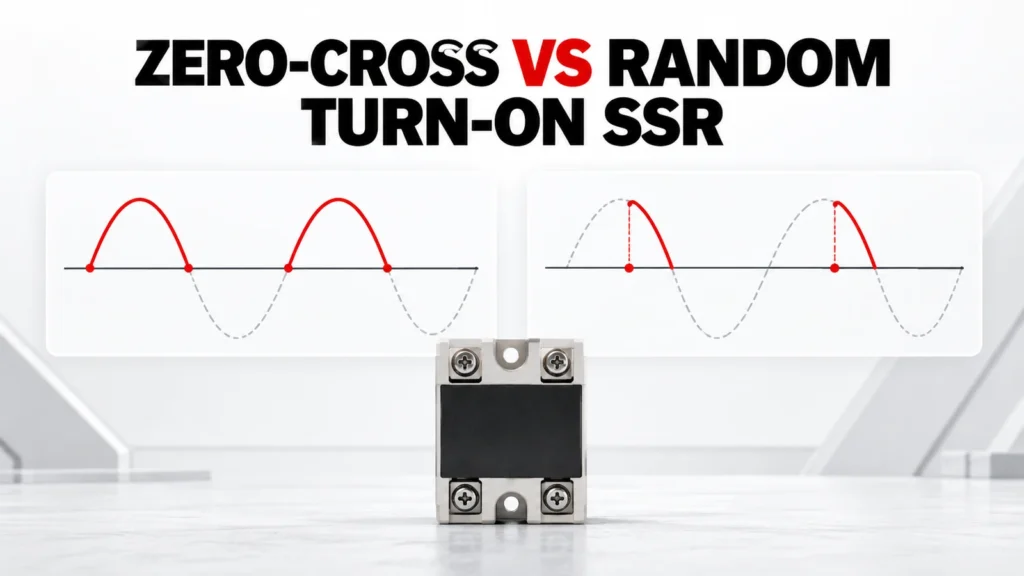
This guide explains the application boundary between zero-cross and random-turn-on AC solid state relay switching. It does not select a relay for an unknown load, state that either switching mode is universally better, or transfer trigger behavior and ratings between product variants.
Karar Alımında Kullanılan Verilere Genel Bakış
| Karar girdisi | Alıcı bunu teyit etmelidir | Gerekli kanıtlar |
|---|---|---|
| Load behavior | Resistive, inductive, transformer, lamp or other documented characteristic | Load datasheet and inrush profile |
| Control objective | Cycle-based regulation, phase-related control or simple on/off duty | Control sequence and timing requirement |
| Output circuit | AC output type and permitted operating envelope | Exact SSR datasheet |
| Switching cadence | Expected operations and minimum on/off timing | Machine duty record |
| Termal tasarım | Loss, mounting surface, airflow and ambient | Exact-model loss data and thermal calculation |

Understand What the Trigger Label Describes
A zero-cross output is intended to begin conduction near a suitable point in the AC waveform after the control input is asserted. A random-turn-on output can respond without waiting for that crossing. The exact behavior, delay and conditions belong to the model datasheet.
These labels describe an output-switching behavior, not the entire relay. The buyer must still verify output type, load compatibility, control input, off-state behavior, thermal limits and mechanical arrangement.
Begin With the Load, Not the Relay
Record the load technology, steady-state current, starting or inrush behavior and any transformer or capacitive input stage. Two loads with the same nominal power can present very different switching conditions.
Ask the load manufacturer or equipment designer for a usable electrical profile. If the load behavior is unknown, mark the SSR selection incomplete rather than treating “resistive” or “inductive” as a guess.
Clarify the Control Objective
Simple temperature control, burst control, rapid cycling and phase-related control do not impose the same timing requirement. State whether the controller merely commands on and off or depends on conduction beginning at a particular point in the waveform.
Confirm that the controller output and the SSR input form a documented interface. Input voltage range, required current, logic polarity and response behavior must all be checked on the exact pair.
Treat Switching Mode and Protection as Separate Decisions
The trigger mode does not by itself solve short-circuit, overload or transient protection. Define the protective architecture for the semiconductor output and verify it through the applicable device and fuse documentation.
Do not infer coordination from a shared current label. Semiconductor protection depends on conditions and evidence that must identify the exact relay, protective device and circuit assumptions.
Complete the Thermal Design
An SSR dissipates heat while carrying load current. The acceptable current therefore depends on junction limits, loss data, thermal interfaces, mounting surface, ambient temperature and airflow.
Use the exact-model curves or loss information to build the thermal calculation. A current headline without its thermal conditions is a catalog-navigation value, not final approval evidence.
Check Off-State and Failure Behavior
Review leakage, minimum load implications, dv/dt susceptibility, isolation information and the expected failure response using the exact documentation. These factors can affect indication circuits, sensitive loads and safe maintenance.
The machine risk assessment should define the required safe state and whether additional isolation or monitoring is needed. Do not assume a semiconductor relay provides a visible or safety isolation function.
Kesin Modele Dayalı Kanıt Dosyası Oluşturun
Create one approval record for the proposed Solid State Relay order code. Put each project requirement beside the supplier document that answers it. Preserve the exact datasheet, dimensioned drawing, circuit diagram, performance curve or application note used, including its revision or retrieval date. A category page establishes family context but cannot prove an exact rating, terminal arrangement, optional feature or system combination.
Kabul edilen her bir açıklamanın aynı sipariş edilebilir ürünü tanımladığını kontrol edin. Benzer gövdeler farklı devreler, terminaller, malzemeler, ürün yazılımı veya aksesuarlar içerebilir. Bir varyanttan en fazla bir parçayı, başka bir varyanttan bir çizimi ve üçüncü bir varyanttan bir özelliği bir araya getirmeyin. Çözülmemiş alanları açıkça işaretleyin; böylece mühendislik ve ticari inceleme aşamalarında görünür kalmalarını sağlayın.
Proje Girdilerini Ürün Kanıtlarından Ayrı Tutun
The project team defines the application: source, load, duty, environment, controls, mechanical limits and required functions. The supplier identifies an exact Solid State Relay and supports it with exact documents. Neither side should fill a gap by inference from appearance, a shared family name or one matching headline value.
Teklifler karşılaştırılırken başvuru kaydını dondurun. Devre, yük, çalışma koşulu, ortam, muhafaza, termal yöntem veya istenen çıkışta bir değişiklik olması durumunda, güncellenmiş bir kayıt hazırlayın ve her tedarikçiden aday ürünü yeniden onaylamasını isteyin. Aksi takdirde, görünüşte karşılaştırılabilir teklifler aslında farklı teknik gereksinimleri karşılayabilir.
İhale Sürecinde Sık Görülen Hatalar
- Selecting Solid State Relay from one headline rating while the application context remains incomplete.
- Komşu bir modele ait devre, eğri, terminal çizimi veya performans beyanını kullanmak.
- Bir aile fotoğrafını veya ürün fotoğrafını kesin teknik delil olarak kabul etmek.
- Bir aksesuar, sistem işlevi veya koordinasyon sonucunun belgelenmeden dahil edildiği varsayılır.
- Elektriksel, termal, mekanik ve kanıt incelemelerini tekrarlamadan bir yedeği onaylamak.
Fiyat ve teslim süresini karşılaştırmadan önce bu eksiklikleri giderin. Değerlendirme yapan kişi, kabul edilen her bir ifadenin kaynağını ya proje gereksinimlerine ya da ilgili belgeye kadar izleyebilmelidir. Bir teklif, teknik açıdan eksik olsa da ticari açıdan ilgi çekici olabilir; ancak eksik kanıtlar teklif metninde gizlenmemelidir.
Tedarikçi Tekliflerini Karşılaştırma Yöntemleri
| Karşılaştırma noktası | Gerekli kanıtlar | Kabul etmeyin |
|---|---|---|
| Tam kimlik | Sipariş edilebilir kodun tamamı ve varyant açıklaması | Sadece soyadı |
| Uygulama eşleşmesi | Dondurulmuş proje girdilerine yönelik tepki | Genel uygunluk beyanı |
| Teknik kanıtlar | Revizyon numarası içeren güncel kesin model belgeleri | Ekran görüntüsü veya benzer model sayfası |
| Teslim edilen kapsam | Birlikte verilen aksesuarlar, arayüzler ve belgeler | Tanımlanmamış “standart paket” |
| Açık sorular | Görünür sapmalar ve açıklamalar listesi | Sessizliğin rıza olarak kabul edilmesi |
| Değiştirme | Her bir gerekliliğe karşı yeni bir inceleme | “Görünüşe dayalı ”eşdeğer” |
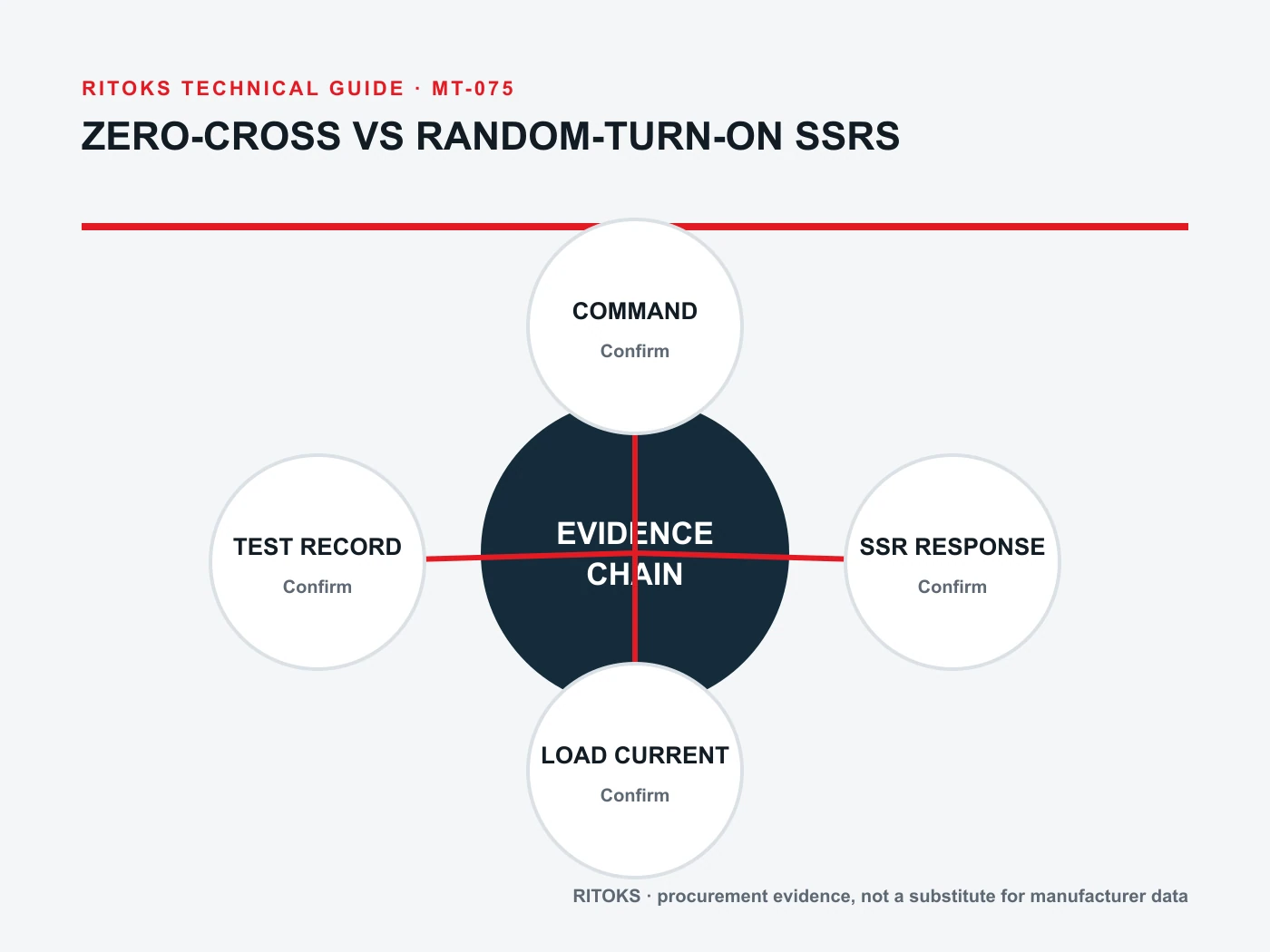
Normalize every Solid State Relay offer to the same application record. Keep document revisions, test conditions, included accessories and open questions beside each value. This makes differences in delivered scope visible and prevents a lower-cost but narrower offer from appearing equivalent to a complete solution.
Karar İş Akışı
- Uygulama mimarisini ve çalışma senaryosunu kesinleştirin.
- Çevresel, termal ve mekanik kısıtlamaları kaydedin.
- Identify the required Solid State Relay function without assuming a model.
- Tam sipariş kodunu ve ilgili belgelerin tam listesini talep edin.
- Her bir talebi, ilgili koşullar ve tanımlarla karşılaştırın.
- Ticari onaydan önce sapmaları ve koordinasyonla ilgili sorunları çözün.
- Kabul edilen kanıtları nihai malzeme listesiyle birlikte dosyaya alın.
Kritik bir uygulama girdisi bilinmiyorsa, belirtilen model belirsizse, gerekli bir iddia yalnızca başka bir üretici veya başka bir sipariş kodu tarafından destekleniyorsa ya da kurulum mevcut kanıtların kapsamı dışındaysa incelemeyi durdurun. Bunlar mühendislikle ilgili eksikliklerdir, editoryal ayrıntılar değildir.
Teklif Talebi Hazırlık Kontrol Listesi
A useful RFQ for zero crossing vs random turn on ssr is concise enough to answer and complete enough to prevent silent assumptions. Identify unknown values as questions and require a full orderable code rather than a generic family recommendation.
- Load behavior
- Turn-on objective
- Control method
- Switching cadence
- Termal yol
- Output type
- Tetikleme modu
- Leakage behavior
- Protection plan
- Exact datasheet
- Miktar, varış yeri ve gerekli belge dili
Güncel teknik veri sayfası sürümünü ve herhangi bir sertifikasyon, uyumluluk, koordinasyon veya performans iddiasının tam kapsamını talep edin. Ticari şartların çözülmemiş mühendislik sorunlarını gölgelememesi için, teknik bilgilerin ardından miktarı ve varış yerini kaydedin.
Mühendislikten Satın Alma Birimine Devir
Engineering approval should identify the exact Solid State Relay code, accepted document revisions, unresolved deviations and the application record used for the decision. Purchasing can then compare commercial offers without silently changing the technical basis. If a supplier proposes another code, different accessory or revised configuration, route it back through the same review instead of treating it as an administrative substitution.
Onaylanmış kanıtları satın alma siparişi ve nihai malzeme listesiyle birlikte saklayın. Mal kabul ve üretim ekipleri, kabul edilen ürünü tanıyabilmek ve etiketleme, terminal düzeni, aksesuarlar veya belgelerde farklılıklar olduğunda işlemi durdurabilmek için yeterli bilgiye sahip olmalıdır. Bu devir teslimi ayrıca, bakım ekiplerine bir fotoğrafa, eski bir fatura açıklamasına veya tek bir başlık derecelendirmesine güvenmek yerine, değiştirme kararları için izlenebilir bir başlangıç noktası sağlar.
Sık Sorulan Sorular
Is zero-cross always better for resistive heating?
It may suit many on/off or burst-control heating duties, but the exact load, controller and model documentation still determine suitability.
Is random turn-on the same as phase-angle control?
No. Random turn-on describes relay response; a complete phase-related control system also requires a suitable controller and documented output behavior.
Can the same heatsink be used for any SSR of the same current?
No. Base losses, mounting, interface and ambient conditions must be calculated for the exact model.
İlgili RITOKS Ürünleri ve Kılavuzlar
Bu bağlantılar yalnızca yayınlanmış ürün ailesi bilgilerini sunmaktadır. Bağlamsal bir bağlantı, ürünlerin birbirinin yerine kullanılabilirliği, uyumluluğu veya onaylanmış bir sistem kombinasyonu olduğunu ima etmez.
Katı Hal Rölesi ürün kategorisi
Published RITOKS Solid State Relay product page
Konuyla ilgili yayınlanmış RITOKS teknik kılavuzu
Teknik Referans
Aşağıdaki kaynak, yalnızca bu kılavuzda belirtilen genel mühendislik kavramını desteklemektedir. Bu kaynağa ait ürün derecelendirmeleri, devre şemaları, onaylar ve koordinasyon sonuçları, RITOKS ürünlerine uygulanamaz.
Omron, Solid State Relays Technical Guide
Supports general distinctions among SSR switching behavior, load and thermal considerations; exact Omron values do not transfer to RITOKS products.
Belirli Bir Modelin İncelenmesini Talep Et
Başvuru şartlarını, belgelere ilişkin ayrıntılı soruları, miktarı ve teslimat adresini RITOKS iletişim formu aracılığıyla gönderiniz. Bir RFQ, tam model incelemesi gerektirir; bu kılavuz, devre, kurulum veya otomatik ikame onaylamaz.