
Solid State Relays for Electronic Switching · Comparison
Zero-Cross vs Random-Turn-On SSRs: Application Boundaries
The difference between zero-cross and random-turn-on solid state relays is not a quality ranking. It is a switching-timing choice that must fit the load, the control objective and the power circuit. A useful comparison therefore starts with what must happen at turn-on, not with a preference for one label. For heater loads, see solid state relays for industrial heater control.
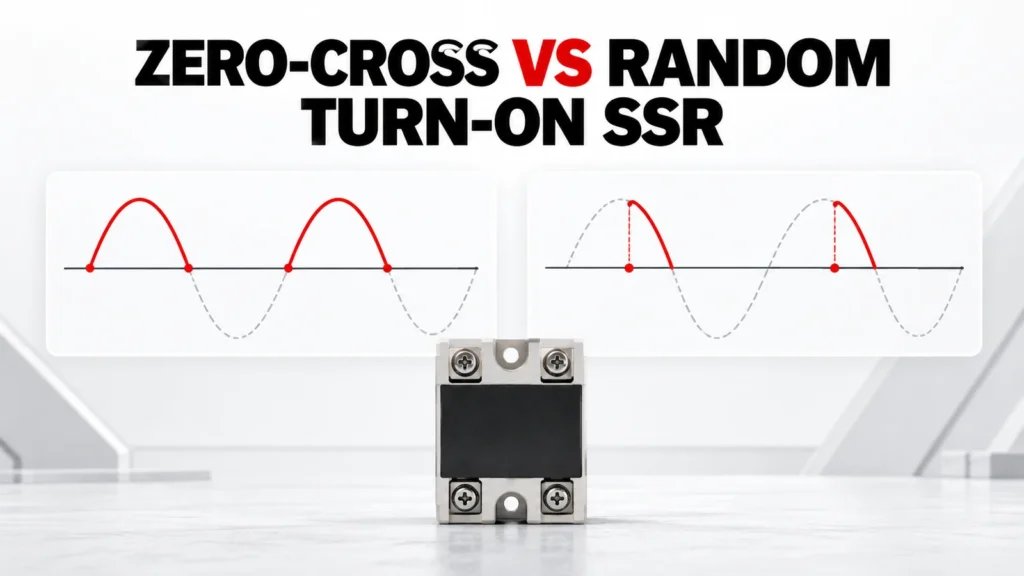
This guide explains the application boundary between zero-cross and random-turn-on AC solid state relay switching. It does not select a relay for an unknown load, state that either switching mode is universally better, or transfer trigger behavior and ratings between product variants.
Panoramica dei dati di input per la decisione
| Dati di input per la decisione | L'acquirente deve confermare | Documenti richiesti |
|---|---|---|
| Load behavior | Resistive, inductive, transformer, lamp or other documented characteristic | Load datasheet and inrush profile |
| Control objective | Cycle-based regulation, phase-related control or simple on/off duty | Control sequence and timing requirement |
| Output circuit | AC output type and permitted operating envelope | Exact SSR datasheet |
| Switching cadence | Expected operations and minimum on/off timing | Machine duty record |
| Progettazione termica | Loss, mounting surface, airflow and ambient | Exact-model loss data and thermal calculation |

Understand What the Trigger Label Describes
A zero-cross output is intended to begin conduction near a suitable point in the AC waveform after the control input is asserted. A random-turn-on output can respond without waiting for that crossing. The exact behavior, delay and conditions belong to the model datasheet.
These labels describe an output-switching behavior, not the entire relay. The buyer must still verify output type, load compatibility, control input, off-state behavior, thermal limits and mechanical arrangement.
Begin With the Load, Not the Relay
Record the load technology, steady-state current, starting or inrush behavior and any transformer or capacitive input stage. Two loads with the same nominal power can present very different switching conditions.
Ask the load manufacturer or equipment designer for a usable electrical profile. If the load behavior is unknown, mark the SSR selection incomplete rather than treating “resistive” or “inductive” as a guess.
Clarify the Control Objective
Simple temperature control, burst control, rapid cycling and phase-related control do not impose the same timing requirement. State whether the controller merely commands on and off or depends on conduction beginning at a particular point in the waveform.
Confirm that the controller output and the SSR input form a documented interface. Input voltage range, required current, logic polarity and response behavior must all be checked on the exact pair.
Treat Switching Mode and Protection as Separate Decisions
The trigger mode does not by itself solve short-circuit, overload or transient protection. Define the protective architecture for the semiconductor output and verify it through the applicable device and fuse documentation.
Do not infer coordination from a shared current label. Semiconductor protection depends on conditions and evidence that must identify the exact relay, protective device and circuit assumptions.
Complete the Thermal Design
An SSR dissipates heat while carrying load current. The acceptable current therefore depends on junction limits, loss data, thermal interfaces, mounting surface, ambient temperature and airflow.
Use the exact-model curves or loss information to build the thermal calculation. A current headline without its thermal conditions is a catalog-navigation value, not final approval evidence.
Check Off-State and Failure Behavior
Review leakage, minimum load implications, dv/dt susceptibility, isolation information and the expected failure response using the exact documentation. These factors can affect indication circuits, sensitive loads and safe maintenance.
The machine risk assessment should define the required safe state and whether additional isolation or monitoring is needed. Do not assume a semiconductor relay provides a visible or safety isolation function.
Creare un file di prove basato su un modello esatto
Create one approval record for the proposed Solid State Relay order code. Put each project requirement beside the supplier document that answers it. Preserve the exact datasheet, dimensioned drawing, circuit diagram, performance curve or application note used, including its revision or retrieval date. A category page establishes family context but cannot prove an exact rating, terminal arrangement, optional feature or system combination.
Verificare che ogni dichiarazione accettata descriva lo stesso articolo ordinabile. Alloggiamenti simili possono contenere circuiti, terminali, materiali, firmware o accessori diversi. Non combinare un massimo di una variante, un disegno di un’altra e una caratteristica di una terza. Contrassegnare esplicitamente i campi non risolti in modo che rimangano visibili durante la revisione tecnica e commerciale.
Tenere separati i dati di input del progetto dalle prove relative al prodotto
The project team defines the application: source, load, duty, environment, controls, mechanical limits and required functions. The supplier identifies an exact Solid State Relay and supports it with exact documents. Neither side should fill a gap by inference from appearance, a shared family name or one matching headline value.
Bloccare il fascicolo di richiesta mentre si confrontano i preventivi. Se il circuito, il carico, le condizioni di funzionamento, l’ambiente, l’involucro, il metodo di raffreddamento o la potenza richiesta subiscono variazioni, emettere un fascicolo aggiornato e chiedere a ciascun fornitore di riconfermare la propria proposta. In caso contrario, preventivi apparentemente comparabili potrebbero rispondere a requisiti tecnici diversi.
Errori comuni negli appalti
- Selecting Solid State Relay from one headline rating while the application context remains incomplete.
- Utilizzo di un circuito, una curva, uno schema dei terminali o una dichiarazione sulle prestazioni proveniente da un modello affine.
- Considerare una foto di famiglia o una fotografia di un prodotto come una prova tecnica inoppugnabile.
- Nel caso in cui un accessorio, una funzione di sistema o un risultato di coordinamento siano inclusi senza documentazione.
- Approvare un sostituto senza ripetere la verifica elettrica, termica, meccanica e delle prove.
Colmate queste lacune prima di confrontare il prezzo e i tempi di consegna. Il revisore dovrebbe essere in grado di ricondurre ogni affermazione accettata ai requisiti del progetto o al documento di riferimento specifico. Una proposta può rimanere interessante dal punto di vista commerciale pur essendo tecnicamente incompleta, ma le prove mancanti non devono sparire all’interno del preventivo.
Come confrontare le offerte dei fornitori
| Punto di riferimento | Documenti richiesti | Non accettare |
|---|---|---|
| Identità esatta | Codice completo per l'ordinazione e descrizione delle varianti | Solo il cognome |
| Corrispondenza dell'applicazione | Risposta in merito agli input del progetto congelati | Dichiarazione generica di idoneità |
| Prove tecniche | Documenti attuali relativi al modello esatto con revisione | Screenshot o pagina del modello correlato |
| Ambito di fornitura | Accessori, interfacce e documentazione inclusi | “Pacchetto standard” non definito” |
| Domande aperte | Elenco delle discrepanze evidenti e delle precisazioni | Il silenzio interpretato come consenso |
| Sostituzione | Nuova revisione rispetto a ogni requisito | “Equivalente” in base all’aspetto |
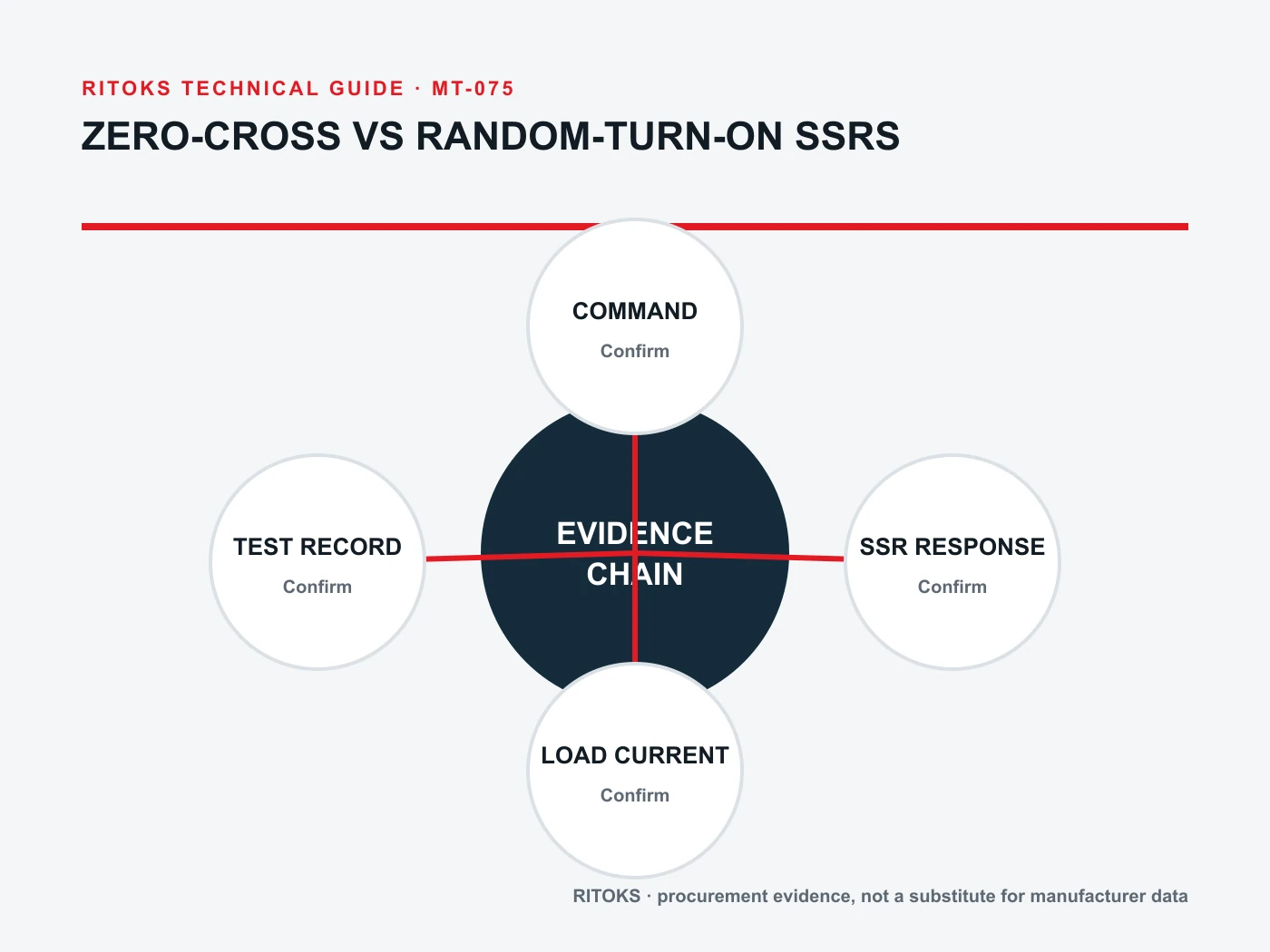
Normalize every Solid State Relay offer to the same application record. Keep document revisions, test conditions, included accessories and open questions beside each value. This makes differences in delivered scope visible and prevents a lower-cost but narrower offer from appearing equivalent to a complete solution.
Flusso di lavoro decisionale
- Definire in modo definitivo l'architettura dell'applicazione e lo scenario operativo.
- Registrare i vincoli ambientali, termici e meccanici.
- Identify the required Solid State Relay function without assuming a model.
- Richiedere il codice d'ordine completo e la documentazione di supporto esatta.
- Confronta ogni copertura assicurativa con le relative condizioni e definizioni.
- Risolvere eventuali discrepanze e questioni relative al coordinamento prima dell'approvazione commerciale.
- Archiviare la documentazione accettata insieme alla distinta base definitiva.
Interrompere la revisione qualora un dato di input critico dell’applicazione sia sconosciuto, il modello indicato sia ambiguo, una dichiarazione richiesta sia supportata solo da un altro produttore o da un altro codice d’ordine, oppure l’installazione non rientri nelle prove disponibili. Si tratta di lacune tecniche, non di dettagli redazionali.
Lista di controllo per la preparazione delle richieste di preventivo
A useful RFQ for zero crossing vs random turn on ssr is concise enough to answer and complete enough to prevent silent assumptions. Identify unknown values as questions and require a full orderable code rather than a generic family recommendation.
- Load behavior
- Turn-on objective
- Control method
- Switching cadence
- Percorso termico
- Output type
- Modalità di attivazione
- Leakage behavior
- Protection plan
- Exact datasheet
- Quantità, destinazione e lingua richiesta per i documenti
Richiedere la versione aggiornata della scheda tecnica e l’ambito esatto di qualsiasi dichiarazione relativa a certificazione, compatibilità, coordinamento o prestazioni. Annotare la quantità e la destinazione dopo i dati tecnici, in modo che le condizioni commerciali non oscurino le questioni ingegneristiche ancora irrisolte.
Passaggio di consegne dal reparto tecnico al reparto acquisti
Engineering approval should identify the exact Solid State Relay code, accepted document revisions, unresolved deviations and the application record used for the decision. Purchasing can then compare commercial offers without silently changing the technical basis. If a supplier proposes another code, different accessory or revised configuration, route it back through the same review instead of treating it as an administrative substitution.
Conservare la documentazione approvata insieme all’ordine di acquisto e alla distinta base definitiva. I team addetti alla ricezione e alla produzione devono disporre di informazioni sufficienti per riconoscere l’articolo accettato e per intervenire qualora l’etichettatura, la disposizione dei terminali, gli accessori o la documentazione risultino diversi. Questo passaggio di consegne fornisce inoltre ai team di manutenzione un punto di partenza tracciabile per le decisioni relative alla sostituzione, anziché dover fare affidamento su una fotografia, sulla descrizione di una vecchia fattura o su una singola valutazione generica.
Domande frequenti
Is zero-cross always better for resistive heating?
It may suit many on/off or burst-control heating duties, but the exact load, controller and model documentation still determine suitability.
Is random turn-on the same as phase-angle control?
No. Random turn-on describes relay response; a complete phase-related control system also requires a suitable controller and documented output behavior.
Can the same heatsink be used for any SSR of the same current?
No. Base losses, mounting, interface and ambient conditions must be calculated for the exact model.
Prodotti RITOKS correlati e linee guida
Questi link forniscono esclusivamente informazioni relative al contesto della famiglia di prodotti pubblicata. Un link contestuale non implica in alcun modo l’intercambiabilità, la compatibilità o una combinazione di sistemi approvata.
Categoria di prodotti: relè a stato solido
Published RITOKS Solid State Relay product page
Guida tecnica RITOKS correlata già pubblicata
Riferimenti tecnici
La fonte riportata di seguito conferma esclusivamente il concetto ingegneristico generale illustrato nella presente guida. I dati relativi alle caratteristiche dei prodotti, gli schemi elettrici, le omologazioni e i risultati di coordinamento in essa contenuti non sono applicabili ai prodotti RITOKS.
Omron, Solid State Relays Technical Guide
Supports general distinctions among SSR switching behavior, load and thermal considerations; exact Omron values do not transfer to RITOKS products.
Richiedi una revisione del modello esatto
Invia i requisiti della richiesta, le domande relative ai documenti specifici, la quantità e la destinazione tramite il modulo di contatto RITOKS. Una richiesta di preventivo (RFQ) richiede una verifica del modello specifico; la presente guida non approva alcun circuito, installazione o sostituto automatico.