
Solid State Relays for Electronic Switching · Comparison
Zero-Cross vs Random-Turn-On SSRs: Application Boundaries
The difference between zero-cross and random-turn-on solid state relays is not a quality ranking. It is a switching-timing choice that must fit the load, the control objective and the power circuit. A useful comparison therefore starts with what must happen at turn-on, not with a preference for one label.
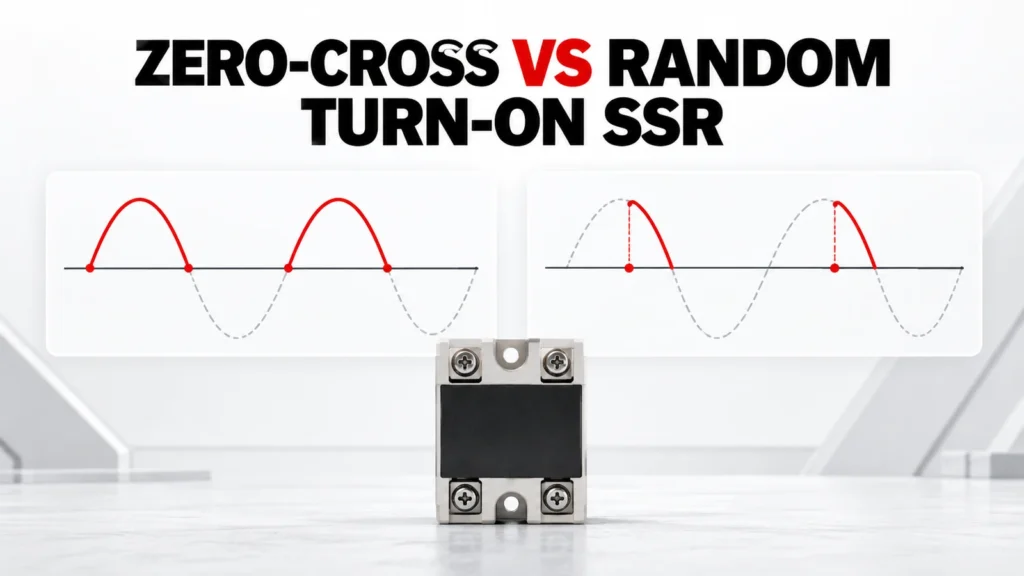
This guide explains the application boundary between zero-cross and random-turn-on AC solid state relay switching. It does not select a relay for an unknown load, state that either switching mode is universally better, or transfer trigger behavior and ratings between product variants.
Podsumowanie danych wejściowych do decyzji
| Dane wejściowe do podjęcia decyzji | Kupujący musi potwierdzić | Wymagane dowody |
|---|---|---|
| Load behavior | Resistive, inductive, transformer, lamp or other documented characteristic | Load datasheet and inrush profile |
| Control objective | Cycle-based regulation, phase-related control or simple on/off duty | Control sequence and timing requirement |
| Output circuit | AC output type and permitted operating envelope | Exact SSR datasheet |
| Switching cadence | Expected operations and minimum on/off timing | Machine duty record |
| Projekt termiczny | Loss, mounting surface, airflow and ambient | Exact-model loss data and thermal calculation |

Understand What the Trigger Label Describes
A zero-cross output is intended to begin conduction near a suitable point in the AC waveform after the control input is asserted. A random-turn-on output can respond without waiting for that crossing. The exact behavior, delay and conditions belong to the model datasheet.
These labels describe an output-switching behavior, not the entire relay. The buyer must still verify output type, load compatibility, control input, off-state behavior, thermal limits and mechanical arrangement.
Begin With the Load, Not the Relay
Record the load technology, steady-state current, starting or inrush behavior and any transformer or capacitive input stage. Two loads with the same nominal power can present very different switching conditions.
Ask the load manufacturer or equipment designer for a usable electrical profile. If the load behavior is unknown, mark the SSR selection incomplete rather than treating “resistive” or “inductive” as a guess.
Clarify the Control Objective
Simple temperature control, burst control, rapid cycling and phase-related control do not impose the same timing requirement. State whether the controller merely commands on and off or depends on conduction beginning at a particular point in the waveform.
Confirm that the controller output and the SSR input form a documented interface. Input voltage range, required current, logic polarity and response behavior must all be checked on the exact pair.
Treat Switching Mode and Protection as Separate Decisions
The trigger mode does not by itself solve short-circuit, overload or transient protection. Define the protective architecture for the semiconductor output and verify it through the applicable device and fuse documentation.
Do not infer coordination from a shared current label. Semiconductor protection depends on conditions and evidence that must identify the exact relay, protective device and circuit assumptions.
Complete the Thermal Design
An SSR dissipates heat while carrying load current. The acceptable current therefore depends on junction limits, loss data, thermal interfaces, mounting surface, ambient temperature and airflow.
Use the exact-model curves or loss information to build the thermal calculation. A current headline without its thermal conditions is a catalog-navigation value, not final approval evidence.
Check Off-State and Failure Behavior
Review leakage, minimum load implications, dv/dt susceptibility, isolation information and the expected failure response using the exact documentation. These factors can affect indication circuits, sensitive loads and safe maintenance.
The machine risk assessment should define the required safe state and whether additional isolation or monitoring is needed. Do not assume a semiconductor relay provides a visible or safety isolation function.
Stwórz plik dowodów oparty na modelu dokładnym
Create one approval record for the proposed Solid State Relay order code. Put each project requirement beside the supplier document that answers it. Preserve the exact datasheet, dimensioned drawing, circuit diagram, performance curve or application note used, including its revision or retrieval date. A category page establishes family context but cannot prove an exact rating, terminal arrangement, optional feature or system combination.
Należy sprawdzić, czy każda zaakceptowana specyfikacja dotyczy tego samego produktu dostępnego w sprzedaży. Podobne obudowy mogą zawierać różne układy elektroniczne, zaciski, materiały, oprogramowanie układowe lub akcesoria. Nie należy łączyć maksymalnej wartości z jednego wariantu, rysunku z innego i cechy z trzeciego. Należy wyraźnie oznaczyć pola, które nie zostały jeszcze wypełnione, tak aby pozostawały widoczne podczas przeglądu technicznego i handlowego.
Należy oddzielać dane wejściowe projektu od dowodów dotyczących produktu
The project team defines the application: source, load, duty, environment, controls, mechanical limits and required functions. The supplier identifies an exact Solid State Relay and supports it with exact documents. Neither side should fill a gap by inference from appearance, a shared family name or one matching headline value.
Należy wstrzymać proces rozpatrywania wniosku na czas porównywania ofert. W przypadku zmiany obwodu, obciążenia, trybu pracy, warunków otoczenia, obudowy, metody chłodzenia lub wymaganej mocy wyjściowej należy sporządzić zaktualizowany dokument i poprosić każdego dostawcę o ponowne potwierdzenie swojej oferty. W przeciwnym razie oferty, które na pierwszy rzut oka wydają się porównywalne, mogą odpowiadać różnym wymaganiom technicznym.
Typowe błędy związane z zamówieniami publicznymi
- Selecting Solid State Relay from one headline rating while the application context remains incomplete.
- Wykorzystanie schematu, wykresu, rysunku zacisków lub danych dotyczących parametrów technicznych z podobnego modelu.
- Traktowanie strony rodzinnej lub zdjęcia produktu jako niepodważalnego dowodu technicznego.
- Zakładając, że akcesorium, funkcja systemu lub wynik koordynacji zostały uwzględnione bez dokumentacji.
- Zatwierdzenie zamiennika bez ponownego przeprowadzania oceny parametrów elektrycznych, termicznych, mechanicznych oraz analizy dowodów.
Przed porównaniem ceny i terminu realizacji należy wyeliminować te luki. Osoba dokonująca przeglądu powinna mieć możliwość powiązania każdego przyjętego stwierdzenia albo z wymaganiami projektu, albo z konkretnym dokumentem kandydata. Oferta może pozostać atrakcyjna pod względem komercyjnym, mimo że jest niekompletna pod względem technicznym, jednak brakujące dowody nie mogą zostać pominięte w ofercie.
Jak porównać oferty dostawców
| Punkt odniesienia | Wymagane dowody | Nie akceptuj |
|---|---|---|
| Dokładna tożsamość | Pełny kod zamówieniowy i opis wariantu | Tylko nazwisko |
| Zgodność aplikacji | Odpowiedź dotycząca wstrzymanych danych wejściowych projektu | Ogólne oświadczenie o zgodności |
| Dowody techniczne | Aktualne dokumenty oparte na modelu dokładnym wraz z wersjami | Zrzut ekranu lub strona poświęcona podobnym modelom |
| Zakres dostawy | Dołączone akcesoria, interfejsy i dokumentacja | Nieokreślony “pakiet standardowy” |
| Otwarte pytania | Lista widocznych odstępstw i wyjaśnień | Milczenie traktowane jako zgoda |
| Zastąpienie | Nowa weryfikacja pod kątem każdego wymogu | “Równoważny” na podstawie wyglądu |
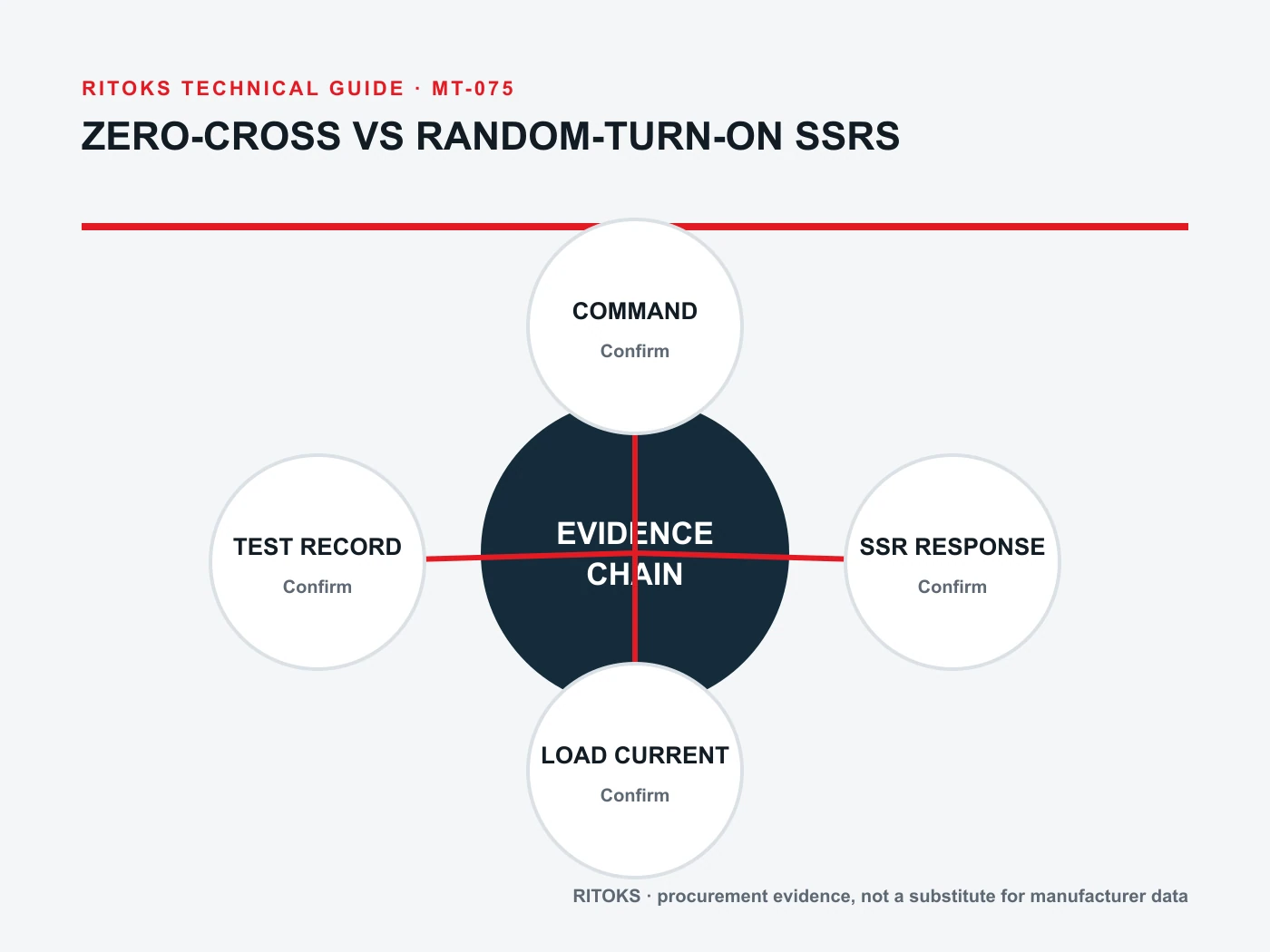
Normalize every Solid State Relay offer to the same application record. Keep document revisions, test conditions, included accessories and open questions beside each value. This makes differences in delivered scope visible and prevents a lower-cost but narrower offer from appearing equivalent to a complete solution.
Proces podejmowania decyzji
- Należy ustalić ostateczną architekturę aplikacji i scenariusz działania.
- Należy odnotować ograniczenia środowiskowe, termiczne i mechaniczne.
- Identify the required Solid State Relay function without assuming a model.
- Prosimy o podanie pełnego numeru zamówienia oraz dokładnych dokumentów uzupełniających.
- Porównaj każde roszczenie z jego warunkami i definicjami.
- Należy rozwiązać kwestie związane z odstępstwami i koordynacją przed zatwierdzeniem handlowym.
- Zarchiwizuj przyjęte dowody wraz z ostateczną specyfikacją materiałową.
Należy przerwać przegląd, gdy kluczowe dane wejściowe aplikacji są nieznane, podany model jest niejednoznaczny, wymagana specyfikacja jest poparta jedynie przez innego producenta lub inny kod zamówienia, albo gdy instalacja wykracza poza zakres dostępnych dowodów. Są to luki techniczne, a nie szczegóły redakcyjne.
Lista kontrolna dotycząca przygotowania zapytania ofertowego
A useful RFQ for zero crossing vs random turn on ssr is concise enough to answer and complete enough to prevent silent assumptions. Identify unknown values as questions and require a full orderable code rather than a generic family recommendation.
- Load behavior
- Turn-on objective
- Control method
- Switching cadence
- Ścieżka termiczna
- Output type
- Tryb wyzwalania
- Leakage behavior
- Protection plan
- Exact datasheet
- Ilość, miejsce przeznaczenia i wymagany język dokumentu
Należy poprosić o aktualną wersję karty katalogowej oraz o dokładny zakres wszelkich certyfikatów, informacji dotyczących kompatybilności, koordynacji lub deklaracji właściwości użytkowych. Należy odnotować ilość i miejsce przeznaczenia po wprowadzeniu danych technicznych, aby warunki handlowe nie przesłaniały nierozstrzygniętych kwestii technicznych.
Przekazanie sprawy z działu inżynierii do działu zakupów
Engineering approval should identify the exact Solid State Relay code, accepted document revisions, unresolved deviations and the application record used for the decision. Purchasing can then compare commercial offers without silently changing the technical basis. If a supplier proposes another code, different accessory or revised configuration, route it back through the same review instead of treating it as an administrative substitution.
Zatwierdzoną dokumentację należy przechowywać wraz ze zleceniem zakupu i ostateczną listą materiałów. Zespoły ds. odbioru i produkcji muszą dysponować wystarczającymi informacjami, aby rozpoznać przyjęty element oraz wstrzymać się z dalszymi czynnościami w przypadku rozbieżności w oznakowaniu, konfiguracji terminala, akcesoriach lub dokumentacji. Takie przekazanie informacji zapewnia również zespołom serwisowym identyfikowalny punkt wyjścia do podejmowania decyzji dotyczących wymiany, zamiast polegania na zdjęciu, opisie ze starej faktury lub jednej ogólnej ocenie.
Najczęściej zadawane pytania
Is zero-cross always better for resistive heating?
It may suit many on/off or burst-control heating duties, but the exact load, controller and model documentation still determine suitability.
Is random turn-on the same as phase-angle control?
No. Random turn-on describes relay response; a complete phase-related control system also requires a suitable controller and documented output behavior.
Can the same heatsink be used for any SSR of the same current?
No. Base losses, mounting, interface and ambient conditions must be calculated for the exact model.
Powiązane produkty i wytyczne firmy RITOKS
Linki te służą wyłącznie do przedstawienia opublikowanych informacji dotyczących rodziny produktów. Link kontekstowy nie oznacza, że produkty są zamienne, kompatybilne ani że dana kombinacja systemów została zatwierdzona.
Kategoria produktów: przekaźniki półprzewodnikowe
Published RITOKS Solid State Relay product page
Powiązany opublikowany przewodnik techniczny RITOKS
Informacje techniczne
Poniższe źródło służy wyłącznie jako ogólne uzasadnienie techniczne przedstawione w niniejszym przewodniku. Podane w nim parametry techniczne produktów, schematy obwodów, certyfikaty oraz wyniki koordynacji nie mają zastosowania do produktów firmy RITOKS.
Omron, Solid State Relays Technical Guide
Supports general distinctions among SSR switching behavior, load and thermal considerations; exact Omron values do not transfer to RITOKS products.
Poproś o przegląd konkretnego modelu
Prosimy o przesłanie wymagań dotyczących zamówienia, szczegółowych pytań dotyczących dokumentacji, ilości i miejsca dostawy za pośrednictwem formularza kontaktowego RITOKS. Zapytanie ofertowe wymaga weryfikacji konkretnego modelu; niniejszy przewodnik nie zatwierdza obwodów, instalacji ani automatycznych zamienników.