
DIN Rail Energy Meters · Comparison
Single-Phase vs Three-Phase DIN Rail Energy Meters
A single phase vs three phase energy meter comparison begins with the circuit being measured. The first question is whether the measurement point is single-phase or three-phase, and which conductors are actually available. That decision changes the input architecture, wiring evidence and commissioning plan. A meter selected from a headline label alone can create an avoidable mismatch even when its display and rail mounting look familiar.
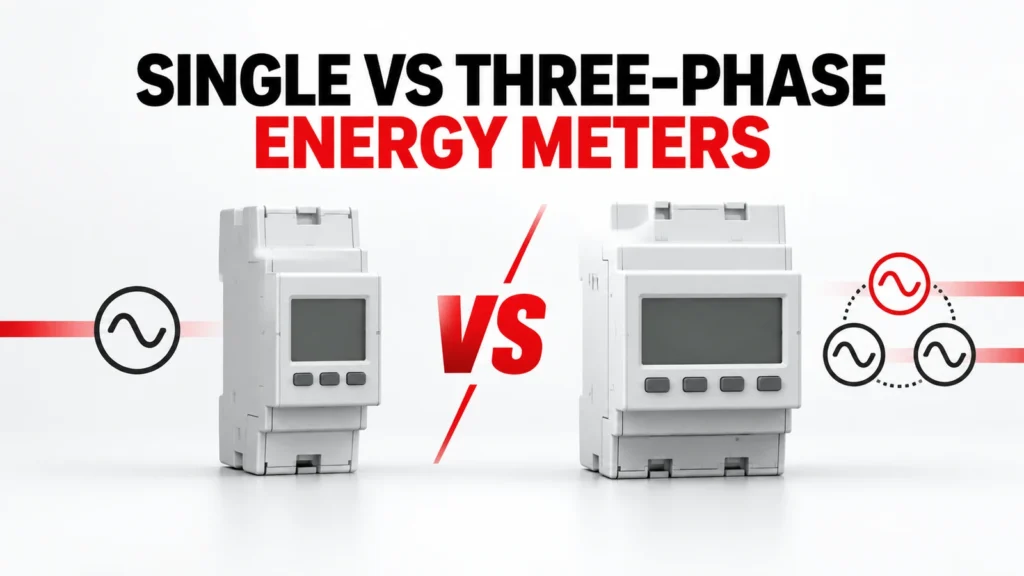
This guide compares the buying questions for single-phase and three-phase DIN rail energy meters. It keeps the meter type separate from direct versus transformer-connected measurement, communications and billing requirements. Each final choice must be supported by the exact meter diagram and order code.
Sekilas tentang Masukan Pengambilan Keputusan
| Area ulasan | Apa yang dicatat oleh pembeli | Bukti yang perlu diminta |
|---|---|---|
| System at measurement point | Document actual phase and neutral arrangement | Approved single-line diagram |
| Current input | Identify direct connection or transformer interface | Exact-meter input and wiring documentation |
| Hasil | Define displayed and exported data | Register map and interface document |
| Pemasangan | Allow space, access and test points | Dimensioned drawing and commissioning plan |
Start at the measurement point
A site can contain both single-phase loads and a three-phase distribution system. The meter belongs to a specific measurement point, so describe the conductors and the circuit boundary there rather than naming only the upstream supply. A single-phase feeder serving one machine is a different metering problem from a three-phase feeder supplying a panel of mixed loads.
Provide a current single-line diagram, location of the meter, feeder identity, available conductors and the operational question the meter must answer. If one meter is expected to represent a group of circuits, show how those circuits enter the metering boundary.
What single-phase metering must establish
For a single-phase application, confirm the supply arrangement and the exact terminal path through or into the meter. A product described as single-phase does not establish whether it is direct connected, transformer connected, two-wire in the expected sense or suitable for every local circuit. The terminals, input limits and installation instructions govern.
A compact meter may be convenient for branch-circuit visibility, but the panel design still needs a suitable protective and isolation arrangement, conductor space and an accessible reading or communications method. Check those items in the assembly plan.
What three-phase metering adds
Three-phase energy measurement involves multiple voltage and current relationships. The wiring scheme must match the actual system arrangement, including whether a neutral is present and how the current inputs are obtained. A label such as three-phase is only the start of the specification.
Compare the exact meter wiring diagram with the panel single-line drawing. Mark each phase, current path and reference connection, and have the design team confirm that the selected scheme measures the intended feeder rather than a convenient subset of conductors.
Separate phase count from current interface
Phase count and current input method are separate decisions. A meter can have a direct-connected path or use external current transformers, depending on its design. The presence of a CT elsewhere in the panel does not prove the proposed meter accepts its secondary output or ratio setting.
If transformers are required, record their ratio, output, accuracy and burden evidence with the meter input specification. For a direct-connected option, review conductor routing, terminals and the specific permitted connection. Do not infer one interface from a neighboring model.
Define the data the project actually needs
Some projects need only a local energy reading. Others need interval data, alarms, pulse outputs or a network connection to a building or industrial system. These are independent requirements that may change the order code or wiring.
State the required measurements, update expectations, communication medium, register documentation and integration owner. A meter with a port is not automatically a working monitoring system: the receiving software must interpret the correct data and the commissioning team must verify the mapping.
Compare offers using one measurement brief
Ask each supplier to respond to the same measurement point, wiring architecture and data requirement. An offer for a single-phase branch meter is not equivalent to a three-phase feeder meter, even when both quote energy measurement. Likewise, a meter that needs external CTs is not a direct substitute for one designed for direct connection.
Record the complete meter code, accessories, transformer requirements, communications option and documents supplied. Keep differences visible instead of normalizing every quotation to a generic energy-meter line item.
Commission the actual installation
At commissioning, verify the connection against the approved diagram and check the sign and plausibility of measured values under known operating states. Compare the meter reading with the intended circuit boundary, not just with a powered display.
Where data is exported, confirm addressing, register interpretation, scaling and the destination system. Capture the configured parameters and as-built wiring so a replacement can be reviewed against the same evidence later.
Membuat Berkas Bukti Model yang Tepat
A category or product-family page helps locate relevant options; it does not by itself approve one variant. For DIN rail energy meters, keep the full proposed order code, current datasheet, terminal or mounting drawing, operating instructions and any project calculation together. Read the conditions attached to each rating or function. If the evidence belongs to a neighboring model, request the correct document instead of carrying the claim across.
Tim proyek bertanggung jawab atas masukan sistem dan kriteria penerimaan. Pemasok bertanggung jawab atas bukti terkait barang yang ditawarkan. Dalam tinjauan teknis, cantumkan setiap persyaratan wajib di samping dokumen dan revisi yang tepat yang memenuhi persyaratan tersebut. Tandai kolom yang kosong sebagai “terbuka”, “bersyarat”, atau “tidak didukung”. Hal ini menghasilkan keputusan yang dapat dilacak dan mencegah agar nilai utama yang menguntungkan tidak menyembunyikan kondisi koneksi atau pemasangan yang tidak kompatibel.
Bandingkan Penawaran Lengkap
| Barang | Catatan dalam perbandingan | Alasan |
|---|---|---|
| Barang yang dapat dipesan | Kode lengkap, varian, dan aksesori yang disertakan | Mencegah asumsi yang didasarkan pada konteks keluarga |
| Kecocokan aplikasi | Tanggapan tertulis terhadap setiap masukan proyek | Menjaga agar pengecualian tetap terlihat |
| Dokumentasi | Lembar data, gambar teknis, petunjuk, dan revisi | Tautan yang mengklaim kepemilikan atas barang yang ditawarkan |
| Hal-hal yang masih perlu dibahas | Pemilik dan tanggal jatuh tempo untuk klarifikasi | Menghindari penerimaan diam-diam |
Gunakan ringkasan proyek yang sama untuk setiap penawaran harga. Ketentuan komersial seperti harga dan waktu penyelesaian dapat dibandingkan setelah ruang lingkup teknis disesuaikan. Jangan menganggap aksesori yang tidak dicantumkan, spesifikasi yang tidak didukung, atau asumsi pemasangan kabel yang belum disepakati sebagai setara dengan penawaran tertulis. Jika ada alternatif yang diajukan, tanyakan input mana saja yang berubah dan ulangi proses peninjauan yang terkait.
Tinjauan Pemasangan dan Penerimaan
Sebelum pemasangan, pastikan bahwa label, kode lengkap, dan aksesori yang dikirimkan sesuai dengan catatan yang telah disetujui. Bandingkan terminal, cara pemasangan, akses konduktor, dan orientasi apa pun yang disebutkan dengan petunjuk yang tepat. Produk yang secara fisik tampak serupa dengan versi yang telah disetujui mungkin masih memiliki konfigurasi kelistrikan, opsi kontrol, atau dasar pengujian yang berbeda.
Rencanakan pemeriksaan sesuai kondisi sebenarnya yang menanggapi risiko nyata proyek. Hal ini dapat mencakup pemeriksaan pemasangan kabel sesuai skema yang disetujui, respons fungsional, pengukuran dalam kondisi operasi yang representatif, serta konfirmasi terhadap fitur komunikasi atau alarm apa pun. Catat kondisi dan hasilnya. Rencana penerimaan harus didasarkan pada bukti aplikasi dan pemasok, bukan pada daftar periksa umum.
Daftar Periksa Permohonan Penawaran Harga
- Identify the circuit, equipment and location that DIN rail energy meters must serve.
- Lampirkan gambar sistem dan kondisi operasi yang mendefinisikan aplikasi tersebut.
- Record supply architecture and its source document.
- Catat konduktor dan dokumen sumbernya.
- Record measurement point and its source document.
- Record meter input and its source document.
- Confirm the exact-model evidence for wiring diagram.
- Confirm the exact-model evidence for ct requirement.
- Confirm the exact-model evidence for data output.
- Confirm the exact-model evidence for commissioning.
- Mohon sampaikan kode pesanan lengkap, aksesori, gambar teknis, dan revisi lembar data.
- Tanyakan mengenai pengecualian, asumsi, pengganti, dan masalah teknis yang belum terselesaikan.
Permintaan Penawaran (RFQ) harus cukup spesifik sehingga pemasok dapat menjawabnya tanpa perlu mengarang nilai-nilai proyek yang belum diketahui. Jika ada masukan penting yang belum diketahui, tandai sebagai pertanyaan dan sebutkan siapa yang akan menentukannya. Jangan jadikan suatu asumsi sebagai kriteria penilaian, klaim kepatuhan, atau metode pemasangan yang disetujui.
Apa yang Mempengaruhi Keputusan
A decision can change when the source arrangement, load behavior, environment, installation geometry or required function changes. Revisit the selected DIN rail energy meters whenever one of those inputs moves outside the approved brief. Recheck the order code and the exact evidence affected by the change; do not rely on a previous approval for a circuit that now asks the component to do different work.
Simpan riwayat revisi singkat mengenai ringkasan proyek, tanggapan pemasok, dan daftar pengecualian yang disetujui. Catatan ini membantu tim teknik, pembelian, dan komisioning untuk bekerja berdasarkan versi yang sama. Hal ini sangat berguna ketika penawaran harga direvisi, ditawarkan produk pengganti, atau desain panel berubah setelah perbandingan pertama.
Pertanyaan yang Sering Diajukan
Can a three-phase meter replace a single-phase meter?
Only if the exact model documentation permits the intended single-phase wiring and the project accepts that configuration. Do not infer compatibility from the broader family name.
Does a meter with RS485 always support the required platform?
No. Obtain the exact protocol and register documentation, then test the intended points in the receiving system.
Are direct-connected and CT-operated meters interchangeable?
No. Their input arrangements and installation evidence differ. Match the meter and any CTs as one measured system.
Halaman RITOKS yang Relevan
Untuk konteks keluarga produk, lihat Pengukuran & Pemantauan Listrik. Halaman produk terkait yang telah dipublikasikan antara lain Dds1108 Single Phase Din Rail Energy Meter, Dts5158b Three Phase Four Wire Din Rail Energy Meter, 2p Single Phase Rs485 Modbus Din Rail Energy Meter. Gunakan dokumen model persis yang mereka miliki saat ini ketika membandingkan suatu barang yang diusulkan.
Untuk penawaran harga khusus sesuai kebutuhan aplikasi, kirimkan ringkasan proyek ke RITOKS bersama dengan diagram-diagram dan pertanyaan-pertanyaan terbuka di atas.