
DIN Rail Energy Meters · Comparison
Single-Phase vs Three-Phase DIN Rail Energy Meters
A single phase vs three phase energy meter comparison begins with the circuit being measured. The first question is whether the measurement point is single-phase or three-phase, and which conductors are actually available. That decision changes the input architecture, wiring evidence and commissioning plan. A meter selected from a headline label alone can create an avoidable mismatch even when its display and rail mounting look familiar.
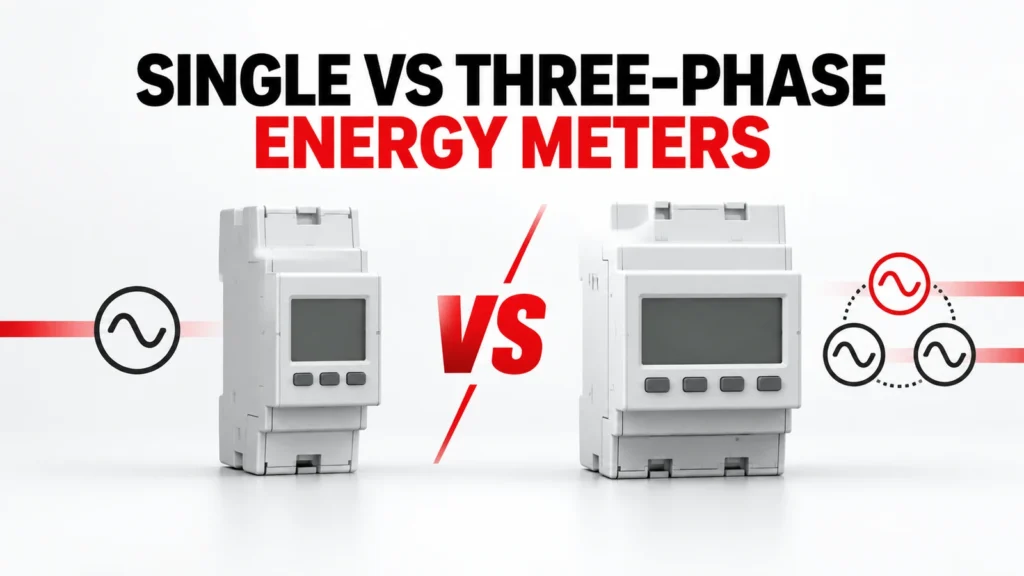
This guide compares the buying questions for single-phase and three-phase DIN rail energy meters. It keeps the meter type separate from direct versus transformer-connected measurement, communications and billing requirements. Each final choice must be supported by the exact meter diagram and order code.
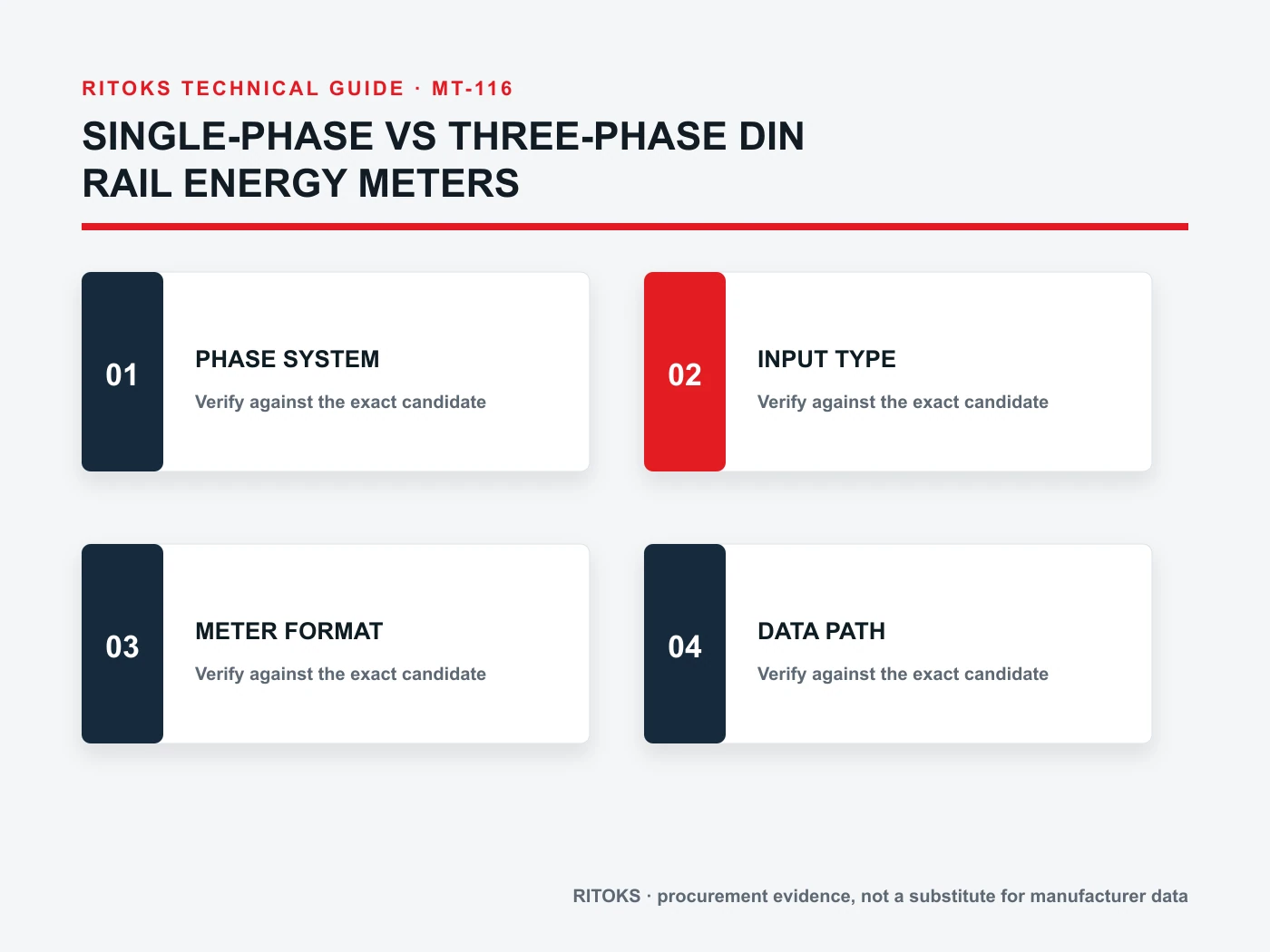
의사결정 입력 요소 요약
| 검토 대상 영역 | 구매자가 기록하는 내용 | 요청할 증거 |
|---|---|---|
| System at measurement point | Document actual phase and neutral arrangement | Approved single-line diagram |
| Current input | Identify direct connection or transformer interface | Exact-meter input and wiring documentation |
| 출력 | Define displayed and exported data | Register map and interface document |
| 설치 | Allow space, access and test points | Dimensioned drawing and commissioning plan |
Start at the measurement point
A site can contain both single-phase loads and a three-phase distribution system. The meter belongs to a specific measurement point, so describe the conductors and the circuit boundary there rather than naming only the upstream supply. A single-phase feeder serving one machine is a different metering problem from a three-phase feeder supplying a panel of mixed loads.
Provide a current single-line diagram, location of the meter, feeder identity, available conductors and the operational question the meter must answer. If one meter is expected to represent a group of circuits, show how those circuits enter the metering boundary.
What single-phase metering must establish
For a single-phase application, confirm the supply arrangement and the exact terminal path through or into the meter. A product described as single-phase does not establish whether it is direct connected, transformer connected, two-wire in the expected sense or suitable for every local circuit. The terminals, input limits and installation instructions govern.
A compact meter may be convenient for branch-circuit visibility, but the panel design still needs a suitable protective and isolation arrangement, conductor space and an accessible reading or communications method. Check those items in the assembly plan.
What three-phase metering adds
Three-phase energy measurement involves multiple voltage and current relationships. The wiring scheme must match the actual system arrangement, including whether a neutral is present and how the current inputs are obtained. A label such as three-phase is only the start of the specification.
Compare the exact meter wiring diagram with the panel single-line drawing. Mark each phase, current path and reference connection, and have the design team confirm that the selected scheme measures the intended feeder rather than a convenient subset of conductors.
Separate phase count from current interface
Phase count and current input method are separate decisions. A meter can have a direct-connected path or use external current transformers, depending on its design. The presence of a CT elsewhere in the panel does not prove the proposed meter accepts its secondary output or ratio setting.
If transformers are required, record their ratio, output, accuracy and burden evidence with the meter input specification. For a direct-connected option, review conductor routing, terminals and the specific permitted connection. Do not infer one interface from a neighboring model.
Define the data the project actually needs
Some projects need only a local energy reading. Others need interval data, alarms, pulse outputs or a network connection to a building or industrial system. These are independent requirements that may change the order code or wiring.
State the required measurements, update expectations, communication medium, register documentation and integration owner. A meter with a port is not automatically a working monitoring system: the receiving software must interpret the correct data and the commissioning team must verify the mapping.
Compare offers using one measurement brief
Ask each supplier to respond to the same measurement point, wiring architecture and data requirement. An offer for a single-phase branch meter is not equivalent to a three-phase feeder meter, even when both quote energy measurement. Likewise, a meter that needs external CTs is not a direct substitute for one designed for direct connection.
Record the complete meter code, accessories, transformer requirements, communications option and documents supplied. Keep differences visible instead of normalizing every quotation to a generic energy-meter line item.
Commission the actual installation
At commissioning, verify the connection against the approved diagram and check the sign and plausibility of measured values under known operating states. Compare the meter reading with the intended circuit boundary, not just with a powered display.
Where data is exported, confirm addressing, register interpretation, scaling and the destination system. Capture the configured parameters and as-built wiring so a replacement can be reviewed against the same evidence later.
정확한 모델 증거 파일 생성하기
A category or product-family page helps locate relevant options; it does not by itself approve one variant. For DIN rail energy meters, keep the full proposed order code, current datasheet, terminal or mounting drawing, operating instructions and any project calculation together. Read the conditions attached to each rating or function. If the evidence belongs to a neighboring model, request the correct document instead of carrying the claim across.
프로젝트 팀은 시스템 입력 사항과 수용 기준을 책임집니다. 공급업체는 제안된 항목에 대한 증빙 자료를 책임집니다. 기술 검토 시, 각 필수 요구 사항 옆에 해당 요구 사항을 충족하는 정확한 문서와 개정판을 명시하십시오. 누락된 항목은 ‘미해결’, ‘조건부’ 또는 ‘지원 불가’로 표시하십시오. 이를 통해 추적 가능한 의사결정이 이루어지며, 유리한 표면상의 수치가 호환되지 않는 연결 또는 설치 조건을 가려버리는 것을 방지할 수 있습니다.
모든 제안 비교하기
| 항목 | 비교 결과 기록 | 이유 |
|---|---|---|
| 주문 가능한 상품 | 전체 코드, 변형 모델 및 포함된 액세서리 | 가족 단위의 추정을 방지합니다 |
| 응용 프로그램 일치 | 각 프로젝트 제안에 대한 서면 답변 | 예외를 계속 표시합니다 |
| 문서 | 데이터시트, 도면, 사용 설명서 및 개정 내역 | 제공된 상품에 대한 권리 주장 |
| 논의 사항 | 소유자 및 명확한 확인이 필요한 기한 | 묵인하는 것을 방지한다 |
모든 견적서에는 동일한 프로젝트 개요를 사용하십시오. 기술적 범위가 표준화되면 가격 및 리드 타임과 같은 상업적 조건을 비교할 수 있습니다. 누락된 부속품, 지원되지 않는 정격 또는 해결되지 않은 배선 가정을 문서화된 제안서와 동등하게 취급해서는 안 됩니다. 대안이 제안된 경우, 어떤 입력 사항이 변경되는지 확인하고, 이에 따라 영향을 받는 검토 과정을 다시 수행하십시오.
설치 및 인수 검토
설치 전에, 납품된 라벨, 전체 코드 및 부속품이 승인된 기록과 일치하는지 확인하십시오. 단자, 장착 방식, 도체 접속부 및 명시된 방향 등을 정확한 지침과 대조하여 확인하십시오. 외관상 승인된 버전과 유사해 보이는 제품이라도 전기적 구성, 제어 옵션 또는 시험 기준이 다를 수 있습니다.
프로젝트의 실제 위험 요소를 다루는 준공 검사 계획을 수립하십시오. 여기에는 승인된 도면에 따른 배선 상태 확인, 기능적 반응 테스트, 대표적인 작동 조건 하에서의 측정, 그리고 모든 통신 및 경보 기능의 확인이 포함될 수 있습니다. 상태와 결과를 기록하십시오. 인수 계획은 일반적인 항목별 체크리스트가 아닌, 해당 애플리케이션 및 공급업체가 제시한 증거 자료를 바탕으로 수립되어야 합니다.
견적 요청 체크리스트
- Identify the circuit, equipment and location that DIN rail energy meters must serve.
- 해당 애플리케이션을 정의하는 시스템 도면과 작동 상태를 첨부하십시오.
- Record supply architecture and its source document.
- 도체 및 그 원본 문서를 기록하십시오.
- Record measurement point and its source document.
- Record meter input and its source document.
- Confirm the exact-model evidence for wiring diagram.
- Confirm the exact-model evidence for ct requirement.
- Confirm the exact-model evidence for data output.
- Confirm the exact-model evidence for commissioning.
- 전체 주문 코드, 부속품, 도면 및 데이터시트의 개정 버전을 요청해 주십시오.
- 제외 사항, 가정, 대체 사항 및 해결되지 않은 기술적 사항에 대해 문의하십시오.
견적 요청서(RFQ)는 공급업체가 누락된 프로젝트 값을 임의로 추정하지 않고도 답변할 수 있을 만큼 구체적이어야 합니다. 필수적인 입력값이 아직 확정되지 않은 경우, 이를 ‘질문’으로 표기하고 누가 이를 결정할지 명시하십시오. 가정을 평가 기준, 준수 주장 또는 승인된 설치 방법으로 삼아서는 안 됩니다.
결정을 좌우하는 요인
A decision can change when the source arrangement, load behavior, environment, installation geometry or required function changes. Revisit the selected DIN rail energy meters whenever one of those inputs moves outside the approved brief. Recheck the order code and the exact evidence affected by the change; do not rely on a previous approval for a circuit that now asks the component to do different work.
프로젝트 개요, 공급업체의 답변 및 승인된 예외 사항 목록에 대한 간략한 수정 이력을 보관하십시오. 이 기록은 엔지니어링, 구매 및 시운전 부서가 동일한 버전을 기준으로 작업하는 데 도움이 됩니다. 특히 견적이 수정되거나 대체품이 제안되거나, 첫 번째 비교 이후 패널 설계가 변경될 때 유용합니다.
자주 묻는 질문
Can a three-phase meter replace a single-phase meter?
Only if the exact model documentation permits the intended single-phase wiring and the project accepts that configuration. Do not infer compatibility from the broader family name.
Does a meter with RS485 always support the required platform?
No. Obtain the exact protocol and register documentation, then test the intended points in the receiving system.
Are direct-connected and CT-operated meters interchangeable?
No. Their input arrangements and installation evidence differ. Match the meter and any CTs as one measured system.
관련 RITOKS 페이지
제품군 관련 내용은 다음을 참조하십시오. 전기 계측 및 모니터링. 이와 관련된 게시된 제품 페이지에는 다음이 포함됩니다. Dds1108 Single Phase Din Rail Energy Meter, Dts5158b Three Phase Four Wire Din Rail Energy Meter, 2p Single Phase Rs485 Modbus Din Rail Energy Meter. 제안된 품목을 비교할 때는 해당 품목의 최신 정확한 모델 사양서를 사용하십시오.
특정 용도에 대한 견적을 원하시면, 프로젝트 개요를 RITOKS에 보내주세요 위의 도표와 미해결 질문들을 바탕으로.