
DIN Rail Energy Meters · Comparison
Single-Phase vs Three-Phase DIN Rail Energy Meters
A single phase vs three phase energy meter comparison begins with the circuit being measured. The first question is whether the measurement point is single-phase or three-phase, and which conductors are actually available. That decision changes the input architecture, wiring evidence and commissioning plan. A meter selected from a headline label alone can create an avoidable mismatch even when its display and rail mounting look familiar.
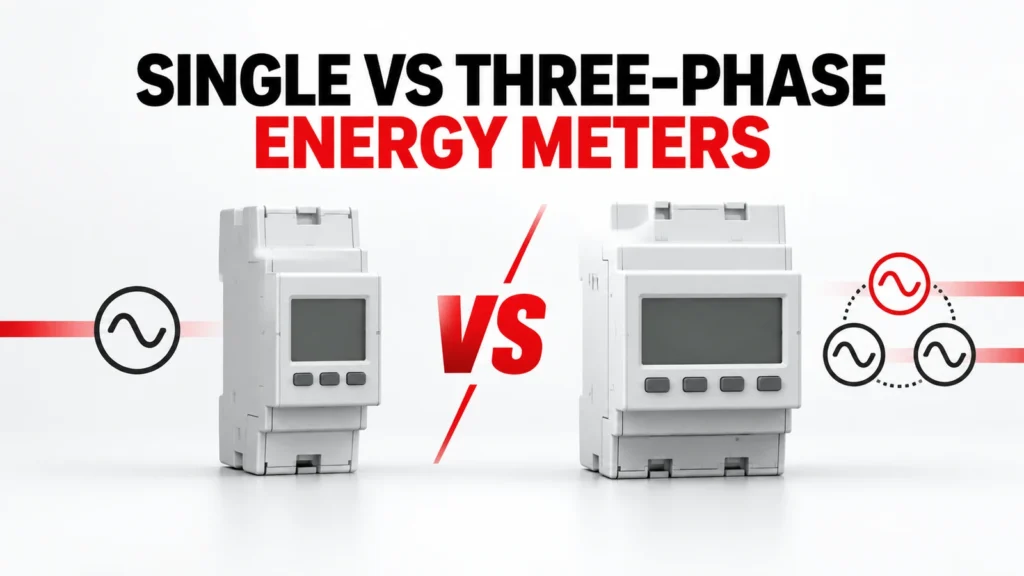
This guide compares the buying questions for single-phase and three-phase DIN rail energy meters. It keeps the meter type separate from direct versus transformer-connected measurement, communications and billing requirements. Each final choice must be supported by the exact meter diagram and order code.
Tổng quan về các yếu tố đầu vào cho quyết định
| Khu vực đánh giá | Những thông tin mà người mua ghi lại | Chứng cứ cần yêu cầu |
|---|---|---|
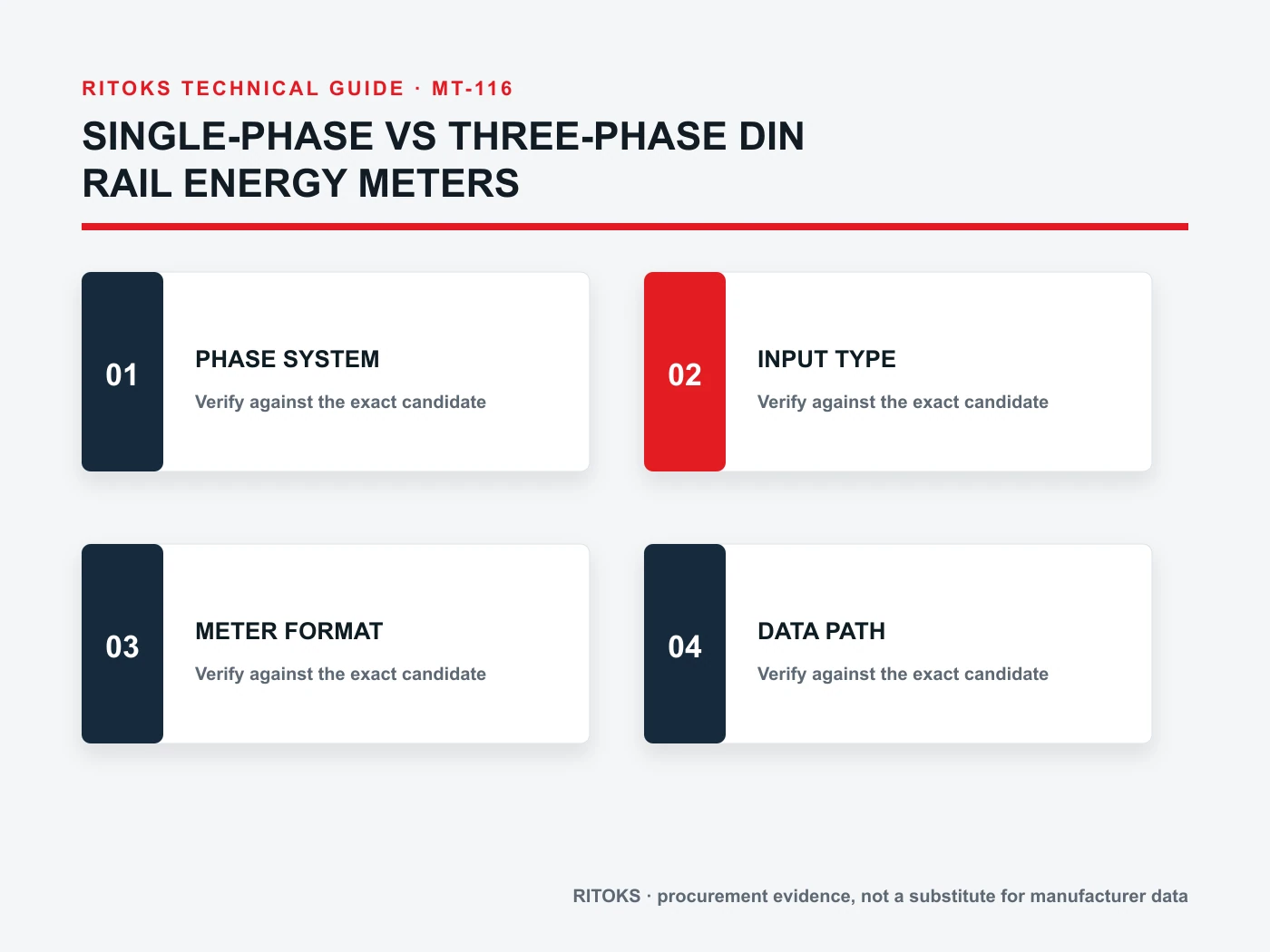
| System at measurement point | Document actual phase and neutral arrangement | Approved single-line diagram |
| Current input | Identify direct connection or transformer interface | Exact-meter input and wiring documentation |
| Kết quả | Define displayed and exported data | Register map and interface document |
| Cài đặt | Allow space, access and test points | Dimensioned drawing and commissioning plan |
Start at the measurement point
A site can contain both single-phase loads and a three-phase distribution system. The meter belongs to a specific measurement point, so describe the conductors and the circuit boundary there rather than naming only the upstream supply. A single-phase feeder serving one machine is a different metering problem from a three-phase feeder supplying a panel of mixed loads.
Provide a current single-line diagram, location of the meter, feeder identity, available conductors and the operational question the meter must answer. If one meter is expected to represent a group of circuits, show how those circuits enter the metering boundary.
What single-phase metering must establish
For a single-phase application, confirm the supply arrangement and the exact terminal path through or into the meter. A product described as single-phase does not establish whether it is direct connected, transformer connected, two-wire in the expected sense or suitable for every local circuit. The terminals, input limits and installation instructions govern.
A compact meter may be convenient for branch-circuit visibility, but the panel design still needs a suitable protective and isolation arrangement, conductor space and an accessible reading or communications method. Check those items in the assembly plan.
What three-phase metering adds
Three-phase energy measurement involves multiple voltage and current relationships. The wiring scheme must match the actual system arrangement, including whether a neutral is present and how the current inputs are obtained. A label such as three-phase is only the start of the specification.
Compare the exact meter wiring diagram with the panel single-line drawing. Mark each phase, current path and reference connection, and have the design team confirm that the selected scheme measures the intended feeder rather than a convenient subset of conductors.
Separate phase count from current interface
Phase count and current input method are separate decisions. A meter can have a direct-connected path or use external current transformers, depending on its design. The presence of a CT elsewhere in the panel does not prove the proposed meter accepts its secondary output or ratio setting.
If transformers are required, record their ratio, output, accuracy and burden evidence with the meter input specification. For a direct-connected option, review conductor routing, terminals and the specific permitted connection. Do not infer one interface from a neighboring model.
Define the data the project actually needs
Some projects need only a local energy reading. Others need interval data, alarms, pulse outputs or a network connection to a building or industrial system. These are independent requirements that may change the order code or wiring.
State the required measurements, update expectations, communication medium, register documentation and integration owner. A meter with a port is not automatically a working monitoring system: the receiving software must interpret the correct data and the commissioning team must verify the mapping.
Compare offers using one measurement brief
Ask each supplier to respond to the same measurement point, wiring architecture and data requirement. An offer for a single-phase branch meter is not equivalent to a three-phase feeder meter, even when both quote energy measurement. Likewise, a meter that needs external CTs is not a direct substitute for one designed for direct connection.
Record the complete meter code, accessories, transformer requirements, communications option and documents supplied. Keep differences visible instead of normalizing every quotation to a generic energy-meter line item.
Commission the actual installation
At commissioning, verify the connection against the approved diagram and check the sign and plausibility of measured values under known operating states. Compare the meter reading with the intended circuit boundary, not just with a powered display.
Where data is exported, confirm addressing, register interpretation, scaling and the destination system. Capture the configured parameters and as-built wiring so a replacement can be reviewed against the same evidence later.
Tạo tệp bằng chứng dựa trên mô hình chính xác
A category or product-family page helps locate relevant options; it does not by itself approve one variant. For DIN rail energy meters, keep the full proposed order code, current datasheet, terminal or mounting drawing, operating instructions and any project calculation together. Read the conditions attached to each rating or function. If the evidence belongs to a neighboring model, request the correct document instead of carrying the claim across.
Nhóm dự án chịu trách nhiệm về các đầu vào của hệ thống và các tiêu chí nghiệm thu. Nhà cung cấp chịu trách nhiệm về các bằng chứng liên quan đến hạng mục được đề xuất. Trong quá trình rà soát kỹ thuật, hãy ghi chú từng yêu cầu bắt buộc bên cạnh tài liệu và phiên bản cụ thể đáp ứng yêu cầu đó. Đánh dấu các trường thông tin còn thiếu là “chưa hoàn thành”, “có điều kiện” hoặc “không được hỗ trợ”. Điều này giúp tạo ra một quyết định có thể truy vết được và ngăn chặn việc một giá trị tổng thể tích cực che lấp một kết nối hoặc điều kiện lắp đặt không tương thích.
So sánh các gói ưu đãi trọn gói
| Mặt hàng | Kết quả so sánh | Lý do |
|---|---|---|
| Sản phẩm có thể đặt hàng | Mã sản phẩm đầy đủ, các phiên bản và phụ kiện đi kèm | Ngăn chặn những giả định ở cấp độ gia đình |
| Sự phù hợp của ứng dụng | Phản hồi bằng văn bản đối với từng ý kiến đóng góp cho dự án | Giữ cho các trường hợp ngoại lệ luôn hiển thị |
| Tài liệu hướng dẫn | Bảng thông số kỹ thuật, bản vẽ, hướng dẫn và các bản sửa đổi | Các yêu cầu liên quan đến mặt hàng được chào bán |
| Các vấn đề còn bỏ ngỏ | Chủ sở hữu và ngày đến hạn để làm rõ | Tránh việc chấp nhận một cách im lặng |
Hãy sử dụng cùng một bản tóm tắt dự án cho mọi báo giá. Các điều khoản thương mại như giá cả và thời gian giao hàng có thể được so sánh sau khi phạm vi kỹ thuật đã được chuẩn hóa. Không nên coi việc thiếu phụ kiện, các thông số kỹ thuật không được hỗ trợ hoặc giả định về hệ thống dây điện chưa được làm rõ là tương đương với một đề xuất đã được lập thành văn bản. Nếu có đề xuất phương án thay thế, hãy hỏi xem những thông số đầu vào nào thay đổi và tiến hành lại quá trình rà soát đối với các phần bị ảnh hưởng.
Kiểm tra việc lắp đặt và nghiệm thu
Trước khi lắp đặt, hãy xác nhận rằng nhãn mác, mã sản phẩm đầy đủ và các phụ kiện đi kèm phải khớp với hồ sơ đã được phê duyệt. So sánh các đầu nối, cách lắp đặt, lối đi của dây dẫn và bất kỳ hướng lắp đặt nào được ghi rõ với các hướng dẫn cụ thể. Một sản phẩm có vẻ ngoài tương tự như phiên bản đã được phê duyệt vẫn có thể có cấu hình điện, tùy chọn điều khiển hoặc cơ sở thử nghiệm khác.
Lập kế hoạch kiểm tra thực tế nhằm giải quyết các rủi ro thực tế của dự án. Việc này có thể bao gồm việc kiểm tra hệ thống dây điện so với sơ đồ đã được phê duyệt, phản hồi chức năng, các phép đo trong các trạng thái vận hành điển hình và việc xác nhận các tính năng liên lạc hoặc báo động. Ghi chép lại các điều kiện và kết quả. Kế hoạch nghiệm thu phải dựa trên hồ sơ ứng dụng và bằng chứng từ nhà cung cấp, chứ không phải từ một danh sách kiểm tra chung chung.
Danh sách kiểm tra yêu cầu báo giá
- Identify the circuit, equipment and location that DIN rail energy meters must serve.
- Vui lòng đính kèm bản vẽ hệ thống và các trạng thái hoạt động xác định ứng dụng.
- Record supply architecture and its source document.
- Ghi lại các bộ dẫn và tài liệu nguồn của chúng.
- Record measurement point and its source document.
- Record meter input and its source document.
- Confirm the exact-model evidence for wiring diagram.
- Confirm the exact-model evidence for ct requirement.
- Confirm the exact-model evidence for data output.
- Confirm the exact-model evidence for commissioning.
- Yêu cầu cung cấp mã đặt hàng đầy đủ, phụ kiện, bản vẽ và phiên bản mới nhất của bảng thông số kỹ thuật.
- Hãy hỏi về các trường hợp ngoại lệ, các giả định, các giải pháp thay thế và các vấn đề kỹ thuật chưa được giải quyết.
Yêu cầu báo giá (RFQ) cần phải đủ cụ thể để nhà cung cấp có thể trả lời mà không cần phải tự suy diễn các thông số dự án còn thiếu. Nếu một thông tin đầu vào thiết yếu vẫn chưa được xác định, hãy ghi rõ đó là một câu hỏi và chỉ rõ ai sẽ là người xác định thông tin đó. Không được biến một giả định thành tiêu chí đánh giá, tuyên bố tuân thủ hoặc phương pháp lắp đặt đã được phê duyệt.
Điều gì ảnh hưởng đến quyết định
A decision can change when the source arrangement, load behavior, environment, installation geometry or required function changes. Revisit the selected DIN rail energy meters whenever one of those inputs moves outside the approved brief. Recheck the order code and the exact evidence affected by the change; do not rely on a previous approval for a circuit that now asks the component to do different work.
Hãy lưu giữ một bản lịch sử sửa đổi ngắn gọn về bản tóm tắt dự án, phản hồi của nhà cung cấp và danh sách các trường hợp ngoại lệ đã được chấp nhận. Hồ sơ này giúp các bộ phận kỹ thuật, mua hàng và vận hành thử làm việc dựa trên cùng một phiên bản. Điều này đặc biệt hữu ích khi báo giá được điều chỉnh, có đề xuất sản phẩm thay thế hoặc thiết kế tủ điện thay đổi sau lần so sánh đầu tiên.
Các câu hỏi thường gặp
Can a three-phase meter replace a single-phase meter?
Only if the exact model documentation permits the intended single-phase wiring and the project accepts that configuration. Do not infer compatibility from the broader family name.
Does a meter with RS485 always support the required platform?
No. Obtain the exact protocol and register documentation, then test the intended points in the receiving system.
Are direct-connected and CT-operated meters interchangeable?
No. Their input arrangements and installation evidence differ. Match the meter and any CTs as one measured system.
Các trang liên quan trên RITOKS
Để biết thêm thông tin về dòng sản phẩm, xem Đo lường và giám sát điện. Các trang sản phẩm liên quan đã được đăng tải bao gồm Dds1108 Single Phase Din Rail Energy Meter, Dts5158b Three Phase Four Wire Din Rail Energy Meter, 2p Single Phase Rs485 Modbus Din Rail Energy Meter. Khi so sánh một mặt hàng được đề xuất, hãy sử dụng các tài liệu về mẫu sản phẩm chính xác hiện tại của họ.
Để nhận báo giá dành riêng cho ứng dụng cụ thể, gửi bản tóm tắt dự án cho RITOKS cùng với các sơ đồ và các câu hỏi mở nêu trên.