
DIN Rail Energy Meters · Comparison
Single-Phase vs Three-Phase DIN Rail Energy Meters
A single phase vs three phase energy meter comparison begins with the circuit being measured. The first question is whether the measurement point is single-phase or three-phase, and which conductors are actually available. That decision changes the input architecture, wiring evidence and commissioning plan. A meter selected from a headline label alone can create an avoidable mismatch even when its display and rail mounting look familiar.
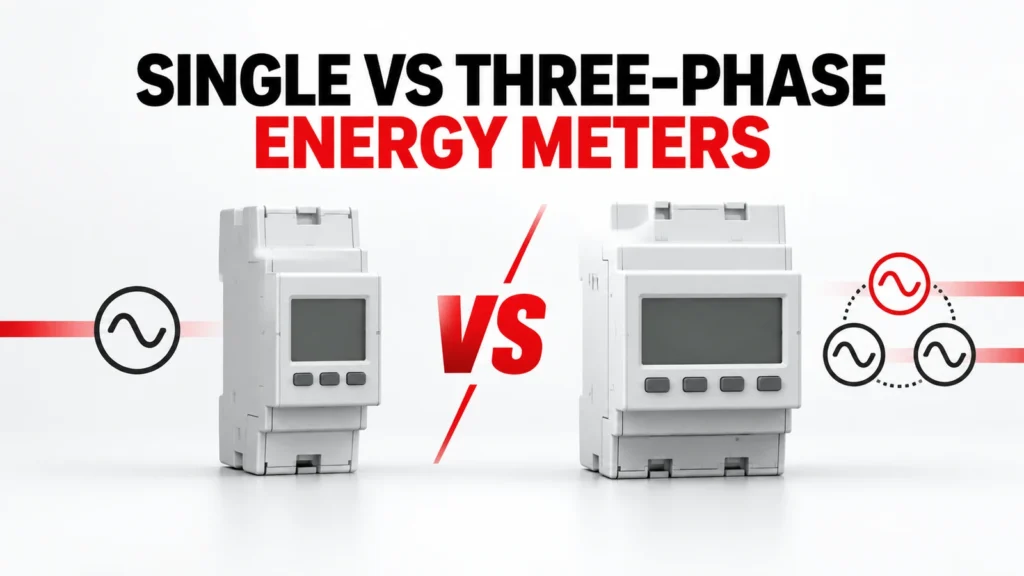
This guide compares the buying questions for single-phase and three-phase DIN rail energy meters. It keeps the meter type separate from direct versus transformer-connected measurement, communications and billing requirements. Each final choice must be supported by the exact meter diagram and order code.
ข้อมูลพื้นฐานสำหรับการตัดสินใจ
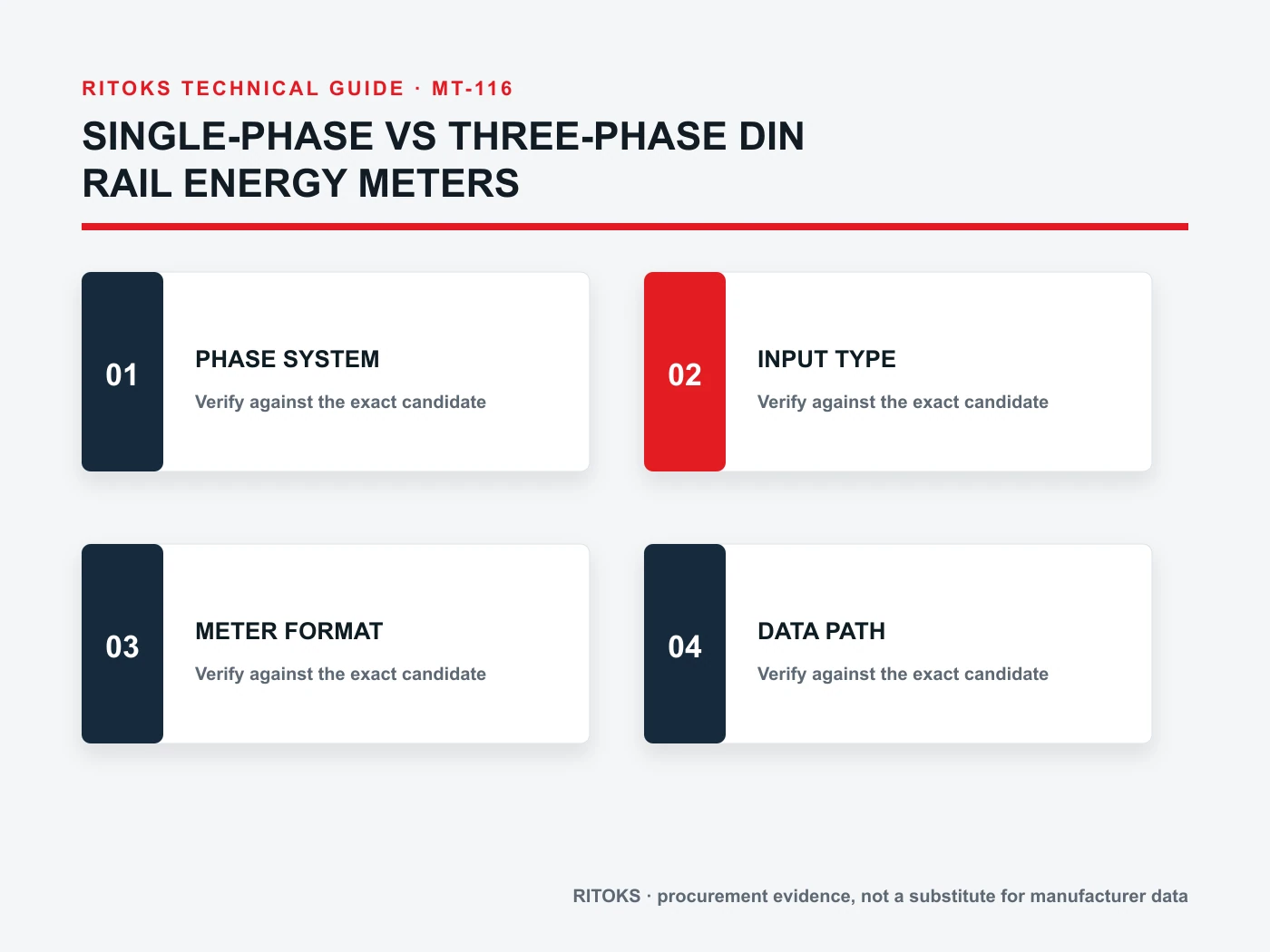
| พื้นที่รีวิว | ข้อมูลที่ผู้ซื้อบันทึกไว้ | หลักฐานที่จำเป็นต้องขอ |
|---|---|---|
| System at measurement point | Document actual phase and neutral arrangement | Approved single-line diagram |
| Current input | Identify direct connection or transformer interface | Exact-meter input and wiring documentation |
| ผลลัพธ์ | Define displayed and exported data | Register map and interface document |
| การติดตั้ง | Allow space, access and test points | Dimensioned drawing and commissioning plan |
Start at the measurement point
A site can contain both single-phase loads and a three-phase distribution system. The meter belongs to a specific measurement point, so describe the conductors and the circuit boundary there rather than naming only the upstream supply. A single-phase feeder serving one machine is a different metering problem from a three-phase feeder supplying a panel of mixed loads.
Provide a current single-line diagram, location of the meter, feeder identity, available conductors and the operational question the meter must answer. If one meter is expected to represent a group of circuits, show how those circuits enter the metering boundary.
What single-phase metering must establish
For a single-phase application, confirm the supply arrangement and the exact terminal path through or into the meter. A product described as single-phase does not establish whether it is direct connected, transformer connected, two-wire in the expected sense or suitable for every local circuit. The terminals, input limits and installation instructions govern.
A compact meter may be convenient for branch-circuit visibility, but the panel design still needs a suitable protective and isolation arrangement, conductor space and an accessible reading or communications method. Check those items in the assembly plan.
What three-phase metering adds
Three-phase energy measurement involves multiple voltage and current relationships. The wiring scheme must match the actual system arrangement, including whether a neutral is present and how the current inputs are obtained. A label such as three-phase is only the start of the specification.
Compare the exact meter wiring diagram with the panel single-line drawing. Mark each phase, current path and reference connection, and have the design team confirm that the selected scheme measures the intended feeder rather than a convenient subset of conductors.
Separate phase count from current interface
Phase count and current input method are separate decisions. A meter can have a direct-connected path or use external current transformers, depending on its design. The presence of a CT elsewhere in the panel does not prove the proposed meter accepts its secondary output or ratio setting.
If transformers are required, record their ratio, output, accuracy and burden evidence with the meter input specification. For a direct-connected option, review conductor routing, terminals and the specific permitted connection. Do not infer one interface from a neighboring model.
Define the data the project actually needs
Some projects need only a local energy reading. Others need interval data, alarms, pulse outputs or a network connection to a building or industrial system. These are independent requirements that may change the order code or wiring.
State the required measurements, update expectations, communication medium, register documentation and integration owner. A meter with a port is not automatically a working monitoring system: the receiving software must interpret the correct data and the commissioning team must verify the mapping.
Compare offers using one measurement brief
Ask each supplier to respond to the same measurement point, wiring architecture and data requirement. An offer for a single-phase branch meter is not equivalent to a three-phase feeder meter, even when both quote energy measurement. Likewise, a meter that needs external CTs is not a direct substitute for one designed for direct connection.
Record the complete meter code, accessories, transformer requirements, communications option and documents supplied. Keep differences visible instead of normalizing every quotation to a generic energy-meter line item.
Commission the actual installation
At commissioning, verify the connection against the approved diagram and check the sign and plausibility of measured values under known operating states. Compare the meter reading with the intended circuit boundary, not just with a powered display.
Where data is exported, confirm addressing, register interpretation, scaling and the destination system. Capture the configured parameters and as-built wiring so a replacement can be reviewed against the same evidence later.
สร้างไฟล์หลักฐานแบบจำลองที่แม่นยำ
A category or product-family page helps locate relevant options; it does not by itself approve one variant. For DIN rail energy meters, keep the full proposed order code, current datasheet, terminal or mounting drawing, operating instructions and any project calculation together. Read the conditions attached to each rating or function. If the evidence belongs to a neighboring model, request the correct document instead of carrying the claim across.
ทีมโครงการเป็นผู้รับผิดชอบข้อมูลนำเข้าของระบบและเกณฑ์การรับมอบ ส่วนผู้จัดหาเป็นผู้รับผิดชอบหลักฐานของสินค้าที่เสนอ ในการตรวจสอบทางเทคนิค ให้วางข้อกำหนดที่จำเป็นแต่ละข้อไว้ข้างเอกสารและฉบับแก้ไขที่ตรงกับข้อกำหนดนั้นอย่างแม่นยำ ให้ทำเครื่องหมายช่องที่ขาดข้อมูลว่าเป็น "เปิด" "มีเงื่อนไข" หรือ "ไม่รองรับ" การทำเช่นนี้จะสร้างการตัดสินใจที่สามารถติดตามได้ และป้องกันไม่ให้ค่าหัวข้อที่ดูดีไปปกปิดความไม่สอดคล้องกันในด้านการเชื่อมต่อหรือเงื่อนไขการติดตั้ง.
เปรียบเทียบข้อเสนอทั้งหมด
| รายการ | บันทึกในการเปรียบเทียบ | เหตุผล |
|---|---|---|
| สินค้าที่สามารถสั่งซื้อได้ | รหัสเต็ม รุ่น และอุปกรณ์เสริมที่มาพร้อม | ป้องกันการสมมติในระดับครอบครัว |
| การจับคู่แอปพลิเคชัน | คำตอบเป็นลายลักษณ์อักษรต่อข้อมูลนำเข้าของแต่ละโครงการ | ทำให้ข้อผิดพลาดยังคงปรากฏอยู่ |
| เอกสารประกอบ | ใบข้อมูลทางเทคนิค, แบบวาด, คู่มือการใช้งาน และฉบับแก้ไข | ลิงก์ที่อ้างอิงถึงสินค้าที่เสนอขาย |
| ประเด็นที่ยังไม่ได้ข้อสรุป | เจ้าของและวันที่ครบกำหนด เพื่อขอชี้แจง | หลีกเลี่ยงการยอมรับอย่างเงียบๆ |
ใช้เอกสารสรุปโครงการเดียวกันสำหรับทุกใบเสนอราคา เงื่อนไขทางการค้า เช่น ราคาและระยะเวลาการผลิต สามารถเปรียบเทียบกันได้เมื่อขอบเขตทางเทคนิคได้รับการปรับให้เป็นมาตรฐานแล้ว อย่าถือว่าอุปกรณ์เสริมที่ถูกละเว้น ค่าพารามิเตอร์ที่ยังไม่ได้รับการสนับสนุน หรือสมมติฐานการเดินสายไฟฟ้าที่ยังไม่ได้รับการแก้ไข เป็นข้อเสนอที่เทียบเท่ากับข้อเสนอที่มีเอกสารรองรับ หากมีข้อเสนอทางเลือก ให้สอบถามว่าข้อมูลใดที่เปลี่ยนแปลงไป และดำเนินการตรวจสอบส่วนที่ได้รับผลกระทบซ้ำอีกครั้ง.
การตรวจสอบการติดตั้งและการรับมอบ
ก่อนการติดตั้ง โปรดตรวจสอบให้แน่ใจว่าฉลาก รหัสครบถ้วน และอุปกรณ์เสริมที่ส่งมาตรงกับข้อมูลที่ได้รับการอนุมัติ เปรียบเทียบขั้วต่อ วิธีการติดตั้ง การเข้าถึงตัวนำ และทิศทางที่ระบุไว้กับคำแนะนำอย่างละเอียด ผลิตภัณฑ์ที่มีลักษณะทางกายภาพคล้ายกับรุ่นที่ได้รับการอนุมัติ อาจมีการกำหนดค่าทางไฟฟ้า ตัวเลือกการควบคุม หรือเกณฑ์การทดสอบที่แตกต่างออกไป.
วางแผนการตรวจสอบตามสภาพจริงที่มุ่งเน้นไปที่ความเสี่ยงที่แท้จริงของโครงการ ซึ่งอาจรวมถึงการตรวจสอบการเดินสายไฟฟ้าตามแผนผังที่ได้รับการอนุมัติ การตรวจสอบการทำงาน การวัดค่าในสภาพการทำงานที่เป็นตัวแทน และการยืนยันการทำงานของระบบสื่อสารหรือระบบเตือนภัยทุกประเภท ให้บันทึกสภาพและผลการตรวจสอบไว้ แผนการรับมอบงานควรอิงจากข้อมูลของระบบและหลักฐานจากผู้จัดหา ไม่ใช่จากรายการตรวจสอบทั่วไป.
รายการตรวจสอบคำขอเสนอราคา
- Identify the circuit, equipment and location that DIN rail energy meters must serve.
- แนบแผนภาพระบบและสถานะการทำงานที่กำหนดการใช้งานของระบบ.
- Record supply architecture and its source document.
- บันทึกผู้ดำเนินการและเอกสารต้นฉบับ.
- Record measurement point and its source document.
- Record meter input and its source document.
- Confirm the exact-model evidence for wiring diagram.
- Confirm the exact-model evidence for ct requirement.
- Confirm the exact-model evidence for data output.
- Confirm the exact-model evidence for commissioning.
- ขอให้ส่งรหัสคำสั่งซื้อฉบับเต็ม อุปกรณ์เสริม แบบวาด และฉบับปรับปรุงของใบข้อมูลทางเทคนิค.
- สอบถามเกี่ยวกับข้อยกเว้น สมมติฐาน สิ่งทดแทน และประเด็นทางวิศวกรรมที่ยังไม่ได้รับการแก้ไข.
เอกสารขอเสนอราคา (RFQ) ต้องมีความชัดเจนเพียงพอเพื่อให้ผู้จัดหาสามารถตอบได้โดยไม่ต้องต้องคาดการณ์ค่าโครงการที่ยังขาดอยู่ หากข้อมูลสำคัญใดยังไม่ทราบ ให้ระบุไว้เป็นคำถามและชี้แจงว่าใครจะเป็นผู้กำหนดค่าดังกล่าว อย่าเปลี่ยนสมมติฐานให้กลายเป็นเกณฑ์การประเมิน ข้ออ้างว่าสอดคล้องกับข้อกำหนด หรือวิธีการติดตั้งที่ได้รับการอนุมัติ.
ปัจจัยใดที่ส่งผลต่อการตัดสินใจ
A decision can change when the source arrangement, load behavior, environment, installation geometry or required function changes. Revisit the selected DIN rail energy meters whenever one of those inputs moves outside the approved brief. Recheck the order code and the exact evidence affected by the change; do not rely on a previous approval for a circuit that now asks the component to do different work.
เก็บประวัติการแก้ไขแบบสั้นของเอกสารโครงการ คำตอบจากผู้จัดหา และรายชื่อข้อยกเว้นที่ได้รับการอนุมัติไว้ การบันทึกนี้ช่วยให้ฝ่ายวิศวกรรม ฝ่ายจัดซื้อ และฝ่ายรับมอบงานสามารถทำงานจากเวอร์ชันเดียวกันได้ ซึ่งมีประโยชน์เป็นพิเศษเมื่อมีการแก้ไขใบเสนอราคา มีการเสนอสินค้าทดแทน หรือการออกแบบแผงควบคุมมีการเปลี่ยนแปลงหลังจากขั้นตอนการเปรียบเทียบครั้งแรก.
คำถามที่มักถูกถาม
Can a three-phase meter replace a single-phase meter?
Only if the exact model documentation permits the intended single-phase wiring and the project accepts that configuration. Do not infer compatibility from the broader family name.
Does a meter with RS485 always support the required platform?
No. Obtain the exact protocol and register documentation, then test the intended points in the receiving system.
Are direct-connected and CT-operated meters interchangeable?
No. Their input arrangements and installation evidence differ. Match the meter and any CTs as one measured system.
หน้า RITOKS ที่เกี่ยวข้อง
สำหรับข้อมูลเกี่ยวกับกลุ่มผลิตภัณฑ์ โปรดดู การวัดและติดตามระบบไฟฟ้า. หน้าผลิตภัณฑ์ที่เกี่ยวข้องที่ได้รับการเผยแพร่แล้ว ได้แก่ Dds1108 Single Phase Din Rail Energy Meter, Dts5158b Three Phase Four Wire Din Rail Energy Meter, 2p Single Phase Rs485 Modbus Din Rail Energy Meter. ให้ใช้เอกสารรุ่นที่ตรงกันในปัจจุบันของผลิตภัณฑ์นั้นเมื่อเปรียบเทียบกับสินค้าที่เสนอ.
หากต้องการใบเสนอราคาสำหรับโครงการเฉพาะ, ส่งเอกสารสรุปโครงการไปยัง RITOKS พร้อมกับแผนภาพและคำถามที่ยังไม่มีคำตอบข้างต้น.