
DIN Rail Energy Meters · Comparison
Single-Phase vs Three-Phase DIN Rail Energy Meters
A single phase vs three phase energy meter comparison begins with the circuit being measured. The first question is whether the measurement point is single-phase or three-phase, and which conductors are actually available. That decision changes the input architecture, wiring evidence and commissioning plan. A meter selected from a headline label alone can create an avoidable mismatch even when its display and rail mounting look familiar.
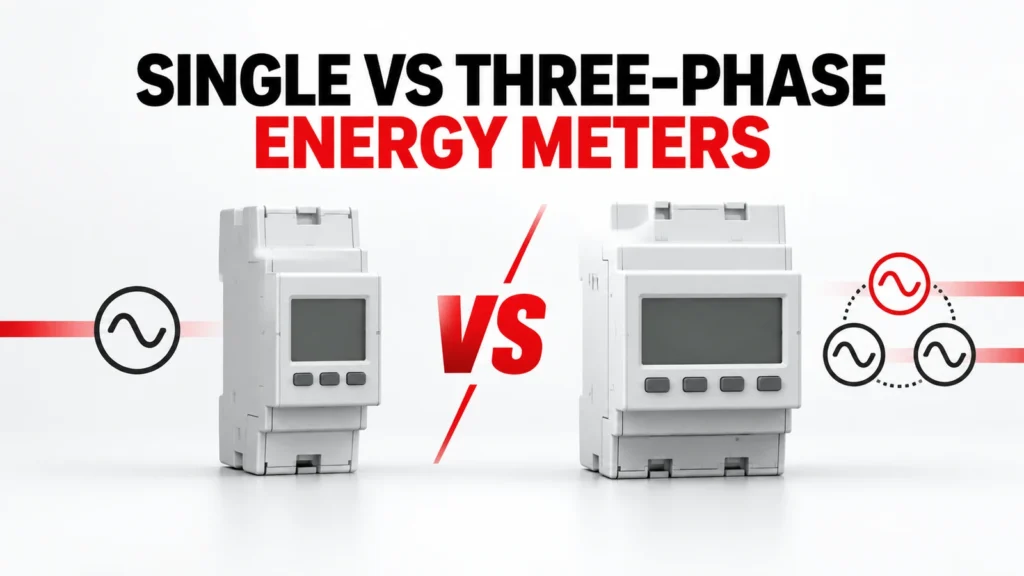
This guide compares the buying questions for single-phase and three-phase DIN rail energy meters. It keeps the meter type separate from direct versus transformer-connected measurement, communications and billing requirements. Each final choice must be supported by the exact meter diagram and order code.
Översikt över underlag för beslut
| Granskningsområde | Vad köparen dokumenterar | Bevis som ska begäras |
|---|---|---|
| System at measurement point | Document actual phase and neutral arrangement | Approved single-line diagram |
| Current input | Identify direct connection or transformer interface | Exact-meter input and wiring documentation |
| Utdata | Define displayed and exported data | Register map and interface document |
| Installation | Allow space, access and test points | Dimensioned drawing and commissioning plan |
Start at the measurement point
A site can contain both single-phase loads and a three-phase distribution system. The meter belongs to a specific measurement point, so describe the conductors and the circuit boundary there rather than naming only the upstream supply. A single-phase feeder serving one machine is a different metering problem from a three-phase feeder supplying a panel of mixed loads.
Provide a current single-line diagram, location of the meter, feeder identity, available conductors and the operational question the meter must answer. If one meter is expected to represent a group of circuits, show how those circuits enter the metering boundary.
What single-phase metering must establish
For a single-phase application, confirm the supply arrangement and the exact terminal path through or into the meter. A product described as single-phase does not establish whether it is direct connected, transformer connected, two-wire in the expected sense or suitable for every local circuit. The terminals, input limits and installation instructions govern.
A compact meter may be convenient for branch-circuit visibility, but the panel design still needs a suitable protective and isolation arrangement, conductor space and an accessible reading or communications method. Check those items in the assembly plan.
What three-phase metering adds
Three-phase energy measurement involves multiple voltage and current relationships. The wiring scheme must match the actual system arrangement, including whether a neutral is present and how the current inputs are obtained. A label such as three-phase is only the start of the specification.
Compare the exact meter wiring diagram with the panel single-line drawing. Mark each phase, current path and reference connection, and have the design team confirm that the selected scheme measures the intended feeder rather than a convenient subset of conductors.
Separate phase count from current interface
Phase count and current input method are separate decisions. A meter can have a direct-connected path or use external current transformers, depending on its design. The presence of a CT elsewhere in the panel does not prove the proposed meter accepts its secondary output or ratio setting.
If transformers are required, record their ratio, output, accuracy and burden evidence with the meter input specification. For a direct-connected option, review conductor routing, terminals and the specific permitted connection. Do not infer one interface from a neighboring model.
Define the data the project actually needs
Some projects need only a local energy reading. Others need interval data, alarms, pulse outputs or a network connection to a building or industrial system. These are independent requirements that may change the order code or wiring.
State the required measurements, update expectations, communication medium, register documentation and integration owner. A meter with a port is not automatically a working monitoring system: the receiving software must interpret the correct data and the commissioning team must verify the mapping.
Compare offers using one measurement brief
Ask each supplier to respond to the same measurement point, wiring architecture and data requirement. An offer for a single-phase branch meter is not equivalent to a three-phase feeder meter, even when both quote energy measurement. Likewise, a meter that needs external CTs is not a direct substitute for one designed for direct connection.
Record the complete meter code, accessories, transformer requirements, communications option and documents supplied. Keep differences visible instead of normalizing every quotation to a generic energy-meter line item.
Commission the actual installation
At commissioning, verify the connection against the approved diagram and check the sign and plausibility of measured values under known operating states. Compare the meter reading with the intended circuit boundary, not just with a powered display.
Where data is exported, confirm addressing, register interpretation, scaling and the destination system. Capture the configured parameters and as-built wiring so a replacement can be reviewed against the same evidence later.
Skapa en bevisfil med en exakt modell
A category or product-family page helps locate relevant options; it does not by itself approve one variant. For DIN rail energy meters, keep the full proposed order code, current datasheet, terminal or mounting drawing, operating instructions and any project calculation together. Read the conditions attached to each rating or function. If the evidence belongs to a neighboring model, request the correct document instead of carrying the claim across.
Projektgruppen ansvarar för systemets ingångsvärden och godkännandekriterier. Leverantören ansvarar för underlaget för den erbjudna produkten. Vid den tekniska granskningen ska varje obligatoriskt krav kopplas till just det dokument och den version som uppfyller det. Markera ett saknat fält som ”öppet”, ”villkorat” eller ”ej stödd”. Detta skapar ett spårbart beslut och förhindrar att ett fördelaktigt nominellt värde döljer en inkompatibel anslutning eller installationsförutsättning.
Jämför alla erbjudanden
| Artikel | Resultat i jämförelsen | Motivering |
|---|---|---|
| Produkt som kan beställas | Fullständig kod, variant och medföljande tillbehör | Förhindrar antaganden på familjenivå |
| Matchning av ansökningar | Skriftligt svar på varje synpunkt i projektet | Håller undantagen synliga |
| Dokumentation | Datablad, ritningar, anvisningar och revideringar | Länkar till uppgifter om den erbjudna varan |
| Öppna frågor | Ägare och förfallodatum för förtydligande | Undviker tyst samtycke |
Använd samma projektbeskrivning för varje offert. Kommersiella villkor som pris och leveranstid kan jämföras när det tekniska omfattningen har standardiserats. Betrakta inte utelämnade tillbehör, icke-stödda prestandavärden eller oklara antaganden om kabeldragning som likvärdiga med en dokumenterad offert. Om ett alternativ föreslås, fråga vilka parametrar som ändras och upprepa granskningen av de berörda delarna.
Granskning av installation och godkännande
Kontrollera före installationen att den medföljande etiketten, den fullständiga koden och tillbehören stämmer överens med den godkända dokumentationen. Jämför anslutningar, montering, ledningsanslutningar och eventuell angiven inriktning med de exakta anvisningarna. En produkt som till utseendet liknar den godkända versionen kan ändå ha en annan elektrisk konfiguration, styrningsalternativ eller testgrund.
Planera en slutbesiktning som tar hänsyn till projektets faktiska risker. Detta kan innefatta kontroll av kabeldragningen mot det godkända schemat, funktionskontroll, mätningar under representativa driftsförhållanden samt verifiering av eventuella kommunikations- eller larmfunktioner. Dokumentera förhållandena och resultaten. Godkännandeplanen bör utgå från applikationen och leverantörens dokumentation, inte från en allmän checklista för artiklar.
Checklista för offertförfrågan
- Identify the circuit, equipment and location that DIN rail energy meters must serve.
- Bifoga systemritningen och driftslägena som definierar tillämpningen.
- Record supply architecture and its source document.
- Registrera ledare och deras källdokument.
- Record measurement point and its source document.
- Record meter input and its source document.
- Confirm the exact-model evidence for wiring diagram.
- Confirm the exact-model evidence for ct requirement.
- Confirm the exact-model evidence for data output.
- Confirm the exact-model evidence for commissioning.
- Begär den fullständiga orderkoden, tillbehör, ritningar och den senaste versionen av databladet.
- Fråga om undantag, antaganden, ersättningslösningar och olösta tekniska frågor.
Anbudsförfrågan bör vara tillräckligt konkret för att en leverantör ska kunna besvara den utan att behöva uppfinna saknade projektvärden. Om en väsentlig uppgift ännu inte är känd ska den markeras som en fråga och det ska anges vem som ska fastställa den. Ett antagande får inte användas som underlag för en bedömning, ett påstående om överensstämmelse eller en godkänd installationsmetod.
Vad som påverkar beslutet
A decision can change when the source arrangement, load behavior, environment, installation geometry or required function changes. Revisit the selected DIN rail energy meters whenever one of those inputs moves outside the approved brief. Recheck the order code and the exact evidence affected by the change; do not rely on a previous approval for a circuit that now asks the component to do different work.
För en kort revisionshistorik över projektbeskrivningen, leverantörens svar och listan över godkända undantag. Denna dokumentation underlättar för teknik-, inköps- och driftsättningsavdelningarna att utgå från samma version. Den är särskilt användbar när en offert revideras, ett alternativ erbjuds eller panelkonstruktionen ändras efter den första jämförelsen.
Vanliga frågor
Can a three-phase meter replace a single-phase meter?
Only if the exact model documentation permits the intended single-phase wiring and the project accepts that configuration. Do not infer compatibility from the broader family name.
Does a meter with RS485 always support the required platform?
No. Obtain the exact protocol and register documentation, then test the intended points in the receiving system.
Are direct-connected and CT-operated meters interchangeable?
No. Their input arrangements and installation evidence differ. Match the meter and any CTs as one measured system.
Relevanta sidor på RITOKS
För information om produktfamiljen, se Elektrisk mätning och övervakning. De relaterade publicerade produktsidorna omfattar Dds1108 Single Phase Din Rail Energy Meter, Dts5158b Three Phase Four Wire Din Rail Energy Meter, 2p Single Phase Rs485 Modbus Din Rail Energy Meter. Använd deras aktuella dokument för den exakta modellen när du jämför en föreslagen artikel.
För en applikationsspecifik offert, skicka projektbeskrivningen till RITOKS med hjälp av diagrammen och de öppna frågorna ovan.