
Køleventilatorer til skabe · Teknisk vejledning
Cabinet Airflow Calculation Inputs: Heat Load, Temperature Rise and Restrictions
Cabinet airflow calculation inputs are often reduced to one fan capacity number. That misses the first engineering task: establish how much heat is produced, which ambient air is available and where that air can travel. A fan moves air through a real enclosure with filters, grilles and obstructions, so the useful result differs from an open-bench rating.
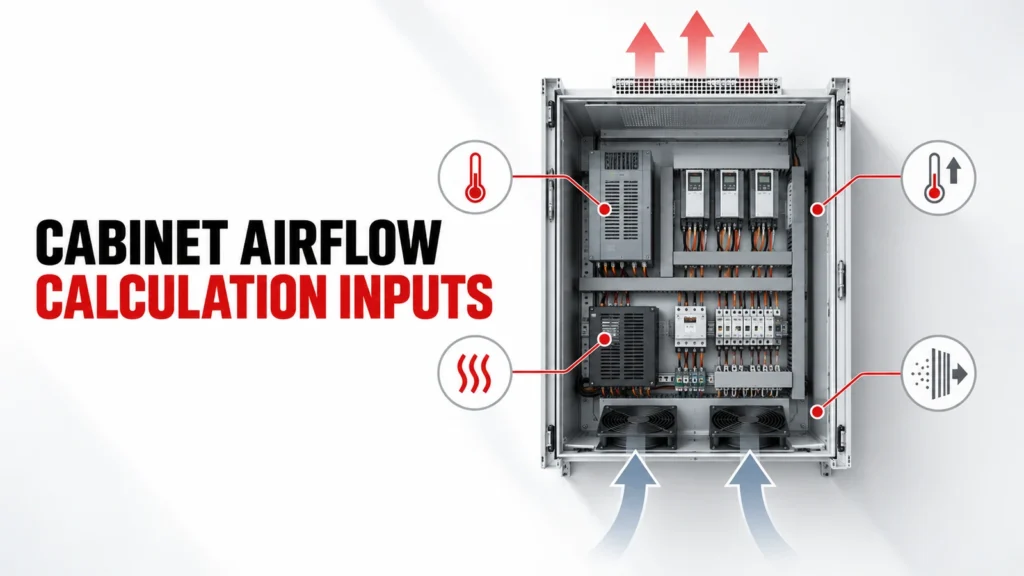
This guide identifies the evidence needed before estimating airflow and comparing fan candidates. It also shows when ventilation is the wrong cooling architecture, such as when ambient air or contamination conditions prevent the intended heat removal.
Oversigt over beslutningsgrundlag
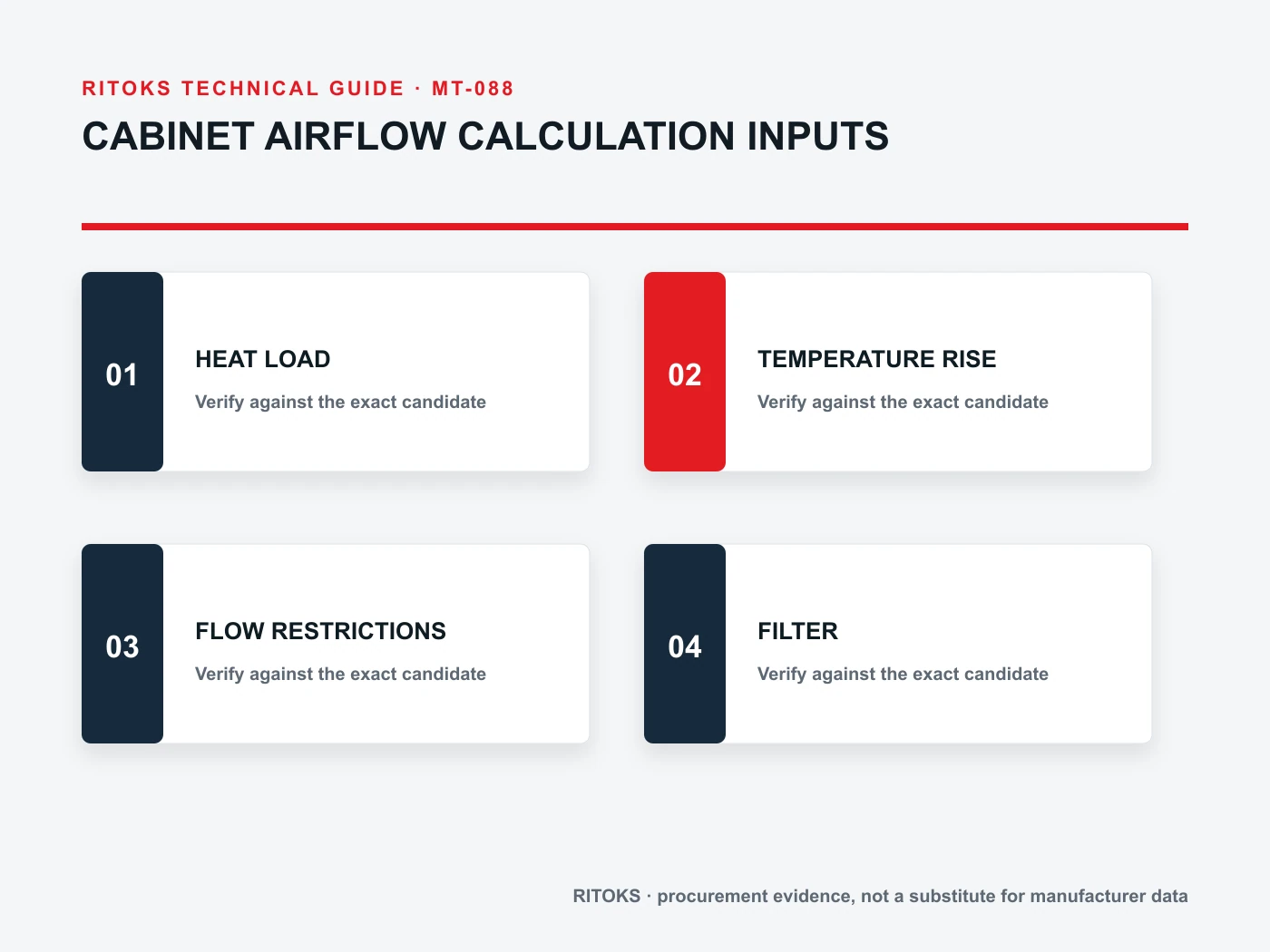
| Gennemgangsområde | Hvad køberen registrerer | Bevismateriale, der skal anmodes om |
|---|---|---|
| Varmebelastning | Losses by component and operating state | Equipment loss data and duty record |
| Miljø | Ambient range and contamination | Site conditions and enclosure objective |
| Luftvej | Inlet, outlet, filters, obstructions | Layout and cutout drawings |
| Fan operating point | Flow at actual pressure resistance | Exact-model fan curve and system estimate |
Inventory real heat sources
List the components that dissipate heat inside the enclosure: power devices, supplies, drives, transformers, control electronics and wiring where relevant. Use credible operating states, not only installed nameplate capacity. Some sources do not peak together, while others have short but significant duty periods.
Record the basis for every loss estimate and the load combinations the cabinet will actually see. Unknown heat inputs should remain open assumptions rather than disappearing into an arbitrary fan margin.
Define ambient and internal limits
Ventilation exchanges cabinet air with surrounding air. Document the ambient range at the actual installation, including solar exposure or nearby hot equipment where relevant, and define the acceptable internal condition for the most sensitive installed component.
The air entering the enclosure cannot be cooler than the surrounding source without an active cooling method. If ambient approaches or exceeds the required internal limit, adding fan capacity alone may not solve the problem.
Draw the path from inlet to outlet
Show where air enters, how it crosses the heat sources and where it leaves. Separate a clear path from a short circuit in which fresh air exits before reaching the critical equipment. Wiring ducts, shelves and component placement can redirect flow.
A useful drawing marks inlet and outlet height, guards, filters, internal barriers and service doors. It lets the design team discuss hot spots and maintenance access before choosing a frame size.
Account for restriction, not only free air
Filters, louvers, grilles and narrow passages impose pressure resistance. A fan curve describes how available flow changes with pressure. Therefore a free-air figure is not the delivered airflow through a finished cabinet.
Ask for an exact-model performance curve and estimate the resistance of the assembled path. Revisit the estimate when filter media, outlet geometry or cabinet layout changes; otherwise the selected operating point may shift.
Consider filter condition over time
A clean filter is not the only operating condition. Dust loading changes resistance and service needs. Define the contamination expected at the site, an inspection method and the replacement element.
Do not invent a fixed maintenance interval from a product category name. The first inspection schedule should reflect actual exposure and be refined from recorded condition and temperature behavior.
Choose fan direction and control deliberately
Whether the fan supplies or extracts air influences pressure direction and leakage paths. The choice also affects where filtered air enters and how it reaches heat sources. Specify any thermostat, alarm or speed control requirement as a separate feature to verify.
Review the supply voltage, wiring and control sequence with the electrical designer. Avoid assuming that a fan family includes monitoring outputs or variable-speed control unless the exact order code confirms them.
Validate the finished cabinet
The estimate narrows candidates; the built cabinet provides the final evidence. Check representative duty states, ambient conditions when possible, internal temperature locations, flow obstructions and alarm behavior.
Document the installed fan, filter, cutouts, control settings and test conditions. If a hot spot remains, trace the airflow path and heat input before simply increasing nominal fan size.
Opret en bevismappe med en præcis model
A category or product-family page helps locate relevant options; it does not by itself approve one variant. For cabinet ventilation, keep the full proposed order code, current datasheet, terminal or mounting drawing, operating instructions and any project calculation together. Read the conditions attached to each rating or function. If the evidence belongs to a neighboring model, request the correct document instead of carrying the claim across.
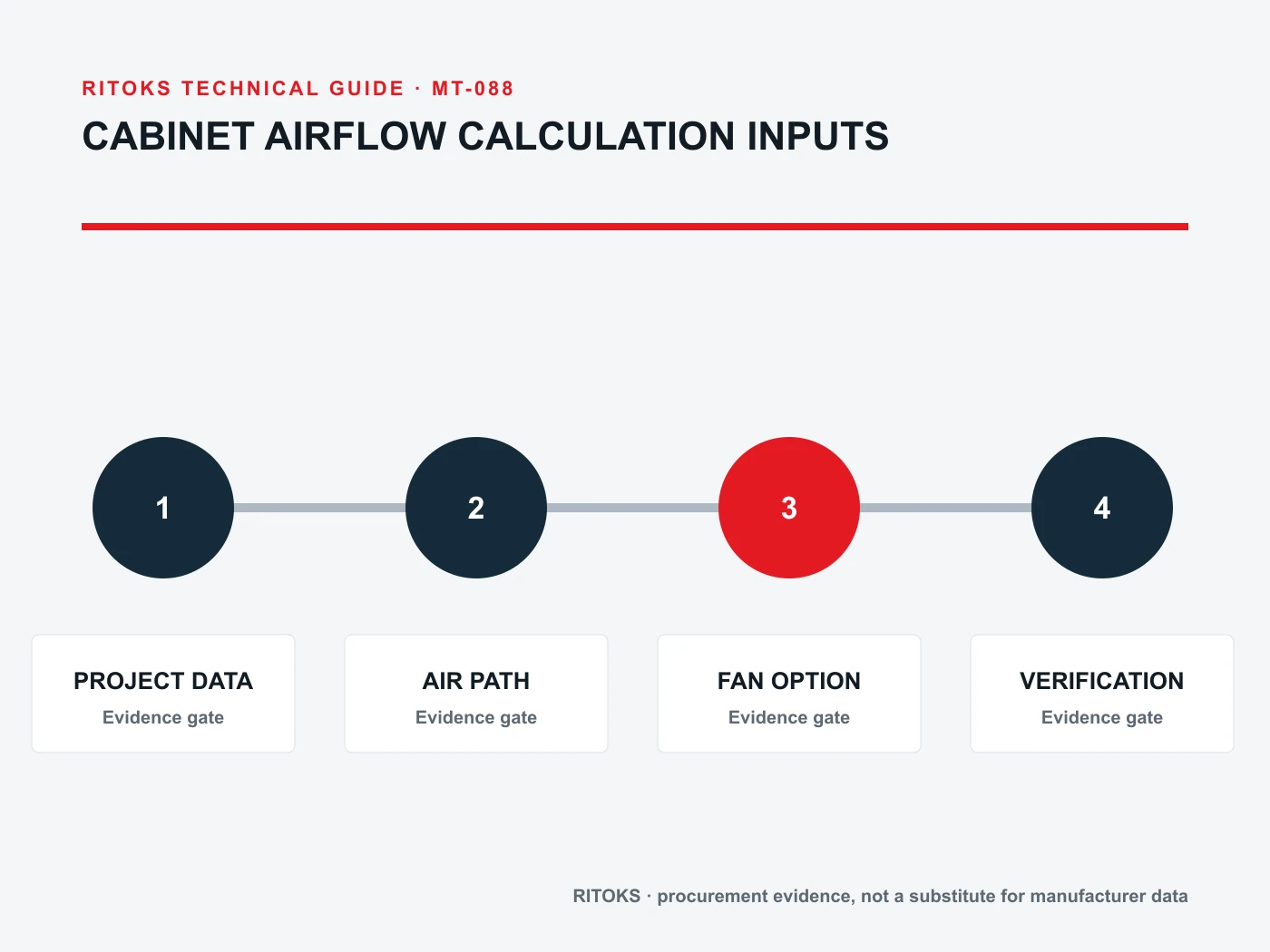
Projektteamet har ansvaret for systemindgangene og godkendelseskriterierne. Leverandøren har ansvaret for dokumentationen for den tilbudte vare. I den tekniske gennemgang skal hvert obligatorisk krav placeres ved siden af det nøjagtige dokument og den nøjagtige revision, der opfylder det. Marker et manglende felt som åbent, betinget eller ikke understøttet. Dette skaber en sporbar beslutning og forhindrer, at en gunstig samlet værdi skjuler en uforenelig tilslutnings- eller installationsbetingelse.
Sammenlign komplette tilbud
| Vare | Resultat i sammenligningen | Begrundelse |
|---|---|---|
| Vare, der kan bestilles | Fuldstændig modelbetegnelse, variant og medfølgende tilbehør | Undgår antagelser på familieniveau |
| Anvendelsesmatch | Skriftligt svar på hvert projektindlæg | Sørger for, at undtagelser forbliver synlige |
| Dokumentation | Datablad, tegning, vejledning og revisioner | Links til oplysninger om den udbudte vare |
| Uafklarede punkter | Ejeren og fristen for afklaring | Undgår tavs accept |
Brug den samme projektbeskrivelse til alle tilbud. Kommercielle vilkår såsom pris og leveringstid kan sammenlignes, når det tekniske omfang er standardiseret. Betragt ikke udeladt tilbehør, ikke-understøttede specifikationer eller en uafklaret antagelse om ledningsføring som svarende til et dokumenteret tilbud. Hvis der foreslås et alternativ, skal du spørge, hvilke parametre der ændres, og gentage den relevante gennemgang.
Gennemgang af installation og aflevering
Før installationen skal du kontrollere, at den medfølgende etiket, den komplette kode og tilbehøret stemmer overens med den godkendte dokumentation. Sammenlign terminaler, montering, adgang til ledere og eventuelle angivne retninger med de nøjagtige instruktioner. Et produkt, der fysisk ligner den godkendte version, kan stadig have en anden elektrisk konfiguration, styringsmulighed eller testgrundlag.
Planlæg en afleveringskontrol, der tager højde for projektets reelle risici. Dette kan omfatte kontrol af ledningsføringen i forhold til det godkendte skema, funktionstest, målinger under repræsentative driftsforhold samt bekræftelse af eventuelle kommunikations- eller alarmfunktioner. Registrer forholdene og resultaterne. Afleveringsplanen bør baseres på oplysninger fra anvendelsesområdet og leverandørens dokumentation, ikke på en generisk tjekliste.
Tjekliste til anmodning om tilbud
- Identify the circuit, equipment and location that cabinet ventilation must serve.
- Vedlæg systemtegningen og drifts tilstande, der definerer anvendelsen.
- Record heat sources and its source document.
- Record ambient range and its source document.
- Record target condition and its source document.
- Record duty cycle and its source document.
- Confirm the exact-model evidence for inlet filter.
- Confirm the exact-model evidence for flow path.
- Confirm the exact-model evidence for system resistance.
- Confirm the exact-model evidence for hot spots.
- Anmod om den fulde ordrekode, tilbehør, tegninger og revisionsnummeret for databladet.
- Spørg ind til undtagelser, forudsætninger, erstatningsløsninger og uafklarede tekniske spørgsmål.
Anmodningen om tilbud skal være så konkret, at en leverandør kan besvare den uden at skulle gætte sig til manglende projektoplysninger. Hvis en væsentlig oplysning endnu ikke er kendt, skal den markeres som et spørgsmål, og det skal angives, hvem der skal fastlægge den. En antagelse må ikke omdannes til en vurdering, en påstand om overensstemmelse eller en godkendt installationsmetode.
Hvad der påvirker beslutningen
A decision can change when the source arrangement, load behavior, environment, installation geometry or required function changes. Revisit the selected cabinet ventilation whenever one of those inputs moves outside the approved brief. Recheck the order code and the exact evidence affected by the change; do not rely on a previous approval for a circuit that now asks the component to do different work.
Før en kort revisionshistorik over projektbeskrivelsen, leverandørens svar og listen over godkendte undtagelser. Denne oversigt sikrer, at ingeniør-, indkøbs- og idriftsættelsesafdelingerne arbejder ud fra den samme version. Det er især nyttigt, når et tilbud revideres, der tilbydes en erstatningsløsning, eller panelkonstruktionen ændres efter den første sammenligning.
Spørgsmål, der skal afklares inden godkendelse
Ask who owns each remaining technical question for the proposed cabinet ventilation. The buyer should confirm the system inputs and installation constraints; the supplier should confirm the exact item, included options and applicable documentation. Put the answer and document revision beside the question. An unanswered point should remain visible in the comparison rather than being converted into an assumed feature.
Når et tilbud indeholder et alternativ, skal du bede om en skriftlig forklaring på ændringerne i kredsløbet, monteringen eller ydeevnen. Gennemgå eventuelle nye tegninger sammen med projektingeniøren, og noter, om den foreslåede ændring er acceptabel. En udskiftning udgør en ny teknisk beslutning, selvom den umiddelbart forekommer kommercielt ækvivalent. Dette er især vigtigt, når flere leverandører bruger lignende produktbetegnelser for forskellige konfigurationer.
Ofte stillede spørgsmål
Can a free-air rating be used as cabinet airflow?
No. The installed filter and cabinet path create resistance, so review the exact fan curve and system operating point.
Will a larger fan always lower cabinet temperature?
Not necessarily. Ambient conditions, heat load and whether air reaches hot components determine the result.
When should I consider closed-loop cooling?
Review another method when outdoor air cannot meet the target condition or must be kept out of the enclosure.
Relevante sider på RITOKS
For yderligere oplysninger om produktfamilien, se Kabinetter og varmestyring. De tilhørende offentliggjorte produktsider omfatter Fd Cabinet Filter Fan Electrical Enclosures, Industrial Ac Axial Cooling Fan 60 250mm, 12038 Ac Axial Cooling Fan 110v 220v 380v. Brug deres aktuelle dokumenter med de nøjagtige modeloplysninger, når du sammenligner en foreslået vare.
For at få et tilbud, der er skræddersyet til netop Deres behov, Send projektbeskrivelsen til RITOKS sammen med ovenstående diagrammer og åbne spørgsmål.