
Вентилятори для охолодження шаф · Технічний посібник
Cabinet Airflow Calculation Inputs: Heat Load, Temperature Rise and Restrictions
Cabinet airflow calculation inputs are often reduced to one fan capacity number. That misses the first engineering task: establish how much heat is produced, which ambient air is available and where that air can travel. A fan moves air through a real enclosure with filters, grilles and obstructions, so the useful result differs from an open-bench rating.
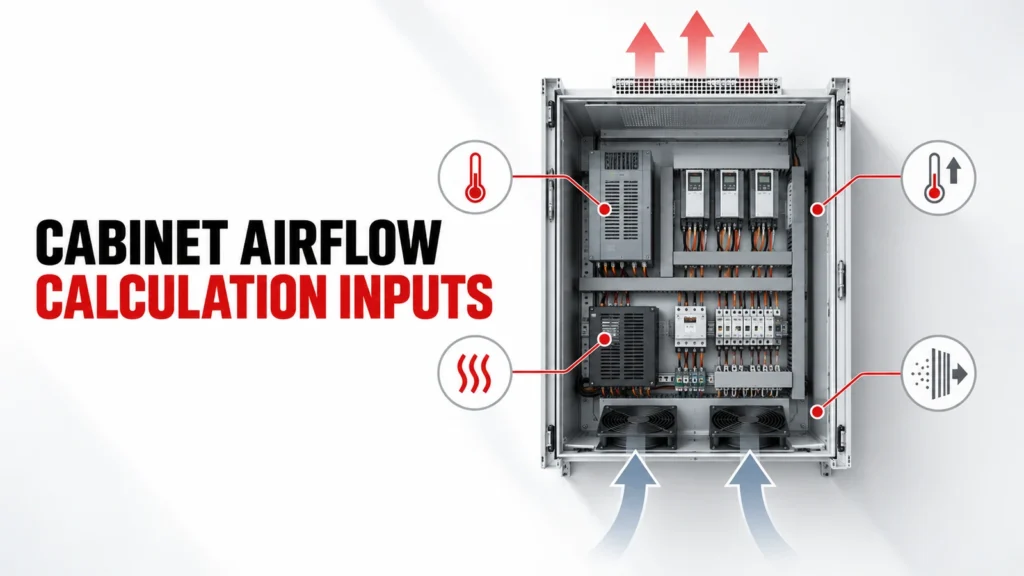
This guide identifies the evidence needed before estimating airflow and comparing fan candidates. It also shows when ventilation is the wrong cooling architecture, such as when ambient air or contamination conditions prevent the intended heat removal.
Короткий огляд даних, що враховуються при прийнятті рішень
| Область огляду | Що фіксує покупець | Докази, які слід вимагати |
|---|---|---|
| Теплова навантаження | Losses by component and operating state | Equipment loss data and duty record |
| Навколишнє середовище | Ambient range and contamination | Site conditions and enclosure objective |
| Повітряний канал | Inlet, outlet, filters, obstructions | Layout and cutout drawings |
| Fan operating point | Flow at actual pressure resistance | Exact-model fan curve and system estimate |
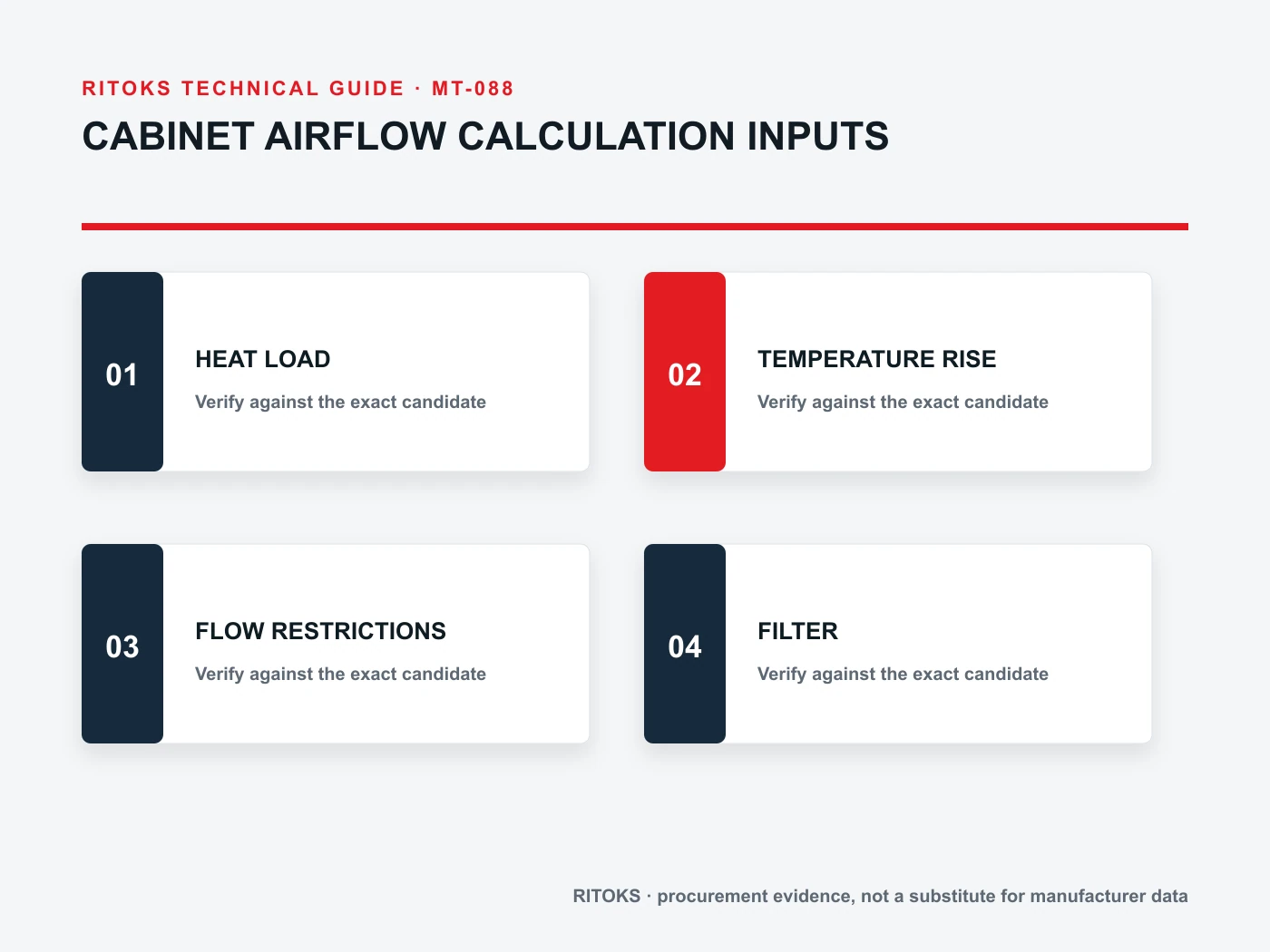
Inventory real heat sources
List the components that dissipate heat inside the enclosure: power devices, supplies, drives, transformers, control electronics and wiring where relevant. Use credible operating states, not only installed nameplate capacity. Some sources do not peak together, while others have short but significant duty periods.
Record the basis for every loss estimate and the load combinations the cabinet will actually see. Unknown heat inputs should remain open assumptions rather than disappearing into an arbitrary fan margin.
Define ambient and internal limits
Ventilation exchanges cabinet air with surrounding air. Document the ambient range at the actual installation, including solar exposure or nearby hot equipment where relevant, and define the acceptable internal condition for the most sensitive installed component.
The air entering the enclosure cannot be cooler than the surrounding source without an active cooling method. If ambient approaches or exceeds the required internal limit, adding fan capacity alone may not solve the problem.
Draw the path from inlet to outlet
Show where air enters, how it crosses the heat sources and where it leaves. Separate a clear path from a short circuit in which fresh air exits before reaching the critical equipment. Wiring ducts, shelves and component placement can redirect flow.
A useful drawing marks inlet and outlet height, guards, filters, internal barriers and service doors. It lets the design team discuss hot spots and maintenance access before choosing a frame size.
Account for restriction, not only free air
Filters, louvers, grilles and narrow passages impose pressure resistance. A fan curve describes how available flow changes with pressure. Therefore a free-air figure is not the delivered airflow through a finished cabinet.
Ask for an exact-model performance curve and estimate the resistance of the assembled path. Revisit the estimate when filter media, outlet geometry or cabinet layout changes; otherwise the selected operating point may shift.
Consider filter condition over time
A clean filter is not the only operating condition. Dust loading changes resistance and service needs. Define the contamination expected at the site, an inspection method and the replacement element.
Do not invent a fixed maintenance interval from a product category name. The first inspection schedule should reflect actual exposure and be refined from recorded condition and temperature behavior.
Choose fan direction and control deliberately
Whether the fan supplies or extracts air influences pressure direction and leakage paths. The choice also affects where filtered air enters and how it reaches heat sources. Specify any thermostat, alarm or speed control requirement as a separate feature to verify.
Review the supply voltage, wiring and control sequence with the electrical designer. Avoid assuming that a fan family includes monitoring outputs or variable-speed control unless the exact order code confirms them.
Validate the finished cabinet
The estimate narrows candidates; the built cabinet provides the final evidence. Check representative duty states, ambient conditions when possible, internal temperature locations, flow obstructions and alarm behavior.
Document the installed fan, filter, cutouts, control settings and test conditions. If a hot spot remains, trace the airflow path and heat input before simply increasing nominal fan size.
Створити файл доказів на основі точної моделі
A category or product-family page helps locate relevant options; it does not by itself approve one variant. For cabinet ventilation, keep the full proposed order code, current datasheet, terminal or mounting drawing, operating instructions and any project calculation together. Read the conditions attached to each rating or function. If the evidence belongs to a neighboring model, request the correct document instead of carrying the claim across.
Команда проекту несе відповідальність за вхідні дані системи та критерії приймання. Постачальник несе відповідальність за підтверджуючі документи щодо пропонованого товару. Під час технічного огляду поруч із кожною обов’язковою вимогою вкажіть точний документ та його редакцію, які її задовольняють. Позначте відсутнє поле як «відкрите», «умовне» або «непідтримуване». Це забезпечує простежуваність рішення та запобігає ситуації, коли сприятливий загальний показник приховує несумісність підключення чи умов монтажу.
Порівняйте повні пропозиції
| Позиція | Запис у порівнянні | Причина |
|---|---|---|
| Товар, який можна замовити | Повний код, варіант та комплект поставки | Запобігає припущенням на рівні сім’ї |
| Збіг заявки | Письмова відповідь на кожен внесок у проект | Забезпечує відображення винятків |
| Документація | Технічні характеристики, креслення, інструкції та редакції | Посилання на претензії щодо пропонованого товару |
| Невирішені питання | Власник та термін надання роз’яснень | Дозволяє уникнути мовчазної згоди |
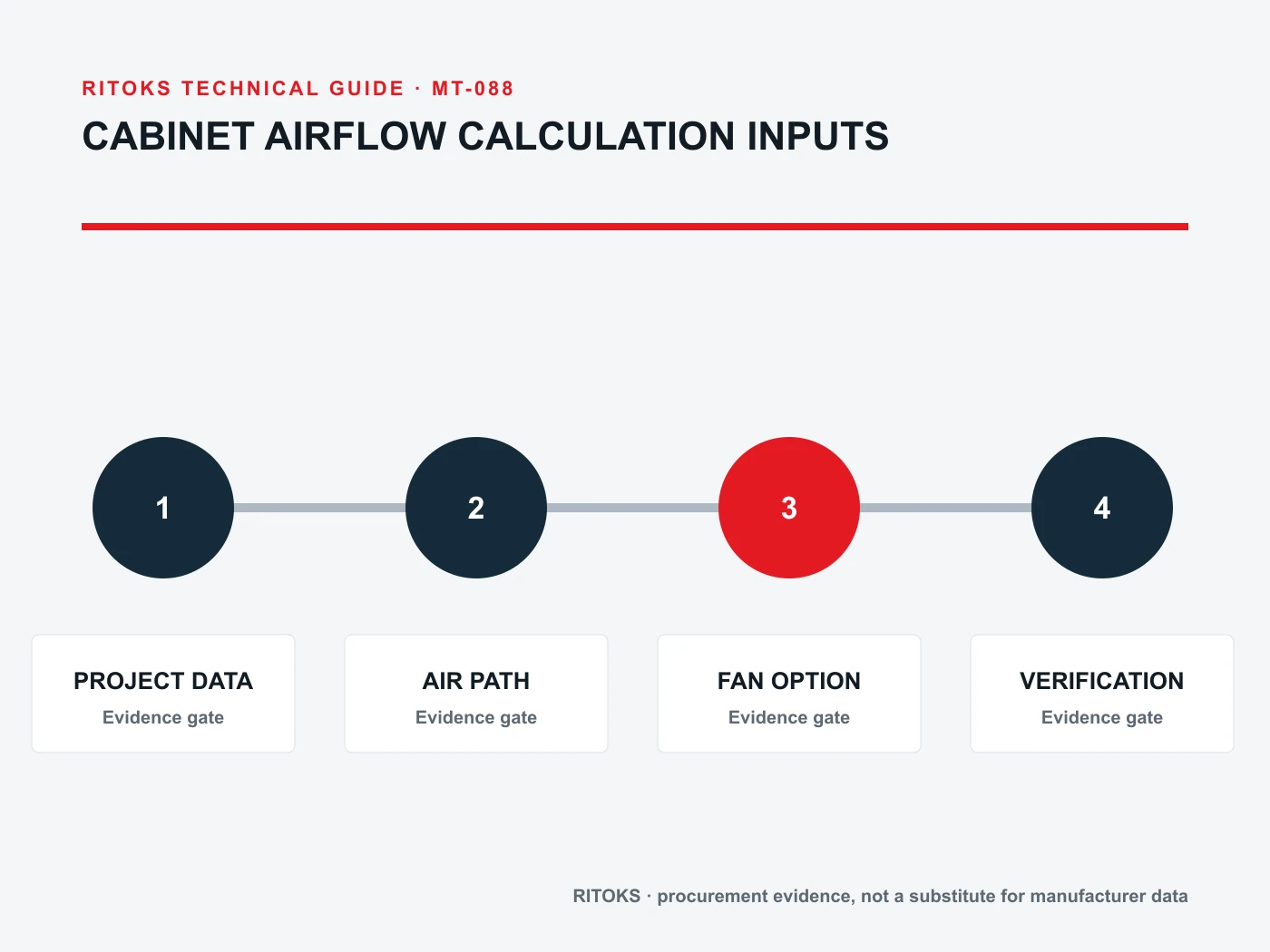
Використовуйте однаковий технічний завдання для кожного комерційного пропозиції. Комерційні умови, такі як ціна та терміни виконання, можна порівнювати лише після уніфікації технічних параметрів. Не слід вважати пропущені аксесуари, непідтверджені номінальні параметри або невизначені припущення щодо схеми підключення еквівалентом документально оформленої пропозиції. Якщо пропонується альтернативний варіант, запитайте, які параметри змінюються, і повторіть перевірку відповідних елементів.
Перевірка монтажу та приймання
Перед монтажем переконайтеся, що етикетка, повний код та комплектуючі, що входять до комплекту поставки, відповідають затвердженій документації. Звірте клеми, кріплення, доступ до провідників та будь-яку вказану орієнтацію з точними інструкціями. Виріб, який зовні схожий на затверджену версію, може мати іншу електричну конфігурацію, варіант управління або основу для випробувань.
Сплануйте перевірку фактичного стану, яка враховуватиме реальні ризики проекту. Це може включати перевірку відповідності електромонтажу затвердженій схемі, функціональну перевірку, вимірювання в типових режимах роботи та підтвердження працездатності будь-яких засобів зв’язку чи сигналізації. Зафіксуйте стан та результати. План приймання повинен ґрунтуватися на технічних вимогах та документації постачальника, а не на загальному контрольному списку.
Перелік питань для запиту на надання цінової пропозиції
- Identify the circuit, equipment and location that cabinet ventilation must serve.
- Додайте схему системи та опис робочих станів, що визначають сферу застосування.
- Record heat sources and its source document.
- Record ambient range and its source document.
- Record target condition and its source document.
- Record duty cycle and its source document.
- Confirm the exact-model evidence for inlet filter.
- Confirm the exact-model evidence for flow path.
- Confirm the exact-model evidence for system resistance.
- Confirm the exact-model evidence for hot spots.
- Запитайте повний код замовлення, перелік аксесуарів, креслення та версію технічного паспорта.
- Поцікавтеся, які є винятки, припущення, замінники та невирішені технічні питання.
Запит на пропозицію повинен бути достатньо конкретним, щоб постачальник міг відповісти на нього, не вигадуючи відсутні значення проекту. Якщо якийсь важливий параметр ще невідомий, позначте його як питання та вкажіть, хто його визначить. Не перетворюйте припущення на оцінку, заяву про відповідність вимогам або затверджений метод монтажу.
Що впливає на прийняття рішення
A decision can change when the source arrangement, load behavior, environment, installation geometry or required function changes. Revisit the selected cabinet ventilation whenever one of those inputs moves outside the approved brief. Recheck the order code and the exact evidence affected by the change; do not rely on a previous approval for a circuit that now asks the component to do different work.
Ведіть короткий журнал змін до технічного завдання, відповідей постачальників та переліку затверджених винятків. Цей журнал допомагає інженерному, закупівельному та вводно-пускому підрозділам працювати з однією й тією ж версією. Це особливо корисно у випадках, коли вноситься зміна до комерційної пропозиції, пропонується замінник або змінюється конструкція щита після першого порівняння.
Питання, які необхідно вирішити перед затвердженням
Ask who owns each remaining technical question for the proposed cabinet ventilation. The buyer should confirm the system inputs and installation constraints; the supplier should confirm the exact item, included options and applicable documentation. Put the answer and document revision beside the question. An unanswered point should remain visible in the comparison rather than being converted into an assumed feature.
Якщо в комерційній пропозиції передбачено альтернативний варіант, попросіть надати письмове пояснення щодо змін у схемі, способі монтажу або технічних характеристиках. Ознайомтеся з новими кресленнями разом з інженером проекту та зафіксуйте, чи є запропонована зміна прийнятною. Заміна є новим технічним рішенням, навіть якщо вона здається еквівалентною з комерційної точки зору. Це особливо важливо, коли кілька постачальників використовують схожі назви серій для різних конфігурацій.
Поширені запитання
Can a free-air rating be used as cabinet airflow?
No. The installed filter and cabinet path create resistance, so review the exact fan curve and system operating point.
Will a larger fan always lower cabinet temperature?
Not necessarily. Ambient conditions, heat load and whether air reaches hot components determine the result.
When should I consider closed-loop cooling?
Review another method when outdoor air cannot meet the target condition or must be kept out of the enclosure.
Відповідні сторінки RITOKS
Щоб ознайомитися з інформацією про сімейство продуктів, див. Корпус та управління тепловим режимом. Серед опублікованих сторінок, присвячених цим товарам, є такі: Fd Cabinet Filter Fan Electrical Enclosures, Industrial Ac Axial Cooling Fan 60 250mm, 12038 Ac Axial Cooling Fan 110v 220v 380v. При порівнянні запропонованого товару використовуйте їхні актуальні документи, що містять точні характеристики моделі.
Щоб отримати цінову пропозицію з урахуванням конкретних вимог вашого застосування, надіслати технічне завдання до компанії RITOKS разом із наведеними вище схемами та відкритими питаннями.