
Ventiladores de resfriamento para gabinetes · Explicação técnica
Cabinet Airflow Calculation Inputs: Heat Load, Temperature Rise and Restrictions
Cabinet airflow calculation inputs are often reduced to one fan capacity number. That misses the first engineering task: establish how much heat is produced, which ambient air is available and where that air can travel. A fan moves air through a real enclosure with filters, grilles and obstructions, so the useful result differs from an open-bench rating.
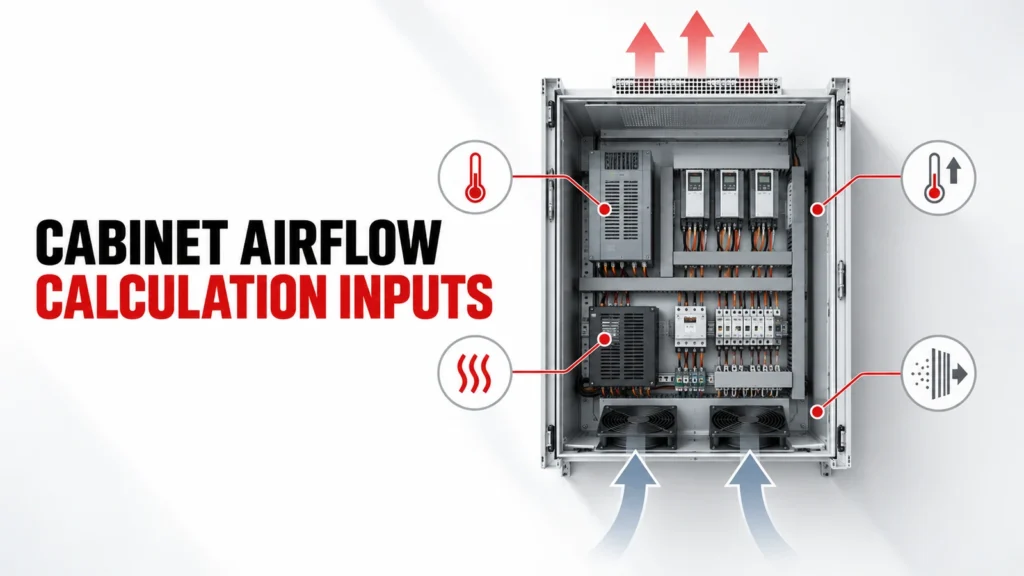
This guide identifies the evidence needed before estimating airflow and comparing fan candidates. It also shows when ventilation is the wrong cooling architecture, such as when ambient air or contamination conditions prevent the intended heat removal.
Visão geral dos dados de base para a tomada de decisão
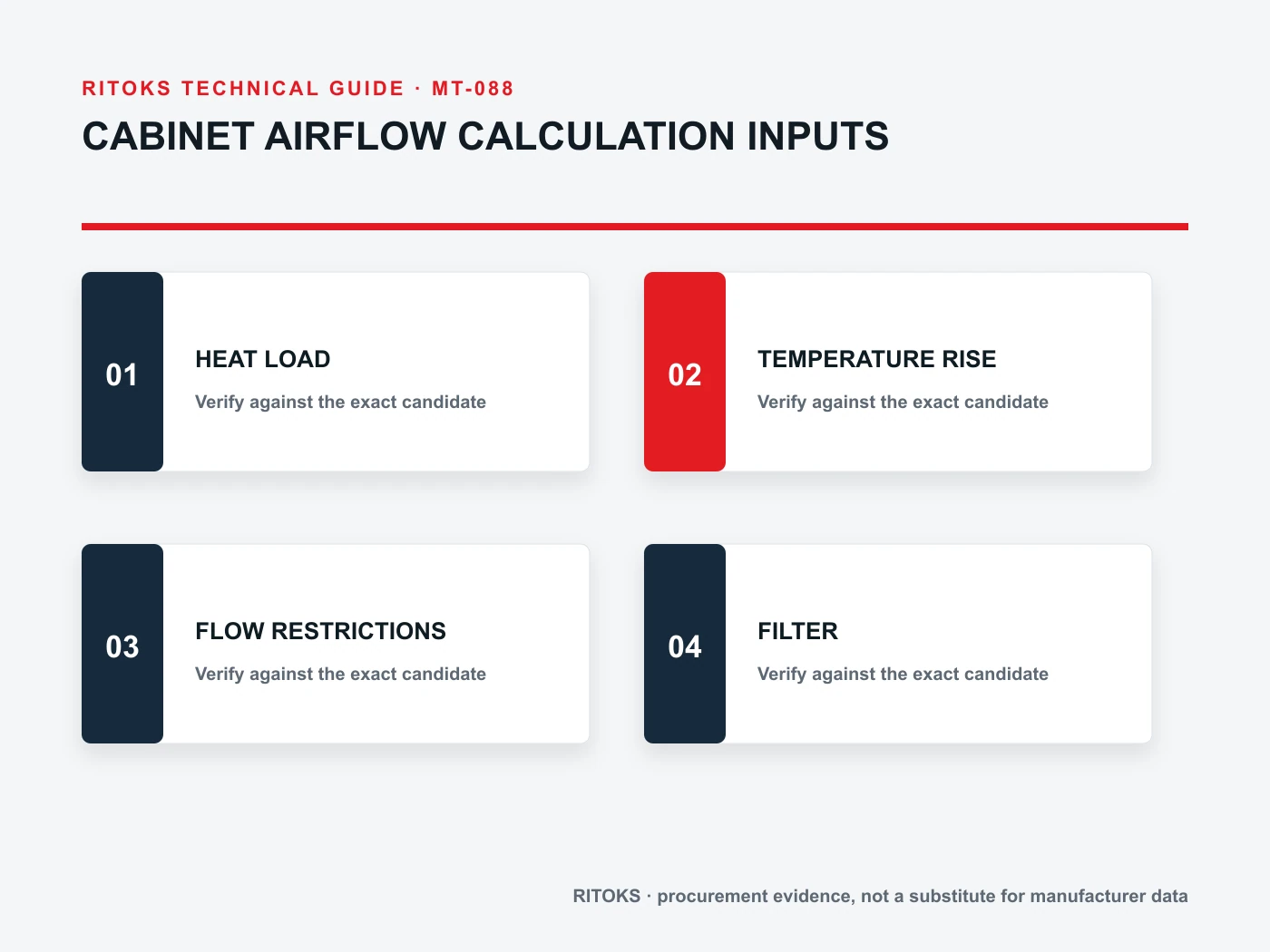
| Área de revisão | O que o comprador registra | Provas a serem solicitadas |
|---|---|---|
| Carga térmica | Losses by component and operating state | Equipment loss data and duty record |
| Meio ambiente | Ambient range and contamination | Site conditions and enclosure objective |
| Trajetória do ar | Inlet, outlet, filters, obstructions | Layout and cutout drawings |
| Fan operating point | Flow at actual pressure resistance | Exact-model fan curve and system estimate |
Inventory real heat sources
List the components that dissipate heat inside the enclosure: power devices, supplies, drives, transformers, control electronics and wiring where relevant. Use credible operating states, not only installed nameplate capacity. Some sources do not peak together, while others have short but significant duty periods.
Record the basis for every loss estimate and the load combinations the cabinet will actually see. Unknown heat inputs should remain open assumptions rather than disappearing into an arbitrary fan margin.
Define ambient and internal limits
Ventilation exchanges cabinet air with surrounding air. Document the ambient range at the actual installation, including solar exposure or nearby hot equipment where relevant, and define the acceptable internal condition for the most sensitive installed component.
The air entering the enclosure cannot be cooler than the surrounding source without an active cooling method. If ambient approaches or exceeds the required internal limit, adding fan capacity alone may not solve the problem.
Draw the path from inlet to outlet
Show where air enters, how it crosses the heat sources and where it leaves. Separate a clear path from a short circuit in which fresh air exits before reaching the critical equipment. Wiring ducts, shelves and component placement can redirect flow.
A useful drawing marks inlet and outlet height, guards, filters, internal barriers and service doors. It lets the design team discuss hot spots and maintenance access before choosing a frame size.
Account for restriction, not only free air
Filters, louvers, grilles and narrow passages impose pressure resistance. A fan curve describes how available flow changes with pressure. Therefore a free-air figure is not the delivered airflow through a finished cabinet.
Ask for an exact-model performance curve and estimate the resistance of the assembled path. Revisit the estimate when filter media, outlet geometry or cabinet layout changes; otherwise the selected operating point may shift.
Consider filter condition over time
A clean filter is not the only operating condition. Dust loading changes resistance and service needs. Define the contamination expected at the site, an inspection method and the replacement element.
Do not invent a fixed maintenance interval from a product category name. The first inspection schedule should reflect actual exposure and be refined from recorded condition and temperature behavior.
Choose fan direction and control deliberately
Whether the fan supplies or extracts air influences pressure direction and leakage paths. The choice also affects where filtered air enters and how it reaches heat sources. Specify any thermostat, alarm or speed control requirement as a separate feature to verify.
Review the supply voltage, wiring and control sequence with the electrical designer. Avoid assuming that a fan family includes monitoring outputs or variable-speed control unless the exact order code confirms them.
Validate the finished cabinet
The estimate narrows candidates; the built cabinet provides the final evidence. Check representative duty states, ambient conditions when possible, internal temperature locations, flow obstructions and alarm behavior.
Document the installed fan, filter, cutouts, control settings and test conditions. If a hot spot remains, trace the airflow path and heat input before simply increasing nominal fan size.
Criar um arquivo de evidências com modelo exato
A category or product-family page helps locate relevant options; it does not by itself approve one variant. For cabinet ventilation, keep the full proposed order code, current datasheet, terminal or mounting drawing, operating instructions and any project calculation together. Read the conditions attached to each rating or function. If the evidence belongs to a neighboring model, request the correct document instead of carrying the claim across.
A equipe do projeto é responsável pelos dados de entrada do sistema e pelos critérios de aceitação. O fornecedor é responsável pelas evidências relativas ao item oferecido. Na revisão técnica, associe cada requisito obrigatório ao documento e à revisão exatos que o atendem. Marque um campo ausente como “em aberto”, “condicional” ou “não suportado”. Isso gera uma decisão rastreável e evita que um valor nominal favorável oculte uma conexão ou condição de instalação incompatível.
Compare as ofertas completas
| Item | Registro na comparação | Motivo |
|---|---|---|
| Item disponível para encomenda | Código completo, variantes e acessórios incluídos | Evita suposições em nível familiar |
| Correspondência de aplicativos | Resposta por escrito a cada contribuição do projeto | Mantém as exceções visíveis |
| Documentação | Ficha técnica, desenho, instruções e revisões | Links relacionados ao item oferecido |
| Questões pendentes | Responsável e prazo para esclarecimento | Evita a aceitação passiva |
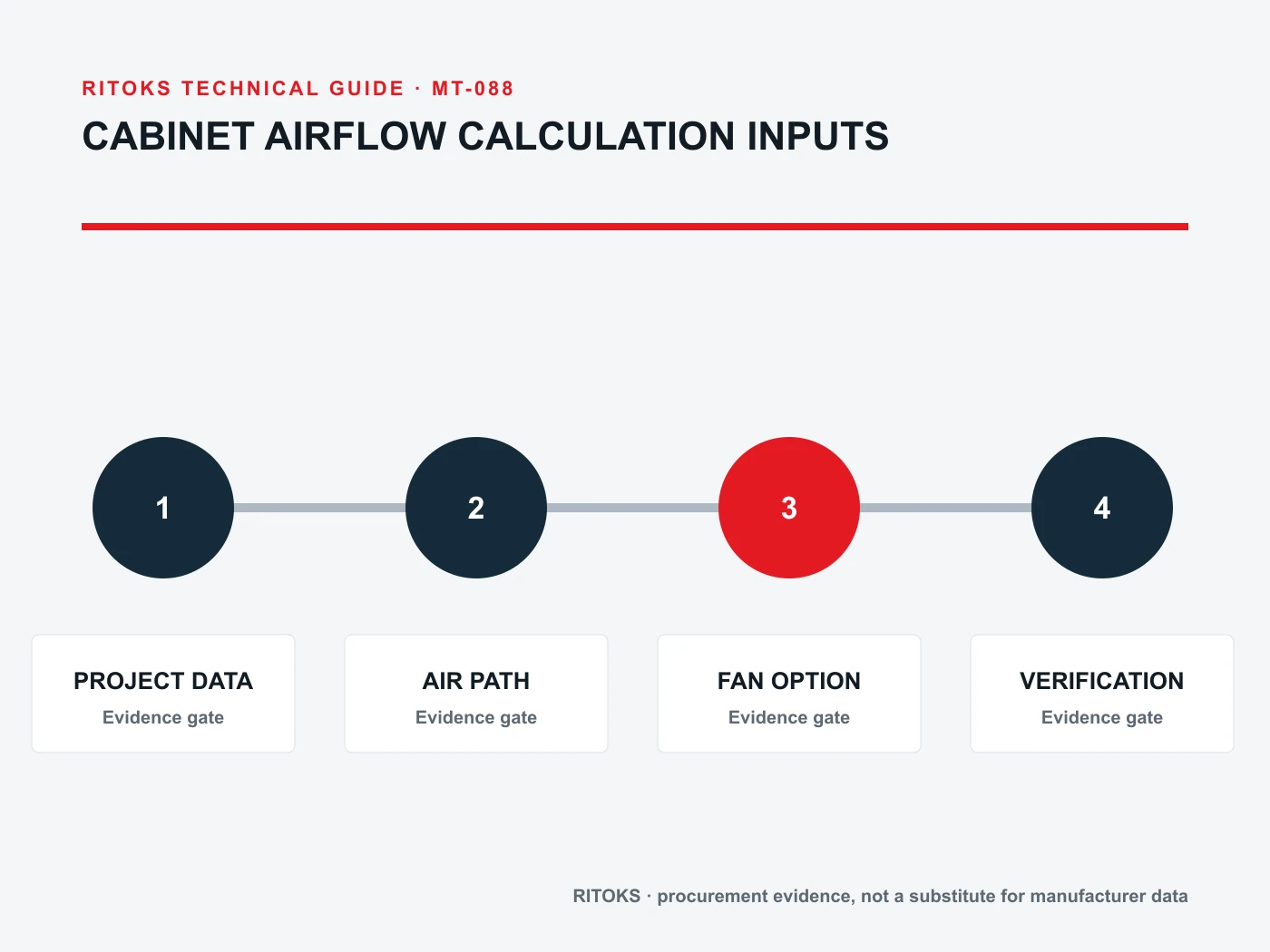
Utilize o mesmo briefing do projeto para todos os orçamentos. Condições comerciais, como preço e prazo de entrega, podem ser comparadas assim que o escopo técnico for padronizado. Não considere acessórios omitidos, classificações não comprovadas ou uma suposição de fiação não esclarecida como equivalentes a uma proposta documentada. Se for proposta uma alternativa, pergunte quais parâmetros se alteram e repita a análise dos itens afetados.
Revisão da instalação e aceitação
Antes da instalação, verifique se a etiqueta fornecida, o código completo e os acessórios correspondem ao registro aprovado. Compare os terminais, a montagem, o acesso aos condutores e qualquer orientação indicada com as instruções exatas. Um produto que pareça fisicamente semelhante à versão aprovada pode, ainda assim, apresentar uma configuração elétrica, opção de controle ou critérios de teste diferentes.
Planeje uma verificação de conformidade com o projeto que aborde os riscos reais do projeto. Isso pode envolver a verificação da instalação elétrica em relação ao esquema aprovado, a resposta funcional, medições em condições operacionais representativas e a confirmação de qualquer recurso de comunicação ou alarme. Registre as condições e os resultados. O plano de aceitação deve basear-se nas evidências da aplicação e do fornecedor, e não em uma lista de verificação genérica de itens.
Lista de verificação para solicitação de cotação
- Identify the circuit, equipment and location that cabinet ventilation must serve.
- Anexe o desenho do sistema e os estados operacionais que definem a aplicação.
- Record heat sources and its source document.
- Record ambient range and its source document.
- Record target condition and its source document.
- Record duty cycle and its source document.
- Confirm the exact-model evidence for inlet filter.
- Confirm the exact-model evidence for flow path.
- Confirm the exact-model evidence for system resistance.
- Confirm the exact-model evidence for hot spots.
- Solicite o código completo do pedido, os acessórios, os desenhos e a versão atualizada da ficha técnica.
- Pergunte sobre exclusões, premissas, substitutos e questões de engenharia ainda não resolvidas.
A solicitação de cotação deve ser suficientemente específica para que um fornecedor possa respondê-la sem precisar inventar valores ausentes do projeto. Se um dado essencial ainda não for conhecido, indique-o como uma pergunta e identifique quem irá determiná-lo. Não transforme uma suposição em uma classificação, uma declaração de conformidade ou um método de instalação aprovado.
O que influencia a decisão
A decision can change when the source arrangement, load behavior, environment, installation geometry or required function changes. Revisit the selected cabinet ventilation whenever one of those inputs moves outside the approved brief. Recheck the order code and the exact evidence affected by the change; do not rely on a previous approval for a circuit that now asks the component to do different work.
Mantenha um breve histórico de revisões do briefing do projeto, da resposta do fornecedor e da lista de exceções aceitas. Esse registro ajuda as equipes de engenharia, compras e comissionamento a trabalharem com a mesma versão. É especialmente útil quando uma cotação é revisada, é oferecido um substituto ou o projeto do painel sofre alterações após a primeira comparação.
Questões a serem resolvidas antes da aprovação
Ask who owns each remaining technical question for the proposed cabinet ventilation. The buyer should confirm the system inputs and installation constraints; the supplier should confirm the exact item, included options and applicable documentation. Put the answer and document revision beside the question. An unanswered point should remain visible in the comparison rather than being converted into an assumed feature.
Quando uma cotação oferecer uma alternativa, solicite uma explicação por escrito sobre as alterações no circuito, na montagem ou nos parâmetros de desempenho. Analise qualquer novo desenho com o engenheiro do projeto e registre se a alteração proposta é aceitável. Uma substituição constitui uma nova decisão técnica, mesmo que pareça comercialmente equivalente. Isso é especialmente importante quando vários fornecedores utilizam denominações de família semelhantes para configurações diferentes.
Perguntas frequentes
Can a free-air rating be used as cabinet airflow?
No. The installed filter and cabinet path create resistance, so review the exact fan curve and system operating point.
Will a larger fan always lower cabinet temperature?
Not necessarily. Ambient conditions, heat load and whether air reaches hot components determine the result.
When should I consider closed-loop cooling?
Review another method when outdoor air cannot meet the target condition or must be kept out of the enclosure.
Páginas relevantes do RITOKS
Para obter informações sobre a família de produtos, consulte Gabinete e gerenciamento térmico. As páginas de produtos publicadas relacionadas incluem Fd Cabinet Filter Fan Electrical Enclosures, Industrial Ac Axial Cooling Fan 60 250mm, 12038 Ac Axial Cooling Fan 110v 220v 380v. Utilize os documentos atuais referentes ao modelo exato ao comparar um item proposto.
Para obter um orçamento específico para sua aplicação, enviar o briefing do projeto para a RITOKS com os diagramas e as questões em aberto acima.