
Kylfläktar för skåp · Teknisk förklaring
Cabinet Airflow Calculation Inputs: Heat Load, Temperature Rise and Restrictions
Cabinet airflow calculation inputs are often reduced to one fan capacity number. That misses the first engineering task: establish how much heat is produced, which ambient air is available and where that air can travel. A fan moves air through a real enclosure with filters, grilles and obstructions, so the useful result differs from an open-bench rating.
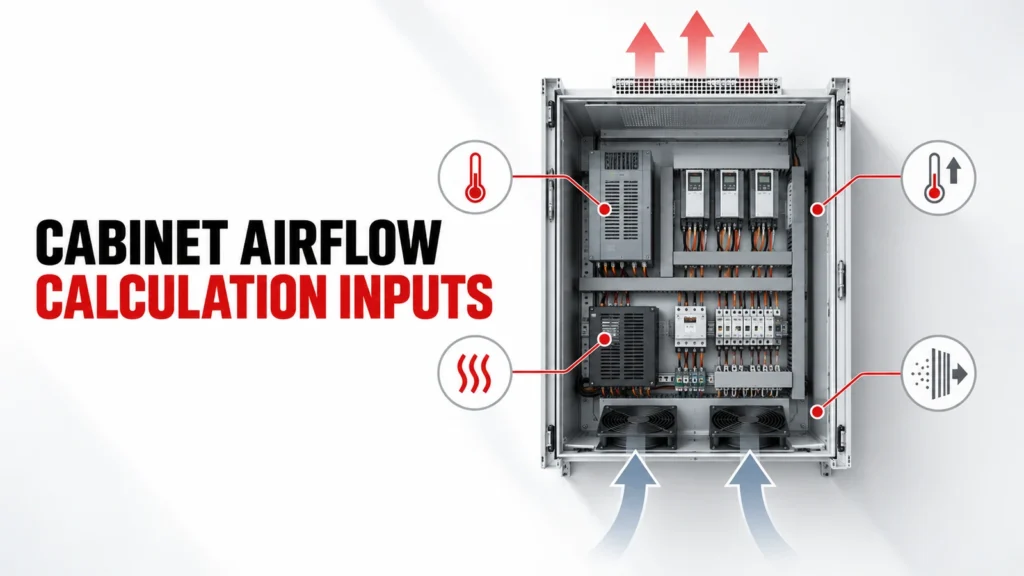
This guide identifies the evidence needed before estimating airflow and comparing fan candidates. It also shows when ventilation is the wrong cooling architecture, such as when ambient air or contamination conditions prevent the intended heat removal.
Översikt över underlag för beslut
| Granskningsområde | Vad köparen dokumenterar | Bevis som ska begäras |
|---|---|---|
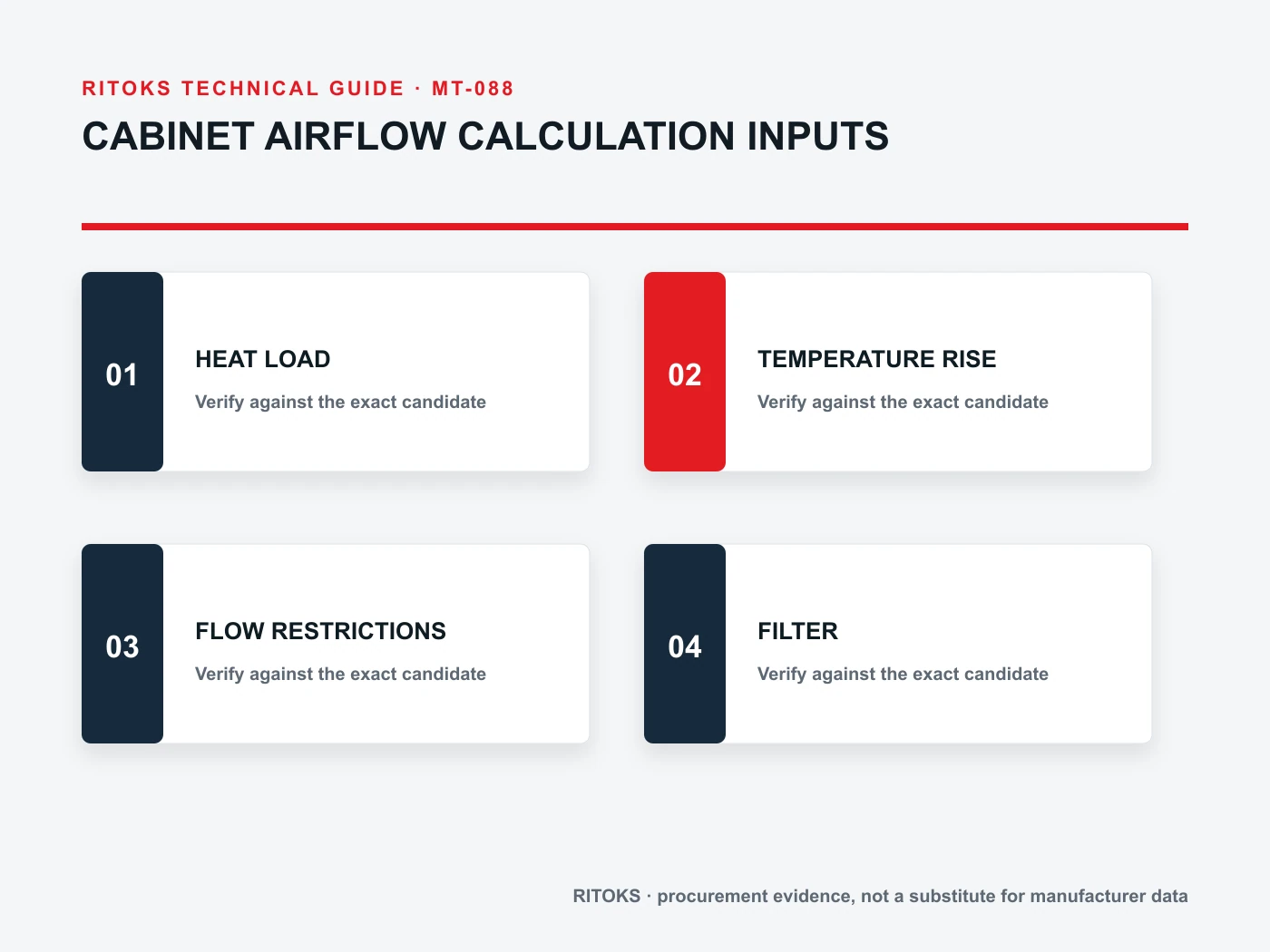
| Värmebelastning | Losses by component and operating state | Equipment loss data and duty record |
| Miljö | Ambient range and contamination | Site conditions and enclosure objective |
| Luftväg | Inlet, outlet, filters, obstructions | Layout and cutout drawings |
| Fan operating point | Flow at actual pressure resistance | Exact-model fan curve and system estimate |
Inventory real heat sources
List the components that dissipate heat inside the enclosure: power devices, supplies, drives, transformers, control electronics and wiring where relevant. Use credible operating states, not only installed nameplate capacity. Some sources do not peak together, while others have short but significant duty periods.
Record the basis for every loss estimate and the load combinations the cabinet will actually see. Unknown heat inputs should remain open assumptions rather than disappearing into an arbitrary fan margin.
Define ambient and internal limits
Ventilation exchanges cabinet air with surrounding air. Document the ambient range at the actual installation, including solar exposure or nearby hot equipment where relevant, and define the acceptable internal condition for the most sensitive installed component.
The air entering the enclosure cannot be cooler than the surrounding source without an active cooling method. If ambient approaches or exceeds the required internal limit, adding fan capacity alone may not solve the problem.
Draw the path from inlet to outlet
Show where air enters, how it crosses the heat sources and where it leaves. Separate a clear path from a short circuit in which fresh air exits before reaching the critical equipment. Wiring ducts, shelves and component placement can redirect flow.
A useful drawing marks inlet and outlet height, guards, filters, internal barriers and service doors. It lets the design team discuss hot spots and maintenance access before choosing a frame size.
Account for restriction, not only free air
Filters, louvers, grilles and narrow passages impose pressure resistance. A fan curve describes how available flow changes with pressure. Therefore a free-air figure is not the delivered airflow through a finished cabinet.
Ask for an exact-model performance curve and estimate the resistance of the assembled path. Revisit the estimate when filter media, outlet geometry or cabinet layout changes; otherwise the selected operating point may shift.
Consider filter condition over time
A clean filter is not the only operating condition. Dust loading changes resistance and service needs. Define the contamination expected at the site, an inspection method and the replacement element.
Do not invent a fixed maintenance interval from a product category name. The first inspection schedule should reflect actual exposure and be refined from recorded condition and temperature behavior.
Choose fan direction and control deliberately
Whether the fan supplies or extracts air influences pressure direction and leakage paths. The choice also affects where filtered air enters and how it reaches heat sources. Specify any thermostat, alarm or speed control requirement as a separate feature to verify.
Review the supply voltage, wiring and control sequence with the electrical designer. Avoid assuming that a fan family includes monitoring outputs or variable-speed control unless the exact order code confirms them.
Validate the finished cabinet
The estimate narrows candidates; the built cabinet provides the final evidence. Check representative duty states, ambient conditions when possible, internal temperature locations, flow obstructions and alarm behavior.
Document the installed fan, filter, cutouts, control settings and test conditions. If a hot spot remains, trace the airflow path and heat input before simply increasing nominal fan size.
Skapa en bevisfil med en exakt modell
A category or product-family page helps locate relevant options; it does not by itself approve one variant. For cabinet ventilation, keep the full proposed order code, current datasheet, terminal or mounting drawing, operating instructions and any project calculation together. Read the conditions attached to each rating or function. If the evidence belongs to a neighboring model, request the correct document instead of carrying the claim across.
Projektgruppen ansvarar för systemets ingångsvärden och godkännandekriterier. Leverantören ansvarar för underlaget för den erbjudna produkten. Vid den tekniska granskningen ska varje obligatoriskt krav kopplas till just det dokument och den version som uppfyller det. Markera ett saknat fält som ”öppet”, ”villkorat” eller ”ej stödd”. Detta skapar ett spårbart beslut och förhindrar att ett fördelaktigt nominellt värde döljer en inkompatibel anslutning eller installationsförutsättning.
Jämför alla erbjudanden
| Artikel | Resultat i jämförelsen | Motivering |
|---|---|---|
| Produkt som kan beställas | Fullständig kod, variant och medföljande tillbehör | Förhindrar antaganden på familjenivå |
| Matchning av ansökningar | Skriftligt svar på varje synpunkt i projektet | Håller undantagen synliga |
| Dokumentation | Datablad, ritningar, anvisningar och revideringar | Länkar till uppgifter om den erbjudna varan |
| Öppna frågor | Ägare och förfallodatum för förtydligande | Undviker tyst samtycke |
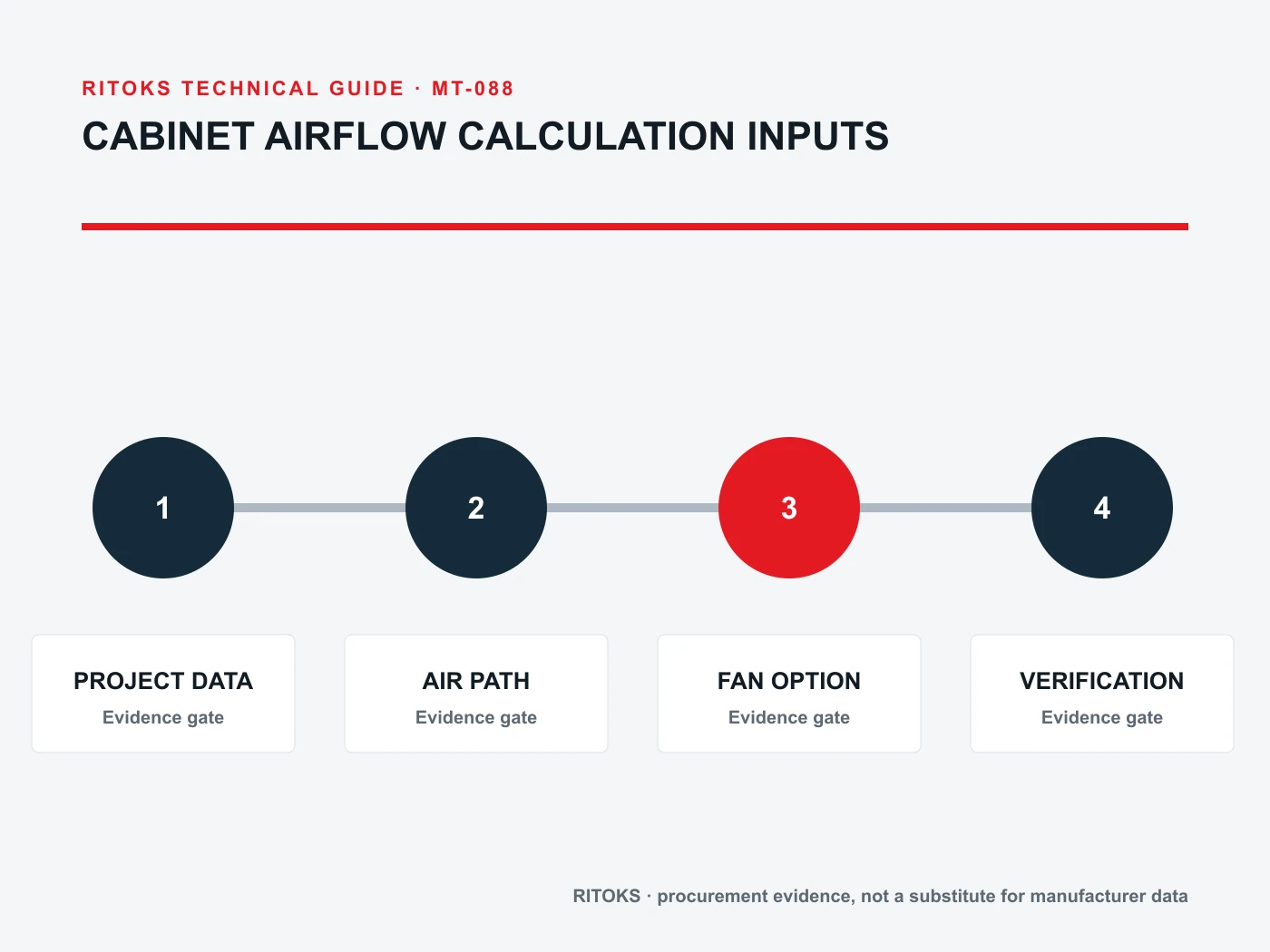
Använd samma projektbeskrivning för varje offert. Kommersiella villkor som pris och leveranstid kan jämföras när det tekniska omfattningen har standardiserats. Betrakta inte utelämnade tillbehör, icke-stödda prestandavärden eller oklara antaganden om kabeldragning som likvärdiga med en dokumenterad offert. Om ett alternativ föreslås, fråga vilka parametrar som ändras och upprepa granskningen av de berörda delarna.
Granskning av installation och godkännande
Kontrollera före installationen att den medföljande etiketten, den fullständiga koden och tillbehören stämmer överens med den godkända dokumentationen. Jämför anslutningar, montering, ledningsanslutningar och eventuell angiven inriktning med de exakta anvisningarna. En produkt som till utseendet liknar den godkända versionen kan ändå ha en annan elektrisk konfiguration, styrningsalternativ eller testgrund.
Planera en slutbesiktning som tar hänsyn till projektets faktiska risker. Detta kan innefatta kontroll av kabeldragningen mot det godkända schemat, funktionskontroll, mätningar under representativa driftsförhållanden samt verifiering av eventuella kommunikations- eller larmfunktioner. Dokumentera förhållandena och resultaten. Godkännandeplanen bör utgå från applikationen och leverantörens dokumentation, inte från en allmän checklista för artiklar.
Checklista för offertförfrågan
- Identify the circuit, equipment and location that cabinet ventilation must serve.
- Bifoga systemritningen och driftslägena som definierar tillämpningen.
- Record heat sources and its source document.
- Record ambient range and its source document.
- Record target condition and its source document.
- Record duty cycle and its source document.
- Confirm the exact-model evidence for inlet filter.
- Confirm the exact-model evidence for flow path.
- Confirm the exact-model evidence for system resistance.
- Confirm the exact-model evidence for hot spots.
- Begär den fullständiga orderkoden, tillbehör, ritningar och den senaste versionen av databladet.
- Fråga om undantag, antaganden, ersättningslösningar och olösta tekniska frågor.
Anbudsförfrågan bör vara tillräckligt konkret för att en leverantör ska kunna besvara den utan att behöva uppfinna saknade projektvärden. Om en väsentlig uppgift ännu inte är känd ska den markeras som en fråga och det ska anges vem som ska fastställa den. Ett antagande får inte användas som underlag för en bedömning, ett påstående om överensstämmelse eller en godkänd installationsmetod.
Vad som påverkar beslutet
A decision can change when the source arrangement, load behavior, environment, installation geometry or required function changes. Revisit the selected cabinet ventilation whenever one of those inputs moves outside the approved brief. Recheck the order code and the exact evidence affected by the change; do not rely on a previous approval for a circuit that now asks the component to do different work.
För en kort revisionshistorik över projektbeskrivningen, leverantörens svar och listan över godkända undantag. Denna dokumentation underlättar för teknik-, inköps- och driftsättningsavdelningarna att utgå från samma version. Den är särskilt användbar när en offert revideras, ett alternativ erbjuds eller panelkonstruktionen ändras efter den första jämförelsen.
Frågor som måste klargöras innan godkännande
Ask who owns each remaining technical question for the proposed cabinet ventilation. The buyer should confirm the system inputs and installation constraints; the supplier should confirm the exact item, included options and applicable documentation. Put the answer and document revision beside the question. An unanswered point should remain visible in the comparison rather than being converted into an assumed feature.
När en offert innehåller ett alternativ, be om en skriftlig förklaring av den ändrade kretsen, monteringen eller prestandagrunden. Gå igenom eventuella nya ritningar tillsammans med projektingenjören och notera om den föreslagna ändringen är godtagbar. En ersättning utgör ett nytt tekniskt beslut, även om den verkar vara kommersiellt likvärdig. Detta är särskilt viktigt när flera leverantörer använder liknande produktbeteckningar för olika konfigurationer.
Vanliga frågor
Can a free-air rating be used as cabinet airflow?
No. The installed filter and cabinet path create resistance, so review the exact fan curve and system operating point.
Will a larger fan always lower cabinet temperature?
Not necessarily. Ambient conditions, heat load and whether air reaches hot components determine the result.
When should I consider closed-loop cooling?
Review another method when outdoor air cannot meet the target condition or must be kept out of the enclosure.
Relevanta sidor på RITOKS
För information om produktfamiljen, se Kapsling och värmehantering. De relaterade publicerade produktsidorna omfattar Fd Cabinet Filter Fan Electrical Enclosures, Industrial Ac Axial Cooling Fan 60 250mm, 12038 Ac Axial Cooling Fan 110v 220v 380v. Använd deras aktuella dokument för den exakta modellen när du jämför en föreslagen artikel.
För en applikationsspecifik offert, skicka projektbeskrivningen till RITOKS med hjälp av diagrammen och de öppna frågorna ovan.