
DIN Rail Energy Meters · Comparison
Single-Phase vs Three-Phase DIN Rail Energy Meters
A single phase vs three phase energy meter comparison begins with the circuit being measured. The first question is whether the measurement point is single-phase or three-phase, and which conductors are actually available. That decision changes the input architecture, wiring evidence and commissioning plan. A meter selected from a headline label alone can create an avoidable mismatch even when its display and rail mounting look familiar.
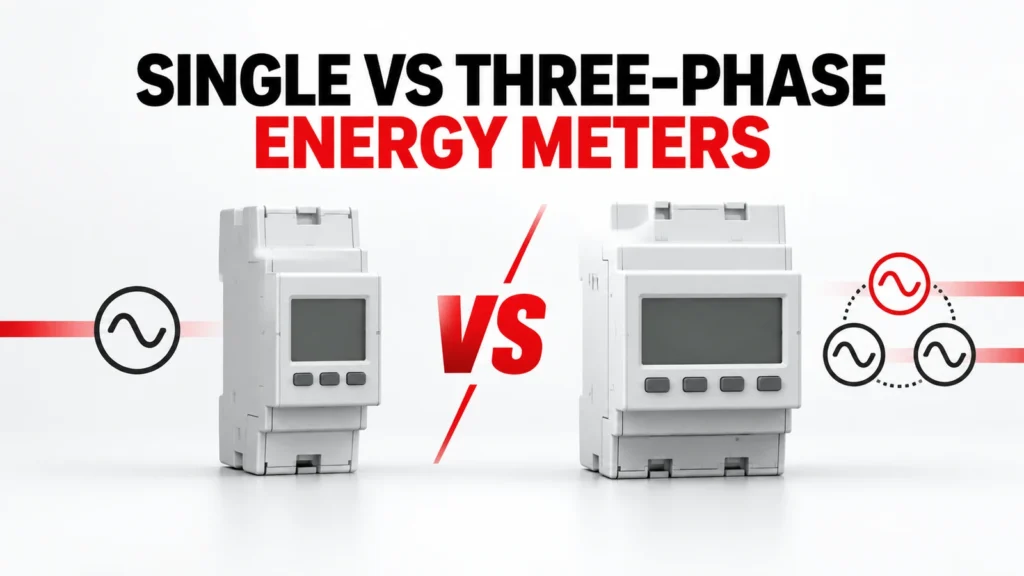
This guide compares the buying questions for single-phase and three-phase DIN rail energy meters. It keeps the meter type separate from direct versus transformer-connected measurement, communications and billing requirements. Each final choice must be supported by the exact meter diagram and order code.
Panoramica dei dati di input per la decisione
| Area recensioni | Cosa registra l'acquirente | Documenti da richiedere |
|---|---|---|
| System at measurement point | Document actual phase and neutral arrangement | Approved single-line diagram |
| Current input | Identify direct connection or transformer interface | Exact-meter input and wiring documentation |
| Risultato | Define displayed and exported data | Register map and interface document |
| Installazione | Allow space, access and test points | Dimensioned drawing and commissioning plan |
Start at the measurement point
A site can contain both single-phase loads and a three-phase distribution system. The meter belongs to a specific measurement point, so describe the conductors and the circuit boundary there rather than naming only the upstream supply. A single-phase feeder serving one machine is a different metering problem from a three-phase feeder supplying a panel of mixed loads.
Provide a current single-line diagram, location of the meter, feeder identity, available conductors and the operational question the meter must answer. If one meter is expected to represent a group of circuits, show how those circuits enter the metering boundary.
What single-phase metering must establish
For a single-phase application, confirm the supply arrangement and the exact terminal path through or into the meter. A product described as single-phase does not establish whether it is direct connected, transformer connected, two-wire in the expected sense or suitable for every local circuit. The terminals, input limits and installation instructions govern.
A compact meter may be convenient for branch-circuit visibility, but the panel design still needs a suitable protective and isolation arrangement, conductor space and an accessible reading or communications method. Check those items in the assembly plan.
What three-phase metering adds
Three-phase energy measurement involves multiple voltage and current relationships. The wiring scheme must match the actual system arrangement, including whether a neutral is present and how the current inputs are obtained. A label such as three-phase is only the start of the specification.
Compare the exact meter wiring diagram with the panel single-line drawing. Mark each phase, current path and reference connection, and have the design team confirm that the selected scheme measures the intended feeder rather than a convenient subset of conductors.
Separate phase count from current interface
Phase count and current input method are separate decisions. A meter can have a direct-connected path or use external current transformers, depending on its design. The presence of a CT elsewhere in the panel does not prove the proposed meter accepts its secondary output or ratio setting.
If transformers are required, record their ratio, output, accuracy and burden evidence with the meter input specification. For a direct-connected option, review conductor routing, terminals and the specific permitted connection. Do not infer one interface from a neighboring model.
Define the data the project actually needs
Some projects need only a local energy reading. Others need interval data, alarms, pulse outputs or a network connection to a building or industrial system. These are independent requirements that may change the order code or wiring.
State the required measurements, update expectations, communication medium, register documentation and integration owner. A meter with a port is not automatically a working monitoring system: the receiving software must interpret the correct data and the commissioning team must verify the mapping.
Compare offers using one measurement brief
Ask each supplier to respond to the same measurement point, wiring architecture and data requirement. An offer for a single-phase branch meter is not equivalent to a three-phase feeder meter, even when both quote energy measurement. Likewise, a meter that needs external CTs is not a direct substitute for one designed for direct connection.
Record the complete meter code, accessories, transformer requirements, communications option and documents supplied. Keep differences visible instead of normalizing every quotation to a generic energy-meter line item.
Commission the actual installation
At commissioning, verify the connection against the approved diagram and check the sign and plausibility of measured values under known operating states. Compare the meter reading with the intended circuit boundary, not just with a powered display.
Where data is exported, confirm addressing, register interpretation, scaling and the destination system. Capture the configured parameters and as-built wiring so a replacement can be reviewed against the same evidence later.
Creare un file di prove basato su un modello esatto
A category or product-family page helps locate relevant options; it does not by itself approve one variant. For DIN rail energy meters, keep the full proposed order code, current datasheet, terminal or mounting drawing, operating instructions and any project calculation together. Read the conditions attached to each rating or function. If the evidence belongs to a neighboring model, request the correct document instead of carrying the claim across.
Il team di progetto è responsabile degli input di sistema e dei criteri di accettazione. Il fornitore è responsabile della documentazione a supporto dell’articolo offerto. Durante la revisione tecnica, abbinare ogni requisito obbligatorio al documento e alla revisione esatti che lo soddisfano. Contrassegnare un campo mancante come “aperto”, “condizionato” o “non supportato”. Ciò garantisce la tracciabilità delle decisioni ed evita che un valore nominale favorevole nasconda una connessione o una condizione di installazione incompatibile.
Confronta le offerte complete
| Articolo | Dato nel confronto | Motivo |
|---|---|---|
| Articolo disponibile | Codice completo, varianti e accessori inclusi | Evita supposizioni a livello familiare |
| Corrispondenza dell'applicazione | Risposta scritta a ciascun contributo al progetto | Mantiene visibili le eccezioni |
| Documentazione | Scheda tecnica, disegno, istruzioni e revisioni | Collegamenti relativi all'articolo offerto |
| Punti in sospeso | Proprietario e data di scadenza per chiarimenti | Evita l’accettazione tacita |
Utilizza lo stesso brief di progetto per ogni preventivo. Una volta standardizzato l’ambito tecnico, sarà possibile confrontare le condizioni commerciali quali prezzo e tempi di consegna. Non considerare gli accessori omessi, i valori nominali non supportati o un’ipotesi di cablaggio non chiarita come equivalenti a un’offerta documentata. Se viene proposta un’alternativa, chiedi quali parametri cambiano e ripeti la revisione relativa agli aspetti interessati.
Verifica dell'installazione e del collaudo
Prima dell'installazione, verificare che l'etichetta fornita, il codice completo e gli accessori corrispondano alla documentazione approvata. Confrontare i terminali, il sistema di montaggio, l'accesso ai conduttori e qualsiasi orientamento specificato con le istruzioni precise. Un prodotto che appare fisicamente simile alla versione approvata potrebbe comunque presentare una configurazione elettrica, un'opzione di controllo o criteri di collaudo diversi.
Pianificate un controllo “as-built” che tenga conto dei rischi effettivi del progetto. Ciò può comportare la verifica del cablaggio rispetto allo schema approvato, la risposta funzionale, le misurazioni in condizioni operative rappresentative e la conferma del corretto funzionamento di eventuali funzioni di comunicazione o di allarme. Registrate le condizioni e i risultati. Il piano di collaudo dovrebbe basarsi sulla documentazione relativa all’applicazione e sulle prove fornite dal fornitore, non su una generica lista di controllo.
Lista di controllo per la richiesta di preventivo
- Identify the circuit, equipment and location that DIN rail energy meters must serve.
- Allegare il disegno di sistema e gli stati operativi che definiscono l'applicazione.
- Record supply architecture and its source document.
- Registrare i conduttori e il relativo documento di origine.
- Record measurement point and its source document.
- Record meter input and its source document.
- Confirm the exact-model evidence for wiring diagram.
- Confirm the exact-model evidence for ct requirement.
- Confirm the exact-model evidence for data output.
- Confirm the exact-model evidence for commissioning.
- Richiedere il codice ordine completo, gli accessori, i disegni e la versione aggiornata della scheda tecnica.
- Chiedete informazioni su esclusioni, ipotesi, sostituzioni e questioni tecniche irrisolte.
La richiesta di offerta (RFQ) deve essere sufficientemente specifica da consentire al fornitore di rispondere senza dover inventare i valori mancanti relativi al progetto. Se un dato essenziale non è ancora noto, indicarlo come domanda e specificare chi lo determinerà. Non trasformare un’ipotesi in un criterio di valutazione, in una dichiarazione di conformità o in un metodo di installazione approvato.
Cosa influenza la decisione
A decision can change when the source arrangement, load behavior, environment, installation geometry or required function changes. Revisit the selected DIN rail energy meters whenever one of those inputs moves outside the approved brief. Recheck the order code and the exact evidence affected by the change; do not rely on a previous approval for a circuit that now asks the component to do different work.
Conservare un breve storico delle revisioni del brief di progetto, della risposta del fornitore e dell'elenco delle eccezioni accettate. Questo documento aiuta i reparti di ingegneria, acquisti e messa in servizio a lavorare sulla stessa versione. È particolarmente utile quando un preventivo viene rivisto, viene proposto un prodotto sostitutivo o il progetto del quadro elettrico subisce modifiche dopo il primo confronto.
Domande frequenti
Can a three-phase meter replace a single-phase meter?
Only if the exact model documentation permits the intended single-phase wiring and the project accepts that configuration. Do not infer compatibility from the broader family name.
Does a meter with RS485 always support the required platform?
No. Obtain the exact protocol and register documentation, then test the intended points in the receiving system.
Are direct-connected and CT-operated meters interchangeable?
No. Their input arrangements and installation evidence differ. Match the meter and any CTs as one measured system.
Pagine RITOKS pertinenti
Per il contesto relativo alla famiglia di prodotti, si veda Misurazione e monitoraggio elettrico. Le pagine relative ai prodotti pubblicate includono Dds1108 Single Phase Din Rail Energy Meter, Dts5158b Three Phase Four Wire Din Rail Energy Meter, 2p Single Phase Rs485 Modbus Din Rail Energy Meter. Quando si confronta un articolo proposto, utilizzare i documenti relativi al modello esatto attualmente in uso.
Per un preventivo specifico per la vostra applicazione, inviare il brief del progetto a RITOKS insieme ai diagrammi e alle domande aperte riportati sopra.