
Power Module Heatsinks · Comparison
Natural-Convection vs Forced-Air Heatsinks for Power Modules
Natural-Convection vs Forced-Air Heatsinks for Power Modules starts with the system question: When does the thermal design require airflow rather than passive cooling? A useful selection brief connects the equipment duty, installation and receiving system to a specific orderable product. The article below separates project inputs from product evidence so that a familiar product name does not quietly become a technical approval.
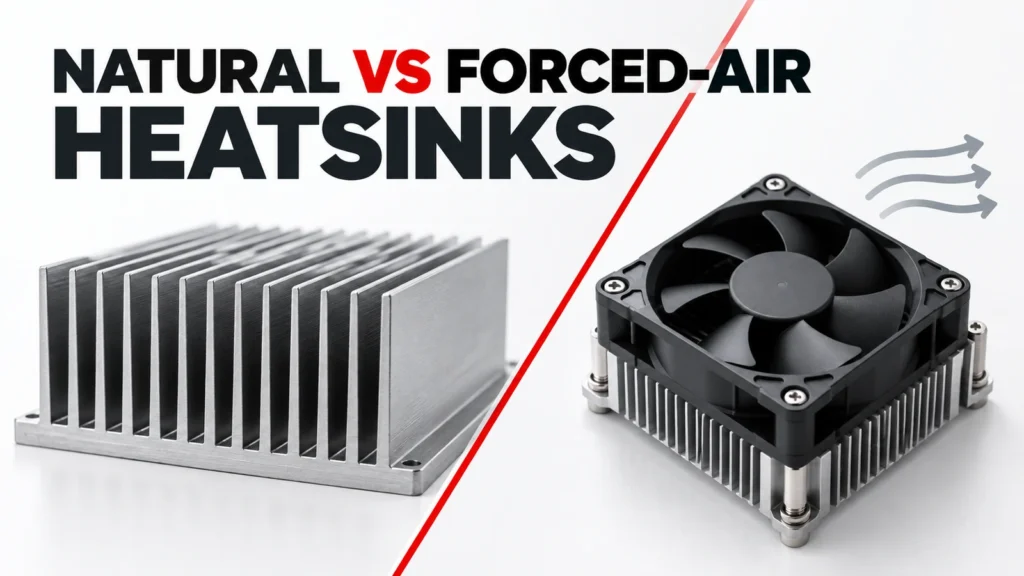
This comparison explains the thermal design evidence required to choose passive or forced-air heatsinking. It gives no universal heat dissipation rating, airflow value, thermal resistance or fan lifetime for a product without exact test conditions.
Oversigt over beslutningsgrundlag
| Gennemgangsområde | Projektindlæg | Bevismateriale, der skal anmodes om |
|---|---|---|
| DEVICE LOSS | Definer den faktiske driftstilstand og systemgrænsen | Godkendt systemtegning eller driftsjournal |
| INTERFACE | Angiv forventninger til grænseflade, geometri eller kontrol | Præcis udstyrs- eller produktbeskrivelse |
| HEATSINK | Miljø- og installationsforhold | Tegning af anlæg eller panel |
| AMBIENT | Beskriv krav til service og godkendelse | Præcise instruktioner og testplan |
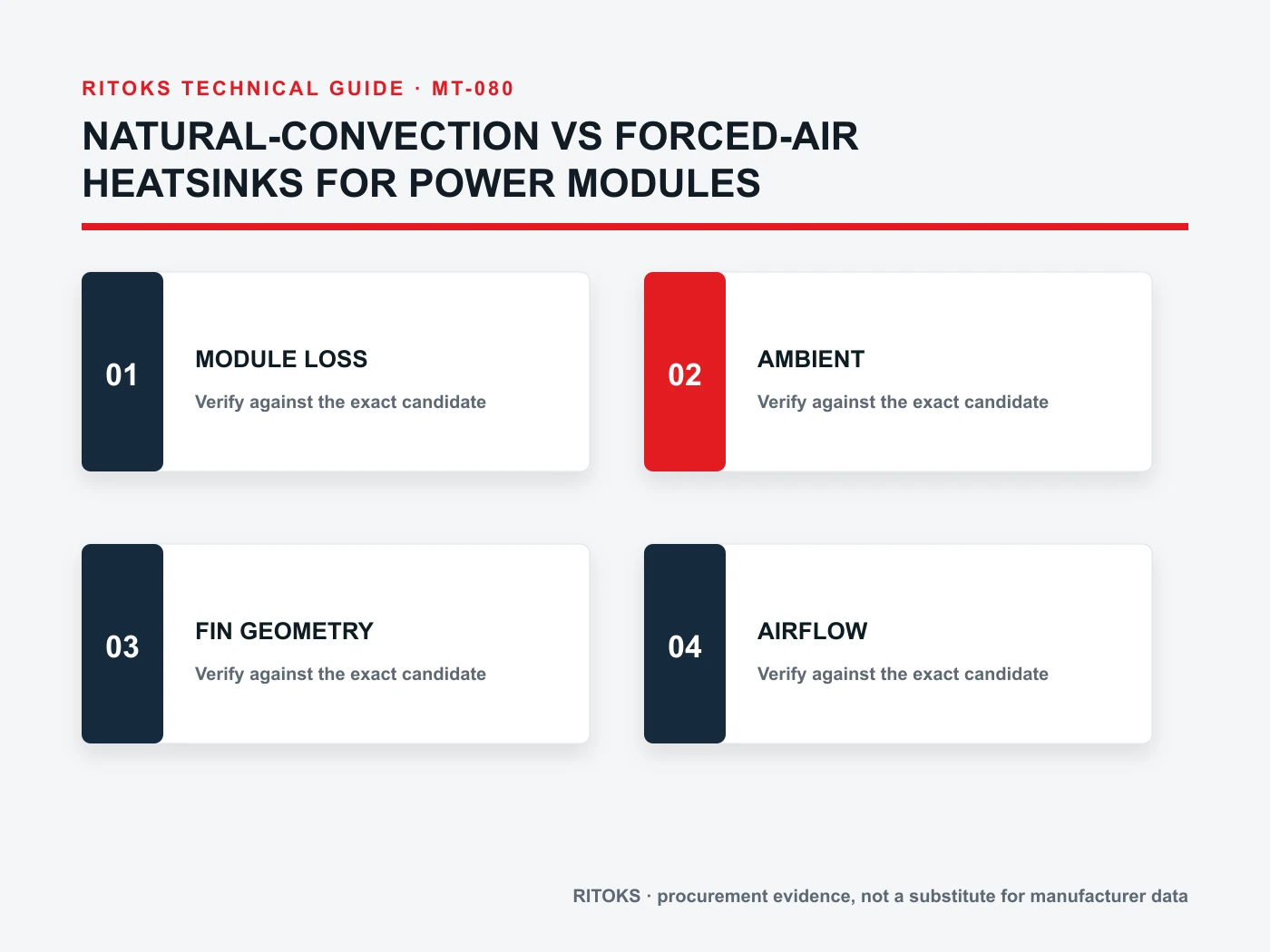
Two cooling methods, one thermal obligation
A natural-convection heatsink transfers heat to surrounding air without a dedicated fan moving air through its fins. A forced-air heatsink uses directed airflow to change that transfer condition. The practical choice is not determined by appearance or the word “power” in a module description. It depends on verified semiconductor loss, allowable temperatures, ambient conditions, mounting and the entire thermal path.
Both approaches can be appropriate in industrial equipment. Passive cooling avoids dependence on a fan, but often requires a compatible installation orientation, space and ambient. Forced air can support a different heat-transfer condition, but introduces airflow, power, acoustic, filtration, service and failure-state questions. The exact device data decides whether either approach has sufficient margin.
Calculate losses before comparing fin shapes
The starting input is the power module’s heat dissipation under representative operating states. Obtain loss information for the exact semiconductor order code and the intended electrical duty. A nameplate current or visually large package does not equal the heat that must leave the assembly. Include continuous and relevant transient conditions in the project brief.
Document whether the module is an SCR, rectifier, diode or another device, because conduction and switching behavior may differ. If the loss model is uncertain, do not backfill a generic wattage. Identify the missing curve or supplier calculation and treat the heatsink selection as provisional until it is supplied.
Trace the complete thermal path
Heat moves from junction through the device package, mounting interface and heatsink into the surrounding air. Each boundary needs evidence. The mechanical contact, approved interface material, mounting pressure and surface condition affect the result, as does the airflow or convection environment at the fins. A quoted heatsink value without its test conditions is not transferable to every assembly.
Ask for the exact thermal data, mounting instructions and a drawing that shows contact area and clearances. Compare the semiconductor’s allowable temperature with the proposed operating states using the supplier’s method. Reserve a prototype temperature check for conditions that are difficult to model, such as a densely populated enclosure or uncertain local air recirculation.
Natural convection needs a real installation context
Passive performance depends on how air can enter, warm and leave the fin channels. Orientation, vertical clearance, adjacent equipment and enclosure temperature may change the result materially. A bench test in open air may not describe a crowded cabinet with nearby heat sources. Define the actual mounting plane and free space before accepting a catalog thermal curve.
The system should also account for warm-start and high-ambient conditions. The passive option may be attractive where fan maintenance is difficult, but simplicity does not waive a thermal check. If the only available data describes a different orientation or ambient, request an applicable test or engineering review.
Forced air is an operating system, not an accessory
A fan rating quoted in free air does not reveal the flow through a heatsink inside a cabinet. Filters, grilles, duct turns, neighboring components and air recirculation can restrict the actual path. Request the fan curve and heatsink performance under documented airflow conditions, then evaluate the assembled path rather than adding nominal component values.
Decide who monitors fan operation and what the equipment does when airflow is lost. A forced-air design can be valid only if its power supply, wiring, maintenance access, replacement plan and alarm behavior are accepted by the project. Include these controls in the quotation and assembly test plan.
Compare reliability and service honestly
A passive design can reduce moving parts but may use more volume and still require clean air passages. A forced-air design can fit a different thermal envelope but needs fan and filter inspection. Dust accumulation affects both fin exposure and the airflow system. State the intended service interval as a project decision, not as an invented universal product property.
Procurement should compare delivered scope: heatsink extrusion, machining, mounting hardware, interface material, fan, guard, filter and cables. Two quotes for “the same heatsink” may include different work. Normalize those inclusions before comparing lead time or price.
Confirm with an assembly-level temperature test
A calculation screens candidates; a representative assembly test closes uncertainty. Measure the relevant points under the operating states and ambient conditions specified by the project engineer, and record how the result maps to the exact device limit. Do not substitute an enclosure air reading for a junction calculation without a supported method.
The test record should identify the exact semiconductor, heatsink, fan configuration if used, mounting material, orientation and enclosure state. A later change to any of these inputs can invalidate the result. Keep the approved thermal configuration with the product build documentation.
Opret en bevismappe med en præcis model
For the proposed Power Module Heatsink, create one approval record with the complete order code, the exact datasheet, the relevant drawing, installation instructions and any curve or test report used for the decision. Date each file or record its revision. A product-family page is useful for discovery, but it does not prove that a particular configuration includes an optional feature or meets a system condition.
Sammenlign hvert enkelt krav med dokumentationen for den pågældende bestillingsvare. Kombiner ikke en maksimalværdi for en produktfamilie fra én variant med et kredsløbsdiagram, en tilbehørsliste eller en termisk kurve fra en anden. Placer uafklarede felter i en synlig kolonne til afklaring. Hvis en leverandør foreslår en erstatningsvare, skal den pågældende gennemgang gentages, inden den tekniske ækvivalens godkendes.
Hold projektindgange adskilt fra leverandørfakturaer
Projektteamet har ansvaret for applikationsdokumentationen: kilde og belastning, driftstilstande, miljø, montering, betjeningselementer, service og godkendelseskriterier. Leverandøren har ansvaret for den foreslåede ordrekode og den tilhørende dokumentation for udstyret. Ingen af parterne bør udfylde manglende oplysninger ved at drage konklusioner ud fra udseendet eller et velkendt familienavn. Et nyttigt svar kan være “data endnu ikke tilgængelige”, forudsat at det manglende punkt har en ansvarlig og en afslutningsdato.
Sæt den pågældende specifikation på hold, mens tilbuddene sammenlignes. Hvis driftsbetingelserne, skabet, strømkilden, måleren, motoren eller beskyttelsessystemet ændres, skal der udstedes et revideret indgangsark, og hver leverandør skal anmodes om at bekræfte sit forslag på ny. Dette forhindrer, at et tidligt tilbud betragtes som en godkendelse af et senere design.
Sådan sammenligner du tilbud fra leverandører
| Tilbudsvare | Hvad skal man sammenligne? | Bevis for godkendelse |
|---|---|---|
| Bestillingsomfang | Komplet sæt med alt tilbehør | Præcist tilbud og stykliste |
| Elektrisk montering | Alle relevante driftstilstande | Dokument med præcise specifikationer, kredsløb eller kurver |
| Mekanisk tilpasning | Montering, terminaler og adgang | Tegning og monteringsvejledning |
| Serviceplan | Metode til eftersyn og udskiftning | Vedligeholdelsesvejledning |
| Uafklarede poster | Forudsætninger, undtagelser og særlige tilfælde | Register over skriftlige redegørelser |
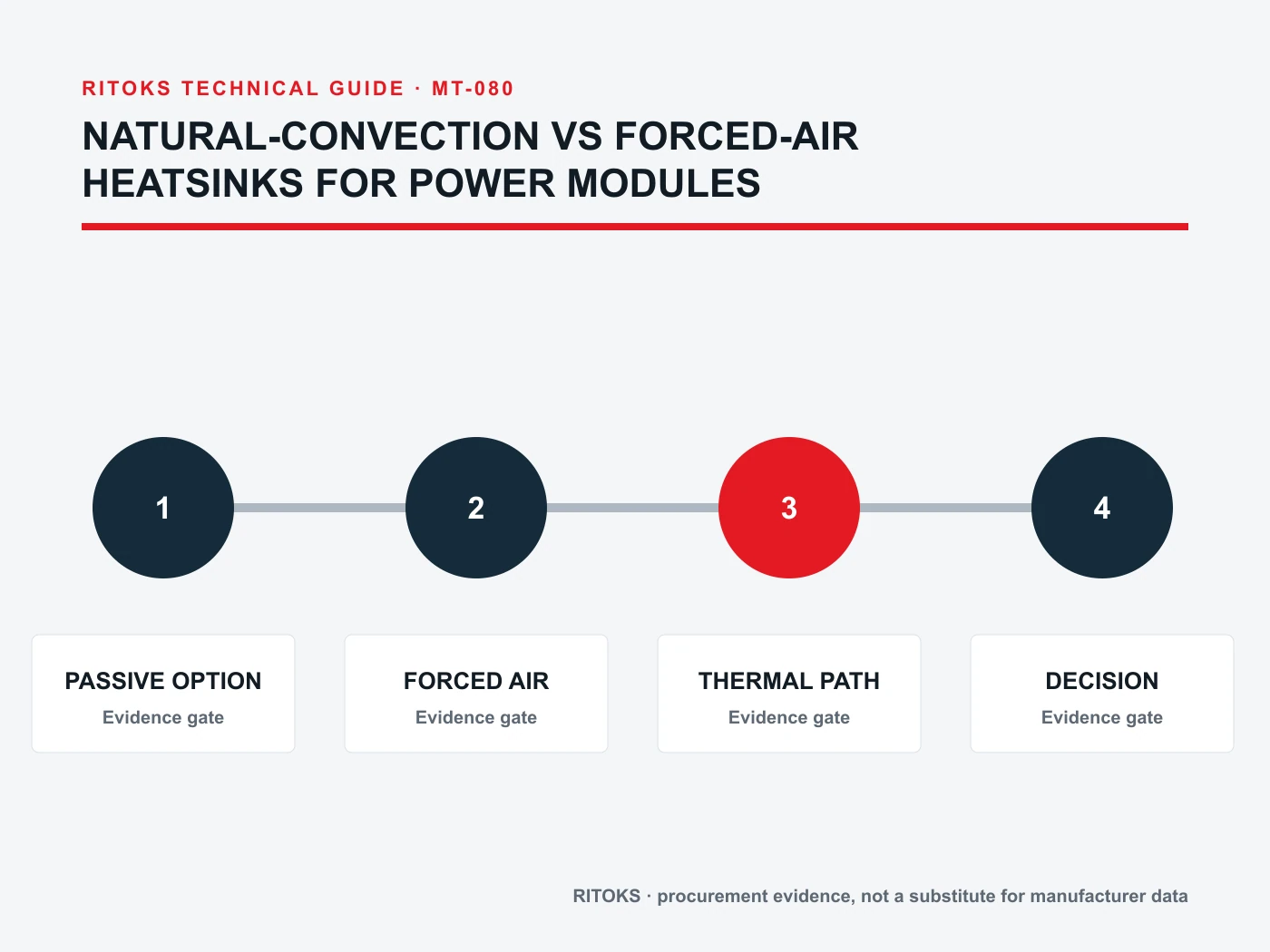
Normalize each Power Module Heatsink offer to the same application record. A shorter lead time or lower price is meaningful only after the technical scope is comparable. Record whether each supplier included the required accessories, documents and support for commissioning. Keep exceptions explicit, especially when the candidate needs a change to the panel or control design.
Kontrolpunkter ved indkøb og idriftsættelse
- Bekræft systemafgrænsningen, driftstilstande og godkendelseskriterier.
- Kontroller én komplet ordrekode i forhold til dokumenterne for den nøjagtige model.
- Løs undtagelser af elektrisk, mekanisk, miljømæssig og service-mæssig karakter.
- Sammenlign det leverede omfang og ændringer i dokumenterne på tværs af tilbuddene.
- Kontroller den modtagne vare i forhold til den godkendte registrering.
- Test den færdige samling i henhold til projektets godkendte procedure.
Ved modtagelseskontrollen skal den leverede mærkat, terminaler, medfølgende tilbehør og dokumenter kontrolleres i forhold til den godkendte ordre. En erstatning fra samme produktserie accepteres ikke automatisk. Ved idriftsættelsen skal de anvendelsesafhængige funktioner kontrolleres, da disse ikke kan fastslås ud fra komponentbeskrivelsen alene. Testplanen skal angive repræsentative tilstande og godkendelseskriterier uden at fastsætte generelle grænseværdier.
Tjekliste til udarbejdelse af anmodning om tilbud
A useful request for quotation on natural convection vs forced air heatsink is concise but complete. Ask for the exact orderable configuration and list unknown values as questions. Do not let the sales description silently answer a technical question that belongs to a calculation, a drawing or a test.
- DEVICE LOSS
- INTERFACE
- HEATSINK
- AMBIENT
- FAN CURVE
- RESTRICTION
- FAILURE MODE
- TEST
- Gældende dokumentversioner
- Mængde, bestemmelsessted og leveringsomfang
Anmod leverandøren om at angive undtagelser, forudsætninger og valgfrie poster separat. Opbevar protokollen med de tekniske præciseringer sammen med tilbuddet, så indkøbsafdelingen og ingeniørafdelingen gennemgår det samme omfang. Hvis en afgørende oplysning stadig mangler, kan kandidaten stadig være kommercielt interessant, men den tekniske godkendelse forbliver uafklaret.
Ofte stillede spørgsmål
Can a Power Module Heatsink be chosen from one headline rating?
Nej. Anvendelsen, den nøjagtige konfiguration samt de relevante elektriske, mekaniske, termiske og miljømæssige forhold skal vurderes samlet. En katalogbetegnelse er et udgangspunkt for undersøgelsen, ikke en fuldstændig godkendelsesdokumentation.
Beviser en familieside en præcis forbindelse eller medvirken?
Nej. Brug den foreslåede ordrekode samt den tilhørende aktuelle tegning, datablad og monteringsvejledning. Valgfrie funktioner eller alternative terminalopstillinger kan variere inden for samme produktserie.
Hvad nu, hvis leverandøren ikke kan angive en af de krævede værdier?
Markér værdien som uafklaret, fastlæg, hvem der skal anskaffe den, og sæt den pågældende beslutning på hold. Du må ikke omdanne en antagelse til en bekræftet påstand blot fordi en købsdato nærmer sig.
Hvor skal gennemgangen fortsætte?
Gennemse Power Module Heatsink category for den tilgængelige produktfamilie, og gennemgå derefter side med relaterede produkter som et muligt udgangspunkt. Disse sider angiver det kommercielle anvendelsesområde; de konkrete standarddokumenter afgør, om løsningen er egnet til formålet. For at få en projektspecifik sammenligning bedes du sende systemoplysningerne og eventuelle spørgsmål via RITOKS’ forespørgselsside.
Hvis en anden enhed eller metode efter gennemgang af dokumentationen viser sig at være mere velegnet, skal du revidere designbeskrivelsen, inden du anmoder om en udskiftning. Sørg for, at dokumentationen er knyttet til det endelige kredsløb og den endelige installation, ikke blot til den produktfamilie, der oprindeligt vakte interesse.