
Power Module Heatsinks · Comparison
Natural-Convection vs Forced-Air Heatsinks for Power Modules
Natural-Convection vs Forced-Air Heatsinks for Power Modules starts with the system question: When does the thermal design require airflow rather than passive cooling? A useful selection brief connects the equipment duty, installation and receiving system to a specific orderable product. The article below separates project inputs from product evidence so that a familiar product name does not quietly become a technical approval.
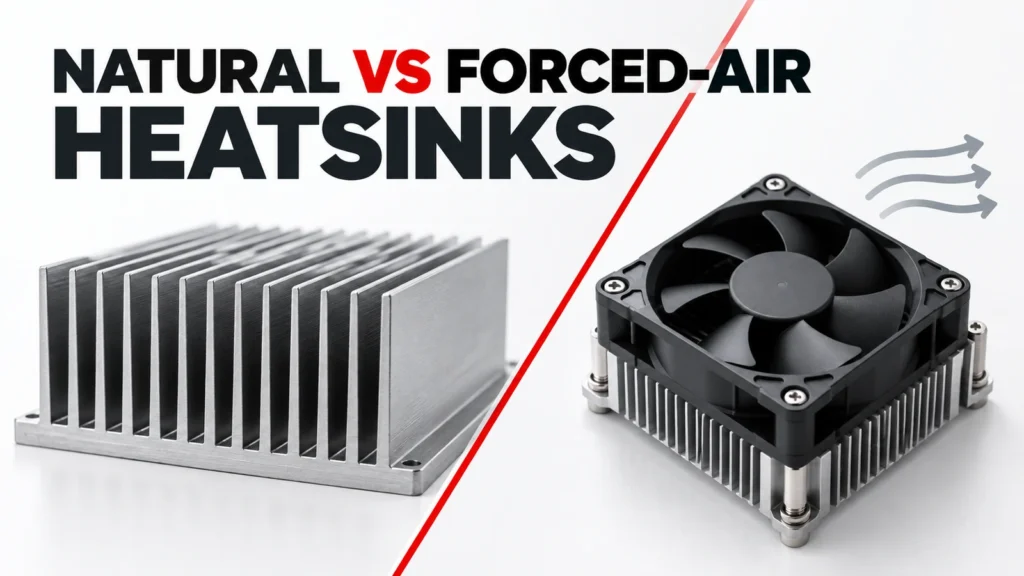
This comparison explains the thermal design evidence required to choose passive or forced-air heatsinking. It gives no universal heat dissipation rating, airflow value, thermal resistance or fan lifetime for a product without exact test conditions.
De beslissingsfactoren in één oogopslag
| Beoordelingsgebied | Projectbijdrage | Te vragen bewijsstukken |
|---|---|---|
| DEVICE LOSS | De feitelijke bedrijfstoestand en de systeemgrenzen vaststellen | Goedgekeurde systeemtekening of dienstrooster |
| INTERFACE | Geef de naam van de interface, geometrie of besturingsverwachting op | Een gedetailleerd document over de apparatuur of het product |
| HEATSINK | Toestand van de omgeving en de installatie | Plattegrond of paneeltekening |
| AMBIENT | Beschrijf de service- en acceptatie-eisen | Gedetailleerde instructies en testplan |
Two cooling methods, one thermal obligation
A natural-convection heatsink transfers heat to surrounding air without a dedicated fan moving air through its fins. A forced-air heatsink uses directed airflow to change that transfer condition. The practical choice is not determined by appearance or the word “power” in a module description. It depends on verified semiconductor loss, allowable temperatures, ambient conditions, mounting and the entire thermal path.
Both approaches can be appropriate in industrial equipment. Passive cooling avoids dependence on a fan, but often requires a compatible installation orientation, space and ambient. Forced air can support a different heat-transfer condition, but introduces airflow, power, acoustic, filtration, service and failure-state questions. The exact device data decides whether either approach has sufficient margin.
Calculate losses before comparing fin shapes
The starting input is the power module’s heat dissipation under representative operating states. Obtain loss information for the exact semiconductor order code and the intended electrical duty. A nameplate current or visually large package does not equal the heat that must leave the assembly. Include continuous and relevant transient conditions in the project brief.
Document whether the module is an SCR, rectifier, diode or another device, because conduction and switching behavior may differ. If the loss model is uncertain, do not backfill a generic wattage. Identify the missing curve or supplier calculation and treat the heatsink selection as provisional until it is supplied.
Trace the complete thermal path
Heat moves from junction through the device package, mounting interface and heatsink into the surrounding air. Each boundary needs evidence. The mechanical contact, approved interface material, mounting pressure and surface condition affect the result, as does the airflow or convection environment at the fins. A quoted heatsink value without its test conditions is not transferable to every assembly.
Ask for the exact thermal data, mounting instructions and a drawing that shows contact area and clearances. Compare the semiconductor’s allowable temperature with the proposed operating states using the supplier’s method. Reserve a prototype temperature check for conditions that are difficult to model, such as a densely populated enclosure or uncertain local air recirculation.
Natural convection needs a real installation context
Passive performance depends on how air can enter, warm and leave the fin channels. Orientation, vertical clearance, adjacent equipment and enclosure temperature may change the result materially. A bench test in open air may not describe a crowded cabinet with nearby heat sources. Define the actual mounting plane and free space before accepting a catalog thermal curve.
The system should also account for warm-start and high-ambient conditions. The passive option may be attractive where fan maintenance is difficult, but simplicity does not waive a thermal check. If the only available data describes a different orientation or ambient, request an applicable test or engineering review.
Forced air is an operating system, not an accessory
A fan rating quoted in free air does not reveal the flow through a heatsink inside a cabinet. Filters, grilles, duct turns, neighboring components and air recirculation can restrict the actual path. Request the fan curve and heatsink performance under documented airflow conditions, then evaluate the assembled path rather than adding nominal component values.
Decide who monitors fan operation and what the equipment does when airflow is lost. A forced-air design can be valid only if its power supply, wiring, maintenance access, replacement plan and alarm behavior are accepted by the project. Include these controls in the quotation and assembly test plan.
Compare reliability and service honestly
A passive design can reduce moving parts but may use more volume and still require clean air passages. A forced-air design can fit a different thermal envelope but needs fan and filter inspection. Dust accumulation affects both fin exposure and the airflow system. State the intended service interval as a project decision, not as an invented universal product property.
Procurement should compare delivered scope: heatsink extrusion, machining, mounting hardware, interface material, fan, guard, filter and cables. Two quotes for “the same heatsink” may include different work. Normalize those inclusions before comparing lead time or price.
Confirm with an assembly-level temperature test
A calculation screens candidates; a representative assembly test closes uncertainty. Measure the relevant points under the operating states and ambient conditions specified by the project engineer, and record how the result maps to the exact device limit. Do not substitute an enclosure air reading for a junction calculation without a supported method.
The test record should identify the exact semiconductor, heatsink, fan configuration if used, mounting material, orientation and enclosure state. A later change to any of these inputs can invalidate the result. Keep the approved thermal configuration with the product build documentation.
Een bewijsmap op basis van een exact model samenstellen
For the proposed Power Module Heatsink, create one approval record with the complete order code, the exact datasheet, the relevant drawing, installation instructions and any curve or test report used for the decision. Date each file or record its revision. A product-family page is useful for discovery, but it does not prove that a particular configuration includes an optional feature or meets a system condition.
Vergelijk elke eis met de documentatie voor hetzelfde bestelbare artikel. Combineer het maximale aantal per productfamilie van de ene variant niet met een schakelschema, een lijst met accessoires of een thermische curve van een andere variant. Zet onduidelijke velden in een zichtbare kolom voor verduidelijking. Als een leverancier een vervangend product voorstelt, herhaal dan de betreffende beoordeling voordat je de technische gelijkwaardigheid ervan goedkeurt.
Houd projectbijdragen gescheiden van facturen van leveranciers
Het projectteam is verantwoordelijk voor het applicatiedossier: bron en belasting, bedrijfsstatussen, omgeving, montage, bedieningselementen, onderhouds- en acceptatiecriteria. De leverancier is verantwoordelijk voor de voorgestelde bestelcode en de bijbehorende documentatie van het apparaat. Geen van beide partijen mag een leemte opvullen door conclusies te trekken op basis van het uiterlijk of een bekende familienaam. Een bruikbaar antwoord kan zijn “gegevens nog niet beschikbaar”, mits het ontbrekende item een verantwoordelijke en een afsluitdatum heeft.
Bevries die specificatie terwijl de offertes worden vergeleken. Als de bedrijfsomstandigheden, de behuizing, de stroombron, de meter, de motor of de beveiligingsarchitectuur veranderen, stel dan een bijgewerkt specificatieblad op en vraag elke leverancier om zijn voorstel opnieuw te bevestigen. Zo voorkom je dat een eerdere offerte wordt beschouwd als goedkeuring voor een later ontwerp.
Hoe vergelijk je offertes van leveranciers?
| Aanbiedingsartikel | Wat moet je vergelijken? | Bewijs van goedkeuring |
|---|---|---|
| Bestelbare omvang | Volledige set inclusief toebehoren | Exacte offerte en stuklijst |
| Elektrische aansluiting | Alle relevante bedrijfstoestanden | Document met exacte classificatie, circuit of curve |
| Mechanische passing | Bevestiging, aansluitingen en toegang | Teken- en montage-instructies |
| Serviceplan | Inspectie- en vervangingsmethode | Onderhoudsinstructies |
| Openstaande posten | Aannames, uitsluitingen en uitzonderingen | Register van schriftelijke verduidelijkingen |
Normalize each Power Module Heatsink offer to the same application record. A shorter lead time or lower price is meaningful only after the technical scope is comparable. Record whether each supplier included the required accessories, documents and support for commissioning. Keep exceptions explicit, especially when the candidate needs a change to the panel or control design.
Controlepunten bij de aanschaf en inbedrijfstelling
- Bevestig de systeemgrenzen, de bedrijfstoestanden en de acceptatiecriteria.
- Controleer één volledige bestelcode aan de hand van de documenten met de exacte modellen.
- Elektrische, mechanische, omgevings- en servicegerelateerde afwijkingen oplossen.
- Vergelijk de geleverde omvang en de wijzigingen in de documenten tussen de verschillende offertes.
- Controleer het ontvangen artikel aan de hand van het goedgekeurde document.
- Test de voltooide assemblage volgens de goedgekeurde procedure van het project.
Bij de ontvangstcontrole moeten het geleverde etiket, de aansluitingen, de meegeleverde accessoires en documenten worden vergeleken met de goedgekeurde bestelling. Een vervangend onderdeel uit dezelfde productfamilie wordt niet automatisch geaccepteerd. Controleer bij de inbedrijfstelling de toepassingsspecifieke functies die niet uitsluitend aan de hand van de documentatie van het onderdeel kunnen worden vastgesteld. In het testplan moeten representatieve toestanden en acceptatiecriteria worden vermeld, zonder dat er algemene grenswaarden worden vastgesteld.
Checklist voor het opstellen van een offerteaanvraag
A useful request for quotation on natural convection vs forced air heatsink is concise but complete. Ask for the exact orderable configuration and list unknown values as questions. Do not let the sales description silently answer a technical question that belongs to a calculation, a drawing or a test.
- DEVICE LOSS
- INTERFACE
- HEATSINK
- AMBIENT
- FAN CURVE
- RESTRICTION
- FAILURE MODE
- TEST
- Toepasselijke documentversies
- Hoeveelheid, bestemming en leveringsomvang
Vraag de leverancier om uitsluitingen, aannames en optionele posten afzonderlijk te vermelden. Bewaar het verslag van de technische toelichting bij de offerte, zodat de afdelingen Inkoop en Engineering dezelfde scope beoordelen. Als een cruciale input nog steeds ontbreekt, kan de kandidaat commercieel gezien interessant blijven, maar blijft de technische goedkeuring in het ongewisse.
Veelgestelde vragen
Can a Power Module Heatsink be chosen from one headline rating?
Nee. De toepassing, de exacte configuratie en de relevante elektrische, mechanische, thermische en omgevingsomstandigheden moeten gezamenlijk worden beoordeeld. Een catalogustitel is een uitgangspunt voor onderzoek, geen volledig goedkeuringsdossier.
Bewijst een familiepagina een exacte verwantschap of een band?
Nee. Gebruik de voorgestelde bestelcode en de bijbehorende actuele tekening, het gegevensblad en de installatie-instructies. Optionele functies of alternatieve aansluitconfiguraties kunnen binnen een productfamilie verschillen.
Wat als de leverancier één van de vereiste waarden niet kan verstrekken?
Markeer de waarde als ‘onopgelost’, bepaal wie deze zal verkrijgen en zet het betreffende besluit tijdelijk in de wacht. Zet een aanname niet om in een bewezen bewering, louter omdat de aankoopdatum nadert.
Waar gaat de recensie verder?
Bekijk de Power Module Heatsink category voor de beschikbare productfamilie, bekijk vervolgens de pagina met gerelateerde producten als mogelijk uitgangspunt. Op deze pagina’s wordt de commerciële bestemming aangegeven; de exacte modeldocumenten bepalen of de toepassing geschikt is. Voor een projectspecifieke vergelijking kunt u de systeemgegevens en openstaande vragen doorsturen via de RITOKS-pagina voor vragen.
Mocht na bestudering van het bewijsmateriaal blijken dat een ander apparaat of een andere methode geschikter is, pas dan de ontwerpopdracht aan voordat je om een vervanging vraagt. Zorg ervoor dat de documentatie betrekking heeft op het uiteindelijke circuit en de uiteindelijke installatie, en niet alleen op de productfamilie die aanvankelijk de aandacht trok.