
Power Module Heatsinks · Comparison
Natural-Convection vs Forced-Air Heatsinks for Power Modules
Natural-Convection vs Forced-Air Heatsinks for Power Modules starts with the system question: When does the thermal design require airflow rather than passive cooling? A useful selection brief connects the equipment duty, installation and receiving system to a specific orderable product. The article below separates project inputs from product evidence so that a familiar product name does not quietly become a technical approval.
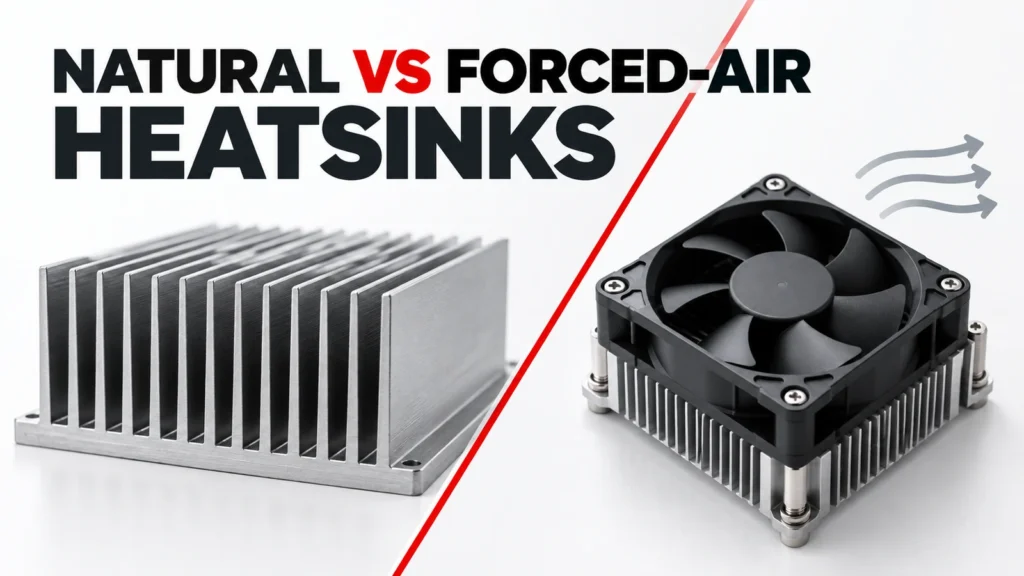
This comparison explains the thermal design evidence required to choose passive or forced-air heatsinking. It gives no universal heat dissipation rating, airflow value, thermal resistance or fan lifetime for a product without exact test conditions.
एक नजर में निर्णय इनपुट्स
| समीक्षा क्षेत्र | परियोजना इनपुट | मांगने के लिए साक्ष्य |
|---|---|---|
| DEVICE LOSS | वास्तविक संचालन स्थिति और सिस्टम की सीमा परिभाषित करें | अनुमोदित प्रणाली आरेख या ड्यूटी रिकॉर्ड |
| INTERFACE | इंटरफ़ेस, ज्यामिति या नियंत्रण अपेक्षा का नाम | सटीक उपकरण या उत्पाद दस्तावेज़ |
| HEATSINK | राज्य पर्यावरण और स्थापना की स्थिति | साइट या पैनल आरेख |
| AMBIENT | सेवा और स्वीकृति आवश्यकता का वर्णन करें | सटीक निर्देश और परीक्षण योजना |
Two cooling methods, one thermal obligation
A natural-convection heatsink transfers heat to surrounding air without a dedicated fan moving air through its fins. A forced-air heatsink uses directed airflow to change that transfer condition. The practical choice is not determined by appearance or the word “power” in a module description. It depends on verified semiconductor loss, allowable temperatures, ambient conditions, mounting and the entire thermal path.
Both approaches can be appropriate in industrial equipment. Passive cooling avoids dependence on a fan, but often requires a compatible installation orientation, space and ambient. Forced air can support a different heat-transfer condition, but introduces airflow, power, acoustic, filtration, service and failure-state questions. The exact device data decides whether either approach has sufficient margin.
Calculate losses before comparing fin shapes
The starting input is the power module’s heat dissipation under representative operating states. Obtain loss information for the exact semiconductor order code and the intended electrical duty. A nameplate current or visually large package does not equal the heat that must leave the assembly. Include continuous and relevant transient conditions in the project brief.
Document whether the module is an SCR, rectifier, diode or another device, because conduction and switching behavior may differ. If the loss model is uncertain, do not backfill a generic wattage. Identify the missing curve or supplier calculation and treat the heatsink selection as provisional until it is supplied.
Trace the complete thermal path
Heat moves from junction through the device package, mounting interface and heatsink into the surrounding air. Each boundary needs evidence. The mechanical contact, approved interface material, mounting pressure and surface condition affect the result, as does the airflow or convection environment at the fins. A quoted heatsink value without its test conditions is not transferable to every assembly.
Ask for the exact thermal data, mounting instructions and a drawing that shows contact area and clearances. Compare the semiconductor’s allowable temperature with the proposed operating states using the supplier’s method. Reserve a prototype temperature check for conditions that are difficult to model, such as a densely populated enclosure or uncertain local air recirculation.
Natural convection needs a real installation context
Passive performance depends on how air can enter, warm and leave the fin channels. Orientation, vertical clearance, adjacent equipment and enclosure temperature may change the result materially. A bench test in open air may not describe a crowded cabinet with nearby heat sources. Define the actual mounting plane and free space before accepting a catalog thermal curve.
The system should also account for warm-start and high-ambient conditions. The passive option may be attractive where fan maintenance is difficult, but simplicity does not waive a thermal check. If the only available data describes a different orientation or ambient, request an applicable test or engineering review.
Forced air is an operating system, not an accessory
A fan rating quoted in free air does not reveal the flow through a heatsink inside a cabinet. Filters, grilles, duct turns, neighboring components and air recirculation can restrict the actual path. Request the fan curve and heatsink performance under documented airflow conditions, then evaluate the assembled path rather than adding nominal component values.
Decide who monitors fan operation and what the equipment does when airflow is lost. A forced-air design can be valid only if its power supply, wiring, maintenance access, replacement plan and alarm behavior are accepted by the project. Include these controls in the quotation and assembly test plan.
Compare reliability and service honestly
A passive design can reduce moving parts but may use more volume and still require clean air passages. A forced-air design can fit a different thermal envelope but needs fan and filter inspection. Dust accumulation affects both fin exposure and the airflow system. State the intended service interval as a project decision, not as an invented universal product property.
Procurement should compare delivered scope: heatsink extrusion, machining, mounting hardware, interface material, fan, guard, filter and cables. Two quotes for “the same heatsink” may include different work. Normalize those inclusions before comparing lead time or price.
Confirm with an assembly-level temperature test
A calculation screens candidates; a representative assembly test closes uncertainty. Measure the relevant points under the operating states and ambient conditions specified by the project engineer, and record how the result maps to the exact device limit. Do not substitute an enclosure air reading for a junction calculation without a supported method.
The test record should identify the exact semiconductor, heatsink, fan configuration if used, mounting material, orientation and enclosure state. A later change to any of these inputs can invalidate the result. Keep the approved thermal configuration with the product build documentation.
एक सटीक-मॉडल साक्ष्य फ़ाइल बनाएँ
For the proposed Power Module Heatsink, create one approval record with the complete order code, the exact datasheet, the relevant drawing, installation instructions and any curve or test report used for the decision. Date each file or record its revision. A product-family page is useful for discovery, but it does not prove that a particular configuration includes an optional feature or meets a system condition.
हर आवश्यकता की तुलना उसी ऑर्डर किए जा सकने वाले आइटम के साक्ष्यों से करें। एक वेरिएंट का फैमिली मैक्सिमम किसी अन्य के सर्किट डायग्राम, एक्सेसरी सूची या थर्मल वक्र के साथ न मिलाएं। अनसुलझे क्षेत्रों को एक दृश्य स्पष्टीकरण कॉलम में रखें। यदि कोई आपूर्तिकर्ता विकल्प प्रस्तावित करता है, तो उसकी तकनीकी समतुल्यता को मंजूरी देने से पहले प्रभावित समीक्षा दोहराएं।.
परियोजना इनपुट्स को आपूर्तिकर्ता दावों से अलग रखें
परियोजना टीम एप्लिकेशन रिकॉर्ड की मालिक है: स्रोत और लोड, संचालन अवस्थाएँ, पर्यावरण, माउंटिंग, नियंत्रण, सेवा और स्वीकृति मानदंड। आपूर्तिकर्ता प्रस्तावित ऑर्डर कोड और सहायक उपकरण साक्ष्य का मालिक है। किसी भी पक्ष को दिखावे या परिचित पारिवारिक नाम से अनुमान लगाकर किसी कमी को भरना नहीं चाहिए। एक उपयोगी उत्तर हो सकता है “डेटा अभी उपलब्ध नहीं है,” बशर्ते कि उस अनुपस्थित आइटम का कोई स्वामी और समापन तिथि हो।.
जब तक प्रस्तावों की तुलना हो रही हो, उस रिकॉर्ड को स्थिर रखें। यदि संचालन शुल्क, कैबिनेट, स्रोत, मीटर, मोटर या सुरक्षा संरचना बदलती है, तो एक संशोधित इनपुट शीट जारी करें और प्रत्येक आपूर्तिकर्ता से अपने उम्मीदवार की पुनः पुष्टि करने के लिए कहें। इससे पहले दिए गए कोटेशन को बाद के डिज़ाइन के लिए स्वीकृति के रूप में लेने से रोका जा सकता है।.
सप्लायर ऑफ़र्स की तुलना कैसे करें
| आइटम की पेशकश करें | क्या तुलना करें | अनुमोदन साक्ष्य |
|---|---|---|
| आदेश योग्य दायरा | पूरा कोड और शामिल सहायक उपकरण | सटीक उद्धरण और सामग्री सूची |
| बिजली की फिटिंग | सभी लागू परिचालन राज्य | सटीक रेटिंग, सर्किट या वक्र दस्तावेज़ |
| यांत्रिक फिट | माउंटिंग, टर्मिनल और एक्सेस | ड्राइंग और इंस्टॉलेशन निर्देश |
| सेवा योजना | निरीक्षण और प्रतिस्थापन विधि | रखरखाव निर्देश |
| खुले आइटम | मान्यताएँ, बहिष्करण और अपवाद | लिखित स्पष्टीकरण रजिस्टर |
Normalize each Power Module Heatsink offer to the same application record. A shorter lead time or lower price is meaningful only after the technical scope is comparable. Record whether each supplier included the required accessories, documents and support for commissioning. Keep exceptions explicit, especially when the candidate needs a change to the panel or control design.
खरीद और कमीशनिंग जांच बिंदु
- प्रणाली की सीमा, संचालन अवस्थाएँ और स्वीकृति मानदंडों की पुष्टि करें।.
- एक पूर्ण ऑर्डर कोड की सटीक-मॉडल दस्तावेज़ों के साथ समीक्षा करें।.
- विद्युत, यांत्रिक, पर्यावरणीय और सेवा संबंधी अपवादों का समाधान करें।.
- प्रस्तावों में प्रदान किए गए दायरे और दस्तावेज़ संशोधनों की तुलना करें।.
- प्राप्त वस्तु की जांच स्वीकृत रिकॉर्ड के अनुसार करें।.
- परियोजना की अधिकृत प्रक्रिया के अनुसार तैयार असेंबली का परीक्षण करें।.
आगमन निरीक्षण में वितरित लेबल, टर्मिनल, शामिल सहायक उपकरण और दस्तावेज़ों की तुलना स्वीकृत ऑर्डर से की जानी चाहिए। एक ही परिवार के प्रतिस्थापन को स्वचालित रूप से स्वीकार्य नहीं माना जाना चाहिए। चालूकरण के समय उन अनुप्रयोग-निर्भर कार्यों का सत्यापन करें जिन्हें केवल घटक साहित्य से स्थापित नहीं किया जा सकता। परीक्षण योजना में सार्वभौमिक सीमाएँ गढ़े बिना प्रतिनिधि अवस्थाओं और स्वीकृति मानदंडों का उल्लेख होना चाहिए।.
आरएफक्यू तैयारी चेकलिस्ट
A useful request for quotation on natural convection vs forced air heatsink is concise but complete. Ask for the exact orderable configuration and list unknown values as questions. Do not let the sales description silently answer a technical question that belongs to a calculation, a drawing or a test.
- DEVICE LOSS
- INTERFACE
- HEATSINK
- AMBIENT
- FAN CURVE
- RESTRICTION
- FAILURE MODE
- TEST
- लागू दस्तावेज़ संशोधन
- मात्रा, गंतव्य और वितरण का दायरा
आपूर्तिकर्ता से अनुरोध करें कि वे अपवादों, मान्यताओं और वैकल्पिक मदों को अलग से बताएं। तकनीकी स्पष्टीकरण रिकॉर्ड को कोटेशन के साथ रखें ताकि खरीद और इंजीनियरिंग एक ही दायरे की समीक्षा कर सकें। यदि कोई महत्वपूर्ण इनपुट अभी भी अनुपस्थित है, तो उम्मीदवार वाणिज्यिक रूप से दिलचस्प बना रह सकता है, लेकिन उसकी तकनीकी स्वीकृति अभी भी लंबित रहेगी।.
अक्सर पूछे जाने वाले प्रश्न
Can a Power Module Heatsink be chosen from one headline rating?
नहीं। अनुप्रयोग, सटीक विन्यास और प्रासंगिक विद्युत, यांत्रिक, तापीय और पर्यावरणीय परिस्थितियों की समीक्षा एक साथ करनी चाहिए। एक कैटलॉग शीर्षक खोज का प्रारंभिक बिंदु है, न कि पूर्ण अनुमोदन रिकॉर्ड।.
क्या एक पारिवारिक पृष्ठ सटीक संबंध या सहायक साबित करता है?
नहीं। प्रस्तावित ऑर्डर कोड और उसकी वर्तमान ड्राइंग, डेटाशीट तथा इंस्टॉलेशन निर्देशों का उपयोग करें। वैकल्पिक सुविधाएँ या वैकल्पिक टर्मिनल व्यवस्थाएँ एक ही परिवार के भीतर भिन्न हो सकती हैं।.
यदि आपूर्तिकर्ता एक आवश्यक मान प्रदान नहीं कर सकता तो क्या होगा?
मूल्य को अनसुलझा के रूप में चिह्नित करें, यह निर्धारित करें कि इसे कौन प्राप्त करेगा और प्रभावित निर्णय को रोक दें। केवल इसलिए कि खरीद की तारीख नज़दीक आ रही है, किसी धारणा को सत्यापित दावे में न बदलें।.
समीक्षा कहाँ जारी रखें
ब्राउज़ करें Power Module Heatsink category उपलब्ध उत्पाद परिवार के लिए, फिर समीक्षा करें संबंधित उत्पाद पृष्ठ एक संभावित प्रारंभिक बिंदु के रूप में। ये पृष्ठ व्यावसायिक गंतव्य की पहचान करते हैं; सटीक मॉडल दस्तावेज़ आवेदन की उपयुक्तता निर्धारित करते हैं। परियोजना-विशिष्ट तुलना के लिए, सिस्टम इनपुट्स और खुले प्रश्नों को माध्यम से भेजें। RITOKS पूछताछ पृष्ठ.
यदि साक्ष्यों की समीक्षा करने के बाद कोई अन्य उपकरण या विधि अधिक उपयुक्त प्रतीत हो, तो प्रतिस्थापन का अनुरोध करने से पहले डिज़ाइन ब्रीफ को संशोधित करें। रिकॉर्ड को केवल उस उत्पाद परिवार से नहीं, जिसने पहली बार ध्यान आकर्षित किया था, बल्कि अंतिम सर्किट और स्थापना से भी जुड़ा रखें।.