
Power Module Heatsinks · Comparison
Natural-Convection vs Forced-Air Heatsinks for Power Modules
Natural-Convection vs Forced-Air Heatsinks for Power Modules starts with the system question: When does the thermal design require airflow rather than passive cooling? A useful selection brief connects the equipment duty, installation and receiving system to a specific orderable product. The article below separates project inputs from product evidence so that a familiar product name does not quietly become a technical approval.
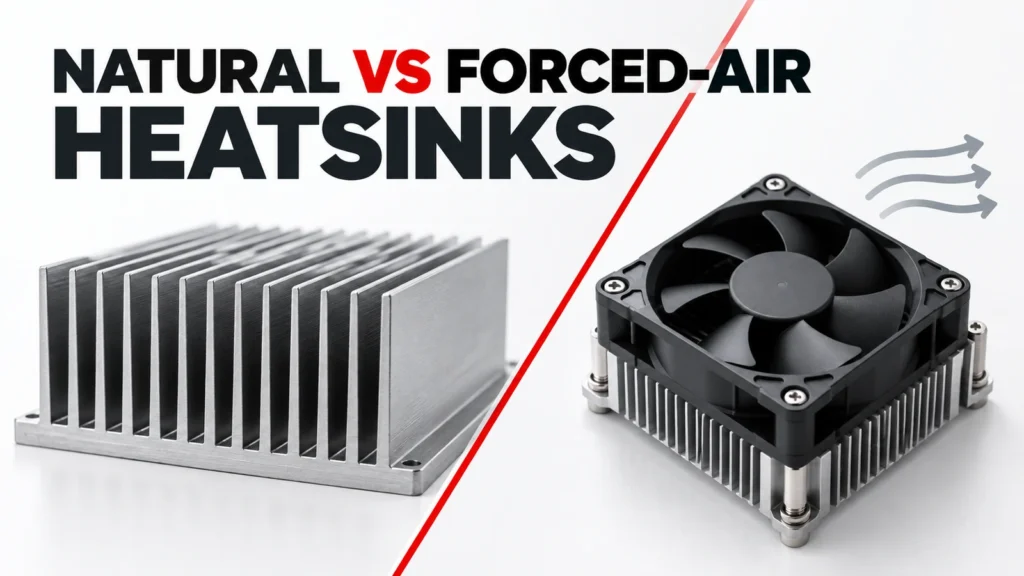
This comparison explains the thermal design evidence required to choose passive or forced-air heatsinking. It gives no universal heat dissipation rating, airflow value, thermal resistance or fan lifetime for a product without exact test conditions.
Karar Alımında Kullanılan Verilere Genel Bakış
| İnceleme alanı | Proje girdisi | Talep edilecek deliller |
|---|---|---|
| DEVICE LOSS | Gerçek çalışma durumunu ve sistem sınırlarını tanımlayın | Onaylanmış sistem çizimi veya görev kaydı |
| INTERFACE | Arayüz, geometri veya kontrol beklentisinin adını belirtin | Ekipman veya ürünün tam teknik belgesi |
| HEATSINK | Ortam ve kurulum koşulları | Şantiye veya panel çizimi |
| AMBIENT | Hizmet ve kabul şartlarını açıklayın | Ayrıntılı talimatlar ve test planı |
Two cooling methods, one thermal obligation
A natural-convection heatsink transfers heat to surrounding air without a dedicated fan moving air through its fins. A forced-air heatsink uses directed airflow to change that transfer condition. The practical choice is not determined by appearance or the word “power” in a module description. It depends on verified semiconductor loss, allowable temperatures, ambient conditions, mounting and the entire thermal path.
Both approaches can be appropriate in industrial equipment. Passive cooling avoids dependence on a fan, but often requires a compatible installation orientation, space and ambient. Forced air can support a different heat-transfer condition, but introduces airflow, power, acoustic, filtration, service and failure-state questions. The exact device data decides whether either approach has sufficient margin.
Calculate losses before comparing fin shapes
The starting input is the power module’s heat dissipation under representative operating states. Obtain loss information for the exact semiconductor order code and the intended electrical duty. A nameplate current or visually large package does not equal the heat that must leave the assembly. Include continuous and relevant transient conditions in the project brief.
Document whether the module is an SCR, rectifier, diode or another device, because conduction and switching behavior may differ. If the loss model is uncertain, do not backfill a generic wattage. Identify the missing curve or supplier calculation and treat the heatsink selection as provisional until it is supplied.
Trace the complete thermal path
Heat moves from junction through the device package, mounting interface and heatsink into the surrounding air. Each boundary needs evidence. The mechanical contact, approved interface material, mounting pressure and surface condition affect the result, as does the airflow or convection environment at the fins. A quoted heatsink value without its test conditions is not transferable to every assembly.
Ask for the exact thermal data, mounting instructions and a drawing that shows contact area and clearances. Compare the semiconductor’s allowable temperature with the proposed operating states using the supplier’s method. Reserve a prototype temperature check for conditions that are difficult to model, such as a densely populated enclosure or uncertain local air recirculation.
Natural convection needs a real installation context
Passive performance depends on how air can enter, warm and leave the fin channels. Orientation, vertical clearance, adjacent equipment and enclosure temperature may change the result materially. A bench test in open air may not describe a crowded cabinet with nearby heat sources. Define the actual mounting plane and free space before accepting a catalog thermal curve.
The system should also account for warm-start and high-ambient conditions. The passive option may be attractive where fan maintenance is difficult, but simplicity does not waive a thermal check. If the only available data describes a different orientation or ambient, request an applicable test or engineering review.
Forced air is an operating system, not an accessory
A fan rating quoted in free air does not reveal the flow through a heatsink inside a cabinet. Filters, grilles, duct turns, neighboring components and air recirculation can restrict the actual path. Request the fan curve and heatsink performance under documented airflow conditions, then evaluate the assembled path rather than adding nominal component values.
Decide who monitors fan operation and what the equipment does when airflow is lost. A forced-air design can be valid only if its power supply, wiring, maintenance access, replacement plan and alarm behavior are accepted by the project. Include these controls in the quotation and assembly test plan.
Compare reliability and service honestly
A passive design can reduce moving parts but may use more volume and still require clean air passages. A forced-air design can fit a different thermal envelope but needs fan and filter inspection. Dust accumulation affects both fin exposure and the airflow system. State the intended service interval as a project decision, not as an invented universal product property.
Procurement should compare delivered scope: heatsink extrusion, machining, mounting hardware, interface material, fan, guard, filter and cables. Two quotes for “the same heatsink” may include different work. Normalize those inclusions before comparing lead time or price.
Confirm with an assembly-level temperature test
A calculation screens candidates; a representative assembly test closes uncertainty. Measure the relevant points under the operating states and ambient conditions specified by the project engineer, and record how the result maps to the exact device limit. Do not substitute an enclosure air reading for a junction calculation without a supported method.
The test record should identify the exact semiconductor, heatsink, fan configuration if used, mounting material, orientation and enclosure state. A later change to any of these inputs can invalidate the result. Keep the approved thermal configuration with the product build documentation.
Kesin Modele Dayalı Kanıt Dosyası Oluşturun
For the proposed Power Module Heatsink, create one approval record with the complete order code, the exact datasheet, the relevant drawing, installation instructions and any curve or test report used for the decision. Date each file or record its revision. A product-family page is useful for discovery, but it does not prove that a particular configuration includes an optional feature or meets a system condition.
Her bir gereksinimi, aynı sipariş edilebilir ürünle ilgili kanıtlarla karşılaştırın. Bir varyanttaki ürün ailesi üst sınırını, başka bir varyanttaki devre şeması, aksesuar listesi veya termal eğriyle birleştirmeyin. Çözülmemiş alanları, görünür bir “açıklama” sütununa yazın. Bir tedarikçi bir ikame ürün önerirse, teknik eşdeğerliğini onaylamadan önce ilgili incelemeyi tekrarlayın.
Proje Girdilerini Tedarikçi Faturalarından Ayrı Tutun
Proje ekibi, uygulama kaydının sorumluluğunu üstlenir: kaynak ve yükleme, çalışma durumları, ortam, montaj, kontroller, servis ve kabul kriterleri. Tedarikçi ise önerilen sipariş kodunun ve destekleyici cihaz belgelerinin sorumluluğunu üstlenir. Tarafların hiçbiri, görünüşten veya tanıdık bir soyadından yola çıkarak bir boşluğu doldurmamalıdır. Eksik öğenin bir sorumlusu ve tamamlanma tarihi olması koşuluyla, “veriler henüz mevcut değil” şeklinde bir cevap verilebilir.
Teklifler karşılaştırılırken bu kaydı dondurun. Çalışma koşulu, kabin, kaynak, sayaç, motor veya koruma yapısında herhangi bir değişiklik olması durumunda, güncellenmiş bir girdi formu hazırlayın ve her tedarikçiden aday ürününü yeniden teyit etmesini isteyin. Bu, erken bir teklifin daha sonraki bir tasarım için onay olarak kabul edilmesini önler.
Tedarikçi Tekliflerini Karşılaştırma Yöntemleri
| Teklif edilen ürün | Neler karşılaştırılmalı? | Onay belgesi |
|---|---|---|
| Sipariş edilebilir kapsam | Tam kod ve birlikte verilen aksesuarlar | Kesin fiyat teklifi ve malzeme listesi |
| Elektrik tesisatı | Tüm geçerli çalışma durumları | Kesin derecelendirme, devre veya eğri belgesi |
| Mekanik geçme | Montaj, terminaller ve erişim | Çizim ve kurulum talimatları |
| Hizmet planı | Kontrol ve değiştirme yöntemi | Bakım talimatları |
| Açık kalemler | Varsayımlar, hariç tutmalar ve istisnalar | Yazılı açıklama kaydı |
Normalize each Power Module Heatsink offer to the same application record. A shorter lead time or lower price is meaningful only after the technical scope is comparable. Record whether each supplier included the required accessories, documents and support for commissioning. Keep exceptions explicit, especially when the candidate needs a change to the panel or control design.
Tedarik ve Devreye Alma Kontrol Noktaları
- Sistem sınırlarını, çalışma durumlarını ve kabul kriterlerini teyit edin.
- Bir sipariş kodunu, modelin tam özelliklerini içeren belgelerle karşılaştırarak inceleyin.
- Elektriksel, mekanik, çevresel ve servisle ilgili istisnaları giderin.
- Teklifler arasında sunulan kapsamı ve belge revizyonlarını karşılaştırın.
- Alınan ürünü, onaylanmış kayıtla karşılaştırarak kontrol edin.
- Tamamlanan montajı, projenin onaylanmış prosedürü uyarınca test edin.
Gelen mal kontrolünde, teslim edilen etiket, terminaller, birlikte verilen aksesuarlar ve belgeler, onaylanmış siparişle karşılaştırılarak kontrol edilmelidir. Aynı ürün ailesinden bir yedek parça otomatik olarak kabul edilemez. Devreye alma sırasında, yalnızca bileşen kılavuzunda belirtilemeyen, uygulamaya bağlı işlevleri doğrulayın. Test planında, genel sınırlar belirlemeden, temsili durumlar ve kabul kriterleri belirtilmelidir.
Teklif Talebi Hazırlık Kontrol Listesi
A useful request for quotation on natural convection vs forced air heatsink is concise but complete. Ask for the exact orderable configuration and list unknown values as questions. Do not let the sales description silently answer a technical question that belongs to a calculation, a drawing or a test.
- DEVICE LOSS
- INTERFACE
- HEATSINK
- AMBIENT
- FAN CURVE
- RESTRICTION
- FAILURE MODE
- TEST
- Geçerli belge revizyonları
- Miktar, varış yeri ve teslimat kapsamı
Tedarikçiden istisnaları, varsayımları ve isteğe bağlı kalemleri ayrı ayrı belirtmesini isteyin. Teknik açıklama kaydını teklifle birlikte saklayın; böylece satın alma ve mühendislik ekipleri aynı kapsamı inceleyebilsin. Kritik bir girdi hâlâ eksikse, aday ticari açıdan cazip olmaya devam edebilir, ancak teknik onayı askıda kalır.
Sık Sorulan Sorular
Can a Power Module Heatsink be chosen from one headline rating?
Hayır. Uygulama, kesin konfigürasyon ve ilgili elektriksel, mekanik, termal ve çevresel koşullar birlikte değerlendirilmelidir. Bir katalog başlığı, bir keşif süreci için başlangıç noktasıdır; tam bir onay belgesi değildir.
Bir aile sayfası, kesin bir akrabalık ilişkisini mi yoksa bir bağlantıyı mı kanıtlar?
Hayır. Önerilen sipariş kodunu ve buna ait güncel çizimi, teknik veri sayfasını ve kurulum talimatlarını kullanın. İsteğe bağlı özellikler veya alternatif terminal düzenlemeleri, aynı ürün ailesi içinde farklılık gösterebilir.
Ya tedarikçi istenen değerlerden birini sağlayamazsa?
Bu değeri “çözülmemiş” olarak işaretleyin, bu değeri kimin elde edeceğini belirleyin ve ilgili kararı askıya alın. Sırf satın alma tarihi yaklaşıyor diye bir varsayımı doğrulanmış bir iddiaya dönüştürmeyin.
İncelemeye Nereden Devam Edilmeli?
Şunlara göz atın: Power Module Heatsink category mevcut ürün ailesi için, ardından şunu inceleyin: ilgili ürün sayfası bir başlangıç noktası olarak. Bu sayfalar ticari kullanım alanını belirtir; uygulamaya uygunluk ise ilgili model belgelerine göre belirlenir. Projeye özgü bir karşılaştırma için, sistem girdilerini ve açık soruları şu adres üzerinden gönderin: RITOKS sorgulama sayfası.
Kanıtları inceledikten sonra başka bir cihaz veya yöntem daha uygun görünüyorsa, değiştirme talebinde bulunmadan önce tasarım özetini güncelleyin. Kayıtları, ilk başta dikkatinizi çeken ürün grubuyla sınırlı tutmayın; nihai devre ve kurulumla bağlantılı olarak tutun.