
Power Module Heatsinks · Comparison
Natural-Convection vs Forced-Air Heatsinks for Power Modules
Natural-Convection vs Forced-Air Heatsinks for Power Modules starts with the system question: When does the thermal design require airflow rather than passive cooling? A useful selection brief connects the equipment duty, installation and receiving system to a specific orderable product. The article below separates project inputs from product evidence so that a familiar product name does not quietly become a technical approval.
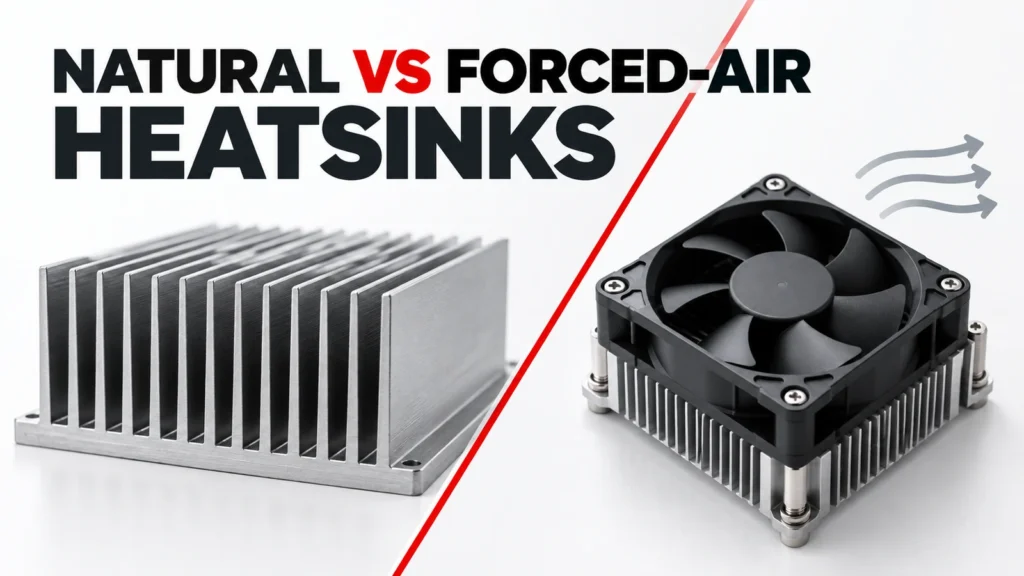
This comparison explains the thermal design evidence required to choose passive or forced-air heatsinking. It gives no universal heat dissipation rating, airflow value, thermal resistance or fan lifetime for a product without exact test conditions.
Päätöksenteon lähtökohdat lyhyesti
| Arviointialue | Projektin lähtötiedot | Pyydettävät todisteet |
|---|---|---|
| DEVICE LOSS | Määritä todellinen toimintatila ja järjestelmän rajat | Hyväksytty järjestelmäpiirros tai toimintapäiväkirja |
| INTERFACE | Nimeä rajapinta, geometria tai ohjausodotus | Tarkka laite- tai tuotetiedote |
| HEATSINK | Laitteen kunto ja asennusolosuhteet | Rakennuspaikka- tai paneelipiirros |
| AMBIENT | Kuvaile palvelua ja hyväksymisvaatimuksia | Tarkat ohjeet ja testaussuunnitelma |
Two cooling methods, one thermal obligation
A natural-convection heatsink transfers heat to surrounding air without a dedicated fan moving air through its fins. A forced-air heatsink uses directed airflow to change that transfer condition. The practical choice is not determined by appearance or the word “power” in a module description. It depends on verified semiconductor loss, allowable temperatures, ambient conditions, mounting and the entire thermal path.
Both approaches can be appropriate in industrial equipment. Passive cooling avoids dependence on a fan, but often requires a compatible installation orientation, space and ambient. Forced air can support a different heat-transfer condition, but introduces airflow, power, acoustic, filtration, service and failure-state questions. The exact device data decides whether either approach has sufficient margin.
Calculate losses before comparing fin shapes
The starting input is the power module’s heat dissipation under representative operating states. Obtain loss information for the exact semiconductor order code and the intended electrical duty. A nameplate current or visually large package does not equal the heat that must leave the assembly. Include continuous and relevant transient conditions in the project brief.
Document whether the module is an SCR, rectifier, diode or another device, because conduction and switching behavior may differ. If the loss model is uncertain, do not backfill a generic wattage. Identify the missing curve or supplier calculation and treat the heatsink selection as provisional until it is supplied.
Trace the complete thermal path
Heat moves from junction through the device package, mounting interface and heatsink into the surrounding air. Each boundary needs evidence. The mechanical contact, approved interface material, mounting pressure and surface condition affect the result, as does the airflow or convection environment at the fins. A quoted heatsink value without its test conditions is not transferable to every assembly.
Ask for the exact thermal data, mounting instructions and a drawing that shows contact area and clearances. Compare the semiconductor’s allowable temperature with the proposed operating states using the supplier’s method. Reserve a prototype temperature check for conditions that are difficult to model, such as a densely populated enclosure or uncertain local air recirculation.
Natural convection needs a real installation context
Passive performance depends on how air can enter, warm and leave the fin channels. Orientation, vertical clearance, adjacent equipment and enclosure temperature may change the result materially. A bench test in open air may not describe a crowded cabinet with nearby heat sources. Define the actual mounting plane and free space before accepting a catalog thermal curve.
The system should also account for warm-start and high-ambient conditions. The passive option may be attractive where fan maintenance is difficult, but simplicity does not waive a thermal check. If the only available data describes a different orientation or ambient, request an applicable test or engineering review.
Forced air is an operating system, not an accessory
A fan rating quoted in free air does not reveal the flow through a heatsink inside a cabinet. Filters, grilles, duct turns, neighboring components and air recirculation can restrict the actual path. Request the fan curve and heatsink performance under documented airflow conditions, then evaluate the assembled path rather than adding nominal component values.
Decide who monitors fan operation and what the equipment does when airflow is lost. A forced-air design can be valid only if its power supply, wiring, maintenance access, replacement plan and alarm behavior are accepted by the project. Include these controls in the quotation and assembly test plan.
Compare reliability and service honestly
A passive design can reduce moving parts but may use more volume and still require clean air passages. A forced-air design can fit a different thermal envelope but needs fan and filter inspection. Dust accumulation affects both fin exposure and the airflow system. State the intended service interval as a project decision, not as an invented universal product property.
Procurement should compare delivered scope: heatsink extrusion, machining, mounting hardware, interface material, fan, guard, filter and cables. Two quotes for “the same heatsink” may include different work. Normalize those inclusions before comparing lead time or price.
Confirm with an assembly-level temperature test
A calculation screens candidates; a representative assembly test closes uncertainty. Measure the relevant points under the operating states and ambient conditions specified by the project engineer, and record how the result maps to the exact device limit. Do not substitute an enclosure air reading for a junction calculation without a supported method.
The test record should identify the exact semiconductor, heatsink, fan configuration if used, mounting material, orientation and enclosure state. A later change to any of these inputs can invalidate the result. Keep the approved thermal configuration with the product build documentation.
Laadi tarkka mallipohjainen todistusaineistotiedosto
For the proposed Power Module Heatsink, create one approval record with the complete order code, the exact datasheet, the relevant drawing, installation instructions and any curve or test report used for the decision. Date each file or record its revision. A product-family page is useful for discovery, but it does not prove that a particular configuration includes an optional feature or meets a system condition.
Vertaa jokaista vaatimusta saman tilattavan tuotteen teknisiin tietoihin. Älä yhdistä yhden variantin tuoteryhmän enimmäisarvoa toisen variantin kytkentäkaavioon, lisävarusteluetteloon tai lämpökäyrään. Kirjaa selvittämättömät kohdat näkyvään selvennyssarakkeeseen. Jos toimittaja ehdottaa korvaavaa tuotetta, toista kyseinen tarkastus ennen kuin hyväksyt sen teknisen vastaavuuden.
Pidä projektin panokset erillään toimittajien laskuista
Hanketiimi vastaa sovellustiedoista: lähteestä ja latauksesta, toimintatiloista, ympäristöstä, asennuksesta, ohjausjärjestelmistä, huollosta ja hyväksymiskriteereistä. Toimittaja vastaa ehdotetusta tilauskoodista ja laitteita tukevasta dokumentaatiosta. Kumpikaan osapuoli ei saa täyttää puutteita ulkonäön tai tutun sukunimen perusteella tehtyjen päätelmien avulla. Hyödyllinen vastaus voi olla “tietoja ei vielä saatavilla”, edellyttäen että puuttuvalla kohteella on vastuuhenkilö ja määräaika.
Jäädyttäkää kyseinen tiedot, kun tarjouksia verrataan. Jos käyttöolosuhteet, kotelo, virtalähde, mittari, moottori tai suojausratkaisu muuttuu, laatikaa päivitetty syöttölomake ja pyytäkää kutakin toimittajaa vahvistamaan ehdokkaansa uudelleen. Näin vältetään se, että varhaista tarjousta pidetään myöhemmän suunnittelun hyväksyntänä.
Kuinka vertailla toimittajien tarjouksia
| Tarjoustuote | Mitä verrata | Hyväksymistodisteet |
|---|---|---|
| Määriteltävissä oleva laajuus | Koko koodi ja mukana toimitettavat lisävarusteet | Tarkka tarjous ja materiaaliluettelo |
| Sähköasennus | Kaikki sovellettavat toimintatilat | Tarkka luokitus-, piiri- tai käyräasiakirja |
| Mekaaninen istuvuus | Asennus, liittimet ja pääsy | Piirustus- ja asennusohjeet |
| Huoltosuunnitelma | Tarkastus- ja vaihtomenetelmä | Huolto-ohjeet |
| Avoimet erät | Oletukset, poissulkemiset ja poikkeukset | Kirjallisten selvennysten rekisteri |
Normalize each Power Module Heatsink offer to the same application record. A shorter lead time or lower price is meaningful only after the technical scope is comparable. Record whether each supplier included the required accessories, documents and support for commissioning. Keep exceptions explicit, especially when the candidate needs a change to the panel or control design.
Hankinnan ja käyttöönoton tarkastuspisteet
- Vahvista järjestelmän rajat, toimintatilat ja hyväksymiskriteerit.
- Tarkista yksi täydellinen tilauskoodi vertaamalla sitä tarkkoihin mallidokumentteihin.
- Ratkaise sähkö-, mekaaniset, ympäristöön liittyvät ja huoltoon liittyvät poikkeustilanteet.
- Vertaa tarjousten sisältöä ja asiakirjojen muutoksia.
- Tarkista vastaanotettu tuote hyväksytyn tietueen perusteella.
- Testaa valmis kokoonpano projektin hyväksytyn menettelyn mukaisesti.
Saapuvien tavaroiden tarkastuksessa on tarkistettava, että toimitetut etiketit, liittimet, mukana toimitetut lisävarusteet ja asiakirjat vastaavat hyväksyttyä tilausta. Saman tuoteperheen korvaavaa tuotetta ei voida hyväksyä automaattisesti. Käyttöönoton yhteydessä on tarkistettava sovelluksesta riippuvat toiminnot, joita ei voida selvittää pelkästään komponenttien käyttöohjeista. Testisuunnitelmassa on mainittava edustavat tilat ja hyväksymiskriteerit ilman, että määritellään yleispäteviä raja-arvoja.
Tarjouspyynnön laatimisen tarkistuslista
A useful request for quotation on natural convection vs forced air heatsink is concise but complete. Ask for the exact orderable configuration and list unknown values as questions. Do not let the sales description silently answer a technical question that belongs to a calculation, a drawing or a test.
- DEVICE LOSS
- INTERFACE
- HEATSINK
- AMBIENT
- FAN CURVE
- RESTRICTION
- FAILURE MODE
- TEST
- Sovellettavat asiakirjan versiot
- Määrä, toimituskohde ja toimituksen laajuus
Pyydä toimittajaa ilmoittamaan poissulkemiset, oletukset ja valinnaiset kohteet erikseen. Säilytä teknisten selvennysten pöytäkirja tarjouksen mukana, jotta hankinta- ja suunnitteluosastot voivat tarkastella samaa tarjouskohdetta. Jos jokin keskeinen tieto puuttuu edelleen, ehdokas voi silti olla kaupallisesti kiinnostava, mutta sen tekninen hyväksyntä jää avoimeksi.
Usein kysytyt kysymykset
Can a Power Module Heatsink be chosen from one headline rating?
Ei. Sovellusta, tarkkaa kokoonpanoa sekä asiaankuuluvia sähköisiä, mekaanisia, lämpöteknisiä ja ympäristöolosuhteita on tarkasteltava kokonaisuutena. Tuoteluettelon nimike on lähtökohta selvitystyölle, ei täydellinen hyväksymistodistus.
Osoittaako sukulaisuusivu tarkan sukulaisuussuhteen vai vain etäisen sukulaisuuden?
Ei. Käytä ehdotettua tilauskoodia sekä sen nykyistä piirustusta, tuotetietolehteä ja asennusohjeita. Valinnaiset ominaisuudet tai vaihtoehtoiset liitäntäjärjestelyt voivat vaihdella saman tuoteperheen sisällä.
Entä jos toimittaja ei pysty toimittamaan yhtä vaadittua arvoa?
Merkitse arvo ratkaisemattomaksi, selvitä, kuka sen hankkii, ja keskeytä asiaa koskeva päätöksenteko. Älä muuta oletusta vahvistetuksi väitteeksi pelkästään siksi, että hankintapäivä lähestyy.
Mistä jatkaa arvostelua
Selaa Power Module Heatsink category käytettävissä olevan tuoteperheen osalta, tarkista sitten aiheeseen liittyvä tuotesivu alustavana lähtökohtana. Näillä sivuilla esitetään kaupallinen kohde; tarkat mallidokumentit määrittävät sovelluksen sopivuuden. Jos haluatte tehdä projektikohtaisen vertailun, lähettäkää järjestelmän syöttötiedot ja avoimet kysymykset osoitteeseen RITOKS-kyselylomake.
Jos todisteiden tarkastelun jälkeen jokin toinen laite tai menetelmä vaikuttaa sopivammalta, päivitä suunnitteluohjeet ennen kuin pyydät korvaavaa ratkaisua. Varmista, että dokumentaatio liittyy lopulliseen piiriin ja asennukseen, ei pelkästään siihen tuoteperheeseen, joka herätti alun perin huomion.