
Power Module Heatsinks · Comparison
Natural-Convection vs Forced-Air Heatsinks for Power Modules
Natural-Convection vs Forced-Air Heatsinks for Power Modules starts with the system question: When does the thermal design require airflow rather than passive cooling? A useful selection brief connects the equipment duty, installation and receiving system to a specific orderable product. The article below separates project inputs from product evidence so that a familiar product name does not quietly become a technical approval.
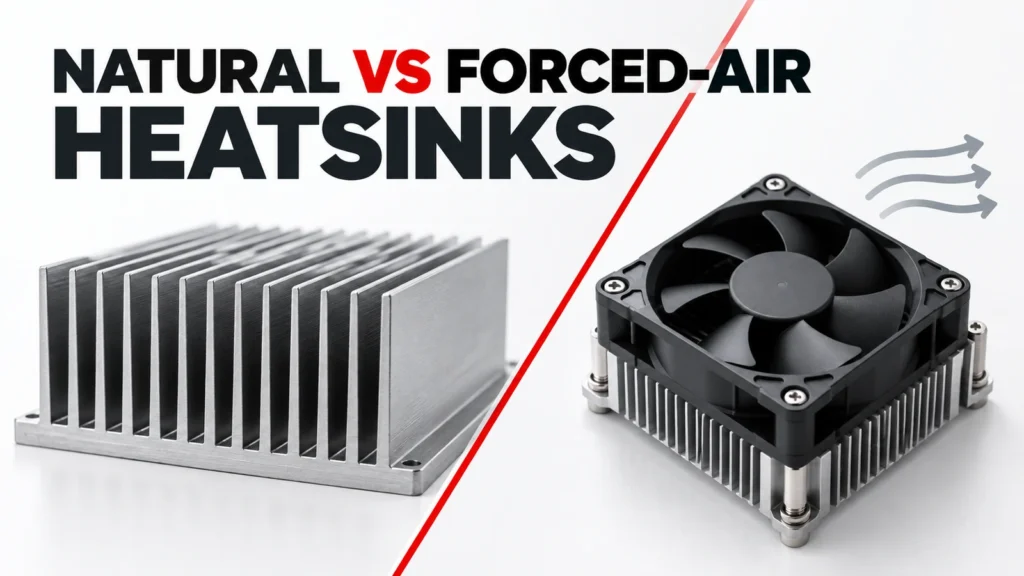
This comparison explains the thermal design evidence required to choose passive or forced-air heatsinking. It gives no universal heat dissipation rating, airflow value, thermal resistance or fan lifetime for a product without exact test conditions.
Översikt över underlag för beslut
| Granskningsområde | Projektunderlag | Bevis som ska begäras |
|---|---|---|
| DEVICE LOSS | Definiera det faktiska driftläget och systemgränsen | Godkänd systemritning eller driftsprotokoll |
| INTERFACE | Ange gränssnitt, geometri eller förväntningar på styrning | Exakt utrustnings- eller produktdokument |
| HEATSINK | Miljö- och installationsförhållanden | Plats- eller panelteckning |
| AMBIENT | Beskriv krav på tjänsten och godkännande | Exakta instruktioner och testplan |
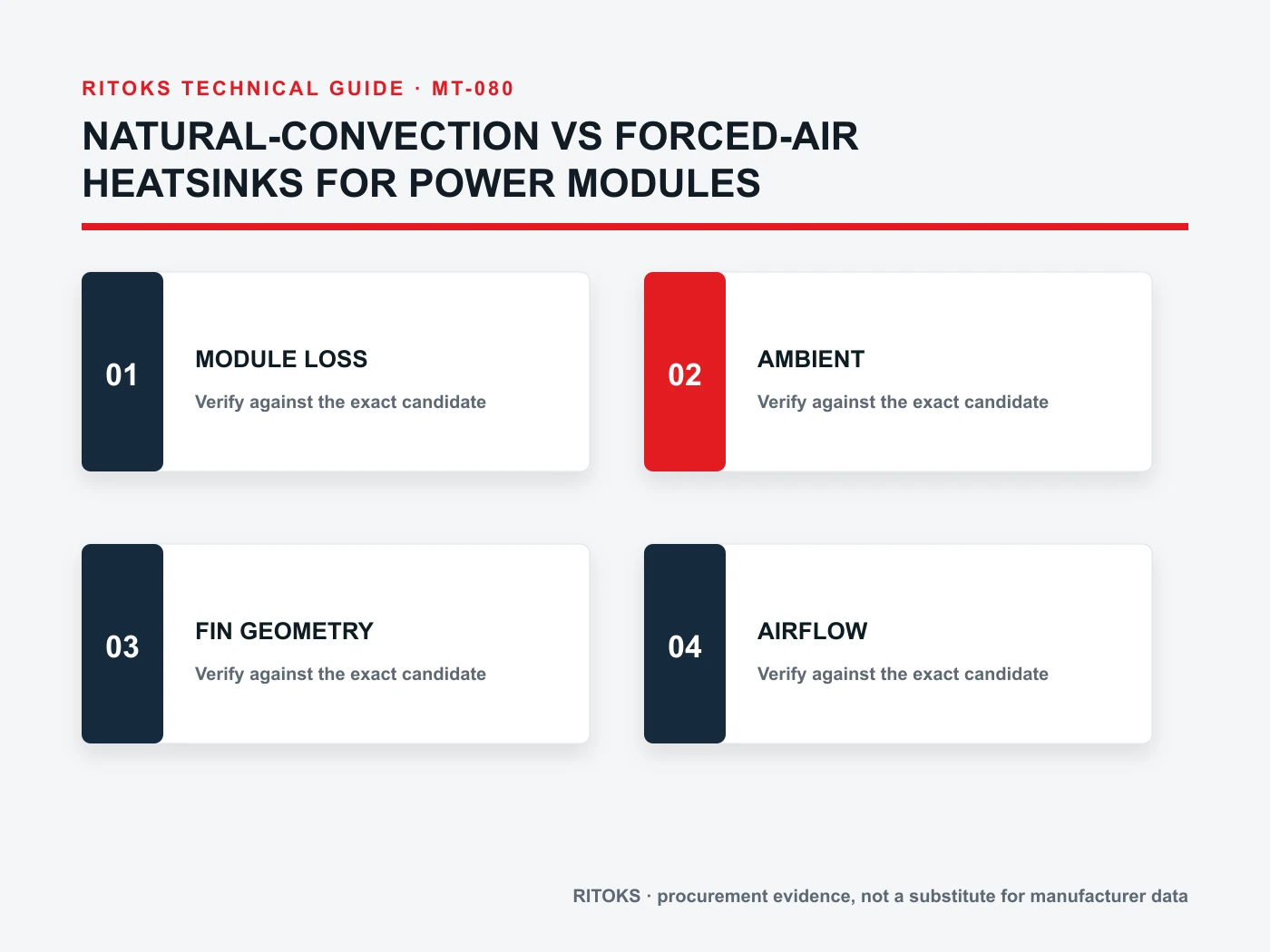
Two cooling methods, one thermal obligation
A natural-convection heatsink transfers heat to surrounding air without a dedicated fan moving air through its fins. A forced-air heatsink uses directed airflow to change that transfer condition. The practical choice is not determined by appearance or the word “power” in a module description. It depends on verified semiconductor loss, allowable temperatures, ambient conditions, mounting and the entire thermal path.
Both approaches can be appropriate in industrial equipment. Passive cooling avoids dependence on a fan, but often requires a compatible installation orientation, space and ambient. Forced air can support a different heat-transfer condition, but introduces airflow, power, acoustic, filtration, service and failure-state questions. The exact device data decides whether either approach has sufficient margin.
Calculate losses before comparing fin shapes
The starting input is the power module’s heat dissipation under representative operating states. Obtain loss information for the exact semiconductor order code and the intended electrical duty. A nameplate current or visually large package does not equal the heat that must leave the assembly. Include continuous and relevant transient conditions in the project brief.
Document whether the module is an SCR, rectifier, diode or another device, because conduction and switching behavior may differ. If the loss model is uncertain, do not backfill a generic wattage. Identify the missing curve or supplier calculation and treat the heatsink selection as provisional until it is supplied.
Trace the complete thermal path
Heat moves from junction through the device package, mounting interface and heatsink into the surrounding air. Each boundary needs evidence. The mechanical contact, approved interface material, mounting pressure and surface condition affect the result, as does the airflow or convection environment at the fins. A quoted heatsink value without its test conditions is not transferable to every assembly.
Ask for the exact thermal data, mounting instructions and a drawing that shows contact area and clearances. Compare the semiconductor’s allowable temperature with the proposed operating states using the supplier’s method. Reserve a prototype temperature check for conditions that are difficult to model, such as a densely populated enclosure or uncertain local air recirculation.
Natural convection needs a real installation context
Passive performance depends on how air can enter, warm and leave the fin channels. Orientation, vertical clearance, adjacent equipment and enclosure temperature may change the result materially. A bench test in open air may not describe a crowded cabinet with nearby heat sources. Define the actual mounting plane and free space before accepting a catalog thermal curve.
The system should also account for warm-start and high-ambient conditions. The passive option may be attractive where fan maintenance is difficult, but simplicity does not waive a thermal check. If the only available data describes a different orientation or ambient, request an applicable test or engineering review.
Forced air is an operating system, not an accessory
A fan rating quoted in free air does not reveal the flow through a heatsink inside a cabinet. Filters, grilles, duct turns, neighboring components and air recirculation can restrict the actual path. Request the fan curve and heatsink performance under documented airflow conditions, then evaluate the assembled path rather than adding nominal component values.
Decide who monitors fan operation and what the equipment does when airflow is lost. A forced-air design can be valid only if its power supply, wiring, maintenance access, replacement plan and alarm behavior are accepted by the project. Include these controls in the quotation and assembly test plan.
Compare reliability and service honestly
A passive design can reduce moving parts but may use more volume and still require clean air passages. A forced-air design can fit a different thermal envelope but needs fan and filter inspection. Dust accumulation affects both fin exposure and the airflow system. State the intended service interval as a project decision, not as an invented universal product property.
Procurement should compare delivered scope: heatsink extrusion, machining, mounting hardware, interface material, fan, guard, filter and cables. Two quotes for “the same heatsink” may include different work. Normalize those inclusions before comparing lead time or price.
Confirm with an assembly-level temperature test
A calculation screens candidates; a representative assembly test closes uncertainty. Measure the relevant points under the operating states and ambient conditions specified by the project engineer, and record how the result maps to the exact device limit. Do not substitute an enclosure air reading for a junction calculation without a supported method.
The test record should identify the exact semiconductor, heatsink, fan configuration if used, mounting material, orientation and enclosure state. A later change to any of these inputs can invalidate the result. Keep the approved thermal configuration with the product build documentation.
Skapa en bevisfil med en exakt modell
For the proposed Power Module Heatsink, create one approval record with the complete order code, the exact datasheet, the relevant drawing, installation instructions and any curve or test report used for the decision. Date each file or record its revision. A product-family page is useful for discovery, but it does not prove that a particular configuration includes an optional feature or meets a system condition.
Jämför varje krav med underlaget för samma beställningsbara artikel. Kombinera inte en maximal värde för produktfamiljen från en variant med ett kretsschema, en tillbehörslista eller en termisk kurva från en annan. Placera fält som inte är ifyllda i en synlig kolumn för förtydliganden. Om en leverantör föreslår en ersättningsprodukt, upprepa den berörda granskningen innan du godkänner dess tekniska likvärdighet.
Håll projektinsatserna åtskilda från leverantörernas fakturor
Projektgruppen ansvarar för applikationsdokumentationen: källa och belastning, driftstillstånd, miljö, montering, styrsystem, service och godkännandekriterier. Leverantören ansvarar för den föreslagna orderkoden och underbyggande dokumentation för enheten. Ingen av parterna bör fylla i luckor genom att dra slutsatser utifrån utseende eller ett välbekant släktnamn. Ett användbart svar kan vara “data ännu inte tillgängliga”, förutsatt att den saknade uppgiften har en ansvarig och ett slutdatum.
Frys den uppgiften medan erbjudandena jämförs. Om driftsförhållanden, skåp, källa, mätare, motor eller skyddsarkitektur ändras, ska du utfärda ett reviderat inmatningsblad och be varje leverantör att på nytt bekräfta sitt förslag. Detta förhindrar att en tidig offert betraktas som ett godkännande av en senare konstruktion.
Så här jämför du leverantörernas erbjudanden
| Erbjudandeartikel | Vad man ska jämföra | Bevis på godkännande |
|---|---|---|
| Beställningsomfattning | Komplett kod och medföljande tillbehör | Exakt offert och materiallista |
| Elinstallation | Alla tillämpliga driftlägen | Dokument med exakta värden, kretsdiagram eller kurvor |
| Mekanisk passform | Montering, anslutningar och åtkomst | Ritningar och monteringsanvisningar |
| Serviceplan | Metod för inspektion och utbyte | Underhållsanvisningar |
| Öppna poster | Antaganden, undantag och särskilda fall | Register över skriftliga förtydliganden |
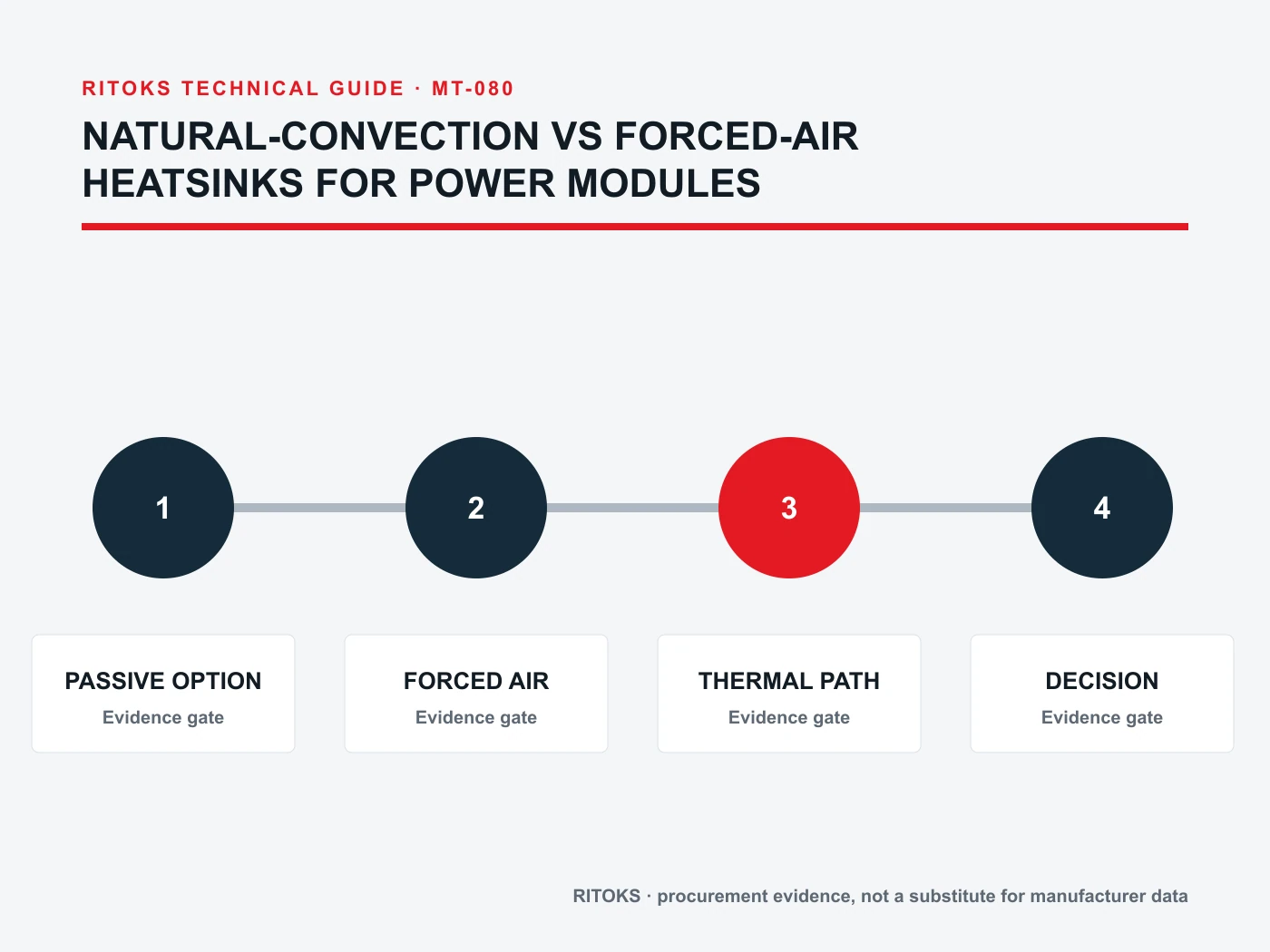
Normalize each Power Module Heatsink offer to the same application record. A shorter lead time or lower price is meaningful only after the technical scope is comparable. Record whether each supplier included the required accessories, documents and support for commissioning. Keep exceptions explicit, especially when the candidate needs a change to the panel or control design.
Kontrollpunkter vid upphandling och idrifttagning
- Bekräfta systemgränserna, driftlägena och godkännandekriterierna.
- Jämför en fullständig beställningskod med dokumenten över de exakta modellerna.
- Åtgärda avvikelser av elektrisk, mekanisk, miljömässig och driftsmässig karaktär.
- Jämför levererad omfattning och dokumentändringar mellan olika anbud.
- Jämför den mottagna varan med den godkända dokumentationen.
- Testa den färdigmonterade enheten enligt projektets godkända förfarande.
Vid mottagningskontrollen ska den levererade etiketten, anslutningarna, medföljande tillbehör och dokument kontrolleras mot den godkända beställningen. En ersättningsprodukt från samma produktserie godtas inte automatiskt. Vid idrifttagningen ska de användningsspecifika funktionerna kontrolleras, eftersom dessa inte kan fastställas enbart utifrån komponentdokumentationen. Testplanen ska ange representativa tillstånd och godkännandekriterier utan att fastställa generella gränsvärden.
Checklista för förberedelse av anbudsförfrågan
A useful request for quotation on natural convection vs forced air heatsink is concise but complete. Ask for the exact orderable configuration and list unknown values as questions. Do not let the sales description silently answer a technical question that belongs to a calculation, a drawing or a test.
- DEVICE LOSS
- INTERFACE
- HEATSINK
- AMBIENT
- FAN CURVE
- RESTRICTION
- FAILURE MODE
- TEST
- Gällande dokumentversioner
- Antal, leveransadress och leveransomfattning
Be leverantören att separat ange undantag, antaganden och valfria poster. Förvara dokumentet med tekniska förtydliganden tillsammans med offerten så att inköpsavdelningen och teknikavdelningen granskar samma omfattning. Om en viktig uppgift fortfarande saknas kan anbudsgivaren fortfarande vara kommersiellt intressant, men det tekniska godkännandet förblir öppet.
Vanliga frågor
Can a Power Module Heatsink be chosen from one headline rating?
Nej. Ansökan, den exakta konfigurationen och relevanta elektriska, mekaniska, termiska och miljömässiga förhållanden måste granskas tillsammans. En katalogrubrik är en utgångspunkt för utredningen, inte ett fullständigt godkännandedokument.
Bevisar en familjesida en exakt släktskap eller anknytning?
Nej. Använd den föreslagna beställningskoden samt den aktuella ritningen, databladet och monteringsanvisningarna. Tillval eller alternativa anslutningskonfigurationer kan variera inom samma produktserie.
Vad händer om leverantören inte kan ange ett av de nödvändiga värdena?
Markera värdet som ”olöst”, fastställ vem som ska anskaffa det och pausa det berörda beslutet. Omvandla inte ett antagande till ett verifierat påstående bara för att ett inköpsdatum närmar sig.
Var ska granskningen fortsätta?
Bläddra bland Power Module Heatsink category för den tillgängliga produktfamiljen, och granska sedan sida med relaterade produkter som en möjlig utgångspunkt. På dessa sidor anges den kommersiella användningsområdet; de exakta modelldokumenten avgör om applikationen är lämplig. För en projektspecifik jämförelse, skicka systemuppgifterna och eventuella frågor via RITOKS:s förfrågningssida.
Om det efter en granskning av underlaget framgår att en annan enhet eller metod är mer lämplig, bör du revidera designbeskrivningen innan du begär ett utbyte. Se till att dokumentationen är kopplad till den slutgiltiga kretsen och installationen, inte bara till den produktfamilj som först väckte intresse.