
Power Module Heatsinks · Comparison
Natural-Convection vs Forced-Air Heatsinks for Power Modules
Natural-Convection vs Forced-Air Heatsinks for Power Modules starts with the system question: When does the thermal design require airflow rather than passive cooling? A useful selection brief connects the equipment duty, installation and receiving system to a specific orderable product. The article below separates project inputs from product evidence so that a familiar product name does not quietly become a technical approval.
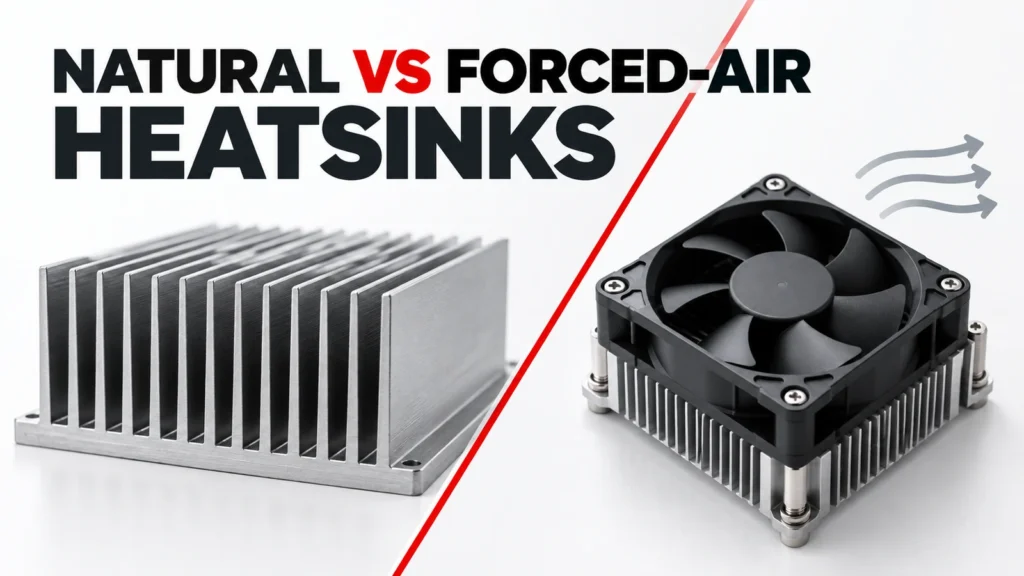
This comparison explains the thermal design evidence required to choose passive or forced-air heatsinking. It gives no universal heat dissipation rating, airflow value, thermal resistance or fan lifetime for a product without exact test conditions.
Tổng quan về các yếu tố đầu vào cho quyết định
| Khu vực đánh giá | Dữ liệu đầu vào của dự án | Chứng cứ cần yêu cầu |
|---|---|---|
| DEVICE LOSS | Xác định trạng thái hoạt động thực tế và ranh giới hệ thống | Bản vẽ hệ thống đã được phê duyệt hoặc sổ ghi chép ca trực |
| INTERFACE | Đặt tên cho giao diện, hình học hoặc yêu cầu về điều khiển | Tài liệu chi tiết về thiết bị hoặc sản phẩm |
| HEATSINK | Tình trạng môi trường và điều kiện lắp đặt | Bản vẽ mặt bằng hoặc bản vẽ bảng điều khiển |
| AMBIENT | Mô tả các yêu cầu về dịch vụ và việc chấp nhận | Hướng dẫn chi tiết và kế hoạch kiểm thử |
Two cooling methods, one thermal obligation
A natural-convection heatsink transfers heat to surrounding air without a dedicated fan moving air through its fins. A forced-air heatsink uses directed airflow to change that transfer condition. The practical choice is not determined by appearance or the word “power” in a module description. It depends on verified semiconductor loss, allowable temperatures, ambient conditions, mounting and the entire thermal path.
Both approaches can be appropriate in industrial equipment. Passive cooling avoids dependence on a fan, but often requires a compatible installation orientation, space and ambient. Forced air can support a different heat-transfer condition, but introduces airflow, power, acoustic, filtration, service and failure-state questions. The exact device data decides whether either approach has sufficient margin.
Calculate losses before comparing fin shapes
The starting input is the power module’s heat dissipation under representative operating states. Obtain loss information for the exact semiconductor order code and the intended electrical duty. A nameplate current or visually large package does not equal the heat that must leave the assembly. Include continuous and relevant transient conditions in the project brief.
Document whether the module is an SCR, rectifier, diode or another device, because conduction and switching behavior may differ. If the loss model is uncertain, do not backfill a generic wattage. Identify the missing curve or supplier calculation and treat the heatsink selection as provisional until it is supplied.
Trace the complete thermal path
Heat moves from junction through the device package, mounting interface and heatsink into the surrounding air. Each boundary needs evidence. The mechanical contact, approved interface material, mounting pressure and surface condition affect the result, as does the airflow or convection environment at the fins. A quoted heatsink value without its test conditions is not transferable to every assembly.
Ask for the exact thermal data, mounting instructions and a drawing that shows contact area and clearances. Compare the semiconductor’s allowable temperature with the proposed operating states using the supplier’s method. Reserve a prototype temperature check for conditions that are difficult to model, such as a densely populated enclosure or uncertain local air recirculation.
Natural convection needs a real installation context
Passive performance depends on how air can enter, warm and leave the fin channels. Orientation, vertical clearance, adjacent equipment and enclosure temperature may change the result materially. A bench test in open air may not describe a crowded cabinet with nearby heat sources. Define the actual mounting plane and free space before accepting a catalog thermal curve.
The system should also account for warm-start and high-ambient conditions. The passive option may be attractive where fan maintenance is difficult, but simplicity does not waive a thermal check. If the only available data describes a different orientation or ambient, request an applicable test or engineering review.
Forced air is an operating system, not an accessory
A fan rating quoted in free air does not reveal the flow through a heatsink inside a cabinet. Filters, grilles, duct turns, neighboring components and air recirculation can restrict the actual path. Request the fan curve and heatsink performance under documented airflow conditions, then evaluate the assembled path rather than adding nominal component values.
Decide who monitors fan operation and what the equipment does when airflow is lost. A forced-air design can be valid only if its power supply, wiring, maintenance access, replacement plan and alarm behavior are accepted by the project. Include these controls in the quotation and assembly test plan.
Compare reliability and service honestly
A passive design can reduce moving parts but may use more volume and still require clean air passages. A forced-air design can fit a different thermal envelope but needs fan and filter inspection. Dust accumulation affects both fin exposure and the airflow system. State the intended service interval as a project decision, not as an invented universal product property.
Procurement should compare delivered scope: heatsink extrusion, machining, mounting hardware, interface material, fan, guard, filter and cables. Two quotes for “the same heatsink” may include different work. Normalize those inclusions before comparing lead time or price.
Confirm with an assembly-level temperature test
A calculation screens candidates; a representative assembly test closes uncertainty. Measure the relevant points under the operating states and ambient conditions specified by the project engineer, and record how the result maps to the exact device limit. Do not substitute an enclosure air reading for a junction calculation without a supported method.
The test record should identify the exact semiconductor, heatsink, fan configuration if used, mounting material, orientation and enclosure state. A later change to any of these inputs can invalidate the result. Keep the approved thermal configuration with the product build documentation.
Tạo tệp bằng chứng dựa trên mô hình chính xác
For the proposed Power Module Heatsink, create one approval record with the complete order code, the exact datasheet, the relevant drawing, installation instructions and any curve or test report used for the decision. Date each file or record its revision. A product-family page is useful for discovery, but it does not prove that a particular configuration includes an optional feature or meets a system condition.
So sánh từng yêu cầu với các bằng chứng liên quan đến cùng một mặt hàng có thể đặt hàng. Không được kết hợp giá trị tối đa của dòng sản phẩm từ một biến thể với sơ đồ mạch, danh sách phụ kiện hoặc đường cong nhiệt từ một biến thể khác. Đưa các trường chưa được làm rõ vào một cột giải thích dễ thấy. Nếu nhà cung cấp đề xuất một sản phẩm thay thế, hãy tiến hành lại quá trình đánh giá liên quan trước khi phê duyệt tính tương đương kỹ thuật của sản phẩm đó.
Giữ các đầu vào của dự án tách biệt với các yêu cầu thanh toán của nhà cung cấp
Nhóm dự án chịu trách nhiệm về hồ sơ ứng dụng: nguồn và tải, trạng thái hoạt động, môi trường, cách lắp đặt, các bộ điều khiển, dịch vụ và tiêu chí nghiệm thu. Nhà cung cấp chịu trách nhiệm về mã đơn hàng đề xuất và bằng chứng kỹ thuật hỗ trợ cho thiết bị. Cả hai bên không nên lấp đầy khoảng trống bằng cách suy diễn từ hình thức bên ngoài hoặc tên họ quen thuộc. Một câu trả lời hữu ích có thể là “dữ liệu chưa có sẵn”, miễn là mục còn thiếu có người chịu trách nhiệm và ngày hoàn thành.
Hãy tạm dừng hồ sơ đó trong khi so sánh các đề xuất. Nếu có thay đổi về nhiệm vụ vận hành, tủ điều khiển, nguồn cấp, đồng hồ đo, động cơ hoặc hệ thống bảo vệ, hãy ban hành một bảng dữ liệu đầu vào đã được điều chỉnh và yêu cầu mỗi nhà cung cấp xác nhận lại phương án đề xuất của mình. Điều này giúp tránh việc báo giá ban đầu bị coi là sự chấp thuận cho thiết kế sau này.
Cách so sánh các đề xuất của nhà cung cấp
| Sản phẩm khuyến mãi | So sánh những yếu tố nào | Bằng chứng phê duyệt |
|---|---|---|
| Phạm vi có thể sắp xếp | Mã sản phẩm đầy đủ và các phụ kiện đi kèm | Báo giá chính xác và bảng kê vật tư |
| Lắp đặt hệ thống điện | Tất cả các trạng thái hoạt động có liên quan | Tài liệu về thông số kỹ thuật chính xác, mạch điện hoặc đường cong |
| Khớp cơ học | Giá đỡ, đầu nối và lối vào | Hướng dẫn vẽ và lắp đặt |
| Gói dịch vụ | Phương pháp kiểm tra và thay thế | Hướng dẫn bảo trì |
| Các khoản chưa thanh toán | Các giả định, các trường hợp loại trừ và các trường hợp ngoại lệ | Sổ đăng ký các văn bản giải thích |
Normalize each Power Module Heatsink offer to the same application record. A shorter lead time or lower price is meaningful only after the technical scope is comparable. Record whether each supplier included the required accessories, documents and support for commissioning. Keep exceptions explicit, especially when the candidate needs a change to the panel or control design.
Các mốc kiểm tra trong quá trình mua sắm và nghiệm thu
- Xác nhận ranh giới hệ thống, các trạng thái vận hành và các tiêu chí chấp nhận.
- Kiểm tra một mã đơn hàng hoàn chỉnh dựa trên các tài liệu mô hình chính xác.
- Xử lý các sự cố liên quan đến điện, cơ khí, môi trường và dịch vụ.
- So sánh phạm vi công việc đã cam kết và các bản sửa đổi tài liệu giữa các đề xuất.
- Kiểm tra hàng hóa đã nhận so với hồ sơ đã được phê duyệt.
- Kiểm tra cụm lắp ráp đã hoàn thiện theo quy trình được phê duyệt của dự án.
Khi kiểm tra hàng nhập, cần đối chiếu nhãn mác, các đầu nối, phụ kiện đi kèm và tài liệu được giao với đơn đặt hàng đã được phê duyệt. Việc thay thế bằng sản phẩm cùng dòng không tự động được chấp nhận. Khi đưa vào vận hành, cần xác minh các chức năng phụ thuộc vào ứng dụng mà tài liệu hướng dẫn của linh kiện không thể xác định được. Kế hoạch thử nghiệm cần nêu rõ các trạng thái đại diện và tiêu chí chấp nhận mà không tự ý đặt ra các giới hạn chung chung.
Danh sách kiểm tra việc chuẩn bị hồ sơ yêu cầu báo giá (RFQ)
A useful request for quotation on natural convection vs forced air heatsink is concise but complete. Ask for the exact orderable configuration and list unknown values as questions. Do not let the sales description silently answer a technical question that belongs to a calculation, a drawing or a test.
- DEVICE LOSS
- INTERFACE
- HEATSINK
- AMBIENT
- FAN CURVE
- RESTRICTION
- FAILURE MODE
- TEST
- Các phiên bản tài liệu áp dụng
- Số lượng, điểm đến và phạm vi giao hàng
Yêu cầu nhà cung cấp nêu rõ các trường hợp loại trừ, giả định và các hạng mục tùy chọn một cách riêng biệt. Lưu giữ bản ghi giải thích kỹ thuật cùng với báo giá để bộ phận mua sắm và kỹ thuật xem xét cùng một phạm vi. Nếu vẫn còn thiếu một yếu tố đầu vào quan trọng, nhà cung cấp tiềm năng đó có thể vẫn hấp dẫn về mặt thương mại, nhưng việc phê duyệt kỹ thuật đối với nhà cung cấp đó vẫn chưa được quyết định.
Các câu hỏi thường gặp
Can a Power Module Heatsink be chosen from one headline rating?
Không. Phải xem xét tổng thể ứng dụng, cấu hình cụ thể cùng các điều kiện điện, cơ khí, nhiệt và môi trường có liên quan. Tên sản phẩm trong danh mục chỉ là điểm khởi đầu để tìm hiểu, chứ không phải là hồ sơ phê duyệt đầy đủ.
Một trang gia đình có chứng minh được mối quan hệ trực tiếp hay chỉ là mối quan hệ gián tiếp không?
Không. Hãy sử dụng mã đặt hàng được đề xuất cùng với bản vẽ hiện tại, bảng thông số kỹ thuật và hướng dẫn lắp đặt tương ứng. Các tính năng tùy chọn hoặc cách bố trí đầu nối thay thế có thể khác nhau trong cùng một dòng sản phẩm.
Nếu nhà cung cấp không thể cung cấp một giá trị bắt buộc thì sao?
Đánh dấu giá trị đó là chưa được giải quyết, xác định ai sẽ thu thập thông tin đó và tạm dừng quyết định liên quan. Không nên chuyển một giả định thành một khẳng định đã được xác minh chỉ vì ngày mua hàng đang đến gần.
Tiếp tục đánh giá ở đâu
Duyệt qua Power Module Heatsink category đối với dòng sản phẩm hiện có, sau đó xem xét trang sản phẩm liên quan như một điểm khởi đầu tham khảo. Các trang này xác định mục đích thương mại; các mẫu tài liệu cụ thể sẽ quyết định tính phù hợp của ứng dụng. Để so sánh cụ thể cho từng dự án, vui lòng gửi các thông tin đầu vào của hệ thống và các thắc mắc qua Trang liên hệ của RITOKS.
Nếu sau khi xem xét các bằng chứng, một thiết bị hoặc phương pháp khác tỏ ra phù hợp hơn, hãy điều chỉnh bản tóm tắt thiết kế trước khi đề nghị thay thế. Hãy đảm bảo hồ sơ được liên kết với mạch điện và hệ thống lắp đặt cuối cùng, chứ không chỉ với dòng sản phẩm ban đầu đã thu hút sự chú ý.